Software
Houzz Logo Print
amanda_giedroc

Water in basement

4 years ago

Hi all. First time homebuilder. Wife and I are building a house by a well known builder in the area. Our foundation was poured on a pretty nice day (above freezing, day after pouring was 50 degrees) in late January. For the past few months, we have had water accumulation in our basement on and off. Sometimes after it rains the water will show up, other times it won't. We are closing on our house soon and our builder says the concrete is "sweating. They recommend running a dehumidifier. Today, when we went by the house, we noticed there was more water accumulation than the past few days. We currently have gutters and our sump pump plugged in. The builder recently did our final grading. We are going to bring an independent inspector and structural engineer to our next walk through to address the basement and other concerns. What are your thoughts on our basement? https://imgur.com/a/t1tBE6U

Comments (14)

  • PRO
    4 years ago

    What are your thoughts on our basement? https://imgur.com/a/t1tBE6U


    Help us by attaching images here.

  • PRO
    4 years ago

    Do you have photos showing what basement waterproofing system was installed and how it was installed?

  • PRO
    4 years ago

    Do you live in a high water table area or something? If you have gutters properly set up, grading is done, and a sump pump running, that pic seems awful damp to me.

    It's obvious from the photo that's just plain concrete there, you don't have any waterproofing or basement treatment going on. What is the air flow down there, is the air being worked with the rest of the house or is it more still down there? Is teh house builder able to tell you WHY they think it's sweating? Running a dehumidifier isn't going to solve that issue, just remove the moisture after it's inside.

  • 4 years ago

    Hi all. I'm OP but posting from a different device. We are building a house in PA. As far as we know, the water table isn't very high but it could be. They did no waterproofing to the exterior of the house. There are perimeter drains but nothing beyond that. Our builder claims the sweating is because the concrete hasn't cured yet.

  • 4 years ago

    Yes, we are opening to finish the basement. There was no waterproofing on the outside of the foundation, unfortunately.

  • PRO
    4 years ago

    Huh? Not cured yet? It was poured in late January, correct? Over two months ago. To my understanding cure is kind of done after a month. The humidity levels might not be equalized, but the curing itself should be long done. Concrete never really goes bone dry, that's why there's often a need for water diversion/proofing actions.

    Sweating often happens because of temprature differences between the slab and the air temp- think like how condensation on a cold drink happens. Sweating can be helped by regulating air flow and temp down in the basement. And also running a dehumidifier if the air/temp can't be addressed well enough. That's why I had asked about your air flow in the basement. It could be sweating if your basement if fairly warm with still air, and the concrete is still rather cold.


    The photo you gave looks more like seeping, or needing moisture barriers or waterproofing- or maybe the drains aren't set up right or something. There's white speckles in the damp that reminds me of efflorescence, and just looks too damp to me for being just sweating. And the way it seems to seep/spread out from the wall and corner to creep across the floor just seems not right for sweating. And from the looks of the lower pics, it's for sure coming from the wall and corner, and does not look like the sump pump backed up.

  • PRO
    4 years ago

    i have no idea about the sweating of concrete that lasts for 5 months so can't help there .Are you planning on using this space for actul living space? Where I live lots of waterproofing goes on on the outside of the foundation, drainage all around and for sure grading away from the house .You might want to show your builder this.

    Concrete typically takes 24 to 48 hours to dry enough for you to walk or drive on it. However, concrete drying is a continuous and fluid event, and usually reaches its full effective strength after about 28 days.Apr 22, 2019

    We bought a house tha never had the walkout basement finished because they got water every spring. We had the whole perimeter graded away from the house good dranage added and we have not hsd one drop of water for the last 15 yrs and a beautiful finished walkout. I am amazed you are ready to close so quickly. The stable where I keep my horse has been building a new home quite modest and started in October and they will finally move in end of May. They have been busy every day during that time . IMO if there is still water in the basement constantly appearing the final grading cannot be done . How well did you check out this builder before signing on ?

  • 4 years ago

    No waterproofing on the outside. How about 10mil plastic put down under the concrete floor?

  • PRO
    4 years ago

    Even if your concrete basement walls were sweating there shouldn't be accumulation of water on the floor. Sounds more like you have insufficient waterproofing on the basement walls. Water can also penetrate thru the concrete floor slab. Since you have an independent engineer/inspector coming I would get him out there before your final grading so that he/she can inspect the waterproofing.

  • 4 years ago
    last modified: 4 years ago

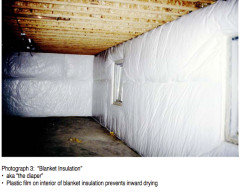
    Looks like you've got diaper insulation. And that's the typical result. If it meets Code in your area, there's no cure as long as it's there. Instead of water vapour drive from outside to inside dissipating into the air, it's trapped behind the plastic, condensing to liquid and there ya go.


    Building Science Corp.

    Of course, without waterproofing on the exterior, you may have bulk water infiltration as well.


    And, as mentioned below, there will also be water from condensation.

  • PRO
    4 years ago

    Hi, Amanda,

    I doubt what you're seeing is a consequence of the curing process. Your basement may be wicking water from the exterior by capillary action. Any "sweating" would be due to condensation on the concrete when its surface temperature drops below the dewpoint of the surrounding air.


    I don't know what the PA building code requires, but the International Residential Code--which forms the basis of most statewide building codes--requires either dampproofing (2018 IRC R406.1) or waterproofing (2018 IRC R406.2) of foundation walls below grade depending on the water table or severe soil-water conditions. Dampproofing is never a good substitute for waterproofing.


    To prevent condensation on basement walls, they should be insulated with air-impermeable insulation such as rigid foam board with the seams taped. That's not what you have. You have fiberglass insulation with a vapor barrier on the inside. There's no air seal. That's not going to prevent humid air from migrating to the back side of the insulation where water vapor can condense on the concrete surface.


  • 4 years ago

    I live in central PA. We have a lot of rain and we have mountains and valleys and waterways.


    The Susquehanna Basin is one of the nation's most flood-prone areas and is vulnerable to a variety of flood risk including riverine flooding, flash flooding, and ice jam flooding. The Basin's topography, geology and nearly 49,000 miles of waterways are contributing factors to this flood risk. Additionally, the physical location of the Basin in the mid-Atlantic region of the United States subjects the watershed to a wide variety of climatic conditions, including tropical systems, strong thunderstorms associated with plunging cold fronts, and lake effect snowfall. While no one can prevent floods, understanding the flood risk associated with your particular location and appropriate response to National Weather Service issued watches and warnings can greatly reduce the risk to life and property.


    https://www.srbc.net/our-work/programs/planning-operations/flooding/


    Wet basements are common, sometimes it feels like many people just accept that basements are wet. When I was looking for a home I was told that the musty smell is just the way basements smell by a realtor.


    This is serious unless you want to live with a moldy, musty basement and potentially a few feet of water in your basement. We have not had much rain so far this year.


  • 4 years ago

    What a recipe for disaster - it's like a giant glass of icewater and the condensation that forms on it - except in house size. :-(