Software
Houzz Logo Print
elena_nuta

Weeping fig pruning help

4 years ago
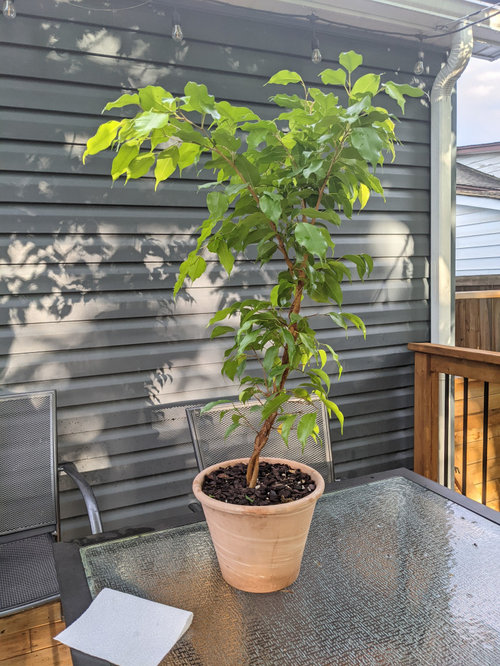
Hi all,
I'm back after almost a year absence.
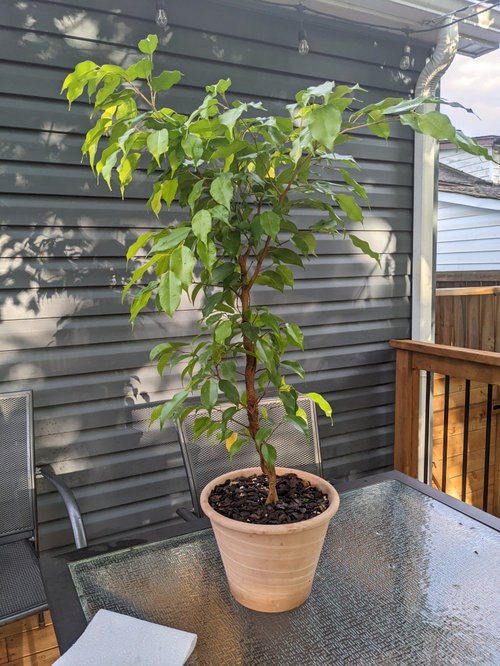
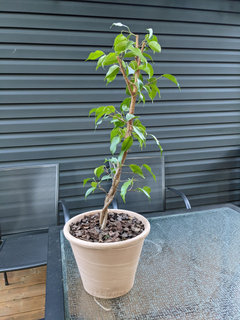
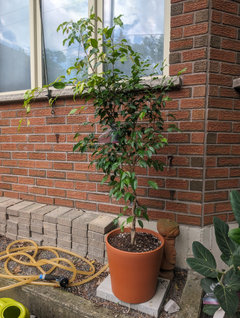
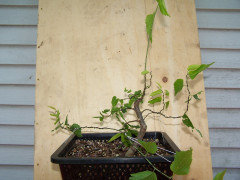
Hoping to get some advice on how to prune this guy, before summer really sets in and I get some beautiful new growth. I know someone will ask what is my goal for this plant and I don't know exactly, I think I want it to get to a nice large floor houseplant/tree.
For some background info, I live in Canada near Toronto and this ficus is potted in a 2:4:1 mix of bark: potting mix: perlite.I don't believe I have any overwatering issues :). During the summer it lived in a south facing window and actually put out a ton of growth. I believe I've read every single one of Al's posts and have made the 5:1:1 mix but am not using it with this plant.
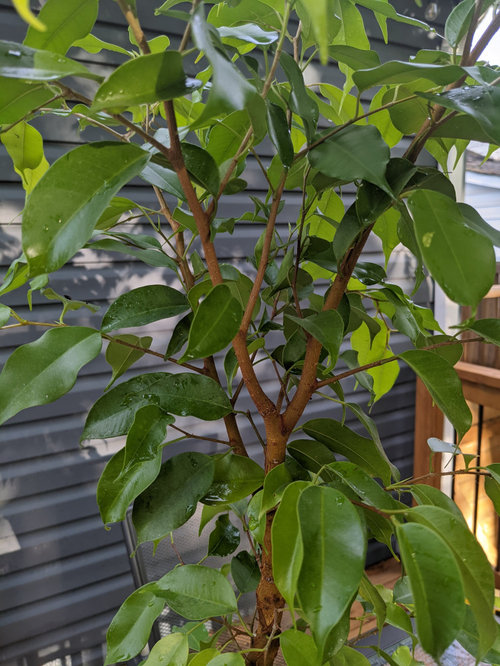
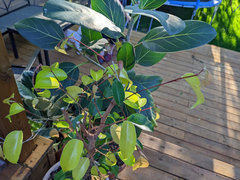
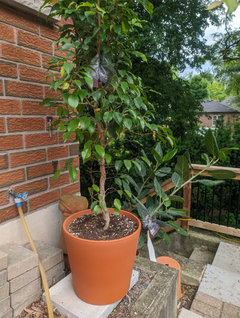
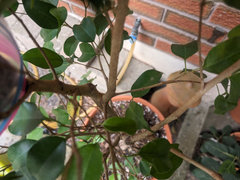
The second photo is taken a quarter turn to the right from the first photo. The third photo is a closeup of the branching.
I know the theory that I should remove lanky winter growth but frankly I can't tell what is winter growth and what isn't, and actually it all looks pretty lanky to me.
I've also seen advice to remove branches growing towards the middle but I don't quite understand where I should cut.. do I remove the whole branch or leave some latent buds to sprout new branches? Also if I do this, won't I end up with a "bald spot" in the middle?
Thanks!

Comments (15)

  • 4 years ago

    I know someone will ask what is my goal for this plant and I don't know exactly,


    ===> its like you read y mind.. stop it.. youre scaring me.. lol ..


    one way to help define where you might want to go.. is to just scroll down at this link.. and just look at hundreds if not thousands of other examples... and just get a 'feel' for where you might want to go ..


    https://duckduckgo.com/?t=ffcm&q=Weeping+fig&iax=images&ia=images&iai=https%3A%2F%2Fcandidegardening.com%2Fimg%2Fff8da041-79fb-4e1e-9960-ceac59501944%2Fcropped%2F1200x1200


    but one thing is for sure.. you dont 'have to' do anything .... besides perhaps cleaning up any crossing branches or removing wounded parts ... too many peeps think they have to do stuff.. you dont ...


    i presume its just on the table for the pic.. but if not.. get it back on the ground ...


    and for outdoors. i might be tempted to stick that pot in a much bigger pot... so the wind doesnt knock the plant over all the time ... just pot in pot.. so you can take it out of the large pot and back in the house for winter ...


    based on these pix ... im thinking part of your problem IDing what need be done.. is that i dont see anything that need be done right now ... whats your hurry ...???


    ken

  • 4 years ago

    If this was my plant I would nip the tip, the newest leaf that is forming, from each of the uppermost branches.

  • 4 years ago

    Thanks Tiffany, I suppose that's just to encourage branching?


    Ken, yes the pot is normally on the ground in a very well protected spot so I'm not worried about it falling over.  I have done the pot-in-pot trick though with other plants, that's a great tip.  I haven't had a chance to scroll through the page you link, but I will look at it tonight.


    The reason I'm in a hurry to prune is that I am worried I will get tighter growth on top of  lankier growth, which I don't think I want

  • 4 years ago

    Hi, Elena - While it's technically correct to suggest you needn't do anything, there is a whole lotta "If you want this, you're going to have to do that" in play here. If we assume you aren't looking for a topiary lollipop-shaped tree with heavy branches at the top (which are already well along in their development) and thin, weak branches low on the tree where they should be thickest, you'll need to start restraining the top, and it should be reduced considerably, now, by cutting the heavy branches all the way back to the first (most proximal) branch facing in an appropriate direction.

    If what you're looking for aligns with the basic outline I sort of skimmed over, we can get started now, or you can just enjoy keeping the tree healthy and leave it in control of how it grows; though, from the exchanges I remember and what you said above, I think you're more interested in upping your game and working toward a more natural looking tree. Your call.

    Al

  • 4 years ago

    Hi Al!

    Glad to hear from you! You're right that I'd like to do what I can to make this tree look as good as possible but I want it to be big. 

    Why will doing nothing result in a less realistic-looking tree? 

    What is an "appropriate" direction for the branching?  I assume out but then I'm back to worrying about a bald spot.

    Thanks!

  • 4 years ago

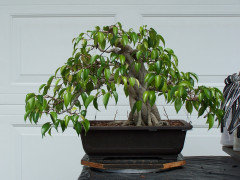
    Why will doing nothing result in a less realistic-looking tree? In nature, tree branches get thinner and thinner toward the top of the tree, and the lowest branches on the tree are the thickest. Your tree exhibits a considerable amount of apical dominance, with the tree being programmed to spend about 2/3 of its available energy (food/ photosynthate created during photosynthesis) on growth in the top 1/3 of the plant. Your tree is developing very thick branching in the top and has weak and thin branching toward the bottom. To key to correcting the fact this is already underway and preventing it from being a continual problem lies in first pruning the top half of the tree back hard, followed by learning how to employ selective pruning and pinching of mostly the top of the tree in order to force more food/energy to be spent on lower branches.

    When a tree is in development, there will always be a decision to be made when it comes to ..... do I allow the tree to do what it wants, which makes it look ok in a temporal sense, or do I bite the bullet and pull the tree back in bounds, then start employing techniques that slow the progression of heaviness in the top. The longer you wait, the more difficult it will be to correct the issue.

    I understand both perspectives, and you sure wouldn't hurt my feelings if you were to simply start pinching, or even just enjoy the tree as it is, but I clearly see where the tree is headed.

    Inosculated (fused) Ficus b:

    After defoliation:


    Notice how heavy branches were cut back to finer branches ^^^^, and the branching low on the tree is heaviest.

    Below, the tree is just starting to fill in after it was defoliated.

    This tree has purposely been kept small because it's a bonsai in training. You don't have to make that imposition on your tree, but you can significantly improve the tree's potential for eye appeal by reigning in the top and beginning a program of pinching and selective defoliation of the top (primarily).

    What is an "appropriate" direction for the branching? Usually it's growing away from the tree's central axis, but not always. When pruning, I choose my pruning cuts mainly based on A) does the branch contribute to the composition, and B) would it be more productive if I left the branch or chose another point along the branch to prune. Most pruning cuts are to remove a branch entirely, or to shorten the branch back to a branch an order lower order branch growing in a more appropriate direction. I assume out but then I'm back to worrying about a bald spot. Usually it's a branch growing away from the tree's central axis, but that changes at the very top of the tree, with some branches oriented in every direction except downward.

    Al

  • 4 years ago

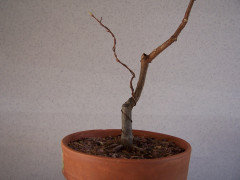
    Well I did something, can't say I feel great about it.  Thoughts? Too much, too little?

  • 4 years ago

    Hard to tell from the photos, but all the new growth has such long internodes!  I thought doing such a hard prune would prevent that, is there anything else I can do about that?

  • 4 years ago

    Hard to tell from the photos, but all the new growth has such long internodes! Internode length is governed primarily by light levels (the brighter the light the shorter the internodes if all else is equal), fertility levels (fertilizing at luxury levels, particularity where N is concerned, promotes long internodes), root congestion (the tighter the roots the shorter will be the internodes), and a few other cultural influences, but those listed are the major players. Don't worry too much, though, you'll always get long internodes initially when you prune hard. Is there anything else I can do about that. As new leaves appear, you can cut them in half or even leave only 1/3 of the leaf. Stop that strategy sometime in Aug, depending on where you live. This decreases the photosynthesizing surface and the amount of food the tree is capable of synthesizing (during photosynthesis). Not to worry though, as those leggy branches thicken, the plant will produce adventitious buds after pruning. You probably told us where you live, but I don't remember. That has much to do with how and how hard you can prune.

    Ficus microcarpa, defoliated almost entirely and remaining leaves cut to 1/2-1/3 normal size for the sole purpose of increasing ramification (branch and leaf density).

    Al

  • 2 years ago

    Thought I would revive this post since it's about the same plant. Here it is this year before I prune it.


    The trunk has considerably thickened and fused since 2 years ago.   There are a lot of thick/heavy branches at the top. I'm looking for some advice as to how to best remove thick branches... Will regular pruning shears be okay?


    I've already decided to layer off a big chunk that's growing to the left in the first photo. The other branches I will cut back close to the main trunk and then hopefully get some thickening of the lower braces. Any thoughts on my pruning plan?

  • 2 years ago

    Anvil type pruners should be avoided because they crush tissue and don't allow you to do delicate pruning cuts. A pair of 7-8" bypass secateurs is a good choice. I highly recommend the Okatsune brand, even over Felco. If you think your interest in trees will be a long term thing, there is no getting away from the idea that a pair of concave cutters is the way to go. Buy the best your budget allows. I have a pair of Joshua Roth concave cutters I bought in the 80s. I use then relentlessly in the garden and they are only now just starting to lose their original sharpness. They are a delight to use compared to ANY brand of secateurs, and they leave a concave wound that closes flush to the bark surrounding the wound when used properly. 8" would be the appropriate size for what you're currently doing. Cuts too large for the concave cutters can be made with a fine-tooth pruning saw or a hacksaw blade with 18 teeth per inch. This Koyo 8" concave cutter in professional grade is roughly the equivalent of the Joshua Roth professional 8" cutter.


    To remove heavy branches in the top 1/3 of the tree, follow the heavy branch back toward the trunk or the next lower order branch. Look for an existing branch (as close to the trunk as possible) already growing in a favorable direction. "Favorable" usually means radiating as straight away from the trunk as you can find, and growing toward a gap in the canopy where it will get plenty of light w/o shading any of the existing branches. As you deciding where to prune the heavy branches back to thinner branches, look at the thinner branches as well. You can also prune the thinner branch to a leaf or higher order branch growing in a favorable direction.


    You can be pretty ruthless in restraining top growth to force energy into lower branches because your tree is already programmed to spend 2/3 of its energy in the top 1/3 of the tree. Essentially, this means you can concentrate on developing lower branches first, then grow in the top after the lower branches are well along in development. The only issue growers unfamiliar with the technique is, the plant might not look as tree-like as you prefer while the lower branches are developing.

    Al

  • 2 years ago

    Hi Al, I've got a pair of Wazakura concave cutters coming, the Koyo ones sound amazing but a bit out of my reach. The Wazakura ones seem to get great reviews on various bonsai forums, hopefully they are good. I debated if getting the secateurs in the brand you recommended vs. getting the Wazakura concave cutters, but the concave cutters sound so nice.

    The last few years, I've been using bypass secateurs (cheapo ones) and then using a razor blade to refine the cut (wouldn't recommend, not very safe...). Do concave cutters get much closer to the main trunk than secateurs? I think I've been cutting at a "correct" distance to the leaf axil so I am wondering if I would need to change anything now that i'll be using concave cutters.

    I thought I remembered seeing an old post of yours about bonsai tools but haven't been able to find it. If such a post exists, would you be able to point me to it?

    Thanks again for taking the time to respond and for your very detailed instructions!

  • 2 years ago

    See the leaf I have in my hand? Where you have leaves in the top half of the tree which already have a branch or bud growing in the axil, snip the leaf off. This reduces the energy going to the branch which in turn makes internodes shorter and leaves smaller - IOW, it will make your tree more compact.


    Two questions. 1. Should this "trick" be applied to all branches or only to the branches of the upper third of the plant? 2. Should it only be carried out from May/June to October or also in autumn/winter?

  • 2 years ago
    last modified: 2 years ago
    @Elena Nuta The concave cutters are considered by those who do a lot of pruning to be the most often used tool, and most indispensable, followed by scissors.

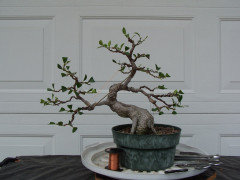
    Do concave cutters get much closer to the main trunk than secateurs? Yes, and they leave a concave scar that doesn't form a lump as callus tissue rolls over the wound. The wound just below the thin branch with wire on it, where the main trunk veers right, was made with a pair of concave cutters, The thin branch is the new trunkline. The heavy branch is a sacrifice branch, its only purpose being to add thickness taper to the trunk. I'll make an angular cut through the thick part just above the thin branch after the sacrifice branch is none doing its job. Notice the stub left on the right side above the thin branch. Because I knew that branch was a sacrifice branch, I used whatever tool I had in my hand to lop it off, likely secateurs.


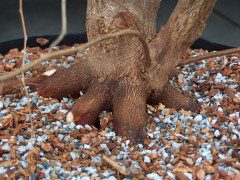
    The cuts on the roots of this Styrax Japonica (Japanese snowbell) were made with concave cutters.


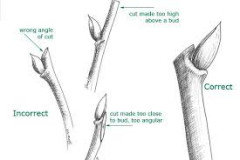
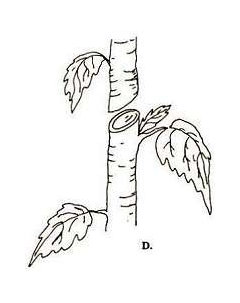
    I think I've been cutting at a "correct" distance to the leaf axil so I am wondering if I would need to change anything now that i'll be using concave cutters. It won't take much practice. Basically, your cuts should be like these:


    If you think you cut too close to a node or the branch or leaf growing from a node, it's helpful to use the wood glue trick to seal the wound to prevent the node from drying out. Alternately, you can leave a stub which will dry out back to the first proximal node. after a couple of months you'll be able to see where the dead tissue stops and the viable tissue begins and can make your cut along the line Mother Nature provided.

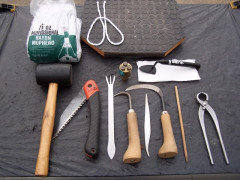
    I don't remember any posts about bonsai tools, though I do mention individual tools from time to time and have often uploaded images of the tools I use for rootwork. Are those what you mean?


    *******************************************************************

    @Michele Rossi "See the leaf I have in my hand? Where you have leaves in the top half of the tree which already have a branch or bud growing in the axil, snip the leaf off. This reduces the energy going to the branch which in turn makes internodes shorter and leaves smaller - IOW, it will make your tree more compact."

    Two questions. 1. Should this "trick" be applied to all branches or only to the branches of the upper third of the plant? Bonsai practitioners use defoliating techniques as a way to balance the flow of energy within the tree. The last image I posted in my comments to Elena (immediately above) shows a Psuedocydonia sinensis (Chinese quince) With heavy branches toward the top and thin weak branches toward the bottom. The 'fix' for that is to remove the heavy branches and grow twiggier growth at the top (easy on apically dominant trees), or prune the heavy branches higher on the tree harder along with partial defoliation. In conjunction with that technique, I'll allow the weaker branches to grow unpruned to a much greater length until they have thickened appropriately. When that has occurred, the branch can be shortened and work on ramification begins.

    While it can be used on any branches, you'll find it's going to be useful primarily in the top 1/3 of the tree where a reduction of energy flow is helpful in balancing the visual weight of branches.


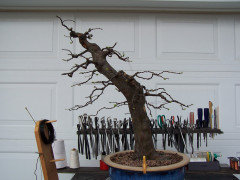
    This largely defoliated hackberry tree has 2 wounds where sacrifice branches have been removed, and there are still 5 sacrifice branches attached to the tree. Reasons to use sacrifice branches: 1) to thicken branches that look out of place because of their light (visual) weight. In this case, they are being used to thicken and add taper to the trunk. The planned apex of the tree is the thin branch with wire, to the right of the tall/vertical green branch. 2) Branches growing upward are a much stronger energy sink than those growing horizontally or downward. That's why all the sacrifice branches are wired or are naturally growing or wired so they are vertically. They sap energy from the all the other branches which shortens internodes and decreases the size of the leaves.

    2. Should it only be carried out from May/June to October or also in autumn/winter? If your tree is robust, you can remove leaves with active buds or branches in their axils any time, but you need to weigh the fact that defoliating slows down growth and development against the facts that A) it will help build a fuller and more compact tree, and 2) the tree will be visually neater without the leaves which have branches growing in their axils.

    Not everyone is willing to play the long game. I don't care that the hackberry above looks ugly because I understand it's in the formative stage of trunk building, so let it be as ugly as it has to in order to achieve that end. You guys (Elena/ Michele) will have to temper what techniques you use and the temporal appearance of your trees against how strong your desire is to make your trees all they can be. There is no right or wrong, but it's good to know you have options.

    Al

Sponsored
Whisler Home Improvement
Average rating: 5 out of 5 stars9 Reviews
Franklin County's Committed Home Improvement Professionals