Software
Houzz Logo Print
heruga

Can someone explain to me how phytophthora works

4 years ago
last modified: 4 years ago

So one of my plant died from phytophthora last year from complete sudden wilting and the same other species plant nearby had partial wilt symptoms with the whole stems eventually dying. A nearby hydrangea also got it. Last year we had so much rain and I’m located in a low spot in the neighborhood. So if my Japanese maple is also nearby does that mean it will eventually get it when the roots spread into where my affected perennials were? Should I save the headache for the future and take the tree out now? The tree was planted very high for drainage but nearby areas had the perennials that suffered from phytophthora so don’t know if that means it’ll definitely get it in the future even if the tree itself is in ok drainage

Comments (19)

  • 4 years ago
    last modified: 4 years ago

    Thank you for the link. I was particularly concerned with the Japanese maple because I know they are one of the most phythophthora susceptible plants. And even with the tree being high under ok drainage itself, once the roots become exposed to phythophthora there is still a chance for luck?

    Unfortunately fixing drainage isn’t an option with my low spot property where all my neighbors properties slope down to mine. There is barely any standing water though except for times when it is under heavy rain. Unless I install a drain or storm grate which is a whole another project… at this point I’m not sure if its rational to consider moving out of my home. Once phytophthora appears it stays forever in my garden no matter how you manage it or improve drainage

  • 4 years ago
    last modified: 4 years ago

    A fungicide alone will provide minimal protection against phytophthora. You really will need to work on managing water movement and drainage in your garden for optimum results.

    However, since none of us can see in person how rain and run off impact your garden, we are not able to make any meaningful suggestions. It might be of value to hire a professional in for a consultation after a significant weather event to make suggestions. Diverting or controlling run off is not all that difficult to achieve once you know where and when it manifests. And better drainage can be accomplished relatively simply by using raised or elevated planting areas.

    It is also important to accurately identify what the source of the root rots maybe. Organisms other than phytophthora can have a similar impact and appearance. Take samples of any dead plants (as fresh/recent as you can manage) to your county extension office for an accurate diagnosis. They will also offer the best treatment strategies for your area depending on species.

    ETA: a Japanese maple with "wet hair"?? WTH does that mean?

  • 4 years ago

    Thanks for the advice, it seems very expensive but I may have to consider it. Although I really would like to know if the tree itself is in good drainage but surrounding areas in the ground have the fungus in it, will the tree eventually be exposed to the fungus and suffer from it? Does phytophthora attack any susceptible plant that touches it regardless of superior drainage or not?

  • 4 years ago

    "Does phytophthora attack any susceptible plant that touches it regardless of superior drainage or not?"

    No. Like many soil borne pathogens, it tends to be very opportunistic and the conditions for its development (consistently wet soils, etc.) must be present.

  • 4 years ago

    Well then I could be a little more hopeful I guess. My tree is under the outer canopy of a giant silver maple too so maybe that can keep the ground drier as silver maple roots grows more… hehe how ridiculous do I sound now..

    I can’t do anything about the waterlogginess, I’ve already regraded the spot because my cedar mulch keeps floating away from every hard rain but it keeps doing the same thing. Do I need to install a drain or something?

  • 4 years ago

    You may need a drain. You may need a swale or you may need a dry creek bed type installation to collect and divert rain water run off. Or turn it into a rain garden.

    FWIW a major landscaping project - like a brand new garden in a new build - really does require site evaluation and planning before plunking in a bunch of plants that may or may not like the existing conditions. Before you add anything else you would hate to lose, take the time now to make any alterations to improve planting conditions. Otherwise you will be endlessly frustrated with less than stellar growth and performance.

  • 4 years ago
    last modified: 4 years ago

    You sure you have an MS in horticulture??

    I wonder too! I think the blanket advice to apply fungicides to "landscape plants" is highly, highly dubious.

    In general, a general fungicide application to landscape plants is recomnended in the early Spring as a disease preventative as well. Hou’d be surprised how much healthier plants thats been given two spring time applications can look in humid / temperate climates as opposed to not.

    OBVIOUSLY, I have no qualms about the judicious use of chemicals in the garden. I have to use a lot of herbicides because I'm surrounded by moronic property owners who let invasives gallop through their gardens. However, long term broad use of fungicides is not an intelligent or sustainable way to deal with issues such as root rot. I have over 50 mature rhododendrons that are perfectly healthy in a VERY humid climate, because I know what I'm doing. Now. It's taken a while, mind you! I did use Aliette and mefonoxam experimentally to prove plants like 'Trewithen Orange' are not strictly speaking, killed by the heat. They could be kept alive here as long as they were treated to prevent root rot. But that's not a long term approach I think anyone should take.


    An exception I would say would be natural fungicides that act as inoculants. I have tried a couple of those. Kathy Van Veen swore by Actinovate in the greenhouse raising of lepidotes, and I would take her word for it. Maybe if Heruga isn't able to address the root cause of their wet soil, that would be a reasonable approach to try.


  • 4 years ago
    last modified: 4 years ago

    I have an honorary PhD in googling stuff!

    https://hortnews.extension.iastate.edu/2018/07/fungicides-and-how-use-them-effectively

    The problem has to be diagnosed correctly: Before applying a fungicide make sure that you know the cause of the disease (is it a disease? If so what is causing it? Fungi? which one?) and when (spring, fall etc.) and how often to apply the fungicide. The timing of the fungicide application can enhance the effectiveness of the product and prevent additional sprays.

    Remember that the best management strategy against plant diseases is by promoting plant health in the first place. Before planting, make sure that soil, water, and light conditions are ideal for your plant. Once the plants have been established, make sure to use the appropriate sanitation, fertilization, and pruning practices to enhance plant health. Plant Problems? The Plant and Insect Diagnostics Clinic can help!

    https://www.rhs.org.uk/advice/pdfs/fungicides-for-home-gardeners.pdf

    The RHS believes that avoiding pests, diseases and weeds by good practice in cultivation methods, cultivar selection, garden hygiene and encouraging or introducing natural enemies, should be the first line of control. If chemical controls are used, they should be used only in a minimal and highly targeted manner. For example, where pests, diseases or weeds pose a serious threat to the wider environment, to important heritage specimens, to habitat, or to native wildlife.

  • 4 years ago
    last modified: 4 years ago

    "Not blanket advice. Go back and reread."

    "In general, a general fungicide application to landscape plants is recomnended in the early Spring as a disease preventative as well."

    If this doesn't qualify as 'blanket' advice, what does? I'm srsly ROTFL.

    There is a place for targeted use of fungicides. If a rose enthusiast is really taking their collection seriously and wants to spray to prevent some black spot of whatever on some beloved hybrid tea, and has researched the right product and how to apply it, go for it. I have NO problem with that. Just as I should be able to spray to get rid of Microstegium and Celastrus. But if Heruga is really having a root rot problem with plants that should have no trouble growing in NJ, which is the impression that I get, largely, they need to do something other than stick a band aid on the problem. It's better to fix the planting site so a japanese maple will last indefinitely, than spend 15 years and a lot of money pouring "preventative" fungicide on it...only to have it fail when the antifungal stops working when the site conditions get worse so that it doesn't help anymore. Or if the pathogens mutate to become resistant. Also we don't know if this kind of long term use upsets an overall microbiome balance. There could well be some hypovirulent Phytophthora species that keep more deadly ones at bay, but would be killed by indiscriminate long term use of such treatments.


    For the record, I myself in the early years had an Acer japonicum vitifolium die when I planted it in the lower part of my yard that wasn't well drained enough. Heruga has found out the problem with the US east coast and our highly variable rainfall. An area that looks like reasonable soil can become a quagmire. There's always the option of engaging a professional who specializes in drainage to review the situation.


  • 4 years ago

    Japenese maples will succumb in wet areas. Even excessive irrigation can cause problems. Best bet is to combat water problem or replace tree with a better suited plant.

  • 4 years ago

    I think I will end up putting in a French drain myself then since I don’t have the luxury to spend any money right now. But Other than being a runoff spot there really isn’t an issue with that spot. Sure it’s a low spot and it’s always moist there but never soggy and I know it because I have an even soggier section in my yard where my foot starts sinking as I walk with my 140lb body. The water also never stands more than an 30 min after a heavy downpour. So I’m not sure how phytophthora founds it’s way there. Maybe I contaminated it from something I got exposed at my work.

    But one problem I do see is.. when I dig trench for the drain, all that extra soil is contaminated and there’s nowhere I can safely dispose it. Even if i try go dump it in those garden drbris cans that the town collects those will become contaminated with the fungus and have to keep those somewhere isolated from my property… then my shoes will be contaminated with the fungus and will expose it to everywhere I walk on. Even when I walk on the sidewalk, once it rains the fungus will wash away to nearby soil and soil gets contaminated. Or my dog can step on it and then spread it elsewhere. Ugh there’s no end to this

  • 4 years ago
    last modified: 4 years ago

    Heruga!!! the root rot organisms in your garden are cosmopolitan.

    https://en.wikipedia.org/wiki/Cosmopolitan_distribution

    They were there before you got there, and will be after you leave. Is it likely there are certain species or strains they are more or less virulent and more or less likely to be found in certain gardens of the east coast...yes...possible. But for example with the dreaded 'sudden oak death', we can be sure with a reasonable degree of certainty, that biosecurity methods kept it from becoming established in the east coast. For now at least. There's no need to worry about where your soil goes. It's not 'contaminated' with anything. You're acting as though there's plutonium in there or something.

    I used to think that the reason a plant like, say, Rhododendron rex would die for me when it was planted out in the garden was because my soil contain these naturally occurring root rot organisms and the 'sterile' planting media the plant was grown in did not. Although this is probably true, I now have a better understanding that the soil to container soil interface is another factor at play. When a plant grown in peat/perlite is planted in clay soil, the 'potting soil' mix can become a void or bathtub that stays wetter than the surrounding soil. (this is also why it's bad to 'amend' a planting hole) Let's time warp back to 2011 - maybe if I had told myself, when planting the large rex I bought onsite at RSF and brought to my MD garden, to splay the root mass four ways and sort of sit them on top of my existing soil - rather than just plant the 3+ gallon pot slightly higher than the existing soil level - it would have survived, at least longer. May not have mattered, as 2011 was the year when I had my worst rains ever. Over 30 inches in the 40 days surrounding Hurricane Irene. The rex had survived the hot summer up to that point, it was the massive amounts of rain that catalyzed the root rot to kill it.

    FWIW I have used this for potting rot sensitive plants (well, most of my plants TBH) in the past few years...https://www.pthorticulture.com/en/products/pro-mix-hp-biofungicide-plus-mycorrhizae/

    but I cannot say for sure whether it makes a huge difference. It surely can't hurt. Do I seem to have fewer deaths from root rot than I used to? Yes. But I do various other things differently than I used to. I still lose plants once in a while. I recently lost for example, all 3 (BVT X mac) X sinofalconeri seedlings I tried in one area, while (Catfortcampy X mac) X sinofalconeri survived. I attribute this to Catfortcampy probably having slightly better genes for root rot resistance. Why? It's a swarm/grex, rather than a single species. And 2 of the species, our native catawbiense and the Asian fortunei, are very root rot resistant. Camforest used to sell R. fortunei as "rhododendron able to grow in [piedmont] North Carolina" although that probably isn't true of all clones of it. Lastly, Gable would have been selecting, whether inadvertently or purposely but probably the latter, for root rot resistance when he selected clones from that cross. Because he was trying to get the yellow of campylocarpum without the notorious root rot sensitivity of those high altitude Asian elepidotes like that one and the closely related wardii.

  • 4 years ago

    Were they really there before I moved in? I moved in to this house almost 2 years ago but I did a complete landscape change in my yard which involved using skid steers that made severe tire ruts in my lawn and caused my yard to be uneven, even with topsoil added. It just wasn't the same anymore. There used to be a giant white pine in that area that was taken down and stump grinded. All the plants that were there pre-landscape reform were fine. There was also a big red Japanese maple directly under the giant silver maple that was doing fine. Then ever since I changed that portion of that yard from lawn to a woodland garden, plants started going downhill. The pre existing hydrangea that was there was fine before but after reforming it started showing signs of wilting on only certain branches. And this is all happening on one side of my woodland garden. The campanula I planted there had dead flower stems that just failed to bloom, some stems of my solomons seal turned completely yellow, my woodland salvia was wilting in certain branches. When root rot starts affecting this many plants, I wonder if they are really host specific or just indiscriminately attacking any plant they touch. The solomons seal is on a section where it is a little higher than surrounding bed.

    So your experience is that even though certain plants died from root rot, different plants/cultivars survived just fine in that same spot where the root rot organism exists? I'm not sure if I have a completely different species of phytopthora then because many plants there seems to be affected. The only ones in that spot that don't seem to be showing any symptoms yet are my liriope, pachysadnra, lychnis miquieliana, kiregeshoma, zingiber mioga, and my 2 trees the 'Osakazuki' Japanese maple and Ichikikei Jiro persimmon. It may just be a matter of time when they will though

  • 4 years ago
    last modified: 4 years ago

    Not all root rots can be attributed to phytophthora. There can be any number of other causal agents, the most common one simply being very poor drainage. In areas that retain water excessively or have perpetually wet soils, it is just a lack of oxygen that causes root decay. Very few plants other than bog plants or aquatics will tolerate those conditions although many can have a greater tolerance for a wet soil than others

    And just because the phytophthora pathogen is present, it is not automatic that any plant in the vicinity will contract it. Like most soil borne pathogens, it is opportunistic and the proper conditions must exist for the pathogen to infiltrate an otherwise healthy plant.

    Although not an oomycete or water mold, Verticillium wilt acts in much the same way. And it is entirely possible to have a plant succumb to this disease while a similarly susceptible species right nearby be untouched.

    Before making too many assumptions, it would be prudent to know precisely what you are dealing with so have the plant you think may be affected by phytophthora evaluated and diagnosed by a qualified plant pathologist.

  • 4 years ago
    last modified: 4 years ago

    Agree with GG, and also,

    "I moved in to this house almost 2 years ago but I did a complete landscape change in my yard which involved using skid steers that made severe tire ruts in my lawn and caused my yard to be uneven, even with topsoil added."

    sounds like you could have done something that negatively impacted the natural drainage that was previously satisfactory for the existing plantings. I have mentioned in prior threads that when an adjacent landowner higher on my hill did some grading, it devastated a portion of my property because it got more runoff. Not a large portion, but, alas, it was where I had planted the insanely rare Larix masterisiana. That was the most bitter and disappointing plant death in my > 15 years in this garden. ☹️

    Verticillium, Phytophthora, and Pythium are all often but not always opportunistic pathogens...and too-wet soil is the opportunity ;-)

  • 4 years ago

    I actually called the rutgers university lab last year for the soil evaluation as you suggested GG but they told me they don’t test for diseases like that and only do simple things like pH and nutrients. Looks like I need to search for a different one.

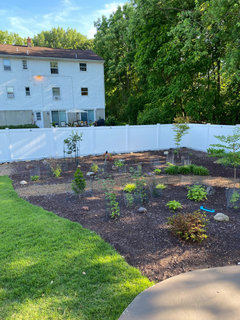
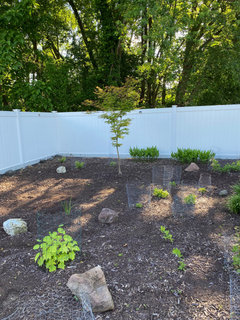
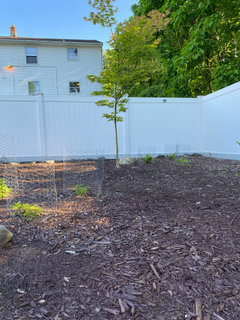
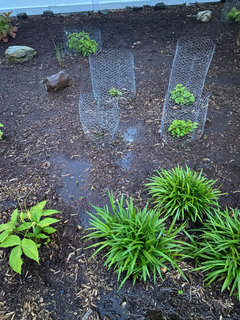
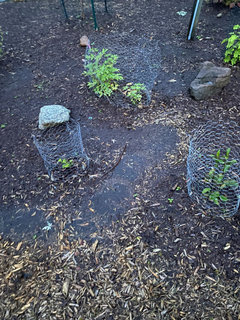
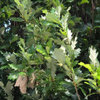
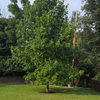
    And this is why I dread doing large projects because somehow I screw up somewhere and open a whole new can of worms that I have to deal with. I’m not even confident doing the french drain myself to be honest, I might just grade out this section so water runs off past the fence here shown in yhis pic. Here are also some pics of where water floods. I remember you telling me about your precious larix loss. Did you have a spare and plant it somewhere else? If so how is it doing? Also did you plant anything new where that larch died?

    I planted my larix kaempferi near my french drain towards the back of the yard early this spring. The french drain behind it does a good job keeping the larch side of the yard dry but the other side is constantly soggy.


    If youcan locate the wet spots by spotting the liriopes in the border in first pic and the outlet. Japanese maple in the corner I keep adding soil to raise it up but it never helps with the water retention


  • 4 years ago
    last modified: 4 years ago

    Call your county extension office, not the university itself. This is one of the services the extension service provides - plant diagnostics, pathology and treatments. They are unlikely to do it inhouse but will have access to trained pathologists. There typically is a cost involved but not huge. It is only $45 per diagnostic request at my local office.

  • 4 years ago

    No there were no spare Larix. Mike Lee of Colvos didn't have many, I think he said I got the last one. I hope some ended up in collections in the PNW. There really aren't many nurseries that offer that sort of thing anymore.

    I don't have time to go into this topic extensively - you can try to find my old posts, good luck - but you might want to investigate the cautious use of CALCITIC limestone or gypsum. (not dolomitic, which is what is easier to find these days at big box stores) CERTAIN clay soils can respond well to them and it will improve tilth and drainage. However, you don't want to make your soil too limey.