

Spacing between Thuja Monpin and Tasman Ruffles
I have a Thuja Monpin and two Tasman Ruffles.
The Monpin says that it has a mature height of 25' and width of 8':
https://www.monrovia.com/ember-waves-western-arborvitae.html
And the Tasman Ruffles have a mature height of 10' and width of 4-5':
https://www.monrovia.com/tasman-ruffles-pittosporum.html
I planted them in a sort of triangle, with 8' between the Thuja and Tasman and 10' between the two Tasman. The idea is that, when they're fully grown, the Thuja will be a taller backdrop to the Tasmans, and I've allowed enough width so that they should get close, but not quite touch.
What do you think, is that a good idea on the width or should they be close enough so that they slightly overlap?
(There's also a Little Gem Magnolia planted 30' to the North, mature size 20-25' tall and 10-15' wide so it will be 20' away from the Thuja when fully grown. Next year, I'll plant loropetalum, nandina, and abelia shrubs, then filled in with flowers; all of which I already have. And maybe Blue Star juniper which I also already have, but I don't love it so maybe not.)
Comments (21)
 4 years ago
I have some serious concerns about the long term viability of the Tasman Ruffles in your location. I've grown a number of different cultivars of Pittosporum tenuifolium in a previous zone 8a garden and the only one to survive more than 10 years was County Park Dwarf (which is reputed to have several degrees more cold tolerance/hardiness than other cultivars). There would always be that odd cold snap down into the low 20's/high teens that would knock them out. I just can't imagine they would survive for very long in a zone 7a.......17F is listed as a minimum temperature before complete dieback.
I think your placement sounds fine - I'm just not at all sure the pitts will live long enough to get large enough to test it fully.
 4 years agolast modified: 4 years ago
Good lord, I almost skipped this thread but glad I didn't.
What the hell is Monrovia thinking? Obviously, at this point in American horticultural commerce, the inmates are running the asylum. The New Zealand Pittosporum is going to struggle with NC summers, and probably die of root rot. If that doesn't kill it, a polar vortex type winter will.
I'd love to try one though...can you tell me what nursery your found it at? Maybe if one of my NC relatives is in that part of NC they can pick one up for me! But I'm a experimental gardener - you probably want something that will last. There are PLENTY of interesting, and in fact rather similar, BLEs, that you could use instead. A good one is Cleyera 'Bronze Beauty'. Will do perfectly fine for you. The flowers have an alluringly tropical scent, probably more so than the Pittosporum flowers.
Gardengal, I saw agonizingly beautiful hedges of various Pittosporums in SE AU & NZ...sounds like, even in the PNW, something like that would be an uncommon sight? I seem to recall seeing pics of them being grown there, though...maybe at either Heronswood or the new Dan Hinkley garden, whatever it's called. Windcliffe or something. Windfall is more like it ;-). Good for them though. They deserved every penny. How big would 'County Park Dwarf' get in 10 years?
Related Professionals
Decatur Landscape Architects & Landscape Designers · Columbia Landscape Architects & Landscape Designers · Lima Landscape Architects & Landscape Designers · Grand Rapids Landscape Contractors · Albert Lea Decks, Patios & Outdoor Enclosures · Manhattan Decks, Patios & Outdoor Enclosures · Provo Decks, Patios & Outdoor Enclosures · Florence Landscape Architects & Landscape Designers · El Paso Landscape Architects & Landscape Designers · Vincennes Landscape Contractors · Redding Landscape Contractors · Atlantic City Home Additions · Nashville Home Additions · Utica Home Additions · Honolulu Home Additions- 4 years agolast modified: 4 years ago
So, rather interesting finding here. NCSU is trying various P. tenuifolium cultivars, but only quite recently https://jcra.ncsu.edu/horticulture/our-plants/results.php?search=pittosporum
But JC Raulston certainly knew what they were, believe me. He surely tried them in the 80s and 90s, and if they had survived, they would be in the database as mature plants. Hillier's says P. dallii is the hardiest NZ pittosporum, but notes that it is hard to sexually or asexually reproduce, thus uncommon. It seems to have never been in commerce in the US at all.
Jason, zone 7A, near Greensboro NC
Original Author4 years agoHumph.
Well.
That sucks. Winter here this last season did drop to the mid-teens, so that's a real problem!
I actually got it from the local Lowes, so at least I have a 1 year guarantee. But I don't exactly want them to die and then start over in a year or two, I would like to live long enough to see the dang trees mature! LOL
But they're mine now, so I guess all I can do is wait and see :-/- 4 years ago
Pitts are uncommon here. You can find them at better nurseries but never a huge selection, perhaps because they DO have only borderline hardiness. Rarely ever P. tobira, although a few mature shrubs exist in sheltered positions (enough to be included in my BLE ID class back in my hort school days!) and the dwarf forms like Cream de Mint now and again in nurseries. I think they think dwarfs carry better hardiness but I'm not gonna waste my money testing that theory :-)
I used to be more of a zone pusher in my younger gardening days but not so much anymore, In fact, I was enough of a zone pusher to be asked to write one of those little regional plant features on that topic for Horticulture magazine. I was asked to write about 3 zone pushing plants in my garden and one of them was Kohuhu or Pittosporum tenuifolium. Which cultivar in particular I don't remember but I know I had at one time grown Silver Sheen, Marjorie Channon and County Park Dwarf. None of those original plants is still alive, victims to an Arctic blast in the early 2000's.
Older and wiser and in a zone higher garden a block up from Puget Sound I only have succumbed to County Park Dwarf since then. This is a Windcliff plant, having purchased it from Dan years ago when I first moved here...not all that far from Windcliff itself and with the same climate and exposure.
My current CPD is going on 15 years now. And in the midst of its annual chartreuse new growth converting to purple :-) It's been in a large container all of its life so not likely representative of a mature inground size........maybe 3' by 3'. It has never been bothered by cold here but then some years I do not even experience a hard frost.
But I can't imagine any of these surviving long in a zone 7! And even pretty iffy in a zone 8!
- 4 years ago
Thanks for the write-up. I found some pics of it, it is very pretty.
Jason, zone 7A, near Greensboro NC
Original Author4 years ago@gardengal48 (PNW Z8/9), for some reason I'm not getting emails when you reply! I've looked through my spam folder and everything, but the last email I got when you replied was May 24. I'm getting emails when @UpperBayGardener (zone 7) replies, though, so I don't know what's up with that.
Anyway.
What I'm reading today is that the Tasman Ruffles is "the hardiest of the species, tolerating temperatures as low as -10C":https://www.gardentags.com/plant-encyclopedia/pittosporum-tenuifolium-tasman-ruffles/18454
So I guess I'll just roll the dice and be prepared for a loss. If they ARE going to die over the winter, though, then I hope it's this winter so that I can exchange them and have time for something else to take their place.
Any suggestions on annuals or something to fill in for the next few years, while waiting for the trees to grow? Right now it's a great big empty looking space!- 4 years ago
Don't believe everything you read :-) -10C is only 14F, just a couple of degrees below the listed minimum temp for this genus and species. But there is nothing to substantiate the accuracy of the cold tolerance level........unless one is a zone 7 gardener that has grown it successfully for at least 10 years. And it hasn't been around long enough to make that kind of assessment.
Caveat emptor!!
Jason, zone 7A, near Greensboro NC
Original Author4 years agoIt doesn't really matter at this point, I bought them several months ago and they're in the ground, so it's too late to return them. And it's too late to plant anything else if I did, so all I can really do is wait and see.
With a mature height of 10', it's not unrealistic to make a plastic shelter when there are cold temps in the forecast. When I was a kid we would see the occasional sub-zero winter (-5 in 1996), but in the last 20 years I can't remember it being in the teens but a few times. So hopefully it won't be tragic!- 4 years ago
Jason, please feel free to ignore the previous comment :- Jordan is a troll that likes to pop in uninvited to deliver completely bogus advice. These shrubs are not going to survive long in a zone 7.......ANY zone zone 7!
- 4 years ago
LOL!! Jordan probably wouldn't know a pittosporum if it smacked him in the face!!
Jason, zone 7A, near Greensboro NC
Original Author4 years agoI finally got an email that @gardengal48 (PNW Z8/9) posted! LOL
Trolling or not, I'd still love some advice on how to fill in while waiting for the trees to grow! Here are some pics.
From the house, facing East: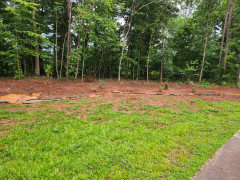
There's a cardboard border laying there right now, once I get more things planted I'll put in mulch and cover the cardboard. I plan to wipe out all of the "grass" (really weeds) in late July, and sow new grass in September (probably a mix of KBG and tall fescue).
Closer pic, standing at the North side and facing South. You can see the Little Gem Magnolia on the left, a Moonflower that's recovering from transplant shock, a small Golden Euonymus, then the Thuja and Tasman Ruffles in the back right: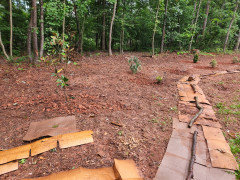
The Magnolia: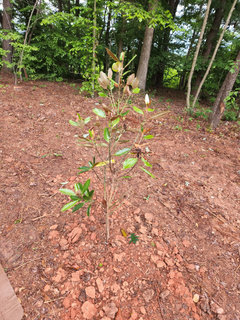
Closer pic of the Moonflower and Golden Euonymus, with another (probably dead) Golden Euonymus a little farther back, and then the Thuja in the back right: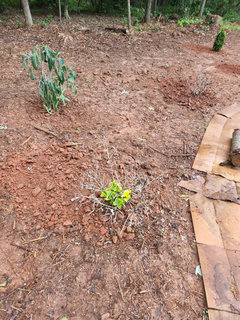
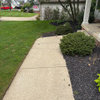
And finally, the Thuja and Tasman Ruffles: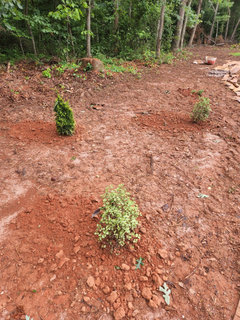
You can barely see that I planted the blue star juniper past the Tasman Ruffles.- 4 years ago
Seeding annuals would be the cheapest and fastest way to fill the space on a temporary basis. Cosmos grows from seed really fast and will flower until frost. Others you might try are poppies, nasturtiums, cleome, marigolds, calendulas, sunflowers, bachelor's buttons. Or any wildflower mix suited for your area.
Jason, zone 7A, near Greensboro NC thanked gardengal48 (PNW Z8/9) Jason, zone 7A, near Greensboro NC
Original Author4 years agoMonrovia lists Nandina as a companion plant to the Tasman Ruffles, and I have several of those that I really don't know what to do with! They don't seem to fit in anywhere else, so they're just kind of "around".
So I'm thinking about putting 3 or 4 of those closer to the wild woods (coming from the driveway, the back part of the garden), between the magnolia and thuja. The ones I have are about 6' tall, so they should provide a bit of a border.
I also have a ton of Autumn Joy sedum that I need to cut (shoulda cut 2 weeks ago), so I can easily plant cuttings in a few bunches towards the front of the garden.
After that, I think that Cosmos might be just the ticket :-) They like hot and dry conditions with tough soil, which sounds like my garden. Size is 1-4' tall, so that's about what I'd want. And they don't cast seeds, so I don't have to worry about dealing with them next year unless I sow more! Sounds perfect, thanks @gardengal48 (PNW Z8/9) :-DJason, zone 7A, near Greensboro NC
Original Author4 years agoDon't worry too much about the Tasman Ruffles, @gardengal48 (PNW Z8/9). We actually discussed this twice before:
https://www.houzz.com/discussions/6208377/new-garden-design-to-hide-neighbors
https://www.houzz.com/discussions/6251370/serbian-spruce-or-alternative
I had to remind myself today that the goal was to build an evergreen barrier to block out the neighbors. The current neighbors are wonderful, but older, so as long as I have a nice little barrier in place when the house inevitably belongs to someone else then everything else is really just cosmetic :-)
If these trees die then it's not a tragedy, I can always replace them with a faster growing shrub or something. The trees or shrubs in front don't even have to be evergreen, really, as long as the back drop is.- 4 years agolast modified: 4 years ago
For whatever reason, plants that originate from the Antipodes tend not to have a great track record in the southeast anyway.
Well, not sure it's 'whatever reason', strictly speaking - it's because the antipodes are generally much milder! And have pleasant cool nights and lower dewpoints. Certainly, New Zealand is, and the parts of Australia where many Australians live.* Look at the dewpoints for even a coastal city just south of Sydney...https://en.wikipedia.org/wiki/Wollongong
Peak yearly dewpoint of only 62F! About like Boston's! You would just barely need air conditioning in normal conditions there. Yet this is a place that practically looks like Hawaii, there are so many "tropical" plants around.
The reason you don't see huge Cordyline australis all over Florida is that they would die of root rot. The "hottest" city in NZ is still cooler in summer than Montreal, Canada! OTOH, SE Australia can at least have meaningful heat waves, and although they tend to be a dry heat, that's still enough to impart some root rot resistance on plants from there. A handful of Grevilleas, for example, can grow in the southeast, especially if on sandy soil. A couple will even survive up here for me, through mild to average winters, although I will always have to keep backup plants in pots for winters like the 'polar vortex' ones.
The situation is even more bleak for plants from Chile. Now that is a country that stays chilly throughout the year, at least in terms of having low dewpoints. Valparaiso is like a cloudier San Francisco, and Santiago like a more arid Sacramento with cooler nights throughout the year. Years ago on this forum there was a guy in Florida who was going to try grow Lapagerias using antifungals. Because otherwise they eventually rot. That's what happened to the one I bought on my x-country trip in 2011...I was of course not leaving it outside, it was going to be in a pot year-round.
I had the "luck" of being in the coastal PNW during one of their worst heatwaves back in the early 90s. Although the days were hot, we were able to sleep at our un-airconditioned hotels and motels because it cooled off enough at night to at least still be warm, but not suffocatingly muggy. Nothing like the US SE in summer. And it only lasted about 3 days. I noticed the most humidity in the Quinault Rainforest, probably because of all the foliage...but again, it wasn't anything like southeastern heat and humidity.
* again I stress I'm comparing where most people live. Obviously, the interior of Australia is hot as hell, but not many Australians actually live there. Likewise there are a handful of towns in New Zealand that get pretty cold in winter - as cold as usda zone 9a maybe LOL - but very few people live in them. I visited one to collect seed in fact. Jason, zone 7A, near Greensboro NC
Original Author4 years agoFor the backdrop, I'm thinking about cryptomeria instead. Green Giants are pretty common and cheap here, but they're skinny and I don't really love the look.
The plan, though, is to clear out a 20-30' stretch along my property border and plant them there, then I'll have about 50' of wild woods (beech, birch, black cherry, maple, and poplar; I'm removing the pines and oaks) before you get to the actual gardens. Hopefully that'll give me the "look" of living in the woods, but still have an evergreen barrier in the winter.- 4 years agolast modified: 4 years ago
Anyhow, Jason, welcome to the world of experimental horticulture! Do keep up updated on your Tasman Ruffles. I would be very curious to know if they make through even the summer. It is entirely possible they do though, depending on conditions. If, for example you get hurricane remnants in August, several inches of rain at once, that is the sort of thing that would greatly increase their chances of being taken out by a cosmopolitan Pythium or Phytophthora species. OTOH if you have a relatively tame summer without such heavy rainfall events, they might make it.
I would slightly prefer Cryptos in NC over GGs, FWIW. Jason, zone 7A, near Greensboro NC
Original Author4 years agoBeing in the foothills, we used to NEVER worry about hurricanes or tornadoes! They would all sort of jump over us, so we never had them. But now we see them every year! Our buildings are definitely not built to hurricane standards, either, so even a small one causes a lot of devastation.
The garden, though, is on a slight slope (so no real flooding to worry about) and protected on the eastern side, so I hope it's OK. I'm more worried about a heavy snow in the winter, that's when the ground there can stay covered in ice for several weeks!
If they do die, though, then I could replace them with witch hazel. I have some growing around the property already and it does well, so it'd be easy to transplant one. Or I could surround the Monpin with Sunshine Ligustrum cuttings. Or maybe both.Jason, zone 7A, near Greensboro NC
Original Author3 years ago@UpperBayGardener (zone 7), you asked me to keep you updated on the Tasman Ruffles.
Well, @gardengal48 (PNW Z8/9) was right, neither of them survived. I protected them when it was below 20F by covering them with a small greenhouse overnight, but as of April 20 there's no growth at all.
I'm about to take them back to Lowes and cash in on that 1-year guarantee.



gardengal48 (PNW Z8/9)