Software
Houzz Logo Print
webuser_602647733

Norway Maple trunk/root rot?

4 years ago

Hi everyone,


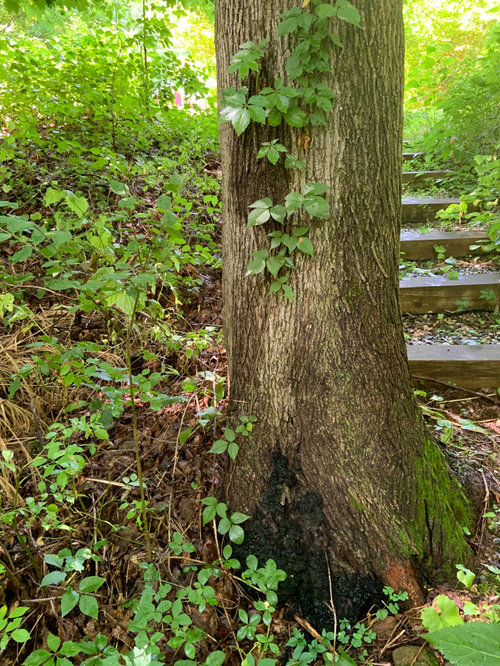
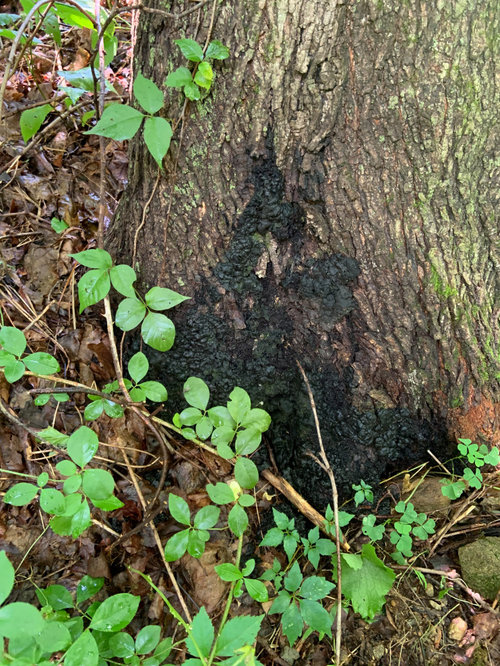
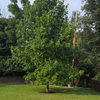
We have a Norway maple that has a black mass/spot at the root of it's trunk. Does anyone know if it can be treated or if the tree is dying? Also if the tree is dying, would it be ok if we left it while it is still alive (tree is far away from home and fence) or could this be something that is contagious and spread to other trees?


Thanks a lot in advance!


Comments (29)

  • 4 years ago

    since it is on no risk to anything nearby ... then just leave it alone.. just as trees grow in tree time.. counted in decades.. they also die in tree time.. so it might be 10 or 20 years before it fails..


    and i sure as heck would not waste money on removal... the coolest thing.. imo.. about a norway maple.. would be watching it rot into the ground ...


    if you really want to plan ahead... plant a new tree or two.. where this one wont fall on it.. so in 20 years.. you will still have a nice tree there ...


    ken

    Am thanked ken_adrian Adrian MI cold Z5
  • 4 years ago

    Also,

    Be real careful around that tree. The area looks infested with P.I. It even has a vine started, part way up the tree.

    You might want to remove that vine while it's still small.

    Am thanked BillMN-z4a
  • 4 years ago
    last modified: 4 years ago

    Sap leaking, but it may be small enough to heal.

    Am thanked bengz6westmd
  • 4 years ago

    Those were my thought too beng.

    Appears to be bacterial wetwood (slime flux disease).

    Not much can be done about it and it generally doesn't have much of an impact on the tree.


    Am thanked BillMN-z4a
  • 4 years ago

    Thanks everyone! Will leave the tree as is.


    @BillMN-z4a good to know thats poison ivy! Will get on the removal.


    @ken_adrian Adrian MI cold Z5 the tree is the start of a woodsy area of the lot so there are a lot of trees around! Why is it cool to see a norway maple rot? Is it for the wildlife that can take over on dead trees or is there something special abour a norway?

  • 4 years ago

    "is there something special abour (sic) a norway?"

    Yes. They are considered an invasive species across much of the east coast and in some pockets along the west coast.

    I am a tree lover but an ailing Norway maple is one I would not hesitate to remove.

  • 4 years ago

    'The crown appears rather full and healthy. Not worth removing at this point.'

    Considering the number of seed they produce, the sooner it's gone the better. imo.

  • 4 years ago

    "Norway maple has been reported to be invasive throughout the northeastern U.S. from Maine to Wisconsin, south to Tennessee and Virginia and also in the Pacific Northwest. Over time, as reforestation occurred across the Northeast, Norway maple joined native tree species as a component of eastern forest ecosystems. It also escaped from town plantings.
    Norway maple forms monotypic populations by displacing native trees, shrubs, and herbaceous understory plants. Once established, it creates a canopy of dense shade that prevents regeneration of native seedlings." invasive.org

    btw, seed germinate rate for Acer platanoides is reported at 35% and a mature tree can produce many thousands of samaras. 35% of 1000 is 350....35% of 5000 is 1750. That is an awful lot of unwanted and invasive seedlings popping up all over!!

    Once again, Jordan expresses very selective treatment of defined invasive species. If he likes the plant, it is OK...if he deems it "useless", not so much.

    I don't give much credence to his opinion.


  • 4 years ago
    last modified: 4 years ago

    Jordan wrote:

    'A Norway Maple cultivated on a property or part of a landscape need not be removed. A few of my clients have beautiful Norway Spruces on their properties that suggesting to remove it solely because its considered invasive species would be misguided.'

    You're talking apples to oranges jordan. Just because two different trees have the same first name? Now that's a little more than just misguided.

  • 4 years ago

    We are also tree lovers, but we removed the Norway maples from our woods to allow the native trees to thrive, and so new trees that planted themselves would be (more likely) desirable species. We also took down the buckthorns. Granted, we were working with a woods, so there was one minor break created by removing a medium sized Norway maple, but the small ones were inconsequential to the overall look, feel, and habitat. The buckthorn was a beautiful tree, but we couldn't allow it to keep spewing seeds either. The space filled in pretty quickly with growth from the silver maples, sugar maples, wild black cherries, pin oaks, and white oaks, with things like wild dogwoods and native honeysuckles in the understory. When we went to plant a small sugar maple that we got at an Earth day event, we found most of the baby trees back there are sugar maples, oaks, and cherries.


    If it would completely change the ecosystem to remove it, I might keep this tree temprarily until I could get more desirable trees big enough to sustain the habitat without it, though leaving it means you'll be fighting its progeny for longer. If the understory is all poison ivy and virginia creeper anyways, I'd be less attached, unless it would create a heat island or something. (Yes, virgina creeper is native, but I don't like it, lol)

  • 4 years ago
    last modified: 4 years ago

    Being sold in stores does not make a plant a good plant to grow. I don't know much about Nandina or whether it's useful, but I would not use being sold in stores as a justification for any plant. Stores will also sell plants that aren't zone appropriate and whatever else is popular. (And zone hardy is not necessarily the same as zone appropriate, just to be clear.)

  • 4 years ago

    "btw, I never said nandina was useful "because it was sold in nurseries". It is useful because it is a highly adaptable broadleaved evergreen shrub that will grow happily under a wide range of garden conditions. And with a lot of very attractive, colorful cultivars. And a pretty narrow window of invasiveness."


    Well, that makes more sense. I couldn't figure out the correlation between usefulness, being sold in stores, and this conversation.


    Useful is a curious term for plants anyways ... I mean, this norway maple is useful. It provides shade, is probably a perch for some birds or squirrels or something, and gives the poison ivy something to climb on. (You don't necessarily want the poison ivy, but it too is "useful" ... it feeds birds with its berries.) Likewisebeing sold in stores doesn't make a plant useful ... it is useful for some other reason; it is sold in stores because people buy it ... presumably because they find it useful. Hence why I said that being sold in stores isn't a justification for a plant being a good plant to grow ... other justification is needed. Being attractive and adaptable is a justification for utility.

  • 4 years ago

    Thanks everyone for your comments! I can see an argument for both sides depending on the situation. We have a Norway maple in the lawn area of our back yard that's quite nice because it provides a lot of shade and we were told that it's extensive root system is preventing that part of the lawn which has a slight sloped from having water drainage issues during rainfall. The woodsy area of the lot has three more Norway maples in addition to a number of other either sugar or red maples (different landscapers have told me different things), and I can see how the extensive seed spreading can lead to unwanted trees in this area that we'll have to be vigilant about clearing while they're small. I wouldn't mind it if we didn't have any Norway Maples in the woods area but large tree removal is pricey. :O

  • 4 years ago
    last modified: 4 years ago

    Sugar maples and red maples look pretty different. Grab a leaf. If it looks like a duck's footprint and turns red in the fall, it's a red maple; if it looks more like the leaf on the Canadian flag and turns yellow and orange in the fall, it's a sugar maple. That is, if red maple and sugar maple are the only options. Norway maple leaves look similar to sugar maple leaves, but they have a milky white sap when you break a petiole, which makes them easy to distinguish. Or post the leaves here, and we can help you identify them.

  • 4 years ago

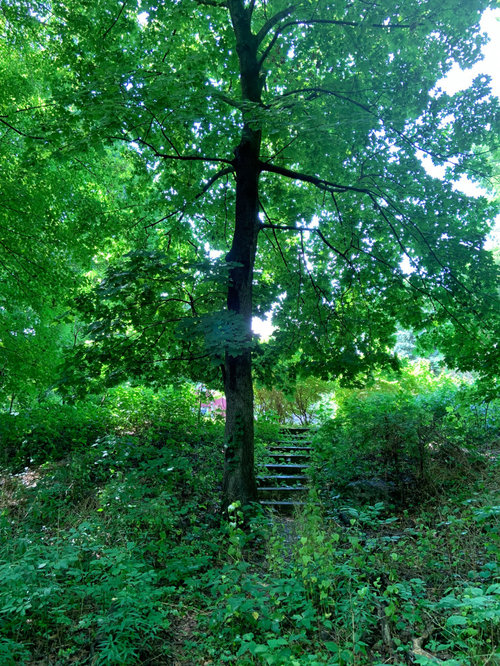
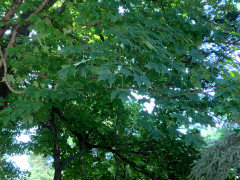
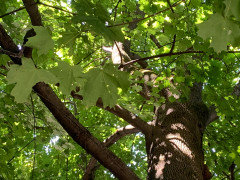
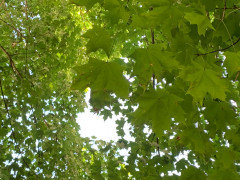
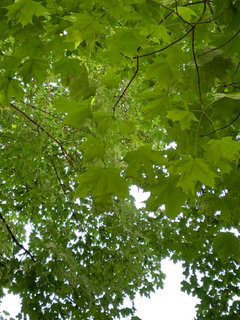
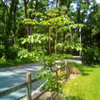
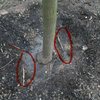
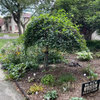
    Thanks! Here's some photos of the leaves closer to the house that some landscapers have told me are red vs sugar maples. I couldn't reach high enough to pull off one of the leaves so zoomed in on the tree.


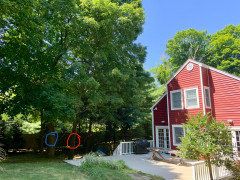
    One other thing I wanted to check is that this tree is around 20 feet from the home and leaning into the home because it's kind of being pushed from the other side by a larger Norway maple. One landscaper had suggested that I remove this tree due to it's proximity / lean into the home, and that it will get worse as the tree grows to mature height and continue to lean more with the larger maple on the other side. It will also get harder to prune/remove in the future. I did some looking online and it seems like both sugar and red maples (regardless of which one this is) should be planted at least 30 feet away from the home so it does seem like this one is too close? The last picture shows the house as well as the red/sugar maple in question circled in red and the larger Norway pushing it from behind circled in blue. Wanted to get everyone's thoughts on this and thanks again!


  • 4 years ago

    I don't see any red maple leaves in your picture. Red maples (acer rubrum) have saw tooth leaf margins. The only pictures that look like sugar maple leaves to me is the second and third pictures, the first one look more like Norway maple.

    I can't help you with leaning tree part, someone else will have to chime in about that.

  • 4 years ago

    Actually, the bark showing on the second picture looks to be Acer platanoides (Noway maple).

    Am thanked BillMN-z4a
  • 4 years ago

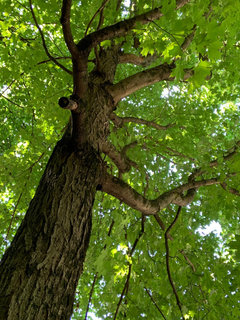
    Thanks @BillMN-z4a! I’m not sure how, but i think i managed to take a picture of the wrong tree earlier in the picture with the bark. You are right, that was actually a pic of the Norway Maple. Here’s a new picture of the bark and leaves of the unknown maple and does it look like a res or sugar? Thanks again!


  • 4 years ago
    last modified: 4 years ago

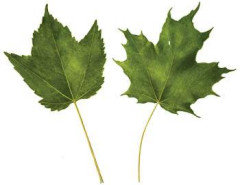
    You tell me.

    Red (acer rubrum) Maple (left). Sugar (acer saccharinum) Maple (right)


    Those you pictured above are sugars.

    Am thanked BillMN-z4a
  • 4 years ago

    @BillMN-z4a thank you!

  • 4 years ago
    last modified: 4 years ago

    Last tree's trunk pic shows sugar maple bark (w/the marked ridges) and leaves. It's up to you, but I wouldn't worry myself, sugar maple wood/branches are tough. Of course, someone who's business is cutting down trees will recommend cutting it down.... :) But the sugar maple is small enough that removing it wouldn't hardly reduce the amount of cooling shade.

    Am thanked bengz6westmd
  • 4 years ago

    Invasive is always a relative term. There are many Norway maples planted in yards near where I live. None are invasive because we have real invasive trees that crowd everything out. Tree of heaven and Bradford pears are at least 100x more invasive.

  • 4 years ago

    Invasiveness is always relative!! Norway maples may not be as noticeable as they have naturalized widely and to many appear to be a natural component of woodlands and natural areas. But they are classified as invasive by both invasives.org and the Invasive Plant Atlas of the US throughout the northeastern U.S. from Maine to Wisconsin, south to Tennessee and Virginia and also in the Pacific Northwest. The US Forest Service quotes an even larger invasive range. This is almost identical to the expanse of the invasive range of callery pear. Check the maps!

    So callery/Bradford pear is nowhere near 100 times more invasive!! It is just more visible as it sticks out more as a non-native species.......maples blend in.

  • 4 years ago

    "Tree of heaven and Bradford pears are at least 100x more invasive."

    And how exactly did you arrive at that calculation?

  • 4 years ago

    Invasiveness does have a range depending on how many of specific criteria are met. In Massachusetts (which I'm using as an example because it's where Ilive and thus best know), there are various levels of invasiveness on the invasive species list from "invasive" to "likely invasive" to "potentially invasive." So, yes, invasiveness IS relative.

    Norway maple is invasive per Massachusetts standards; tree of heaven is also invasive on the list; Bradford pear is not on the list.


    How Massachusetts determines invasiveness:

    https://www.mass.gov/doc/invasive-plant-list/download

  • 4 years ago
    last modified: 4 years ago

    Well, when I drive down the road, for every Norway maple I see growing in the wild, I see at least 100 tree of heaven and bradford pear. 100x is probably understating the invasiveness, if anything. And it's not just noticing one tree over another. it's blindingly obvious which trees are far more invasive than others. Bradford Pears can no longer be sold in many locations because of their invasiveness. So, it's not just me noticing.

  • 4 years ago

    Well I'm sure if you have more aggressive invasive species growing together in the same area, the more aggressive species will crowd out the less aggressive ones. What you are talking about kidhorn is more local conditions with those species.

    You get further north where tree of heaven isn't as aggressive and the norway maple can do a lot of damage, especially in the new england states where sugar maples are abundant.


    'Norway maple is an invasive species. It is a non-native popular landscape tree that can spread into native woodlands. Norway maple invades woodlands by out-competing sugar maple due to its shade tolerance. Wildflower diversity is reduced because it forms a dense canopy.'


    Norway maple (umn.edu)


    https://extension.umn.edu/identify-invasive-species/norway-maple#:~:text=Norway%20maple%20is%20an%20invasive,it%20forms%20a%20dense%20canopy.


  • 4 years ago
    last modified: 4 years ago

    I can't say that I've ever noticed a tree of heaven driving down the road, but it doesn't make it less invasive, and I can't say they're just not noticable to me. I also couldn't tell you a sugar maple from a Norway maple with any certainty from driving past it unless it's got its fall colors, so maybe I'm just not looking carefully at the roadside trees, and the tree of heaven are hiding amongst the walnuts and hickories.