Software
Houzz Logo Print
webuser_307435964

What to do with this cactus?

4 years ago
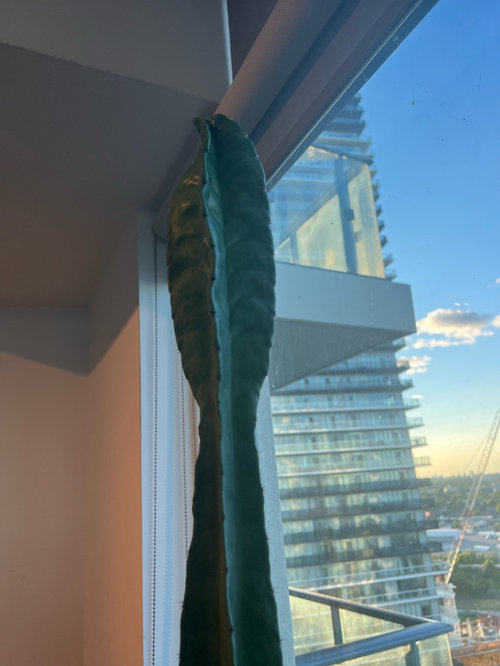
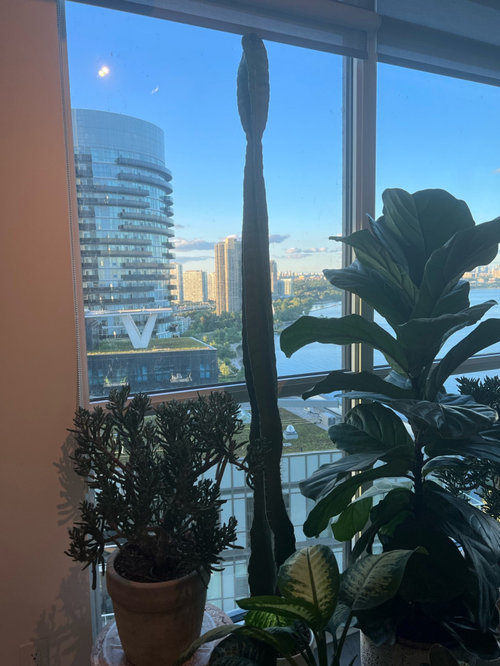
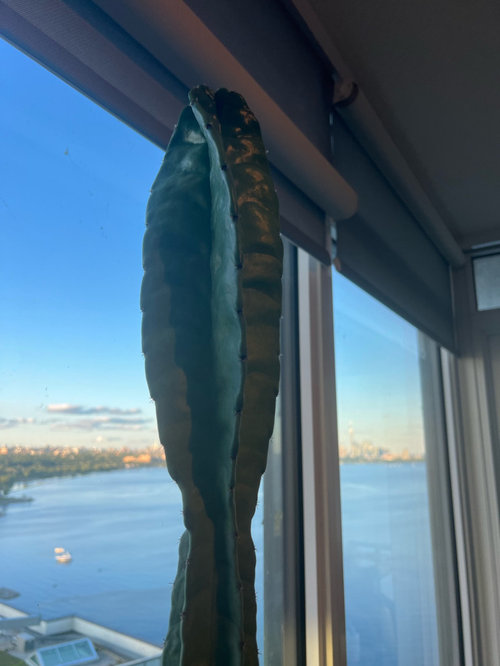
I have a tall cactus approximately 7 feet tall. Recently it has begun to grow a new large head on the top of the cactus. The thickness of the new piece seems to not be growing proportionate to the rest of the cactus.

Due to the height of the cactus I am afraid if this new piece keeps growing in width it may tip the cactus over

Is there any way to cut the top of the cactus off and re plant it?

Would that be more harmful than good to the existing cactus?

Any ideas how to do this?

Appreciate any suggestions !! 😊

Comments (9)

  • 4 years ago

    they will need to worry about when it grows another foot and the prime growth point is in full shade .. or on the ceiling.. i cant quite tell how much space is up there... ken

  • 4 years ago

    Sorry I can’t answer your question about cutting it off. I just want to say your plants look great and your views look even better!

  • 4 years ago

    I have some thoughts, but could you tell me how old the plant is, or at least how long it's been under your care?

    Al

  • 4 years ago

    Al: I have had the cactus about 1.5 years. It was about 2 feet when I first bought it so it is growing very quickly. We get great bright indirect light in my condo

  • 4 years ago

    Ken: that’s a good point. I didn’t think about that. I have about another 1-2 feet before it reaches the ceiling

  • 4 years ago
    last modified: 4 years ago

    Sonja, do you see how it's jointed? That would be a good place to cut, though really anywhere along the column would (ultimately) be fine, though perhaps a little out of natural growing for this species of columnar cereus (yes, it's night-blooming, like an Epiphyllum, but not a particularly jungle-environment plant) - I think it's South American in origin.

    Set the cutting aside to callus in a dry place. After a few days, get some porous potting soil and slightly insert the cut end into the soil, supporting the cutting with rocks/pots/something else to support the cutting. Prior to doing this, you could dust the end with Rootone - it's not usually necessary for these plants, but it could aid in rooting. Place this in a well-lit-but-not-too-much-direct-sun place, the warmer the better (sun-warmed concrete is great for bottom heating, but you can also use a warming mat) as this aids in rooting. In a day mist the cutting heavily, but don't water the soil. Keep at this for a month, and the cutting should have rooted by then, or well on its way to doing so. I'd say after a month you can water the soil a little.

    This plant, like all cacti (but particularly columnar and paddle {Opuntia} types) has edible fruit. The one-night-only flower is nice too.


    Considering this plant's environment, it's very well grown (no disrespect meant - it really is extraordinary that it lives there so evenly formed and well-cultivated). I'm used to seeing this plant's types in the ground in the Southwest or West Coast (in the USA), and to see it on an apartment window's sill is beyond groovy.


  • 4 years ago

    The changing of the seasons during the plant's annual growth cycle is the primary driver of the change in the plants diameter/ taper, and there might be a secondary influence on diameter/taper if you potted up or repotted. Tight roots (being rootbound) causes stress that negatively affects the plant in a number of ways, one of which is it's negative influence on growth. Potting up will partially relieve the stress associated with root congestion while a full repot, which includes bare-rooting, root pruning, and a change of grow medium, will entirely eliminate the stress of root congestion until the next approximate point in time when the root/soil mass can be lifted from the plant intact.

    Getting back to the primary influence producing the undulating nature of the plant's diameter: Associated with the annual growth cycle is the gradual change in both the intensity and duration of the plant's photo load. Longer days and brighter sun increases the number of photons striking the plant's photosynthesizing surface, so it is better able to use the energy of light to make simple sugars from CO2. Simple sugars are the plant's true 'food', and more food equals a broader girth, as many of us can bare witness to. This means that WHEN you cut the plant back is going to have an impact on what it looks like. If you truncate the plant (cut it back) now, you will be remove the apex/apical meristem of the 'trunk', which terminates its ability to extend/grow taller and will cause the plant to branch at and immediately below the point of truncation. It is not a good idea to truncate the plant where it is most narrow, because the branching above that point will be heavy, so truncating at a narrow point will not only make the plant visually top-heavy, it will also be physically top-heavy, so best to truncate it low on the plant and at the thickest part of one of the undulations. The lower cut will add visual balance to the new branching which is certain to occur, and it will provide room for the new branches to grow. You probably don't want to truncate the plant at the narrow point near the top because it allows no space for the fast-growing new branches that will occur.

    If you're going to do any propagation, you will only get 1 propagule from the cut off piece that can be considered a tip cutting, and that would be the cutting that that includes the plants apex which will allow the plant to grow taller as a single stem. You can make several propagules, but the other propagules will not have the ability to grow taller as a single stem because with the stems apex removed, the other cuttings will be obligated to branch at or immediately below the upper cut. The only way to make the propagules without an apex to grow a single stem is by removing all branches except one which will serve as the only (new) leader; but even at that, there will be a notable offset where the plant makes the transition from the original cutting to the new branch that serves as the new leader.

    Last thought - when you truncate the plant, cut it with a very sharp and sterile tool. If there are any shredded edges or damaged tissue, use a scalpel to clean up the tags as this damaged tissue is where rot will begin. Scalpels are cheap, and you'll find a ton of uses for them around the house, especially if you do a lot of plant manipulation. The disposable plastic scalpels are about $1 apiece and last a long time. After the distal wound (where the branches will grow) is trimmed up, wait until it stops weeping, then paint it with waterproof wood glue and let it dry. This will stop tissue at the wound site from drying up and dying back, causing a large and unsightly wound.

    Al

  • 4 years ago

    @cactusmcharris

    Hi thanks so much for all the information. That’s all very helpful. I had no idea that it could bloom or have fruit - I am assuming I would need quite a bit more sun to see any blooms. Quite impressive to see in pictures though.
    But I will try what you suggested. It doesn’t seem to be as hard a process as I was thinking it might be. I do have a warming mat so I will use that.
    And thanks! I am very fortunate to get excellent indirect light in my condo so my plants all seem to thrive!

  • 4 years ago

    @tapla

    Thanks for the information Al. Very helpful!
    I think I likely do need to repot. Root congestion may actually be likely at this point. I have not changed the pot since I first planted the cactus and it does look quite small now compared to the size of the cactus.

    Is there an ideal time of year to truncate the plant? Is it ideal to truncate it eventually though as opposed to just continue to let it grow? I don’t necessarily care to have a cactus with branches .. I was just more concerned with the top piece not growing proportionality to the rest of the cactus that it may get too top heavy eventually ..

    I didn’t think about that - I can now see how cutting at that one narrow point would not be a good idea. I appreciate all the information. I feel I have a good understanding about how the propagation works now. I didn’t know anything about the apex of a plant before so that was quite helpful. Thanks!

Sponsored
Hope Restoration & General Contracting
Average rating: 4.7 out of 5 stars35 Reviews
Columbus Design-Build, Kitchen & Bath Remodeling, Historic Renovations