Software
Houzz Logo Print
ruthj98

Tell me about Japanese Maple tree roots

I've had my Japanese Maple for 15 years or more. For as long as I can remember, the leaves always get dried out each year. This tree is by our front door and we are seriously considering removing it and replacing it with something else.

One issue is that it was buried too deep. Can't fix it now. I am not asking for any solution here.

What I really want to ask is: where is the most important part of the soil that should be watered under the JM? I am thinking that the roots might go beyond the actual canopy of the tree and that it is important to water around the canopy and further out. My husband has been watering near the trunk. I am thinking further out would be more beneficial.

Comments (36)

  • 4 years ago

    A happy Japanese maple doesn't get dried out leaves ... it drops leaves in fall with the rest of the deciduous trees. What you're describing is leaf scorch ... which can be water related and remediable, or it can be something worse; your local extension or potentially an arborist would be able to tell you better. Root rot can initially present similarly, but if this has been going on for 15 years, you'd have large dead or dying branches if it were root rot.

    Some information on leaf scorch, and it's causes:

    https://hgic.clemson.edu/factsheet/maple-diseases-insect-pests/


    Yes, the roots of a Japanese maple absolutely extend outward to the dripline and beyond. They, like most maples, have relatively shallow roots (mostly in top couple feet of the ground around them, as opposed to oaks and pines and other tap-rooted trees), so the roots expand outward to seek water and nutrients. It would like water all the way out, not just at the trunk.

    newhostalady Z6 ON, Canada thanked BlueberryBundtcake - 6a/5b MA
  • 4 years ago

    "I am thinking that the roots might go beyond the actual canopy of the tree"

    This is true for any tree......the bulk of the feeder roots - those that absorb soil moisture and draw up nutrients - extend well beyond the canopy edge or dripline. And with nearly all tree species as well, these feeder roots are located just under the soil surface. In fact, it is reported that 85% of a tree's roots are located within the first 16 inches of soil. Tap roots, with a few minor exceptions, tend to be only for anchorage and generally disappear with time. Even taprooted trees will have an extensive expanse of more surface oriented feeder roots.

    Start watering at the canopy edge or dripline and outward.....not in close to the trunk. JM's tend not be very drought tolerant and appreciate plentiful soil moisture during any hot, dry spells

    newhostalady Z6 ON, Canada thanked gardengal48 (PNW Z8/9)
  • 4 years ago

    "Tap roots, with a few minor exceptions, tend to be only for anchorage and generally disappear with time."

    Good to know, I thought they used both lateral and tap roots for water and nutrients ...

    newhostalady Z6 ON, Canada thanked BlueberryBundtcake - 6a/5b MA
  • 4 years ago

    Under very arid conditions or with very low water tables, taprooted trees may use their tap roots to access water. But this is very unlikely in any cultivated garden setting.

    But not necessary nutrients. These are almost without exception located in the top few inches of the soil profile so a taproot is pretty much useless for this purpose. And why all trees develop a wide lateral expanse of feeder roots, taprooted or not.

    newhostalady Z6 ON, Canada thanked gardengal48 (PNW Z8/9)
  • 4 years ago

    Blueberry Bundtcake, thanks for the link about diseases and leaf scorch.

    I am understanding that it is most important to water well around the dripline.

    This Japanese Maple has had leaf scorch each year for quite some time. I can't remember the last time there was minimal leaf scorch.

    This year has been a very dry one and hot. So our thought about this tree is that we will give it more year (2023) to do better or we are removing it. We will do a better job of watering.

    I did do a post before and was told that the JM was buried too deep. So I tried to remove soil around the trunk and we boxed it in to try to keep the soil level lower for the JM. This did not seem to help.

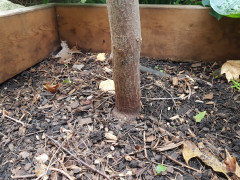
    Pictures:


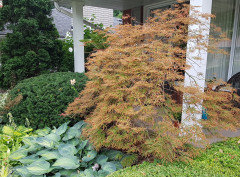
    This is what the tree looks like now and this is also along our walkway to our door.


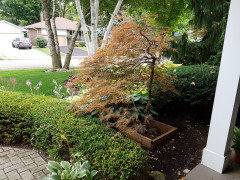
    I am standing at my front door. This is the back of the tree.


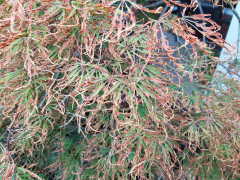
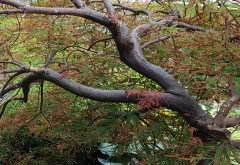
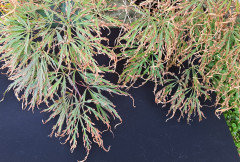
    The leaves look like this.


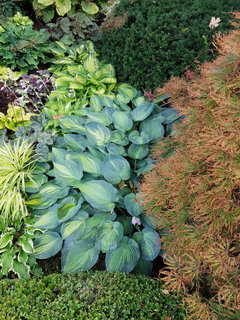
    Maybe these blue hosta are making it difficult to get enough water to the JM? But then if the hosta wasn't getting enough water, it would have some yellow leaves.


  • 4 years ago
    last modified: 4 years ago

    Can you explain how you water the tree? The leaf damage looks like a combination of irregular watering exacerbated by some scorch. But I doubt scorch is a major factor.

    The brown, shriveled leaf tips, especially on heavily dissected forms, is a classic indication of letting the soil dry excessively between watering. Believe it or not, established hostas can be remarkably drought tolerant during stretches of hot, dry weather so not surprised they look fine. But the maple will be much less tolerant - it wants consistently moist soils - and even more so if not provided the water where it can most readily access it.

    I would agree that that is probably not ideal siting for that tree. If you can hold out until late dormancy, I'd try to move to a better location, where more even watering can be assured. And maybe give that one side a chance to fill in :-)

    newhostalady Z6 ON, Canada thanked gardengal48 (PNW Z8/9)
  • 4 years ago

    imo.. and heavily simplified to help you understand..


    and using an acorn as an example..


    the tap root simply holds the acorn there.. as the sprout uses up the nutrients in the acorn .. and once lateral roots develop.. the tap serves no purpose beyond any other root ...


    if tap roots were imperative.. there would be no horticultural trade of larger specimens.. as potting and ball and burlap destroy the tap roots ... unless you are selling very young tiny plants ... and if that were the case .... you may as well just plant your own acorn ..


    the root mass of a tree is said to be 2 to 3 times what you see above ground ... and it is in a pancake form ..


    here is the neighbors silver maple


    they do not grow like this

    https://duckduckgo.com/?q=tree+drawing+with+roots&t=ffab&iar=images&iax=images&ia=images


    my usual suggestion is.. if you water and fert your lawn anywhere within 3 times the height of the tree... presume you are ferting and watering the tree .. trees are survivors.. and will find and take what they need... ask any hosta grower.. lol ...


    i now have seen your pix... some JMs have a very shallow fiborus root mass.. and any excessive digging can effect the mat of roots.. leading to water issues ...


    ken


    ps: what is the 2 by 4 box?? .. and why cant you lower the soil level around the trunk??


    newhostalady Z6 ON, Canada thanked ken_adrian Adrian MI cold Z5
  • 4 years ago

    Can you explain how you water the tree?

    My husband and I water our front garden. Usually by sprinkler. I told my husband that the JM might need more water. I didn't know he was just watering inside the box. Not good.

    When using the sprinkler, it may be possible that the water hits the leaves of the JM and the water just runs down the leaves instead of behind and around the JM.

    Now, in regards to scorch----Unfortunately this JM now only gets some midday sun, that is, the hottest sun of the day. It may get an hour or two of that. Otherwise no sun.

    I never thought of moving the plant. That would be pretty difficult, wouldn't it? (Of course, don't know where we would put it. Everything is filling up!) Do you think that side would actually fill in a bit?

    The square board was to keep the soil line down as the plant was buried too deep. I'm not sure if the soil has kind of filled in now.

    So I can:

    (1) remove more soil around the base of the plant.

    (2) water better by making sure the soil all around the JM and further out is watered thoroughly.

    (3) move the JM

  • 4 years ago

    From what I understand, and this is from a reputable horticulturist on this forum, Japanese maples aren't as fussy about being planted on the deep side as some other trees may be.

    She may want to chime in about is subject and most likely will. :-)

    newhostalady Z6 ON, Canada thanked BillMN-z4a
  • 4 years ago

    OK Bill.

    I also wrote about my JM a year or two ago. I can't locate that thread. Is there a way I could find it?

  • newhostalady Z6 ON, Canada thanked floral_uk z.8/9 SW UK
  • 4 years ago

    Sorry nhl,

    I tried to look but your profile does not show a 'posts you have started' category.

    I think it was that post back then that GG mentioned about planting depth not being a significant issue.

    newhostalady Z6 ON, Canada thanked BillMN-z4a
  • 4 years ago

    Did I really write that Bill? Can't imagine why I would :-) Depth is always an issue (regardless of tree species), especially too deep. Shallow or high planting not so much.

    newhostalady Z6 ON, Canada thanked gardengal48 (PNW Z8/9)
  • 4 years ago

    Thank you Floral and Bill for trying to find my past post about this JM. Floral, the post you found is of my very young JM that I will also be asking for help with. But for now, I will concentrate on this JM as we are at a critical stage---give up or persevere.

    With the help of Google, I was able to find my previous thread. At this point, I am reviewing the comments given to me on that post. After absorbing that information, I will be back to review those comments with you.

    If you would like to look at the previous post, here it is. It was done in 2019!


    https://www.houzz.com/discussions/5535358/should-i-give-up-on-this-crimson-queen

  • 4 years ago

    Yup, that's the post I was referring to.

    Nope, GG never said that about planting too deep not being a problem. :-)

    I will leave now. It was interesting reading the old post again. Thanks!


    My only other thought is that it appears so dark in your pictures above with the JM, can it be it's not getting enough light from the ever-growing canopy?


    newhostalady Z6 ON, Canada thanked BillMN-z4a
  • 4 years ago
    last modified: 4 years ago

    Well, I have gone back and read the previous thread that I had started 3 years ago. I came to realize that I hadn't done all that I was to do in order to improve the health of this tree. So I am back again asking for help---thankful for the help, but disappointed in myself for not following through.

    Let's move forward now.

    Bill, you remembered the previous post I wrote! What a good memory! You and Jordan mention about the tree perhaps not getting enough light. That is something to assess for sure. We have two birch trees blocking some of the sun and our neighbor planted a sugar maple tree 8 years ago and it is growing like crazy now. It will shade MY property from the best sun of all---morning sun---not theirs. That makes me so sad. Previous owners planted this tree on city property and now the tree belongs to the city! That means it can't be removed and/or replaced by the owners. Frustrating.

    So what did I take away from the previous post?

    (1) Requires evening moist soil. Check our watering and watering method to ensure enough moisture is received around the tree, not just near the trunk.

    (2) Continue to remove soil to expose root flare. Cut any fine roots growing upwards.

    (3) Mulch around the tree, but not by the trunk to retain moisture.

    (4) Make sure that the soil level in the box remains the same. As the soil rises, remove excess to expose that root flare.

    (5) Do not allow organic material, like leaves, to pile up in the boxed area. This could smother the root flare.

    (6) Make a note of when the leaf scorching begins. Note the weather at that time (temperature and rain).

    Anything else I'm missing?

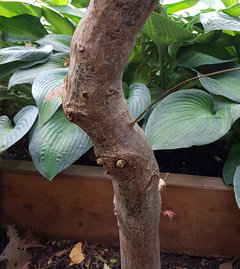
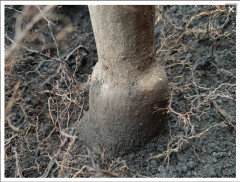
    I will take more pictures---of the root graft; I noticed a dead branch; and also some tiny small growth along the stem or trunk. Is that good?

    EDITED TO ADD:

    (7) Don't burn the roots with chemical fertilizer! Use composted manure.

    (8) Needs more sun (4-6 hours). Trim tree branches to allow more sun to come through.

  • 4 years ago
    last modified: 4 years ago

    I wouldn't mess with (2) anymore. If you got down to the root flare within a 10-12" radius of the trunk and taken care of any possible circling roots, you've already taken care of the problem area. The roots further out will generally find the 'sweet spot' on their own and continued disturbing of the roots will have diminishing returns at best.

    I agree with the idea of watering (when it needs watering) a larger area than just out to the drip line. During a normal year, when moisture is good, it's not as much of an issue but during extended dry periods, the more outlying roots could get dry enough to experience damage by not getting enough water. I'm talking drought or near drought conditions.

    You wouldn't think that with that much shade, your tree would experience leaf scorch but I'm not in an area where we see many JM's. Must be just the heat can do that to them.

    newhostalady Z6 ON, Canada thanked BillMN-z4a
  • 4 years ago

    Here are a few more photos I took yesterday.

    Bill, do you still think I should remove more soil within the boxed area?

    Jordan, leaf scorch can be from the wind also?


    I can see some little growths here and there.


    and here:


    The leaves:


    I just thought of something else which could also be a factor. My husband takes care of the grass and the shrubs. I take care of the perennials. When we were trying to address this issue of leaf scorch, we found out that using chemical fertilizer was not good for the JM. I asked my husband to stop fertilizing the tree. I would do it by adding some composted manure. But he is still fertilizing the boxwood hedge on one side of the JM and the yew on the other side of it. The roots of the JM must be there also. Maybe we should try to use composted manure for the JM and the plants around it where the tree roots might be.

    This year it has been hot for a longer time, very dry and I think windier.

    It is hard to water the area that is closest to the porch. Our watering has been from the other side. We have now begun to water both sides.

  • 4 years ago

    NHL,

    I looked back at the old thread and according to the picture, you could still be an inch to the root flare. Me personally, I would remove more soil until the root flare shows. But that's just me, I tend to be a bit of a perfectionist with whatever I do. :-)


    Is it going to be the end of the tree if you don't? No, I don't think so. There's a thin line between what's best and what will work, and I think we're at the line with the way it is now.

    I believe that's the root flare on the left, if so, you're pretty close and should be fine.


    newhostalady Z6 ON, Canada thanked BillMN-z4a
  • 4 years ago

    Bill, I like perfectionists! Thank you for looking back and showing me a picture of the graft and root flare as it was in 2019. I can't believe how much of the soil has filled in! I am determined to get out there and remove that soil! I am not the type to just give up and remove this tree. I am trying to work with it and give it a good chance to get better. There are a lot of things on the to-do list!

  • 4 years ago

    I've been looking to see how much sun this tree gets---a bit of dappled sun in the morning and then it gets sun from about 12 noon to 1:30 p.m. That's not a lot of sun. Maybe not enough.

  • 4 years ago

    That's not much for a tree that would prefer 4-6 hrs. and would do better if it did.

    What you are experiencing is, over the years a perfectly planned yard slowly becomes a deep woods scenario. Is that a northern exposure?

    What you need is a qualified person to come 'on site' and show you where things could 'opened up' to provide more sun. But I'll defer to the landscape people.

    You have a beautiful yard NHL. :-)

    newhostalady Z6 ON, Canada thanked BillMN-z4a
  • 4 years ago

    You're right Bill, the amount of sun my Japanese maple is getting is not enough now. The amount of sunlight this tree gets has changed since the planting of it.

    The front of the house has an eastern exposure. So my property is very much affected by the maple tree previous neighbors planted next door. I have two birch trees on my property. One is a city tree that was damaged in an ice storm years ago, but is still hanging in there. The only control I really have left now is with my own paper birch tree because my city would allow me to cut it down. It's a beautiful tree. In as much as I respect trees and love trees, I would seriously consider removing it. The two birch trees in my front yard have too many surface roots. My backyard is filled with maple tree roots. So now with the neighbor's tree growing like crazy, the sunlight in my front garden is becoming less and less. Gardening in this property is challenging and frustrating. So much so that I sometimes consider moving. So maybe removing the birch tree (or at the very least one trunk of it) may open up the front garden a little more.


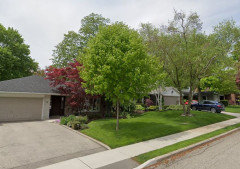
    Here is a photo of my neighbor's house (left) and my house (right). The sun comes up exactly in the direction of this picture. The tree in center is a sugar maple tree growing like crazy now. You can see my Japanese maple tree at the front of my house and my two birch trees.


  • 4 years ago

    I agree in that there really isn't room for 2 full sized trees on a lot that size, especially with neighboring trees nearby. And landscapes do need adjusting from time to time.


    I find it odd that a tree in my yard is considered a 'city tree'. In my town it's the ones on the boulevard that have that title.


    And what makes it worse is that tree (city tree) is the ugly one.

    Would the city allow you to remove it if you replaced it with something else?

    Even so, then the paper birch is still located to close to the house and would need to be removed eventually.


    So, I would agree to remove the PB and put another JM or smaller statured tree or anything else you like that would be of visual interest in that spot.


    It's too bad the two trees weren't just switched around and you could cut just the ugly one. ;-)


    Again, I'm not a professional, but sometimes you gotta do what you gotta do. :-)

    newhostalady Z6 ON, Canada thanked BillMN-z4a
  • 4 years ago


    Bill, it is really good to hear your comments especially with someone who is looking at our situation with "fresh eyes."

    I agree with you about there being too many trees for the property with our size being 50 x 100 feet.

    As for what is considered as being a city tree, where I am the city's property is several feet in from the sidewalk. The boulevards in my area vary in depth. In those areas with a wider boulevard, the city has planted large trees in those spots. That means there would be no other city tree on that property. That works so much better! It keeps the leaf debris away from the eavestroughs and allows more sunlight onto the front lawn and garden. It also allows for more light to come into the home which can reduce energy consumption---and in my opinion, just makes the house feel warmer, brighter and more cheerful.

    But many properties here with a narrow boulevard, have city trees planted a few feet from the sidewalk which is considered city property (like mine). The homeowner is to maintain that part of their property as their own, but should it be necessary to dig there or whatever, the city has the right to do so.

    I agree that it would have been nice to have the two birch trees switch positions.

    "Would the city allow you to remove it (city birch tree) if you replaced it with something else?" Well, maybe---but probably not. They will one day when the tree is dying. But the city has a list of trees I would have to pick from to replace it with. There are no small trees on that list! The tree list has 30 trees---25 large and 5 medium. That's it! So it means when, one day, and my city tree is removed, the tree I choose from that list could grow bigger than the one I have now! Very frustrating!

    "So, I would agree to remove the PB and put another JM or smaller statured tree or anything else you like that would be of visual interest in that spot." That sounds so good to me!


  • 3 years ago

    Well, part of my city birch tree fell this morning. The city says they are going to remove all of the tree due to rot. That's the good news. Bad news: they are going to plant a replacement tree from a city list of trees of which only 3 are medium sized trees and the other 27 are large sized growing trees. I have enough trees on my property for its size. Upsetting.

  • 3 years ago
    last modified: 3 years ago

    Can you request one of the medium sized trees?

    Will they put it a bit further out toward the street?

    Either way, I would think that a new tree of any kind would take 25-30 years to get big enough to be a problem for the rest of the yard. Especially starting up under/near more mature trees that limit the hours of direct sun.

    newhostalady Z6 ON, Canada thanked BillMN-z4a
  • 3 years ago

    "Can you request one of the medium sized trees?" Yes. I will be able to choose two trees of which the city will plant one of the two. The medium trees are: Ruby Red Chestnut tree, Japanese Katsura tree and the Hazel (Filbert) Turkish tree. I am thinking of making a post to ask about which of the trees on the list are the best choice. I've already eliminated the 5 maple trees, the honey locust, the catalpa and the two linden trees. So that leaves me with 21 trees!


    "Will they put it a bit further out toward the street?" Don't think so. The tree is about 6 feet away from the sidewalk. My guess is that they will plant it right beside the same spot as there is some kind of gas line which I think will limit some of the possibilities to plant.


    I was really hoping that they would not plant another tree because it would be too close to my birch tree. I thought they allowed a certain amount of distance from other trees. I will have to find out about that. I always toyed with the idea of planting a small tree myself which would have been between the city birch tree and my birch tree. I don't think they would plant another tree then. Too late now.


    It's true that the new tree will be small for a long time. I like that! And my front yard will get a bit more sun without the birch tree---but my neighbor's sugar maple tree is growing rapidly now and each year my morning sun is and will be decreasing because of their tree. Too bad the city birch tree didn't fall on that sugar maple!

  • 3 years ago
    last modified: 3 years ago

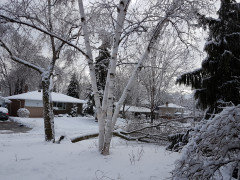
    Here's a photo I took showing the fallen tree trunk (one of three trunks).


  • 3 years ago

    Well, 6 months ago you were wondering about removing a tree. Just like that bingo, you're getting rid of one with no cost to you and are even getting a free replacement tree. And you find that upsetting? I don't get it. ;-)


    You can't do anything about your neighbors Acer s. unless you can come to some agreement about branch trimming, if any encroaches on your side of the property line.


    I can't help you with tree choices, but I'd try for the most decorative as far as blooms or Fall colors etc. being it will be on the small side for a while and in plain view out front.


    The shade problem on your JM from the birch could change somewhat with the city birch leaving the area, just have to wait and see.


    Another option again would be to remove both birches, and add a rock garden, accent tree (JM?) of some sort and even another center piece of interest in that part of the yard to allow more light in along the front of the house, at least for the next several/many years.


    newhostalady Z6 ON, Canada thanked BillMN-z4a
  • 3 years ago
    last modified: 3 years ago

    It's true that months ago I was wondering about whether I should remove my own beautiful white bark birch tree. And now the city birch tree has rotted and is in the process of being removed. So why would that upset me? That's one less tree and that's good! I am upset because I don't want a replacement tree planted on my front yard! I have enough tree canopy and tree roots on my property. The tree bylaw has made it very difficult for property owners with trees to remove any tree (even if it poses difficulties for the homeowner and damages their property). Most of all, I ask myself, why it is that homeowners with trees have so many restrictions in regards to what they can do with their trees and are even penalized by having to pay for permits to ask for a tree to be removed; require replacement trees---sometimes one, but mostly 3, or 5 or more to plant on their property if one tree is removed etc. Whereas those homeowners with no trees can remain treeless and suffer no ill effects if that is what they choose. The property right across the road from me has no trees on their property. I say, why not have the city plant "my" replacement tree on the city portion of their property? The homeowners with trees support the tree canopy, but the city only makes things difficult for us by enforcing a lot of rules about how we manage our trees, what happens to our trees, how many replacement trees we would have to plant, where we can plant them and a very restricted list of trees we can choose from.

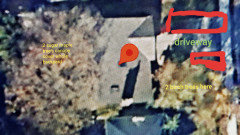
    Not a good picture, but might give you an idea of my tree canopy:

    The red marks the only grass you can see from this aerial view.


    Trees are living things. They grow. Things change. I don't hate trees. I think they are wonderful. BUT they need to be planted in the right place!

    It just may be that my Japanese Maple will be happier without the one birch tree. We will have to see what happens.

    I like your idea Bill of removing the 2nd birch tree and adding an accent tree or something of interest in the yard. This season we will just wait and see what the difference is now that one tree is gone. We had planned to remove at least one of the 4 trunks of our own birch tree to allow more sunlight to reach the garden. We will decide on that later too.

  • 3 years ago
    last modified: 3 years ago

    Sounds like a plan!

    Let us know how things turn out later on. ;-)

    I don't think I would cut a single trunk from a mature birch though. My biggest concern would be that rot could start in such a large wound and continue on into the rest of the tree. Basically, all the trunks are feeding from the same root mass.

    newhostalady Z6 ON, Canada thanked BillMN-z4a
  • 3 years ago

    Regarding removing a trunk from our birch tree, Bill, I am glad you explained why removing one would not be a good idea. The crew that came to clean up the fallen city tree also told my husband that the whole tree had to be removed because the rot that made the one trunk fall now made the other two trunks unstable. I wasn't sure I believed them as I know the city is trying to increase the tree canopy by 2050 and need to find places to plant their large growing trees.


    So now we wait to see if the city really plans to plant a replacement tree; we wait and see how much more sunlight our property will get without the city tree; and we will consider whether removing our birch tree is a good idea or not.


    By the way Bill, we are not supposed to trim any city tree, even the ones the city plants just within the few feet they own in front of our property---even if it encroaches on our "side." And it certainly will encroach on private property. How could a large tree not?


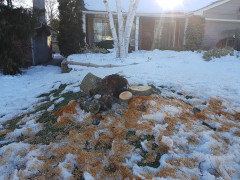
    This picture is what the city left us with. Said they are backlogged and probably would be coming back in a few months.

  • 3 years ago

    The upside is you got rid of the ugliest tree in your yard. :-)

    Thanks for the update!


    newhostalady Z6 ON, Canada thanked BillMN-z4a
  • 3 years ago

    That made me smile Bill!