Software
Houzz Logo Print
westes

Bark Soil for Pomegranate Trees?

4 years ago
last modified: 3 years ago
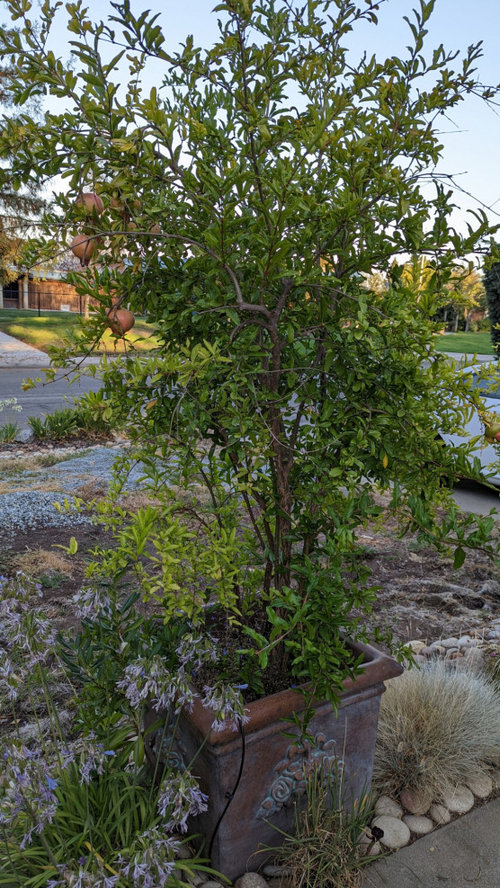
Have any of you growing pomegranate trees noticed a preference for soil mixes that heavily favor bark over other organic materials? I have some container Ambrosia Pomegranates that need to go into a raised bed, and this resource claims that the best container soil mix would be five parts bark, one part perlite, and one part potting soil. That seems like heavily acidic soil, but assuming I get the pH within the 5.5 to 7 range, it is still more than 70% bark. This is going into a raised bed, not into a container, but a raised bed is different than an in-ground planting and can take a soil mix that is close to a container mix. I will probably have at least 30% of the raised bed soil mix be the native clay loam soil.

For those of you who grow pomegranates in containers, have you found a preference for bark soils?


Comments (6)

  • 3 years ago
    last modified: 3 years ago
    Your source does not say that. It expressly states that that mix is for containers, not in ground planting. In ground planting of trees and shrubs should be in the native soil.


    From your source:

    ”Planting:

    To plant your pomegranate tree in the ground, dig a hole deep enough to cover the root ball. We recommend digging a hole in a cone shape and planting the tree to the center of the cone. Plant so that the top of the root ball is flush with the native soil level. If your location has heavy clay soil create a mound about 12” above the native soil line with a better draining soil mix of compost and mulch.

    For container growing, you will want to create a soil mix that is 5-parts coarse bark, 1-part coarse perlite, and 1-part premium potting soil. This soil mix is designed for maximum drainage which reduces the chances of root disease.”

    westes Zone 9b California SF Bay thanked floral_uk z.8/9 SW UK
  • 3 years ago

    if you dig a hole in mother earth.. and amend the soil in that hole.. in effect your are using mother earth as a pot filled with un-natural soil ... just sounds like a lot of work and cost.. and potentially leading to more problems than solutions...


    my short rule is.. NEVER amend a planting hole ...as you are creating a condition in the hole only.. and if well tended.. the plant should grow roots right out to the hole planted.. so what was the point of amending it anyway ...


    you shouldnt need different PLANTING rules for different plants... according to name...


    though in this case.. dealing with the pH issue is not really a planting issue... its a cultural issue ... is you see the difference ...


    ken


    notice section one.. august is not really a planting time fro trees and shrubs .... so i hope you are talking now.. but not acting for another month or so ... by mid sept.. night temps are tending toward cold.. so the plant can recover from whatever stress a fall day throws at the transplant ....


    https://sites.google.com/site/tnarboretum/Home/planting-a-tree-or-shrub

    westes Zone 9b California SF Bay thanked ken_adrian Adrian MI cold Z5
  • 3 years ago

    @floral_uk z.8/9 SW UK I left out important details so I edited the post to make this clearer. I am building a large circular stone wall that will act as a raised bed, So I have some opportunity to create a hybrid soil mix that is more organic in the raised sections.

    In any case, even for a pure container situation, have others noticed that this genus prefers heavily-concentrated bark soils?

  • 3 years ago
    last modified: 3 years ago

    @ken_adrian Adrian MI cold Z5 I won't be planting until late September.

    I am not a big fan of adding heavy organic content into a planting hole. That would result in a "bathtub effect" with a highly moisture-retentive organic mix potentially under the water table of the surrounding soil, exposing the roots to too much water.

    I think a purist doing an in-ground planting would say to get a soil test, then amend with just the minimal amount of organic material needed to correct any organic matter deficiency in the native soil. Since extremely fertile soil normally does not have more than 10% organic matter, that would be absolutely minimal amendment in the worst case.

    My situation is different, with an enormous mass of soil sitting above the ground level, and guaranteed to be above the water table, because I am using a very high raised bed behind a retaining wall. I, therefore, have the opportunity to create something more like container soil, rich in organic matter, that will never become a water trap and death sentence for the roots.

    I know some people do not like to create huge soil layer changes from organic to clay, on the thought that the roots may not want to penetrate into the deeper soil layers. This particular species/hybrid is not a very large plant, if you even want to believe that trees do not deal with changing soil layers all the time in nature. If you go to a place like Texas, in many places like Austin the top two feet of soil are organic matter, followed by three or four feet of heavy clay, followed by rock very near the surface. I think nature deals with such situations all the time, and trees are smarter than people when navigating such issues.

  • 3 years ago

    @tapla (mid-Michigan, USDA z5b-6a) I appreciate your comment about soil structure versus chemistry. But I wonder if chemistry is also not part of the issue. Let me give an example with Rhododendrons. They do poorly when I plant Rhododendrons in a heavier sand soil mixture. If I substitute the sand for sized bark, they do exceptionally well (at least until the bark degrades and nitrogen is robbed). Assuming I took the time to make the perched water table in these two soils similar and assuming they both have good water retention and oxygen saturation, both soils appear to give a similar "structure" to the Rhododendron roots. If not, then the differences in structure are something subtle and involve concepts I do not understand well.

    You have done it in other places here, but maybe you could document here what is the composition of your current raised bed soil, as you originally made it. Then maybe document how you would make it today if you were starting over.

    My raised bed formula is similar to yours with one difference. But I want to defer discussing that until I see the details of your formula.