Software
Houzz Logo Print
lmecheverri

Jade Plant going into a pot

3 years ago
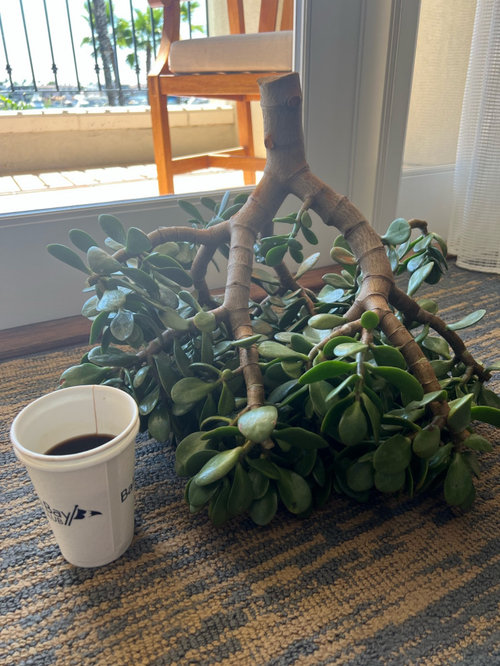
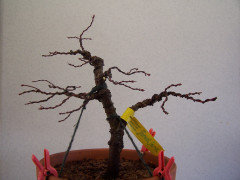
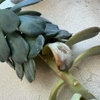
Hello Pros- I was given this jade plant in California and FedExing it to Miami. It had a clean cut. I know I need to leave it as is for a few week until it develops a callus before planting in a pot. Other than this any recommendations to have a successful transition from the field into a pot outside of state? How to keep it now and when planted? In the dark, outside (FL) or inside? When to water?
Regarding leaves, trimming, pruning and defoliate? How to do it, when to do it, where to do it? Any other tip or recommendation to reach success? Coffee cup to show size. Thanks!!!

Comments (15)

  • 3 years ago

    Cinnamon on the cut

    2 days waiting

    replant and water

    and pray

  • 3 years ago

    Only two days? Thought suggested was few weeks

  • 3 years ago

    Depends your weather

  • 3 years ago

    Dry???

  • 3 years ago

    I would do it as Popmama said, and aim for the same exposure as it is in now, if your goal is to continue the same appearance. Might need shelter from too much rain in FL, like a covered porch where the sun shines under for at least several hours per day.


    Just don't give it too much coffee before shipping. You don't want it getting the jitters in the box.


    A nice unglazed pot will provide some weight as ballast, and the breathable sides eliminate most risk of rotting roots (after they have formed) unless you are watering constantly.

  • 3 years ago

    It grew in California (Newport Beach) taking it to Miami so very humid outside. I did once this with a smaller plant but left it without ground like for 2 weeks. What about the leaves at this time? Dark or light?

  • 3 years ago

    Not sure I understand "dark or light?" question.

  • 3 years ago

    Keep in the dark, like a closet or basement or with sunlight.

  • 3 years ago

    Why would you keep it in the dark? That would be a recipe for disaster. The leaves need sunlight to carry on photosynthesis. I would give it some sun daily or dappled sun, but not full sun as it recovers from ”surgery” and shipping. Dont put in a giant pot.


    Tiffany has the best reply. You can wait a couple weeks to water especially with FL humidity.

  • 3 years ago
    last modified: 3 years ago

    I would prune the propagule back quite hard. There is no way the plant will be able to absorb enough water to sustain that much foliage. Pruning will reduce the risk of the entire plant collapsing or branches dying back randomly; and, it will force a lot of back-budding which will leave you with a fuller and more compact plant.

    Using a clay pot slightly larger than you think you might need and using a brick in the bottom of the pot will help limit excess water retention.

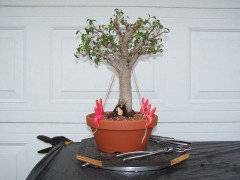
    Stabilizing your cutting is very important. If your pot is plastic, you can melt several (at least 3) holes through the sidewall near the top and tie it off using the holes. If you're familiar with a trucker's hitch' (type of knot), that works best if you have an anchor point on the pot.


    Al

  • 3 years ago

    with no roots.. you can NOT put it in sun ... it will sun burn.. the leaves will wither and fall off ... its not a light or dark thing.. the issue is direct sun ...


    my first thought was to make a hundred smaller cutting out of it ... which are hard enough to root.. with out trying to root a huge mature plant ...


    if you have spare knitting needles around.. or can get some cheap at the dollar store... those can be used to prop up a huge no root plant ...


    google rooting jade plants ... look to videos.. i will do it for you


    https://duckduckgo.com/?t=ffab&q=propagatin+jade+plants&iax=videos&ia=videos


    watch ALL OF THEM ... and then you will feel secure in what to do with yours ...


    ken


  • 3 years ago
    last modified: 3 years ago

    Leaves will indeed wither and perhaps be shed, but it won't be due to sunburn, rather, it would be due to the inability of the plant to absorb and move enough water to keep a volume of foliage so large hydrated, and the shedding of leaves that is part of a severe drought response.

    "Sunburn" (photo-oxidation) is a chemical reaction which results in degradation of the plant's photosynthesizing machinery, and has nothing to do with whether or not a plant or propagule has roots. Something I wrote about sunburn and heat stress:

    When plants are not adequately conditioned to high light intensity levels, the additional photo load can cause chlorophyll molecules to rise to a more excited state than normal. If light levels are high enough, the energy released as electrons in molecules return to their normal energy state may be sufficient to form oxygen radicals from O2. These are the same O2- radicals found in H2O2 (hydrogen peroxide) and are extremely reactive particles which will readily destroy (oxidize/ bleach) chlorophyll molecules. The entire process and technical term is photo oxidation, and we generally refer to it as sunburn.

    Many confuse over-heating with photo-oxidation (sunburn). They're different. I wouldn't put a plant in a direct sun exposure and check daily for signs of burning. If your plant is sunburned, a LOT of cells have been killed by the free oxygen O-negative radical that's generated during photo over-exposure. IOW - by the time there's a symptom, the damage has been done.

    Overheating is caused by passive solar gain. Imagine how hot a dark green car gets in intense direct sun when there is no breeze to get a sense of what passive solar gain is - light energy being converted to heat. Overheating commonly occurs indoors because of a layer of still air (called the boundary layer) that surrounds the leaf. It serves to insulate the leaf so heat is trapped in the leaf and not lost to surrounding air. Most cases of overheating can be avoided by rigging a fan on a timer so it disrupts the boundary layer during periods of intense photo load.

    A higher leaf temperature increases the likelihood of damage from photo-oxidation, which is why the most damage is normally seen in the thickest part of the leaf, which would be along the leaf's mid vein, and the least damage at leaf margins where leaf tissue is thinner and dissipates heat faster. Sunburn initially presents as silver/ gray/ tan areas toward the middle of the leaf, except in severe cases where the entire leaf might be involved. Damaged ares might turn black and ooze if leaves are thick, fleshy, and made up of a high % of water. Leaves thinner and made up of a lower % of water usually turn brown and dry in the days after the initial damage occurred.

    Al

  • 3 years ago

    @tapla (mid-Michigan, USDA z5b-6a) How does a brick in the bottom of the pot manage to limit excess water retention?

  • 3 years ago

    Through displacement.

    By "excess" water, I'm referring to "perched water", which is water held in the medium against the force of gravity, occupying the space between soil particles, and 'refusing' to exit the pot (through the drain hole(s). There are 2 forces that work against gravity to make a "perched water" to take up residence in the pot/grow medium. The first is water's tendency to stick to itself (cohesion). The other is water's tendency to stick to soil particles and pot walls (adhesion). These forces, added together to create "capillarity" can become stronger than gravity with the primary driver being the size of the particles from which the medium is made. A medium made primarily of peat has many times the capillary pull of a medium comprised primarily of pine bark, so peaty media generally hold significantly more water than media made of bark.

    Ideally, water would be held as a microscopically thin layer on the outer surface of soil particles, in the internal pores of porous material, and at the interface where soil particles contact each other. Water held between soil particles robs roots of oxygen essential to normal function.

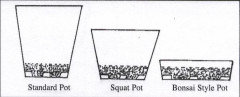
    When any medium supports perched water, when that medium is holding as much water as possible, the maximum ht of the perched water table will be the same in any container, regardless of shape or ht.

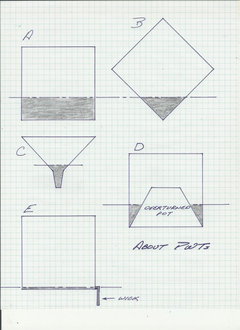
    The containers in the image below are all filled to the top with soil, and the image illustrates a constant height of the perched water table.

    B illustrates that the simple act of tipping your pots to a 45* angle after watering significantly reduces the amount of excess (perched) water the planting can hold. C illustrates the max ht of the perched water table is a constant for any given soil/medium, and how the shape of a container limits the amount of excess water a planting can hold. D illustrates how ballast (think of the brick) displaces excess water. E provides a visual of what can happen if you use a wick hanging below the drain hole to help eliminate excess water.

    Back to the brick:

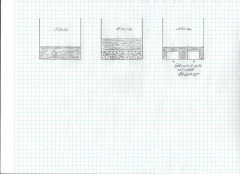
    These images reflect the constant ht of the perched water table. The middle image also shows why "drainage layers" don't work because water 'perches' above the drainage layer. The image on the right shows how objects used as ballast limit the amount of perched water a planting can hold. The excess water in the right image occupies 30 squares on the graph paper. The bricks displace 12 squares. Dividing 12 by 30 shows 40% of the medium occupied by excess water has been displaced by the bricks. Adding 2 more bricks would reduce the volume of grow medium 'capable' of holding excess water by 80%.

    It doesn't have to be bricks. You can use other objects (like an overturned pot (with the drain hole covered) plastic building blocks, pieces of treated lumber or Trex decking, an empty plastic storage container, etc..

    Al