

soapstone slab advice?
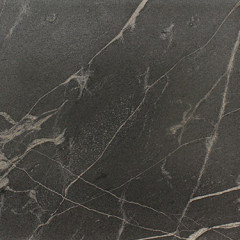
We are having soapstone put in for a peripheral countertop in a kitchen built-in. Fabricator sent this photo of the slab he picked and wants us to approve it. Hard to tell from a photo, but some of those veins look like they have deep fissures. Just wondering if someone familiar with soapstone could advise on if it's supposed to look like that? Fabricator had to pick this up at a distributor a couple hours away... but I'll happily send him back if this is a particularly poor specimen that he chose. If it looks like these are like cracks when I see it in person, is that how it is supposed to look? Should it be smooth? Should there be deep fissures?

Comments (38)
 PRO4 years agolast modified: 4 years ago
Fissures? They look like perfectly normal veins to me. Is soapstone veined? Yes, it is.
More importantly, you don't select any counter top from a photo. You go look at it , you run your hand over it. Has a flaw? Where is the flaw? In the portion of the slab you need or it isn't?
Go do your due diligence when the slab arrives.
 4 years ago
Definately take the time to go onsite to the see and pick the slab you want. Picking from a photo is not a good idea.
Related Professionals
Concord Kitchen & Bathroom Designers · Great Falls Kitchen & Bathroom Designers · Aberdeen Kitchen Remodelers · Texarkana Kitchen Remodelers · South Bend Custom Countertops · Helena Custom Countertops · Bangor Home Remodeling · Dover Kitchen Remodelers · Flagstaff Kitchen Remodelers · Bend Kitchen Remodelers · Tallahassee Bathroom Remodelers · Greenfield Bathroom Remodelers · San Luis Obispo Bathroom Remodelers · Barnstable Interior Designers & Decorators · Temecula Kitchen & Bathroom Designers PRO4 years ago
Take a trip and see this in person the farbricator does not choose slabs . We have our stone yards and fabricators in one place and it makes this whole issue so much better and easier. What exactly are you doing with the slab, probably not a bad idea to show us where this is going since you are here. Post a pic in a commnet here do not start another post for the pics.
- 4 years ago
Do not depend on a photo to approve the slab. Do not let your fabricator pick the slab, and tell you that it’s acceptable. You need to see the slab yourself, and test for hardness.
Soapstone comes in a variety of hardnesses…from very soft (where you can scratch it with your fingernail), to the very hard where even a coin won’t easily scratch it. Any slab you can scratch with your fingernail, you don’t want.
Additionally, ideally you should have a sample to test with, to make sure it really IS soapstone. Soapstone will not stain or etch. It is impervious to everything, and should NEVER be sealed.
Can soapstone have fissures? Yes. Which is why you need to see the slab in person. You will be doing yourself a disservice, if you depend on the fabricator to choose the slab for you.
I don’t know where you live, but unless you’re in a rural area, there’s bound to be an actual soapstone dealer…whose main busines is selling soapstone, somewhere near you. We got our soapstone from M. Teixeira. Teixeira is the largest soapstone dealer in the US, with locations across the country. They have a tremendous inventory of a variety of soapstone slabs…unlike, generic stoneyards, where soapstone is an afterthought with just a few slabs on site.
Soapstone dealers are experts in all things soapstone, including fabrication of the stone. This is important, because soapstone is fabricated differently than all other stones. Done improperly, and your soapstone counters will have problems with water rings, and and/or smudges. Fabricated by an expert, and you won’t encounter problems, and will absolutely love your counters.
- 4 years ago
This looks pretty typical for sopastone, but yes, what they all said--go see it in person. If you can't and need to approve remotely, I don't see any particular reason not to go with this one--it's lovely. If there are imperfections, some will be addressed during fabrication, and a good soapstone fabricator can epoxy any remaining areas where there are fissures and you'll never know. (I'll add the caveat that water rings and other patina come with the territory with soapstone--that's less about fabrication than it is about how you choose to maintain the stone over time. Soapstone isn't a great counter choice if picture perfect is the goal.)
 4 years ago
It's pretty.
If you don't trust this guy to know what a bad fissure is, he's not your guy.
(I'm assuming you can't actually go pick out your own slab for some reason--it happens! If you CAN, go look at the thing. If you can't, ask for more photos, close up. And ask questions.)- 4 years agolast modified: 4 years ago
“I'll add the caveat that water rings and other patina come with the territory with soapstone--that's less about fabrication than it is about how you choose to maintain the stone over time.”
@artemis78, that is entirely incorrect. As a soapstone owner for 6 1/2 years…purchased from and fabricated by M. Teixeira, as stated in my post above, I’ve never, ever had an issue with water rings…because the folks at Teixeira are experts in soapstone fabrication.
All of the complaints on this forum about water rings, smudges, etc., have all been from people who purchased their soapstone from generic stoneyards. It has nothing to do with how one maintains the stone, as no special maintainance is required. One doesn't have to oil or wax the stone. Many people leave their soapstone alone. Either way, properly fabricated to the proper grit, the counters perform as they should, without defects such as water rings.
Yes, soapstone will develop patina over time, from cooking splatters, and rolling out dough, or even from the oil in your hands. However, these are easily removed. Periodically, we use Bon Ami or Comet, water, and the scrubby side of a Scotch blue sponge…and, the stone is brought back to it’s natural state.
So, please, stop spreading misinformation about something you know very little about, first hand.
- 4 years ago
P.S. There used to be a guy, known as Florida Joshua on this site, who owned a soapstone dealer in South Florida, (East Coast), called Creative Soapstone. Before he retired and closed up shop, a few times a year, he would travel up and down the east coast, fixing the improperly fabricated counters of GardenWeb (which Houzz purchased several years ago) posters. This was done by appointment, of course.
And, oh boy, was he in demand! Every one of the posters clammoring for his help, had purchased their soapstone from generic stoneyards, whose main business is granite, marble, quartzite and manmade Quartz. Ignorant of the unique properties of soapstone, these stoneyards created issues with the counters, by incorrectly fabricating. After Joshua refabricated the counters on site, the posters’ problems ceased.
Nothing to do with ”maintenance”, and everything to do with fabrication.
K Flowerdot (zone 4b)
Original Author4 years agoThanks, all! My husband went to see it in person today and found the veins to be nice and smooth and not fissures. I am seeing how a photo definitely isn’t adequate. Appreciate all the help!
- 4 years ago
Make sure you discuss with the fabricator how you want the slab(s) templated…as in, which parts of the slab you want for specific areas on your counters. The sections should be taped out and marked on the slab(s). Like this:
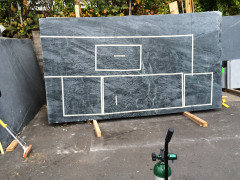
You might prefer the areas with more prominent veining to be in the most visible areas of your counters, for instance.
- 4 years ago
I agree--fabrication method doesn't affect the nature of the stone. A sealer kind of can, but that's different.
- 4 years ago
100% agree with Artemis. We are newbies with soapstone - we've only had it installed since May. Ours also shows water rings and does patina. We leave ours unoiled. And we knew what we were getting into regarding the patina. However, those that want a more consistent look/don't like the idea of an organic surface that may change with use, should be advised to use a different material. I do disagree that fabrication has anything, really, to do with how soapstone performs. That's basically like saying the right fabricator can prevent marble from staining or etching. Fabricators cut, finish edges, seam, etc. The only thing a fabricator can do to affect performance is sealing if the material calls for it. Soapstone does not call for sealing, and as you can read by both my and Artemis' experience, some (most, dare I say) varieties of soapstone, unsealed, show water rings and patina. It's just what soapstone does.
- 4 years ago
@artemis78, i aplogize for the assumptions I made in my previous post. Your moniker does look very familiar to me, as being one of the old timers on this site. Though, I didn’t recall that you had soapstone. In my old age, memory sometimes fails. 😊
Soapstone has become quite popular on Long Island. The 6 people I know with soapstone kitchens, got their slabs from M. Teixeira. Two of them have a soft variety, one of the Venatas, I believe. Another has Anastacia (hard), and three have Stormy Black, which is on the harder side. None of them have had a problem with water rings. The two with the soft stones have lots of dings and scratches…but, no rings.
I’m wondering, have you ever reached out to Teixeira, to see if they can mitigate your issue?
- 4 years ago
We've never reached out to them specifically around the water rings (because again, they don't bother us, and based on the experiences of two other friends who have the same soapstone variety, they're par for the course for our particular stone).
However, we did recently finished a bathroom project where we'd hoped to use soapstone (ended up with quartz for other reasons). I called our M. Teix branch and explained that we had Barroca in our kitchen and wanted something in the bathroom with a similar look but that would be more resistant to water stains. Their response was "yeah, so definitely not Barroca. We'd recommend Stormy Black for that." So...guessing that isn't the first time they've heard reports of water rings with this variety (and yet they still sell plenty of it, because it is beautiful and more affordable than some of the other types). And it was certainly an opening for them to say "hey, we can address that for you if you want!" if it was something easily solved, but they didn't.
There is absolutely such a thing as poor fabrication of soapstone, and more problematically, of stone yards passing slabs off as soapstone when they are not, and I'm sure sometimes that contributes to the problem. But in this case, I think it just has to do with the nature of softer soapstone and how it performs. We like our counters overall, but we're also not fussy about their looks.
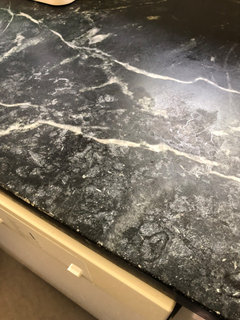
This is Barroca with water stains--this is next to our sink where our dish rack sits, and it gets wet things dripped on or set on it often enough that it just isn't worth the headache of regularly oiling it to reduce the marks. (I swipe it with an oil rag if company is coming and it spiffs right up.) These are mostly from drips off of things on the rack, but where the stain came from a glass with ice in it or a steaming pot, it will be perfectly round.
And this is the same stone in an area of the kitchen that rarely encounters water or glasses--more or less what it looked like when it was new, apart from some pitting and dings because Barroca is very soft. We oil 1-2x a year, generally.
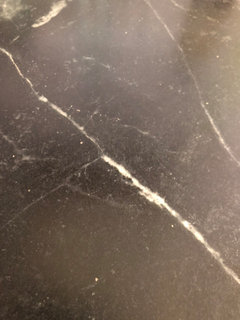
- 4 years ago
@L Thomas…that is just so wrong. Comparing marble and soapstone fabrication, just doesn’t compute. As part of fabrication, marble is either polished, or honed. If sealed, marble will not stain. However, it will ALWAYS etch. Honing can disguise the etching some, but not eliminate it.
Soapstone, on the other hand, has to be sanded to a particular grit (I forget the number), in order to perform properly. This is an important step in fabrication. You see, soapstone fabrication is more than ”cut, finish edges, seam, etc.”
Properly fabricated, a very cold glass of liquid will initially leave a dimensional ring of water on top of the soapstone. However, the ring should entirely evaporate.
To state that ”some (most, dare I say) varieties of soapstone, unsealed, show water rings and patina. It's just what soapstone does.”, is just wrong. First of all, soapstone should never, ever be sealed. Sealing ruins the performance of soapstone, as the sealer just sits on top, unable to permeate the surface. Secondly, ”most” varieties do not show water rings. If you read completely, my post above, you’d have seen that none of the people I’m aquainted with who have different varieties of soapstone, have issues with water rings.
- 4 years ago
I’ve gotta say, @artemis78, that is a beautiful stone! I actually like it with the water marks! Gives the stone lots of interest, and character. But then, I also like etchings in marble. They tell a story of much use, and love.
Interesting info, about Barocca. I’ve always liked it’s appearance, but was leery of such a soft stone. I went to school, so to speak, on the experiences of the folks on the GardenWeb years back (you were probably one), and knew to test for hardness…and ask for advice, when we went to Teixeira. I wanted a hard stone with green inclusions, and was directed to the slab we bought.
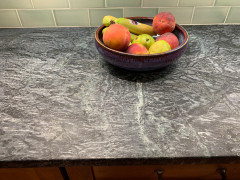
This is unoiled. The veining is more dramatic when oiled…which we haven’t done in 5 years.
- 4 years ago
@darbuka, please do not tell me I am wrong when I am not. I do believe we are talking about two different steps of fabrication. I was referring to the folks who get your slabs from the slab yard, take it to their place, template, put the slab on a CNC machine, finish edges, bring your slabs to your house, install, seam, etc. These folks do no finish the surface of the material - they only finish the cut edges. They recieve the slabs already polished or honed from the slab yard. These are the types of fabricators that 99% of the time on gardenweb folks are referring to.
I believe you are talking about the process of fabricating slabs out of blocks of stone. These are all steps taken wayyyyyyy before any slab yard (including Teixiera) gets slabs. Honing and polishing any stone is "sanding" with a grit. The finer the grit, the shinier the stone. Different stones require different grit levels to get to certain sheens/finishes. That is the case with any natural stone, not just soapstone.
Properly fabricated, a very cold glass of liquid will initially leave a dimensional ring of water on top of the soapstone. However, the ring should entirely evaporate.
Again, that is incorrect. Fabrication has zero to do with this; it has everything to do with nature of the material itself.
First of all, soapstone should never, ever be sealed
Agreed, and if you read my post, I say as much.
If you read completely, my post above, you’d have seen that none of the people I’m aquainted with who have different varieties of soapstone, have issues with water rings.
Great - and I will show you all the cases where it is an issue. Including one, right here in this thread, who had stone fabricated by the folks you site as being experts in soapstone.
Again, stop telling people they're wrong because they have a different experience than you do. - 4 years agolast modified: 4 years ago
Yes, we were among the few to have Barroca in the GW world back when we chose it, since I think that variety was relatively new to the market back in 2010 (and soapstone overall was a much smaller slice of the market than it is now). Some friends had just had it installed at the time, but theirs was still brand new. (I noticed with our most recent project that M. Teixeira has since trademarked the name--!) So we didn't have much to go on, but also, at the time it was one of only a couple of true gray/black soapstones that M. Teix offered. I think we were deciding between Santa Rita and Barroca, and Barroca was quite a bit less expensive and also less green. I've written lots of words of warning about it here in the years since, though.
It is beautiful and I still love the look, but while I'd do soapstone again--hence the bathroom project--I wouldn't buy (nor do I recommend to others) this particular variety unless it's for an area that won't see heavy use. Less because of the water spots than because of the dings and chips along the edge, though. (You can see a little of that in the photo, and that's not a section of counter where anyone stands for any length of time--in front of our sink, there are big gouges where belt buckles hit the counter.)
- 4 years ago
I picked my slabs out at the Alberene quarry in Schuyler, VA. They directed me to the fabricator they wanted me to use and those guys did only soapstone. We have terrible issues with water rings and marks. My stone is definitely softer.
- 4 years agolast modified: 4 years ago
“I was referring to the folks who get your slabs from the slab yard, take it to their place, template, put the slab on a CNC machine, finish edges, bring your slabs to your house, install, seam, etc. These folks do no finish the surface of the material - they only finish the cut edges. They recieve the slabs already polished or honed from the slab yard.“
Well now, @L Thomas, nowhere in your previous post did you state that. Artemis78 and I had been discussing our experiences with M. Teixeira’s fabrication. Teixeira does their own sanding of the soapstone tops. They are an all in one soapstone company…supplier, templater, and fabricator of the entire stone, from top to bottom.
I highly doubt that ”These are the types of fabricators that 99% of the time on gardenweb folks are referring to.” Teixeira has locations across the country, and associated soapstone companies who work with them, where they don’t have a direct presence. In addition, there are a whole bunch of companies who specialize and supply soapstone, like Vermont Soapstone, Garden State Soapstone, Dorado Soapstone, Bucks County Soapstone, Mirasol Soapstone, Green Mountain Soapstone…and on and on and on.
Some people live in areas, usually less populated, where there are no actual one stop soapstone operations. For those, a generic stoneyard is their only choice. But, if you live in a sizeable metro area, soapstone specialists are out there. You just have to look for them.
By the way, if ”Fabrication has zero to do with this; it has everything to do with nature of the material itself.”, then why was Florida Joshua (did you thoroughly read my above post?) able to solve the water marks issues on the counters he resanded, in the homes of all the posters who contacted him, up and down the East Coast?
- 4 years ago
Darbuka, while I appreciate you sharing your experience often on gardenweb, understand that your experience does not invalidate others who have different experiences than you. It is clear from the inaccuracies in your advise that you do not know as much about the topic at hand as you think you do. I hope that you will take time doing some research, spend some time with a local reputable fabricator and understand the process better before you continue to advise in such an aggressively authoritative manner.
- 4 years ago
As yet, I am a baby in the soapstone world. I will say that we ordered the soapstone sample box from M Teixeira, laid the 8 samples out on the counter, and tried them all out. Water rings were much more prevalent on some than others. Some were more easily scratched than others, the oiling on some lasted longer than on others....just our experience, but as all the samples were from M Teixeira, it would seem to me that variety plays a big roll in livability. That being said, fabrication is important too. We went to a fabricator near us looking for a larger sample, and what they showed us was so shiny..it had either been sealed with something, or finished to way beyond the usual grit. I wouldn't trust that yard even if I was sure I had the variety I wanted.
- 4 years agolast modified: 4 years ago
@G W…your instincts were correct. Soapstone should never be shiny.
As for the Teixeira samples, when I went through this process 7 years ago, I don’t recall water rings showing on any of them…however, I had asked for samples of only the harder varieties. So, perhaps that made a difference.
As artemis78 indicated, his variety, Barroca, is very soft. @blueskysunnyday also says her problematic stone (Alberene), is soft.
Is Belvedere one of your samples? If so, did that sample suffer water rings? Just curious, because our Belvedere counters have had no issues whatsoever.
If you are within a 3 hour drive of a Teixeira location, I highly suggest you go there in person…to look at the slabs. The patterning varies from slab to slab, within each variety. You might prefer to pick the veining that appeals most to you. The staff will gladly move slabs around for you.
Good luck, and have fun!
- PRO4 years agolast modified: 4 years ago
If you need 24/7 look of perfection? Skip soapstone from anywhere. It's not for you. Get a honed or leather Absolute Black granite and call it a day. Or get "American Soapstone and I defy you to be able to see a difference, though you will feel it.
Soap "stone" isn't a stone. It is a rock. Its soft warm feel? Talc.
But if you need it to look like quartz, or granite, or whatever? Skip it.
K Flowerdot (zone 4b)
Original Author4 years agoWell here’s an update to the original post. Got the soapstone installed today. I wasn’t here when it was installed, husband was. It looks too shiny to me. Not what I was expecting. Is it supposed to be a little shiny when new? I was picturing more of a matte surface.
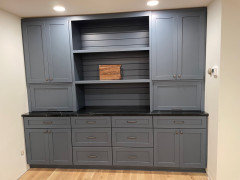
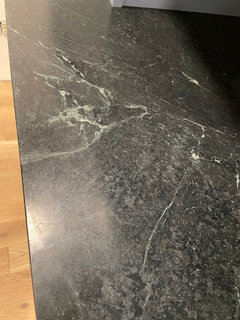
- 4 years ago
Below are two pics of my soapstone, the day of install. First pic is unoiled. Second is just after Teixeira’s installers did the first oiling.
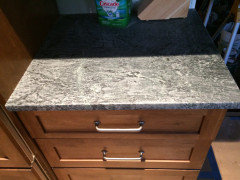
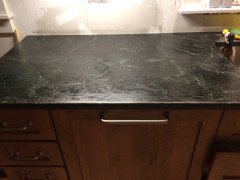
The unoiled counter has no shine. It’s a completely matte finish, and had a seductive silkyness to the touch. The oiled section was shiny…until the mineral oil evaporated.
K Flowerdot (zone 4b)
Original Author4 years agoThanks. There’s no seductive silkiness to what I have. Just feels like granite. I was picturing more of a chemistry lab - like surface.
- PRO4 years agolast modified: 4 years ago
I am not positive you have soapstone. There are indeed granite that mimic it so closely, you need very skilled touch to even feel the difference.
Take a bit of worn sandpaper to yours in a very inconspicuous spot........if NOTHING happens?' You may have " American Soapstone," It is a granite. Names can vary at stone yards.
But the bottom line is that soapstone WILL scratch. Granite? No not much : )
https://langstone.com/product/american-soapstone/
K Flowerdot (zone 4b)
Original Author4 years agoOh, thank you. I’m going to make a new post about this and then reach out to my countertop guy once I have more info!!
- PRO4 years ago
Bottom line? If you can't scratch it? I doubt it is soapstone. The talc softness in it? You can do it with a manicure scissors.
K Flowerdot (zone 4b)
Original Author4 years agoOk, my husband said it scratches really easily. He’s the one who helped install the top cabinets yesterday and said it scratched easily. And the installers repeatedly told us it scratches easily. So I guess it passes that test… I haven’t tried to scratch it myself. Maybe it just needs a different finish.
- PRO4 years agolast modified: 4 years ago
No, it's fine. You have a false expectation for the feel. If it was oiled, You may be feeling that.
Point ? It's there and not going anywhere : ) Slabs vary as well, some "softer" than others. It's a natural rock. Ask Mother Earth.
- 4 years ago
It's possible your soapstone was oiled (a lot) to give it that look. Try cleaning it with dawn and see if it removes some of the oil.
K Flowerdot (zone 4b)
Original Author4 years agoI’ll try cleaning it with soap. The top cabinets aren’t even installed yet and my husband said they never glued the thing down, so I bet there’s possibility to have the finish redone or something
- 4 years agolast modified: 4 years ago
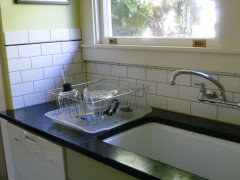
That looks very similar to how ours looks when it's oiled. My guess is that they oiled it after the install. (Pretty sure our installers did--they definitely asked whether we planned to oil it and left us with a container of their preferred oil when we said yes.) Crazily I didn't take pictures right after it was installed, but this is a couple of months later, and you can see that it's still shiny:
For the most part we don't oil it--just a few times a year if we want to hide patina--and it goes back to matte in a few months. I have never tried scrubbing the oil off with soap, so not sure how well that would work. But it will come off on its own with time (or with rubbing alcohol or acetone).FWIW, ours is not glued down either. I remember asking about that (having read about epoxy glue used with granite) and the installer--an experienced soapstone company--said that was not needed for soapstone. It sits directly on our cabinets. No idea if that's the industry norm, but it's been rock solid for 12 years, so it seems to work fine. You can certainly refinish soapstone in place--it is much like wood in that respect--but for shiny vs. matte, it's much better to just let time to do the trick.
Your counter looks great!
- 4 years ago
@artemis78 is correct. Soapstone does not get glued down. Soapstone is denser, and much heavier than granite, or any of the stones used for kitchen counters. Once in place, it’s not moving.









artemis78