

1-stage, 2-stage, or variable heat pump for a/c and heat
I live in Colorado in the Denver area, so about a mile high. Our a/c is original to our house built in 1994. The gas furnace was replaced in 2011. Both work well now, but we know the a/c will fail at some point. We installed solar panels last year and have excess capacity. With more efficient a/c from a newer system, we'll have even a bit more capacity.
I have spoken with a few reputable vendors in our area and gotten some quotes to replace the a/c with a heat pump. I'm a bit confused about a few things that I hope someone can clarify for me:
- Vendors have said that a heat pump will work down to anywhere from 40 to 30 F. That's a wide range. We're looking at units that are 16 to 18 SEER, mostly from Lennox, but one vendor likes Amana. What is the temperature down to which the heat pump should work?
- Vendors also seem to have different views of 1-stage, 2-stage, and variable units. From what I've read, it seems that the 2-stage and variable help keep temperatures from varying widely from the setpoint. But, those units may be more likely to have problems and be more expensive to fix. All quotes carry 10-year warranties on the unit, parts, and labor as long we have annual maintenance done. What are your view on there on the number of stages, their usefulness, durability, and efficiency? I'm totally confused.
- With a heat pump, does it work OK to turn the night time temperature down to 63 during heating season, then back to 68 during the day (with an automatic thermostat)? We heard something that made us think that might not work well. Would it take a long time for the temperature to reach 68 in morning?
Those are all my questions for now, but I suspect I may have more as we try to figure this out.
Thanks for your help!!
Comments (38)
 3 years ago
2 stage and variable systems are only good as the installer so make sure they are good or stick with single stage. Setback tstats save energy and you quickly figure out how much in advance it must be programed to reach comfort. I'm not a fan of maintenance contracts but I'm also capable of doing my own maintenance.
- 3 years agolast modified: 3 years ago
- The heat pump will work below freezing.
- SEER measures cooling efficiency, not heating.
- Amana heat pumps are the same as Goodman e.g., Amana ASZC18 is Goodman GSZC18 so you may find other dealers to get quotes from for the same product.
- I strongly recommend a two-stage heat pump. (I have a packaged heat pump.) In stage one, the unit operates at about 70% capacity and the blower operates at reduced speed. The lack of "woosh" from the registers results nearly inaudible operation most of the time.
- A two-stage heat pump is actually three stage when equipped with optional resistance heat (as it should be). The unit operates in stage one, stage two, and stage two+resistance heat. Controlled by the thermostat, resistance heat is only added when the compressor alone cannot keep up with demand.
- Should you turn the thermostat down five degrees each night? Depending on the thermostat configuration, that could cause resistance heat to turn on every morning to quickly raise the temperature. That could be expensive. I have a Honeywell T10 Pro thermostat* which can be configured to prevent the resistance heat from turning on, for example, unless the room temperature drops dramatically from the "set point"** or a certain number of minutes passes during compressor-only operation and the room temperature has not yet reached the set point.
- I recommend a wi-fi thermostat. Using an app, you can reduce the set point when you are away for a significant amount of time and increase the temperature back to normal before you return.
*recommended
**desired room temperature
wingal thanked wdccruise Related Professionals
Paducah General Contractors · Florence General Contractors · Dayton General Contractors · Sault Ste. Marie General Contractors · Modesto General Contractors · Calgary General Contractors · Dover Home Remodeling · Lake City Home Remodeling · Petersburg Home Remodeling · Elmira Home Remodeling · Providence Home Remodeling · Hobbs Home Remodeling · Elizabeth City Bathroom Remodelers · Texarkana Bathroom Remodelers · Auburn Bathroom Remodelers PRO3 years ago
Hi, wingal,
I suggest you also consider a hybrid system comprised of a heat pump coupled with a gas furnace. I had one in my former home for 16 years +/-. In air conditioning mode, it operates as an air conditioner would. In heating mode, the heat pump will operate unless it's either too cold outside or the temperature difference between the desired (setpoint) temperature and indoor temperature is greater than a couple of degrees. In that case, the furnace kicks on. The hybrid system gives you the ability to take advantage of lower-cost heat heat pump heat when you only need to take the chill off your home and gas heat when it's too cold for even Santa to go outside. If you like setting the temperature back by more than a degree or two at night, the hybrid would reduce the response time for heating the home in the morning.
The temperature at which a heat pump can extract useful heat is certainly of interest, but there's more it to that. What needs to be determined for any particular heat pump is the "balance point." That's the temperature at which the heat pump's heat output exactly matches the home's heating load. Comparing the balance point temperature with climate data for Denver will give you an idea how often a particular heat pump will be sufficient without the need for back up heat. PRO3 years ago
With gas heat you're really just making it more complicated. Sure there's luxury in being able to have duel fuel system / I don't view Denver as a really extreme winter type climate. It can get cold, there will be snow fall which is another consideration to running a heat pump.
You don't want to be out there clearing the snow from the heat pump do you?
It's not that a duel fuel set up can't work, it's more about why would you do that?
California the reason is because they are banning gas appliances... so are you marching to join them?
Don't forget about the coming phase out of R410a refrigerant. Joining California in crazyiness isn't going to be cheap on the old pocket book. Many more things to consider here than just 1 speed, 2 speed, Inverter and so on.
Colorado is for the most part a more moderate type climate. You have solar, but solar does little good at night... spend more money for a power wall?
------------Not to discourage you but to bring things you're probably not thinking about to the forefront.
You have choices, but isn't it good to think about the pros as well as the cons to what you're attempting to do?
---------- heat pump operation ---------As temps outside fall there is less heat in the air. Moisture in the air will start to freeze on the outside coil of the heat pump at around 35F. When a heat pump enters defrost (a widely controversial subject in terms of controlling it / entering it etc.) When the heat pump enters defrost mode it doesn't produce heat. Typically this is when you need heat the most (it's cold). So you have additional source of heat. Your case this is the big bad gas furnace.
---------- Additional things to consider ------------
More costly Inverter type heat pumps will fair better than single or two speed heat pump. But more cost for a mostly moderate type climate? You can do it if money is no object.
National inverter brands will require you to replace everything + upgrade to communicating type system. When they work these work well... but... most of the time you're being sold isn't necessarily going to work out in the cost department.
Outside the national brands the disruptor (Bosch) does things differently. Certainly there can be even more pros and cons considering this choice. It's a choice, the advantage is you don't have to replace the furnace to implement it. No proprietary communicating controls to make it run. It's only sold as a heat pump currently so you could match it up with duel fuel kit and be good to go.
They have cheaper rendition to the 2.0 option which is less efficient but price point for this inverter is going to challenge 2 speed condensers. Bosch inverter runs circles around a 2 speed.
Distributor: certain areas are better situated to choosing equipment that is available in their area. Supply chain problems may continue for a while yet. Distributor is the link that provides your contractor with parts --- there is no such thing as a part fairy. These are real jobs that people show up and work in person. (They're not pretending to work by "phoning it in")- PRO3 years agolast modified: 3 years ago
Ray,
The fear mongering is misplaced. Do you realize how important oil and gas are to Denver's economy? Do you really think they'll be rushing to outlaw the use of gas in Colorado?
"Colorado is for the most part a more moderate type climate."
Colorado has four different IECC climate zones. Denver is in climate zone 5. That's the same climate zone as Chicago. I don't think most people would call that "moderate" if they visited between October and April. You might want to check climate data before making ridiculous assertions.
- PRO3 years ago
Do you realize how important oil and gas are to Denver's economy? Do you really think they'll be rushing to outlaw the use of gas in Colorado?
It's a left leaning state. The question Charles should be reworded to say "Do Coloradians realize how important oil and gas is to their economy."
----------------
The average temp for Denver is anywhere from 10 to 20 degrees warmer than Chicago.
Can it get cold... ah yes. --- factors like windchill play a factor as well. Rather than just jiber for the sake of jabbering over what someone means here's some real numbers to sink your teeth into...
click to enlarge.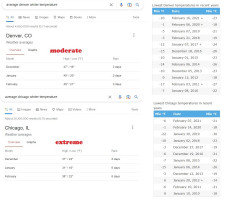
Denver is moderate in terms of the "average" temperature. Context is important Charles.
- 3 years ago
The outdoor winter design temperature for the Denver is -3 F degrees. The lowest Chicago winter design temperature is -1 F degrees. I visited Denver this past February. I haven't felt that kind of cold in many years.
What is the temperature down to which the heat pump should work?
The lower the outdoor temperature, the less heat the heat pump will produce. At some point the heat loss of the house is greater than the heat the heat pump is able to produce. It comes down to the heat pump type, size, and the heat loss of your house. The size of the heat pump should be sized for the cooling load, and not the heating load. I recommend getting a quote from a HVAC installer does heating and cooling load calculations as part of his quote. The calculation will help determine at what temperature the heat pump can't keep up with the heating load. It will still be an approximation.
From what I've read, it seems that the 2-stage and variable help keep temperatures from varying widely from the setpoint.
Properly sized and installed single stage equipment can keep the temperature at the desired set point.
What are your view on there on the number of stages, their usefulness, durability, and efficiency?
The biggest benefit of 2-stage equipment is comfort. Most the time the equipment will be running in the low stage. This will be quieter operation and not blast of hot or cold air every time it turns on. There is a small gain in efficiency due to the longer run times in the low stage. The reduced on-off cycles helps with long term life expectancy. I would recommend purchasing 2-stage equipment if the budget allows it.
With a heat pump, does it work OK to turn the night time temperature down to 63 during heating season, then back to 68 during the day.
The answer depends on the what thermostat and equipment you buy. In a simple heat pump system the thermostat will turn on the back up electric resistance heat when coming out of set back period. In a better system, the thermostat will not turn on the back up heating if the outdoor conditions are mild. It can take a long time for the heat pump to recover compare to your current gas furnace. This is why temperature set backs are discouraged with heat pumps. I use temperature set backs both day and night and I find it saves a lot of money.
Your gas furnace is only 11 years old and you live in a very cold climate. Keeping the gas furnace and creating a dual fuel system would be a good option. The solar panels generate less electricity in the winter. The use of the furnace would compensate for that loss. The other option is going all electric. Post your gas and electric rates. A calculation comparing the cost of heating using the two options can be done to help make the decision.
- PRO3 years ago
Ray,
Look at the data you provided. The daily low temps for Chicago and Denver are nearly identical. If you design a heating system for a home in Denver based on the average daily high temperatures, your clients will be, well, left in the cold when the sun goes down.
Houzzers will be better served if you limit your advice to the proper technique for uncrating and installing replacement units, and leave design and policy-related questions for folks who actually have some subject matter expertise.
 3 years ago
Let's send him some comic books with large print so he can do something else while he drinks coffee in the morning. It's tiresome, his comments and tone repels people from using and reading these threads.
wingal
Original Author3 years agolast modified: 3 years agoWhew, this is really confusing.
If you have a political opinion, I'd appreciate it if you'd keep it to yourself. It's not helping me.
I need to clarify. We are planning to keep the 11 yo gas furnace as backup to the heat pump. We also have an LG battery with the solar system. So, the heat pump to replace a/c is both the green and economical thing to do in our situation. That much I'm fairly sure of. I know that gas prices are going up. I also know that our power company will be moving to time of use pricing in the future, so we plan to use the battery a lot from 3 to 7 pm, when rates will be highest. Our excess electrical capacity gets rolled over month to month.
As for tempertaures, we see it all. I've lived here for nearly 27 years. Most winters, we'll have at least one cold snap with temps below 0 at night and maybe +2 or 3 during the day or staying below 0. These snaps last 1 to 3 days, on average. We also have temps in the 60s and 70s in the winter, which is crazy, but we get them. Temps often vary 30 degrees in one day. So overnight might be 35 and daytime up to 65, or so, which is what we're having now, with that 30-degree range going up or down.
I'm trying to figure out the rates from our latest statement. Well, I can't make heads or tails of the info. Is this the electric rate?
Excess Energy Cr 55.79 kWh - $0.083560
Excess Energy Cr 15.21 kWh - $0.071360
Gas?
Usage Charge 5 therms $0.193940
wingal
Original Author3 years agoAt the risk of sounding really dumb, what is resistance heat that some of you referred to?
- PRO3 years ago
Hi, wingal,
The emergency/back-up heat for a heat pump is typically electric strip heaters or "resistance" heat. If you keep your gas furnace for back up heat (when it's too cold for the heat pump to meet the heating needs,) you don't need the strip heaters.
Looks like your electric rates are tiered, i.e., you pay a progressively higher rate for usage in tiers. That's how water usage is billed in my area. - 3 years ago
"At the risk of sounding really dumb, what is resistance heat that some of you referred to?"
Simple answers are difficult to get from houzzers. Old fashion toasters and electric kitchen ranges are resistant heaters. Clean, reliable,simple to maintain/repair,lowest price equipment but most expensive to operate.
- PRO3 years ago
"Old fashion toasters and electric kitchen ranges are resistant heaters." They might be "resistant" heaters if you need to kick start them to get them to work. Otherwise, they're electric resistance heaters.
- 3 years agolast modified: 3 years ago
wingal -
I'm a homeowner, I can try to answer some of your questions:
-A heat pump may be suitable in your location to maintain a given indoor temperature when outdoor temps are cool and not too cold but perhaps not at other times.
- Heat pumps put out less heat than furnaces, so they're not suitable for morning recovery from nighttime setbacks when it's cool or cold outside. To use assumed numbers, let's say your house is 2500-3000 sq feet. Your air conditioner may be 3 or 4 tons (a digit sequence in the model number shown on the outside unit will include 036 for 3 tons, 042 for 3.5 tons, 048 for 4 tons). Each ton is 12K BTUs. At ideal outside operating temperatures, a 4 ton heat pump may produce up to 48,000 BTUs of heat or cooling per hour. Your furnace may be 80 or 90K BTUs per hour, so nearly twice as much heat output. A heat pump may recover from a nighttime setback if it isn't too cold outside but it could take many hours longer than a furnace would take.
-I believe some thermostats can be set to use the furnace instead of the heat pump when outside temps are below a set outdoor temp, for instance,35 degrees, or if the recovery temperature difference inside is greater than 2 or 3 degrees. That's what you'd want to do.
-there are split heat pumps that will work at colder temperatures.
- What is the "settle up" period for your solar production with your utility? Is it annual? Depending on how much "overproduction" you have, you could easily use up any credit balance from the summer before winter ends. Heat pumps do use a lot of power. If electricity in your area isn't expensive, then it doesn't matter as much.
Good luck.
- PRO3 years agolast modified: 3 years ago
If you have a political opinion, I'd appreciate it if you'd keep it to yourself. It's not helping me.
I need to clarify. We are planning to keep the 11 yo gas furnace as backup to the heat pump. We also have an LG battery with the solar system. So, the heat pump to replace a/c is both the green and economical thing to do in our situation. That much I'm fairly sure of. I know that gas prices are going up. I also know that our power company will be moving to time of use pricing in the future, so we plan to use the battery a lot from 3 to 7 pm, when rates will be highest. Our excess electrical capacity gets rolled over month to month.
Wingal,
Unfortunately politics is what is driving changes that are coming soon to the HVAC world. I don't make rules but I am force to follow them as they come. If you had a business that depends on knowing the law what may be coming the last thing you'd do is bury your head in the sand like many do on this board. It's not my pleasure to run rampant in divisive politics, but just like on this board you will not avoid them.
If you don't like an opinion(s) you shouldn't come to a forum board asking for them. So with that out of the way.......
Because you plan on keeping the 11 yo gas furnace this will likely limit your choices, possible dramatically. Most major HVAC MFGs are privy to making their machines communicating using their own proprietary communication signal. To top that off equipment available can quite often be a challenge to come by. Especially the upper tiers like 2 speed and Inverter.
Many HVAC co's may take the stance that you replace everything or get nothing because? It's an opinion based on what I see in my area. If it's good enough for my area? These are opinions you won't get from others because they don't actually run calls.
Green and Economics. Burning less electricity is green no doubt about that, however doing green things doesn't necessarily relate well to economics all the time. Meaning this may be an adventure of just spending money because we can versus what is going to help us save money economically.
It is extremely difficult to beat natural gas for what it does in terms of heat. Regardless of the minor production of CO2 emissions that it produces as waste. The little not so green thing they won't tell you about a heat pump is that the refrigerant in the machine is currently over 2000 times worse than CO2.
Some will argue the above paragraph is political when in fact it's the truth as ugly as that can be sometimes. If you don't like the truth, you won't like what I have to say. I'm fine with that, I make no apology for the truth.
But AC and heat pump systems are completely sealed systems. True. But because I actually run HVAC calls I know that in as little as 3 years sometimes less a refrigerant leak can develop thru a variety of ways. Sometimes defective equipment, sometimes improper service / installation procedures and so on.
I have a you tube channel with videos show casing these kinds of things. Oh but Ray only develops cartoons? If only my job was that easy.
So if Refrigerant when it leaks is 2000 times worse for the environment than CO2 how green is that? We're gonna fix that.
We'll fix it by banning the bad old R410a. Just not yet. Within the next few years. The choice(s) to replace R410a is still not that good when compared to CO2? Nope. Hundreds of times worse than CO2. Not so green huh?
If the USA is to hit the targets set by the Kigali amendment to the Montreal Protocol by 2035-2036 even these up coming replacement refrigerants will be chopped. So your truly "green" machine could be over a decade or more away.
To make matters worse it will most likely be a flammable refrigerant to one degree or another. The new ones coming are mildly flammable.
The reason I tell you and anyone wanting to read and listen is for truthful information to base your decision from. I don't care what you pick. I don't care what brand you pick. I don't care if you pick a heat pump or choose ac with natural gas. It's only about providing you with truthful info that you can make a decision from.
Why don't I care what you pick? They all break and I work on all of them.
In terms of the weather -- what you deal with in Denver. A heat pump will fare far better with higher daily temps in the upper 40's --- that 10-20 degree difference from Chicago --- well I used to live in Chicago area... no comparison. I also lived in Colorado, Springs when I was a young buck. ------ Entirely different climates that really shouldn't even be used within the same breath.
Chicago is even worse politically IMHO, but that's another story.
In terms of sizing a furnace for Colorado. Colorado isn't my market so you get home owners voicing opinions of what sizing should or shouldn't be --- I don't pretend to be something I am not.
I am a Texas licensed HVAC contractor in Texas. I am in a discussion about HVAC. Keep that in mind. You're gonna have to find a contractor in your area that you can trust. Which is a bold statement in an of itself. How do you think I know this. How many times have I gone to jobs sold by some other contractor who didn't say this or that up front. Ignore what I say at your own peril.
The change winds are blowing... personally it doesn't matter to me what refrigerant they pick or how many times they change. To you?
Want to buy a new air conditioner or heat pump? It's the green thing to do, because your old refrigerant wasn't green.
Now let the crying game begin. (Everything is a joke to you Ray --- well I have to have some fun or I'd go looney tunes like some choice characters on this board.)
- 3 years ago
Can you post the brand and model number of the furnace? That will help determine what type of dual fuel system you can configure. Be aware SEER rating is determine by the combination of the furnace or air handler, coil,, and the outdoor condenser (AC or heat pump). Your 11 year old furnace likely does not have a published SEER rating with the two new components. The contractors should explain this to you in their quotes. I recommend you don't make buying decisions solely on SEER ratings.
To add further confusion to this, equipment sold after January 1 will also have a SEER2 rating. The SEER2 ratings uses a more stringent test condition which is supposed to be more realistic.
- 3 years ago
@Austin Air Companie: "Most major HVAC MFGs are privy to making their machines communicating using their own proprietary communication signal."
You can use a standard thermostat with heat pumps such as the Amana ASZC18. If you look at the wiring diagram (page 23) of the Spec Sheet, you see one box labeled "Legacy Indoor Thermostat" and one box labeled "Communicating Indoor Thermostat". The Honeywell T10 Pro, for example, would be wired as a "legacy" thermostat; it supports a natural gas furnace for backup heat. Other thermostats such as Ecobee and Nest would also be wired as "legacy" thermostats.
- PRO3 years ago
You can use a standard thermostat with heat pumps such as the Amana ASZC18.
True but this wasn't how the machine was designed to be run... it was designed to be communicating controlled via Comfort Bridge technology on a paired Amana furnace or Air Handler (electric furnace) --- you can use any legacy thermostat even when you buy the whole system --- the gotchya is the electronics inside the furnace. -- That is how it was designed to be sold. The furnace electronics 'known as Comfort Bridge Technology' communicate with the outdoor unit and vice versa.
The product warranty the unit comes with doesn't cover improper installation. That's a fight you will lose, wdccruise -- you know if the machine doesn't live up to your expectations as an example.
The Bosch Inverter, which would run circles around the Amana ASZC18 was designed to be controlled by a legacy thermostat. No communication required.
As I said previously I work on all of them. - PRO3 years ago
Would you know what is improper installation is just by looking at it?
Who makes this determination of proper versus improper?
(There's more to installing a heat pump than using a particular thermostat to operate it.)
Note: I am not trying to convince the DIYer, I am telling you the reader the difference from wise to foolish. If you're naturally wealthy --- go ahead.
If you don't like what I say now, you certainly won't like what I say later. - 3 years ago
@Austin Air Companie: "If you don't like what I say now, you certainly won't like what I say later."
No "ifs" about it.
- PRO3 years ago
One thing that is true about Ray is that he's often in error but never in doubt. He is at least consistent.
- PRO3 years ago
Sure according to the DIY market I am always in error.
According to the builder's of the free world, yeah because I don't subscribe to fine dining and fine accommodations or pretending to be something I'm not. (hey just call the mechanical HVAC contractor over here.)
I am so often in error that I've managed to piece together a career that is nearly 3 decades long. Talk about the impossible.
If you think proper installation consists of the unit turns on and the unit turns off --- sure go ahead pay no attention to what I say.
Imagine how many times in my career I went to someone's house who tried to fix and repair their HVAC system. It turns on and off so what is wrong?
If you can imagine that imagine the houses I've been to in which I've more or less walked away. My life is like the gambler... you gotta know when to walk away - you gotta know when to run.
To do it yourself means to do it with out help from others.
When you subscribe to be something you're not --- I am always in error. - 3 years ago
"To do it yourself means to do it with out help from others."
Which can save time and money,plus give one a sense of accomplishment but doing it with help from too many others is a poor idea. I think it's known as too many cooks spoil the broth. I believe 90% of people coming to houzz don't even know the basics so would be wise hiring work done or inlist a mentor if they are serious about learning the trade. Since retirement I've done projects primarily because contractors are backlogged and doubled their prices. From lack of stamina I've took on helpers along the way that want to learn and earn. Forums could be a valuable resource for technical questions and guidance but that isn't happening much here. "Why doesn't my ac cool as well as it did last year" or "tell me what I should buy" aren't technical questions but folks copy and paste something or link You Tubes and call them answers.Ya'll evidently believe everyone is interested in your opinions else you wouldn't post them so here's mine. I didn't mention names once so if you recognize yourself don't blame me.
- 3 years ago
@klem1: "I believe 90% of people coming to houzz don't even know the basics so would be wise hiring work done or inlist a mentor if they are serious about learning the trade."
It isn't necessary for one's goal to be to "learn the trade" to get enough information from other forum participants to solve a problem. One doesn't need to be an electrician -- or to learn to be one -- to change a light switch.
 3 years agolast modified: 3 years ago
Multi-stage HPs/ACs are no less reliable than single stage - that's an old wives tail! Modulating furnaces are a little more complex (I have two such systems) but would go with a 2 stage system in the future.
"With a heat pump, does it work OK to turn the night time temperature down to 63 during heating season, then back to 68 during the day."
Not a good idea. 40 years ago, Honeywell had "Intelligent Recovery" HP thermostats which gradually increased the setpoint over a few hours after a nighttime set back to prevent the backup resistance strips from kicking in. Most (if not all) thermostats today with "intelligent recovery" do not do this - they simply turn on the heat an hour or so earlier, heat strips and all, so it's nice and toasty when you wake up.
- 3 years ago
@sktn77a: "...to prevent the backup resistance strips from kicking in. Most (if not all) thermostats today with "intelligent recovery" do not do this - they simply turn on the heat an hour or so earlier, heat strips and all, so it's nice and toasty when you wake up."
The Honeywell T10 Pro thermostat allows you to lock out backup heat for a period of time (30 minutes to 16 hours) and/or when the outside temperature is above a set temperature (e.g., 30 degrees) forcing the compressor (only) to warm up the house.
- PRO3 years ago
forcing the compressor (only) to warm up the house.
The compressor isn't the source of heat in a heat pump system. - 3 years ago
At Austin Air Companies:
- Customer: "I need a new heat pump."
- Ray: "Happy to help."
- Customer: "I think I'd like a heat pump with a two-stage compressor."
- Ray: "The compressor isn't the source of heat in a heat pump system."
- Customer: "Ah, then I'll order a heat pump without a compressor."
- Ray: "Great! That'll save you a lot of money. Five hundred bucks for a cabinet and blower."
- Customer: "Wow! Such a deal."
- Ray: "I service Katy, Texas!"
- PRO3 years agolast modified: 3 years ago
at wdccruise house
- I am gonna put in a heat pump! I can DIY!
- wdccruise: put in anything you want buy it on internet!
- wdccruise: thermostat is all you need: if it turns on and off it works!
- cold weather comes: this manufacturer sucks this thing is a piece of garbage!
- proceeds to wear layers the rest of the winter.
- summer comes! This thing is a piece of garbage it doesn't cool either!
- gives up making it work calls contactor to learn something -- contractor tells him unit has no warranty.
- wdccruise says: yeah it does I registered it!
- contractor: it wasn't properly installed.
- wdccruise: yes it was it turned on and it turned off.
- contractor; Then why am I here?
- wdccruise: you're chopped liver that's why. (I think I'll call Ray -- no, I will tell you the same thing + this >>> have fun.)
In 29 years I stopped counting the times I saw this play out over 20 years ago. Let that sink in or just pretend you're natually weathly. You'll pay for an education one way or another. I paid for mine up front. - PRO3 years ago
The context of wdccruise's comment was with regard to disabling emergency (back up) heat and requiring that the heat pump supply heat. It wasn't a thermodynamics faux pas. I would expect anyone with an education level comparable to Jethro Bodine to have understood it. Apparently you did not.
- PRO3 years agolast modified: 3 years ago
But in another thread Charles said this: (he's already violating his own rule)
click to enlarge.
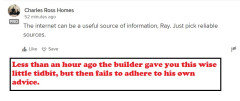
How am I doing about posting credible sources Charles?
- 3 years ago
@Austin Air Companie: "wdccruise: you're chopped liver that's why. (I think I'll call Ray -- no, I will tell you the same thing + this >>> have fun.)"
I'd call my grandmother for help before I'd call Ray...and she's dead!
wingal
Original Author3 years agoFor those who tried to actually help, thank you, but I've given up trying to wade through the sniping to find the useful tidbits. Too bad. These forums used to be helpful. Now they are not.
- PRO3 years ago
I think you work here is done, Ray, and you have contributed as much positive energy as you ever have.

wdccruise