Software
Houzz Logo Print
ajay_singh116

Robin Red Holly not producing berries

I live in New Jersey, Zone 6b. Last fall (Oct 2021) I planted a row of eight Holly trees about 5-6 feet in height. These were the Robin Red variety. They are supposed to be more deer resistant than Nellie Stevens and also have a darker green color. This spring I saw some winter burn - but all Hollie trees did well and even showed about a foot of growth. But the surprise is that there are no red berries. Now the Red Robin cultivar is supposed to be a female only cultivar which doesn’t require a male Holly close by in order to produce berries. So I have read. I have an older large 20 foot tall Nellie Stevens near by which is laden with red berries. But none of the new Hollies have any berries. What do you suppose is going on.. Even when I picked them up last fall, none of the trees had any berries on them. I should have noticed it back then itself…

Comments (25)

  • 3 years ago

    No comments on this post. Wondering if I posted it on the wrong wall..

  • 3 years ago
    last modified: 3 years ago

    i would probably call it a shrub.. before i would call it a tree.. but frankly... its the same peeps so dont worry about it ..

    rather large transplants.. i would expect 3 to 5 years for the plants to get fully established.. and berry to expectation...

    and even then you would be left with all the other variables that might impact berry production ...

    give them time...

    ken

  • 3 years ago

    It is not the same parentage as Nellie Stevens so I would not expect berry production to be identical. And while a male pollinator may not be required, fruit set is reputed to be light regardless. And even Nellie will produce heavier berry crops if a suitable male is located nearby. Because of the parentage involved in the hybridization, I'd suspect a male clone of Ilex latifolia to be a good pollination partner.

    btw, the "red" of the Robin Red trademark name refers to the color of the new growth foliage, not the berries :-))

  • 3 years ago
    last modified: 3 years ago

    you might be interested in this post.. about annual seed production in various trees ...

    https://www.houzz.com/discussions/6321930/antithesis-of-a-mast-year#n=19

    there are many variables in such ... and in your case.. im sure the recent transplant is the most prevalent reason at this time ...

    ken

  • 3 years ago

    AJ, I suspect that there are two primary issues going on. One, everything I read about these lovely hollies suggests that they DO need a male pollenizing variety planted nearby. 🐝

    Two, the hollies have had to undergo a lot of energy sapping stress from planting time until now. Plants can only do so many jobs at one time as each task requires energy resources that have either been stored by the plant or that are being manufactured on a daily basis for immediate use.


    A newly planted shrub or tree will automatically spend banked energy on the development of a root system. This is true whether the plant is container grown or field grown (B&B). It’s been proven that containerized woody plants have a harder, more prolonged acclimation period than those that are recently dug from the field.


    Therefore, if your plants are using stored carbon reserves to make a strong new root system PLUS grow a foot of new growth, there just isn’t enough in the bank to spend on flowering and fruiting, too.


    Does any of this make sense. 💡

  • 3 years ago
    last modified: 3 years ago

    Stressed trees and shrubs often fruit heavily in response to adversity - if the new holly planting in question is flowering it can fruit. When pollination requirements are met. Also if it is making vigorous top growth that means its general condition is the opposite of shocked or stunted.

    Otherwise as mentioned previously ROBIN is a trademark. With the involved patented cultivar actually being 'Conin'. Details of its history and description are here: USPP9486P - Ilex hybrid variety named `Conin` - Google Patents

  • 3 years ago

    Thank you all for insightful comments. What is very interesting - is that there is not one berrry. Nada. Nothing. Not even one in eight trees planted side by side. I could imagine Low berry production. But not even one? This becomes even more fascinating when the nearby Nellie Stevens (older and bigger) is laden with a heavy berry crop. Isn’t that fascinating !!

  • 3 years ago

    If these Robin Holly trees need a male Holly tree, shouldn’t Nellie Stevens also need a male pollinator. They both have a common parent. I don’t have a male tree in my yard. But the fact that the Nellie Stevens is laden with berries- throws us off that trail. So I remain quite perplexed. One theory which may explain this if it turned out that Nellie Stevens can produce berries without a male tree while the Robin Holly does need a male pollinator and the literature suggesting otherwise is incorrect

  • 3 years ago

    I suggest you contact the good folks at Holly Society of America: http://www.hollysocam.org/


    They will be able to answer your question without conjecture.

  • 3 years ago
    last modified: 3 years ago

    The hybridization of Nellie Stevens versus that of Conin (aka Robin) is not close enough to make effective comparisons. Because they share some degree of parentage from the same species does not necessarily extrapolate to similar growth and behavior. It is just not reasonable to make that inference. It is believed the genetic donation from I. cornuta is what contributes to the tendency towards parthenocarpy.......Nellie has quite a lot of cornuta DNA; Conin/Robin not so much. And there is enough documentation to support that even Nellie and other so-called parthenocarpic hybrids will generate better berry crops with a suitable male plant nearby.

  • 3 years ago

    Thank you both. Gardengal- your theory is the most persuasive. Viburnumvalley- thank you. I will write to the Holly Society. Just to be clear- I’m not really perturbed by this issue- I’m just fascinated and needed to solve the mystery!

  • 3 years ago

    One more thought...are you certain those hollies are female? The thought comes to mind when you mentioned the heavy berry crop your Nellie Stevens set. Do you know the easy way to tell the difference between a male and female holly?


  • 3 years ago

    They'd be male only if not actually ROBIN ('Conin').

  • 3 years ago

    Thanks Nandina. They were sold to me as Robin Holly and were tagged with that name. I wondered first if these were males but then I read that all Robin Holly’s are males. Do please tell me the east way to tell the difference between male and female. Maybe these are male varieties which were mislabeled …

  • 3 years ago

    My blue boy and girl hollies are the first thing the deer go after on my lot, always after snow covers the ground. Not deer resistant, deer candy.

  • 3 years ago

    Thats brilliant Nandina. I’m now looking forward to spring to check the blossoms. In fact learning from you, I would also ask my kids to do the same and report if the holly is a male or female.

  • 3 years ago

    Unfortunately, if your hollies don’t flower, you’ll be none the wiser. Did yours flower this year? They don’t always.

  • 3 years ago

    If you haven't already looked for images, here are a few that show the differences that nandina described.


    Here is an American Holly (Ilex opaca) with staminate (male) flowers:


    Here is an American Holly (Ilex opaca) with pistillate (female) flowers:


    Any questions?


  • 3 years ago

    That last photo shows Ilex opaca 'Hogwarts'.

  • 3 years ago

    "Who you calling 'Hogwarts'..."


  • 3 years ago

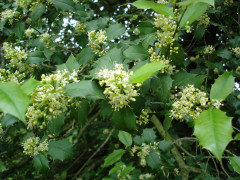
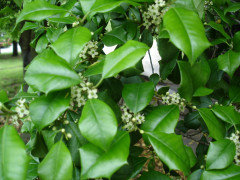
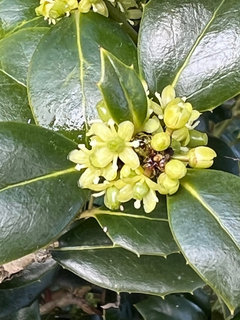
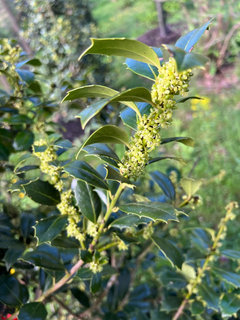
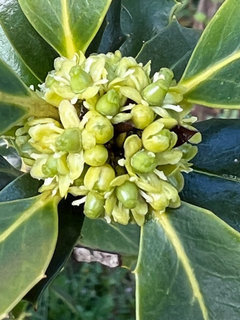
    Just sharing an update on this thread. Spring is here. And my Red Robin Holly is laden with flowers. (Last year, there were no flowers, maybe because the plant was experiencing transplant stress)… it seems these are female flowers as I deem from pictures sent by Nandina and Viburnum. Question now is if these will become fruits?

  • 3 years ago

    Since this is supposedly a self fertile cultivar you should see some berries develop. But like any allegedly self fertile dioecious plant, you will get better and heavier berry or fruit production if you plant a suitable pollination partner nearby.

  • 3 years ago

    Thanks Gardengal. I understand that the Nellie Stevens variety is “partially parthenocarpic”- and that it produces a heavier berry crop if a male equivalent - an Edward Stevens tree is close by. Do you think a Red Robin Holly is also partially parthenocarpic?

    Nandina- if you see this, I was inspired by your story and today I took my young kids to show them the female flowers of this Holly. Thank you

  • 3 years ago
    last modified: 3 years ago

    I haven't read all the responses, but I would just say that a cold winter, or a late hard frost can kill any holly flower buds so that the plant will not bloom that year. No blooms = no berries.


    My Dwarf Burford holly is notorious for getting frozen buds nearly every spring. So i never see berries.

Sponsored
Urban Upkeep LLC
Average rating: 5 out of 5 stars6 Reviews
Columbus High Quality Painting Expert