Software
Houzz Logo Print
blakrab

Powderpuff (Mimosa strigillosa)?

3 years ago
last modified: 3 years ago
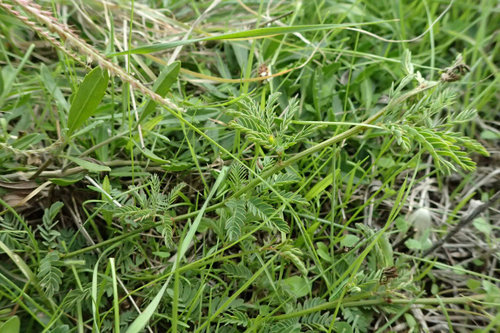
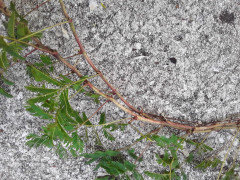
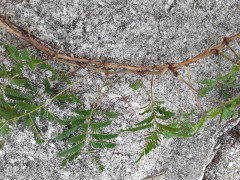
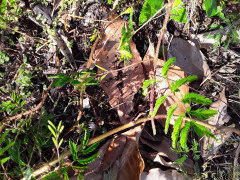
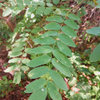
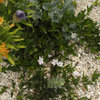
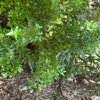
This wildflower was found growing roadside. Just from the leaves/stems, can you tell if it's a Powderpuff (Mimosa strigillosa), Shame Plant (Mimosa pudica), Yellow Puff (Neptunia lutea), etc?


Comments (6)

  • 3 years ago
    last modified: 3 years ago
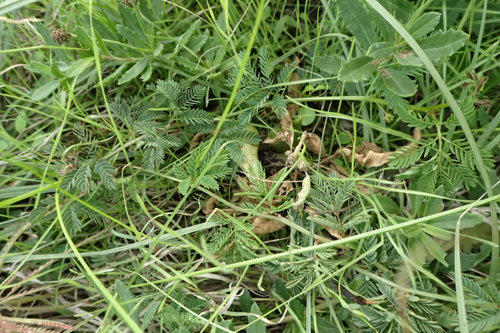
    Mimosa strigillosa, Sunshine Mimosa looks like the closest match and the stems aren't supposed to have prickles, and this plant doesn't. Was that why you said it didn't look like a mimosa stem, Carol, because it doesn't have prickles?

    The 2 most common Mimosa species in Dallas are M. strigillosa and M. quadrivalvis. Mimosa quadrivalvis has been split into 5 new species, M. floridana, M. latidens, M. nuttallii, M. hystricina, and M. roemeriana. The other 2 Mimosa species observed in Dallas are Mimosa pudica,(alien), and Mimosa microphylla. These 2 species are also armed with prickles. With these 5 new species,(former varieties of M. quadrivalvis), added with all other Mimosa species in the whole state of Texas, makes 18 species total in Texas. There is no data that shows amount of occurance for species,( that were formerly varieties of M. quadrivalvis).

    Fabales, Fabaceae, Caesalpinioideae, Mimosoid Clade, Mimosa, strigillosa

  • 3 years ago
    last modified: 3 years ago

    Sorry to be late in my reply - the stems in the above photos look ridged, light green, and smooth to me - but perhaps those are stems of something else?

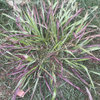
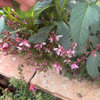
    The mimosa I have has rough wiry stems with a red tinge to them and they're round:


  • 3 years ago

    Carol, the stems can be green or red. The photos are confusing. In the future please clear all other plants from the plant in question, so we can clearly see the plant by itself. Ive mentioned this before.

  • 3 years ago
    last modified: 3 years ago

    I agree the photos are rather confusing, yet the first photo in the OP appears to show a stem with the leaves emerging from it - and it has ridges, which I do see in an image search for quadrivalvis - but all images I find of those show thorns, some more than others. It is in the common name too: sensitive briar.

    It's clearly not the same as what's growing in my own yard - which I believe is M. strigillosa. As you can see in the photos I posted, mine does not have any thorns at all.

    Is it possible that the plant in question might be Hoffmannseggia or some other legume?

  • 3 years ago
    last modified: 3 years ago

    Yes, it definately could be Hoffmannseggia, or another legume. I don't know of any other similar legumes besides Hoffmannseggia, but it's possible, because it's Texas. The rounder, more bluish leaves fit Hoffmannseggia. The photo isn't good enough to see the leaf surface clearly, and a good photo of a leaf underside would be very helpful. Most Hoffmannseggia species have tuberous roots. I don't know if Hoffmannseggia leaves close at night, but the leaves on the OP's plant look like they are beginning to close, or open. There are no rushpeas up here in the north. Hoffmannseggia is in the same Fabaceae subfamily Caesalpinoideae. David, you can try keying it to Hoffmannseggia glauca, which is the most common species and the only Hoffmannseggia species observed in the Dallas area. This is a new genus for me. I've heard about a lot of Texas flora, but never this genus, and I approached it as being a Mimosa, without knowing there were other very similar plants in Texas.

    https://swbiodiversity.org/seinet/taxa/index.php?taxon=3975&clid=3232