Software
Houzz Logo Print
berjouhi45

Wood Flooring Transition

3 years ago
Hello, folks!


I have a design dilemma involving the transition between two flooring.


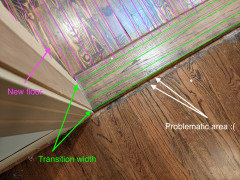
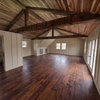
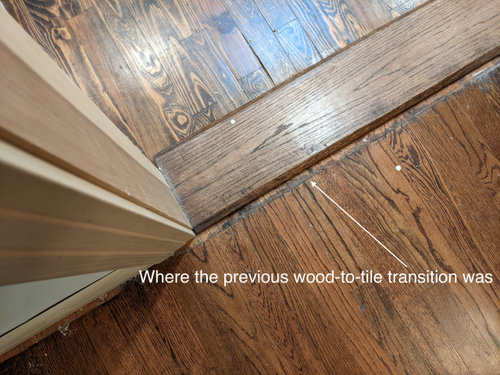
A little background: we're looking into replacing the pine flooring in the kitchen (the room at the top of the picture) with oak (like the dining room at the bottom of the picture) and have a continuous flooring between the two rooms with no raised transitions. Prior there were tiles on top of the pine (and linoleum!) and a step-up transition. The transition you see in the picture was put in temporarily (it's not nailed down, and I moved it a little out of the way so you can see the flooring underneath).


A flooring contractor suggested interlacing the new flooring with the flooring in the dining room, or add an inset transition made of a few boards running in the perpendicular direction to the floors. In either case he says we must refinish the dining room as well because of that strip of flooring in the picture.


We're looking for some thoughts, though, as we really would rather not refinish the dining room.


Thanks in advance!


Comments (16)

  • 3 years ago

    Interlacing the new with the old and then sanding them both down to get a fresh start on the stain would be my choice.

    Anna thanked decoenthusiaste
  • 3 years ago

    I would not interlace the flooring,

    they are different sizes and would create more notice.

    a planed down thickness 'threshold' piece of flooring as flush to the flooring as possible.

    finish to match one side or the other.

    Anna thanked Lyn Nielson
  • 3 years ago

    Thank you @decoenthusiaste and @Lyn Nielson for your comments!


    We should be able to match the size of the planks with the new flooring laid in the kitchen, so both options should actually be feasible. But I wonder if there was a third option that didn't involve sanding down the whole dining room.

  • PRO
    3 years ago

    I agree saving a bit and hating it will not be worth it.

    Anna thanked Patricia Colwell Consulting
  • 3 years ago

    I would definitely interlace and refinish to match. You’ll be happiest with that result.

    Anna thanked Rachel Lee
  • 3 years ago

    The right way is to lace in the new flooring and then refinish everything to match. However, your budget and your ambition might not find that approach suitable. How much existing flooring needs to be refinished and is there sufficient wood remaining for a full sand and refinish job? Is the floor due for refinish or in great shape?


    I believe that the existing residue on the old floor could be cleaned up and sanded and stained to become much less obvious. Then inlay a transition board matching with the new flooring.You won't be able to get the color to blend completely but it should be close. Remember that a refinish job is also going to have imperfections and around door trim is a common place to notice scratches, uneven stain or bubbles/debris in the finish coats.

    Anna thanked Lyndee Lee
  • 3 years ago

    Thank you @Lyndee Lee! I especially appreciate your pointing out the potential imperfections with refinishing, I hadn't thought of that.


    We got so far only one quote from a flooring contractor who said we would need to refinish the whole dining room, which is about 100 sqft. There should be wood left to be sanded down, even though the floors are almost 80 years old. I quite like their patina and I don't mind some scratches, I would really like not to touch them though. The other thing is that the dining room is connected to the living room via a 4-5 ft opening (with no transitions), so I'm not completely confident how the refinishing can be stopped ....

  • 3 years ago

    Does all the pine floor look like that? Because I'd totally keep that!


    As far as partial refinishing, I had my 70 year old floors refinished up to a doorway after patching due to a renovation. I didn't want to go further into the foyer because then you gotta do the hall then the bedrooms then the...you know. The whole thing. And I was living there.


    My floor guy was able to do it. You can't tell, except that one section is in better shape than the other because it was refinished/patched. :)

    Anna thanked Fori
  • 3 years ago

    Usually you would refinish all continuous areas of flooring at the same time. However it is possible to stop the work if there is a transition line built in or created with a thin piece of wood in the doorway. If the cased opening runs parallel with the flooring, you could pick a row and refinish up to that same row all the way across. However if the boards run through the opening, any attempt to stop in the middle will never look right.

    When doing a partial refinish or spot patch, you work on individual boards as the normal differences between boards will help hide the difference in the finish. Refinishing is not just stain matching but also matching the finish reflection level and clarity. The rework will never be a perfect match but a talented flooring guy will get it close. At just the right time of day or a specific viewpoint, the light will bounce differently over different finishes but it shouldn't be obvious.

    Anna thanked Lyndee Lee
  • PRO
    3 years ago

    It is possible to get unfinished flooring in the same wood as you are trying to match nand have the new floor finished to match . I do it often but usually it needs some kind of transition if that is what you plan to do.

    Anna thanked Patricia Colwell Consulting
  • 3 years ago

    This may be an unorthodox suggestion, but if it would go with the overall aesthetics of your house, could you install a row of pretty handmade ceramic tiles in the doorway? There would be no attempt to disguise the transition, but could simply be a very pretty way of joining two floors. No step up, of course, flush with the wood on both sides.

    Anna thanked annoulaxeni
  • 3 years ago

    We interlaced flooring and sanded and stained both old and new at the same time and can’t tell a difference. We also did a perpendicular board across an entry way with a using a wider board at the same time and it looked good too. I think the key is to sand, stain and use the same wood at the same time.

    Anna thanked Kate
  • 3 years ago

    Thanks everyone, I really appreciate the input!


    @Fori Sounds like we're in the same situation! Unfortunately, the pine floor is pretty beaten up, we already had it refinished about 5 years ago.


    @annoulaxeni That's an interesting suggestion and it could look very pretty!


    A transition does seem minimally invasive and I wouldn't mind it necessarily, but that half-inch strip of unfinished dining room flooring that extends below the threshold area between the jambs worries me. I guess a pro may be able to sand it by hand?


  • 3 years ago

    To be fair, it kinda looks like that floor needs to be redone too--looking along the walls for example, it looks like some shoe molding was removed leaving an old finish exposed. Your "problematic area" is bigger than the transition. I think it might be best to interlace and r(e)finish both, cutting it off at the transition to the next room (which you try to match)

    Anna thanked Fori
  • 3 years ago

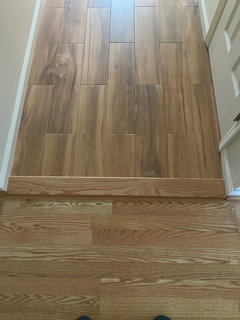
    I had a similar issue reguarding 2 different flooring materials and what kind of transition piece to use. I had Pergo flooring (that I love) in my kitchen. I needed to replace some dark slate flooring in my hall that intersects my kitchen flooring. My Pergo had been discontinued. I chose some Italian porcelain wood look tile for my hallway that had the same tones as my Pergo. My carpenter made a simple wood transition piece. It is acceptable, but not ideal. I like the idea of interlacing the 2 floorings.

    Anna thanked kculbers