Software
Houzz Logo Print
ken_adrian

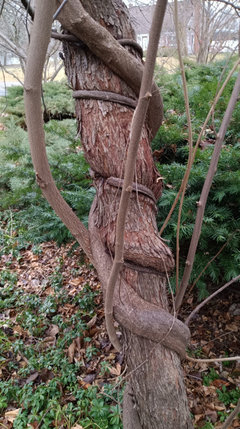
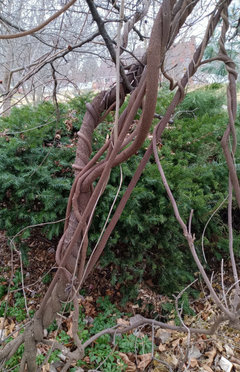
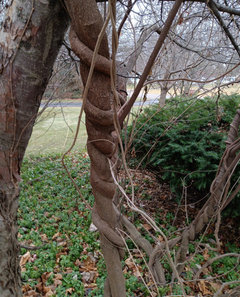
strangler vines .. whats that all about ...

3 years ago
last modified: 3 years ago

elderly neighbor.. VERY GOOD friend ... was a good friend to my kids as they grew up.. one of the neighborhood grandpas .. and he was a docent on my garden tours ...

he said he thought it was a clematis ... i said no way .. but then i thought maybe it was an autumn sweet ... is that augustafolia or something like that .. he said it flowered.. but could recall if it was fall blooming.. nor if it was white ...

is there any other clem with this growth potential?>??

or any other vining plant that could grow 30 feet in ground freeze MI ... no tropical options ...

and no ..... i didnt see any dead leaves on the ground ...

ken

Comments (35)

  • 3 years ago


  • 3 years ago

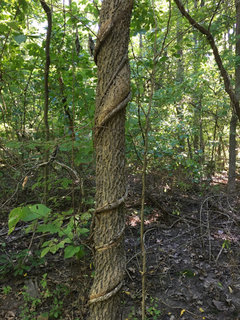
    It looks to me like either an American or Chinese wisteria (both twine counterclockwise). A Chinese one will likely start blooming before most of the leaves emerge while an American one blooms after leaves emerge.

  • 3 years ago
    last modified: 3 years ago

    Most likely, Celastrus scandens (American bittersweeet) or Celastrus orbiculatus (Oriental bittersweet).

    https://www.minnesotawildflowers.info/shrub/american-bittersweet

  • 3 years ago
    last modified: 3 years ago

    woodyoak is correct, appears to be wisteria (bittersweet twines clockwise).

  • 3 years ago

    If you look at the picture in the link I posted above, you will see a specimen of Celastrus scandens strangling a tree in a CCW fashion.

  • 3 years ago
    last modified: 3 years ago

    I think we were all posting at the same time. I grow wisteria so that's what I’m familiar with. When I looked at images of bittersweet I see that it could be that too… The leaves will look different though so once leaves emerge in spring it should be easier to tell which it is.

  • 3 years ago
    last modified: 3 years ago

    Bill - it looks like the pictures in your link all show C scandens twining clockwise, and the references I've checked seem to confirm that is the case. My photos of oriental bittersweet are all clockwise. (I've looked at and cut so many oriental bittersweet vines lately that I made the mistake of jumping to a conclusion without looking closely at first.)

    Plus, Ken's elderly neighbor said it flowered.

  • 3 years ago

    I had to look several times, but it appears the plants in kens pictures are twining clockwise.

    Or am I getting disoriented? lol

    CW would eliminate both species of bittersweet.

  • 3 years ago

    Japanese wisteria.


    ' Vines of Chinese wisteria grow in a counter-clockwise direction (as do those of our native wisteria). Japanese wisteria vines grow clockwise.'


    https://extension.umd.edu/resource/chinese-and-japanese-wisteria#:~:text=Vines%20of%20Chinese%20wisteria%20grow,19%20on%20the%20Japanese%20variety.

  • 3 years ago

    And then there’s the problem of different sources defining clockwise and counterclockwise differently! I follow the method that vines that rise from lower left to upper right are counterclockwise and those that rise from lower right to upper left are clockwise. So, oops, you’re right Bill, those are clockwise in the pictures so Japenese wisteria would be the correct choice of wisteria! But looking at the leaves in spring would clarify the wisteria vs. bittersweet possibilities.

  • 3 years ago

    ' Bill - it looks like the pictures in your link all show C scandens twining clockwise, and the references I've checked seem to confirm that is the case. '


    Dave,

    vines grow from the bottom to the top, so what I see is totally the reverse of what you are saying. Or do you start at the top and follow the rotation to the bottom?

  • 3 years ago

    My computer is unbelievably slow tonight and we are posting at the same time so pardon the confusion. :-)

  • 3 years ago
    last modified: 3 years ago

    I've never grown wisteria, and haven't observed it very closely, but based on the reference below I'd agree with Japanese wisteria. However, assuming upward growth from left to right is termed "clockwise", and right to left "counterclockwise", Japanese wisteria would apparently be right to left, i.e. "counterclockwise". It's enough to make your head spin...

    http://www.namethatplant.net/article_asthevinetwines.shtml

    See also this link from MD

    https://mdinvasives.org/iotm/march-2016/#

  • 3 years ago
    last modified: 3 years ago

    Woodyoak, Dave,

    I believe the two species of bitter sweet we mentioned above are both CCW. But yes, a leaf check would be a good idea in case there is another form of bittersweet that goes CW (opposite), that we don't know about.

    :-)

  • 3 years ago

    The real question....like toilets...would it twine clockwise down under....rotflmbo.....


    Now go outside to your dormant winter garden and snap some pix for a topic...


    Ken

  • 3 years ago
    last modified: 3 years ago

    ' It's enough to make your head spin.. '

    dave, an easier way to determine CW from CCW is to look at the plant from top to bottom. As the vine grows up, the direction the vine goes around the trunk gives you the answer.

    (I'm as much an engineer as I am a gardener.) :-)

  • 3 years ago

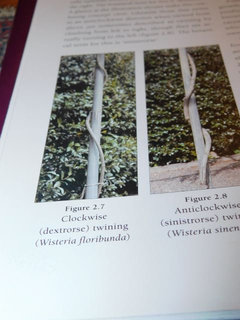
    This is the best illustration I have found - it's from Peter Valder (now deceased)'s book Wisterias A Comprehensive Guide:


  • 3 years ago

    Ya, that's what I meant, woody! lol

  • 3 years ago
    last modified: 3 years ago

    There is a short shoot showing dormant buds bottom right of the top picture. They're Wisteria buds imo. And given the direction of twirl, that would make it JW.

  • 3 years ago

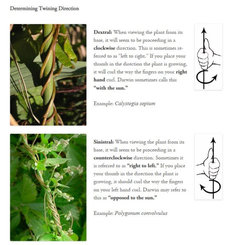
    It's all based on the observer's perspective, of course, but per some online digging, I believe the current botanical usage for "dextrorse" (clockwise) would be for vines that ascend to the right (looking upward from the ground), and "sinistrorse" (counterclockwise) for vines that ascend to the left (looking upward from the ground). So the illustrations in the wisteria book woodyoak posted above would be incorrect (at least based on current convention).

    See the link I included above "As the vine twines", where it says, "Twining direction can be determined by looking at (or imagining) the vine twining around a branch or pole. Look at the pole or branch from the base (from the direction from which the vine is growing)."

    See also "determining twining direction" on this webpage: https://climbers.lsa.umich.edu/?page_id=2 , which includes this illustration


  • 3 years ago

    Now you're making my head hurt dave.

    And I know someday we'll all be looking up from the ground.

    But for now, I'll continue to look down on the plants from above and withdraw from the conversation. :0)

  • 3 years ago

    There definitely seems to be two interpretations of how to define the directions… Since ‘clock’ is part of the term, I consider the image of a clock-face so if you take that arrow image in arbordave’s post above and think of a minute or second hand moving across the face of the clock, the first image looks to show the hand of the clock going, for example, from 5 to 4 to 3…. while the second arrow seems to move from 3 to 4 to 5…. so which is ’clockwise’ or ’counterclockwise’ would be the reverse of what that site concluded in my view…!


    As someone who grows both a Chinese and a Japanese wisteria, I find the twining direction to take a distant second place now to the difference in the timing and nature of their flowering when it comes to identifying the species. The twining only matters as an ID method before they flower or when you don’t aren’t familiar with the specific plant under consideration. And it’s just semantics once you are familiar with the look of the growth habits of each wisteria species…


    I will withdraw from the conversation now too. But I would be interested to see a picture of this vine in flower in the spring!

  • 3 years ago

    I would also guess oriental bittersweet, their roots are orange.

  • 3 years ago
    last modified: 3 years ago

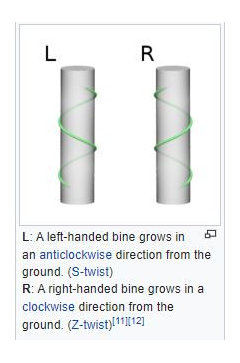
    BillMN, "for now, I'll continue to look down on the plants from above" I think we have to keep in mind what happens when the plant grows taller than the observer - CW becomes CCW (and vice versa). But if we take the perspective of the plant (i.e. looking from the ground up), the direction of twining remains the same. Wikipedia has this diagram for Twining vines

    Beth, oriental bittersweet (see photo below) twines to the right (clockwise) as it grows upward. The vine Ken posted twines to the left, so it can't be oriental bittersweet. And Ken's neighbor said it flowered (which I'm assuming he wouldn't have said if it was bittersweet). So Japanese wisteria (as floral concluded) remains the likely ID. I do wonder what the plant being "strangled" in Ken's photo is (?)

    @sam_md - maybe you can clear up something in a post you made in an old thread (from 16 years ago): Twining plants, describing the direction - in your list it looks like you may have reversed the direction of twining for W floribunda and W sinensis (?)

  • 3 years ago

    Ya. it's no big deal dave. It's the first time I heard of plant people looking at it that way. So, it was a bit of a shock after thinking of it in mechanical terms for the last half a century.

    I'll keep that in mind when talking horticulture from now on. :-)

  • 3 years ago

    One last comment;

    I wonder when this is idea of viewing up the axis came about.

    With older sources like Peter Valders showing just the opposite, I can imagine the confusion this will cause in the future when someone uses the word clockwise or CCW among a crowd of people schooled with opposite ideas.

  • 3 years ago
    last modified: 3 years ago

    I checked some Wisteria buds this morning. Pretty sure that’s what I’m seeing in the pictures.

  • 3 years ago

    my kids cant even tell time off a clock with hands.. and they are twenty somethings..


    in the future.. no one will be able to understand this conversation at all ...


    ken


    ps: no one answered my question of whether they would twine the opposite way down under.. .. tough audience.. lol .. but the toilet water analogy might give future generations something to use in such a discussion ... but the terminology evades me right now ... bowl and counter bowl-wise????

  • 3 years ago
    last modified: 3 years ago

    Ken - do a Google search using the words wisteria twine Australia. Counterclockwise tends to be called anticlockwise in Australia but the species twine in the same direction as here.

  • 3 years ago

    The initial strangled tree looked like a Redbud to me, by the flaking bark.


    Agree with Wisteria ID, too. Devilish plants, and darn hard to eliminate when you don't want them any more.

  • 3 years ago
    last modified: 3 years ago

    Viburnum Valley, it's good that someone mentioned the potential invasiveness of non-native wisterias. I believe they are considered invasive in quite a few states, probably more so in the south/southeast. I've only seen them escape in a couple locations in my area, while oriental bittersweet is becoming a huge problem throughout my region.

    woodyoak, yes researchers in Australia showed that being in the north or south hemisphere had no effect on the direction of twining. It's interesting that over 90 percent of the vines they encountered were right-handed (which they called "anticlockwise", but I believe would be called "clockwise" per the references I posted). They hypothesize that, "the widespread phenomenon of anticlockwise twining arises as a function of microtubule orientation operating at a subcellular level " (whatever that means). I couldn't find a good explanation why Chinese and Japanese wisterias twine in different directions, however.

    Ken, here's an excellent article by Scientific American on the question of the direction water spins when going down a drain in the north vs south hemisphere. Short answer: in theory yes, it spins in different directions, but other factors and variables generally override the "Coriolis effect". And as the Australian researchers showed, the Coriolis effect has no bearing on the direction of twining. " in the future.. no one will be able to understand this conversation at all... " Probably true, Ken, but I think it's helpful if we can find agreement on the terminology because it's an aid in identifying twining plants. As Jan Haldeman said in "As the vine twines", "My search for twining information yielded many sources reporting wrongly about Wisteria. These sources ranged from reputable botanical and horticultural publications to confused gardener online discussions", which only leads to increasing confusion as the misinformation is repeated.

  • 3 years ago

    Now, I need to go out and photo-determine which way my evil rampant '''Amethyst Falls' wisteria is twining around those plants it is intent on exterminating.

  • 3 years ago

    It's easy, I just have to remember that when talking twining of plants, it's just the opposite of what it really is...... J/k 8^))

  • 3 years ago

    We have a little collection of girdled stems, after lianas such as clematis, honeysuckle and wisteria have grown around a young branch., resulting in spiralling, sculptural growth patterns. Grand-daughter calls these either unicorn horns or fairy wands. Green wood-workers love this sort of growth (along with burrs, galls and other interesting growth shapers).