Software
Houzz Logo Print
seniorballoon

Bad soil, very bad soil

3 years ago
last modified: 3 years ago

We're talking really bad. The kind of bad soil that can barely grow grass. It's mostly glacial till, clay and sand. Not much organic matter. Imagine you have a 50 by 50 foot area that you want to turn into a garden. How do you go about amending the soil?


I have several areas like this and over the years have used a few different methods. I'll detail those later. What prompted this was the thread on the youtube channel Garden Answers. Several people were asking about amending soil and the question were getting lost.

So how do start converting this bad soil to good soil when it needs so much love?

Comments (26)

  • 3 years ago

    What are you trying to grow?

    SeniorBalloon thanked ShadyWillowFarm
  • 3 years ago
    last modified: 3 years ago

    Plants...Sorry couldn't resist. I grow a wide variety of plants and in any area you will find shrubs, herbaceous perennials, vines, shade lovers, and sun lovers. This question is less about specific plants and more about creating good soil. While I realize there are some plants that need specific conditions such as alpine plants or plants that actually grow better in bad soil, this question is about basic soil amendment.

    In the other thread there were questions and some comments about whether you should till in compost. @Embothrium made a comment that it would break down and cause the areas to sink and that you would just have to add more. I would definitely like to hear him say more on that.

    This might not be just about the initial amending, but also maintaining the soil quality.

  • 3 years ago

    We started off here in 1999 with very bad clay soil. I swear you could have made pottery with some of this stuff! The slope on the south side of the driveway would not even grow grass…. The soil in most of the garden is decent now. The main things we did were to use mycorrhizal fungus supplements with the initial plantings, leave all fallen leaves, fallen pine needles and dead growth from the current year’s garden on the ground to ’compost in place’ over the winter. We used soaker hoses in the beds in the first 7 years or so to water carefully. Now we mostly just live with whatever water Nature provides. ione bed we did use the ’lasagna’ approach tomaking the bed using sod removed from various areas but most of the beds were just planted into whatever soil was there when we removed the grass. Tough plants, good organic matter from the ’compost in place’approach, and parience worked well. A mulching leaf-blower came in handy at times too.

  • 3 years ago

    To improve bad soil, you add organic matter. Have a compost heap. That said, you have to take into consideration your deeper soil. If you're on a glacial esker, for example, you may have slightly sandy soil over essentiall gravel. Or you might have clay. If you add organic matter and make the top foot of each of those soils ideal, you're still going to have a huge difference. One will drain pretty quickly, the other won't.


    So. ultimately, you want to plant plants that like the soil you have.

  • 3 years ago

    Ah, we built a garden out of an asphalt car park over solid glacial till. We conceded defeat after a day spent with a Kango hammer and landscaper's bar and built huge raised beds using concrete blocks. One of the beds needed 18 tons of topsoil. It was literally the only way to make a garden which could be planted.

    My home garden is the same, only on builder's rubble and subsoil. Again, raised beds were the only possible solution. We had to import worms and loads of our home-made compost. I consider this to be a workable solution after years of pots on hard standing.

  • 3 years ago

    glacial till is a mixed bag I thought

    some compaction

    some very dens loam-ish areas with poor drainage


    some areas could be sandy-gravely, fast draining and "lean"


    if you want to experiment I would start some green manure, eg sowing things that grow proper roots and annual in growth habit


    compost is usefull on top, but in the long run you need to get roots into te soil


    do you have machines available?


    as a general rule some shrubs tend to be tougher or less demanding than veggies or chique perennials.


    if lawn does not grow I would suspect compaction, and that is tricky to ammend

  • 3 years ago
    last modified: 3 years ago

    Yep, Linaria - can be a mixed bag but the gardens most notable were inaccessible without a mechanical digger (which we used for the pond). Absolutely solid flint nodules. We originally laughed and got our landscapers bars out...but 6 hours later, we had dug a trench which was 4 foot x 2 ft and were knackered. Time to hire a bobcat. In my tiny garden, such machinery would have filled in the entire space so we built upwards.

    What is astonishing is the root growth from under the pots. Escaping the bottom through the drainage hole, the roots proceed to push between the tiny gaps between paviours, I guess, having got that far, a compact layer of builder's rubble is no obstacle at all...but I now have enormous plants (lilac, aloysia triphylla, acer, iochroma and fuchsia), which are as vigorous as if they had been planted into a lush garden loam. Life really is tenacious... I had to buy a special drill bit to make drainage holes in the sides of terracotta pots since the bottom holes were completely blocked with root mass.

  • 3 years ago
    last modified: 3 years ago

    Your soil probably isn't as bad as you think. It's probably just compacted. The easy answer is to either get some dump trucks of compost down on it or add a lot of leaves and other organic matter and let it rot. Worms will eat into it and burrow into the existing soli and loosen it up. Might take a year or two to become decent.

  • 3 years ago

    I'm no expert, but planting some mixture of cover crops, including some deep-rooted and some nitrogen fixing, would be a good start, whether or not you plan on mechanical attempts at decompaction. Of course, I also strongly support any and all organic mulches, as much as you can afford.


    Martha

  • 3 years ago
    last modified: 3 years ago

    I have used most of these suggestions other than planting a cover crop. All of them result in decent soil and plants grow just fine. But converting a large area is very labor and time intensive. Even doing a raised bed like this is still labor intensive:


    I have dug out entire areas and filled those with good soil, that was when I had hired a track hoe operator for some other jobs and since it was there had them do that as well. That's too expensive to be practical.

    I've added many yards of compost and tilled that in, also labor intensive.

    All of those work, but is there one that makes better soil conditions? Natures way is closer to lasagna method. Many cycles of growth and shedding of leaves and dead branches, decomposing year after year. That would take time, but it would be interesting to try. I certainly have an area where this could be tried. It would take a few years before it was ready for planting and one issue is weeds will want to join the party.

    The one that didn't work was to dig a hole for an apple tree and fill it with good soil. The roots never grew out into the surrounding soil. I did this for two apple trees. One died and I really have no idea why. The other grew for several years, but was toppled by a bear. Since the roots never grew beyond the hole it wasn't stable and strong enough to hold up.

    But are any of these superior?

  • 3 years ago

    It depends on your resources. Cover crops are easy, though you do have to keep on top of the appropriate mowing to keep them under control. Lasagna takes a great deal of 'stuff' to do properly, but is also easy. Double digging and amending takes muscle, but takes care of my big bugaboo - rocks. Raised beds take money.


    Pick your poison.

  • 3 years ago

    The modified lasagna method I used was topped with newspapers (which helped to control weeds..) and I planted into it the following spring by cutting holes in the paper as needed. I am disabled - even the 20 years or so ago when I was doing this - so it was manageable for me and got results quickly. What I did was remove the somewhat weak grass (from the lawn area destined to be a bed) by having someone cut the grass into ~4" strips (which made it easy for me to use a flat-bladed weeding tool to lift the grass), then piling the grass soil side up on the desired bed area (on top of the grass left in that area), scattering mycorrhizal fungus supplement between the layers as I made them (the fungus mycelia growth adds organic matter and it breaks down the grass - the fungus is a normal component of good soil but my soil was not good!) I made about a 4-6" high bed and topped it all with newspaper and left it for the winter. Over the years, the beds have flattened to be near-level with the remaining lawn/mulch path and things grow well in it and the soil now is good there. I used to have pictures of it from when it was made - but they are all on the old, disconnected computer in the basement so I don't have access to them anymore! But it was an easy and successful approach to quickly improving the soil and making a garden bed... Maybe you could adapt that sort of approach for what you need?

  • 3 years ago

    I once bought land that was on a hillside with soil eroded and carried away into valley below leaving shale rock surface. Knowing land would adjoin a planned lake in the future,I set about improving it. I laid out and marked lanes where I would alow free dumping of non-treated wood from construction sites,trees,limbs,leaves,spoiled hay,stall cleanings,tree service wood chips,produce from nearby farmer's market and other compostable material. Alternating lanes between compostables were marked for free soil disposal along with soil from ponds I dug to store water for irrigation. As two windrows of compostable material with windrow of soil between were complete I used a track loader tractor to cover sides of compostable with soil. As lanes on other sides were windrowed,I covered those sides with soil. As the project took shape,levees with swales angled down hill to slow water flow. As swales neared property line, another just downhill ran opposite direction. Several sinkholes appeared as soil washed into voids below so I bought an old dump truck and a large tractor with quick attach hoe and bucket to fill voids with stockpiled material. Levees ceased caving and leaving sinkholes after four years so I planted trees,shrubs, fescue,rye and vetch to farther stabilize soil surface. Following Spring I hired a farmer to inject anhydrous ammonia into the mounds several places and near perennials. I broke close to even when I sold the truck and made a profit on tractors.

  • 3 years ago

    Digging in pick up truck loads of compost is what I did, 20 years ago for more like a 20x20 area near the front of the house - but I understand looking for something less labor intensive for a larger area, for sure.


    I've used woodchips from our dead trees and brought in extra woodchips too, for areas further from the house to make a garden 'room' (filled in low spots). Maybe over a year or two a thick layer of woodchips will do the trick to bring soil improvement. Our area is now what seems to be great soil and it's now a question of what to do with it since it was supposed to be a 'floor' and pathways and is now begging to be planted into.

  • 3 years ago

    All interesting ideas and it's got me thinking. When I started this thread it was to just have a conversation about soil building, I didn't have a specific project in mind, but one is forming.


  • 3 years ago
    last modified: 3 years ago

    You might want to look into this product. Plant Delights, a very fine nursery, recommends it for clay soils, and it was mentioned recently, under the name Soil Perfector (the name Espoma sells it under), in a recent article in a quality gardening magazine. I intend to try it this spring.

  • 3 years ago
    last modified: 3 years ago

    I've been using this product for years to top dress my garden.

    https://www.dejongss.com/fertil-mulch-bulk-or-pre-bagged

    The plan forming in my head is for a shady area on a bit of a slope. It doesn't need to be ready for planting any time soon as I have more than enough areas to take care of. We have many large leaf maples. In fact the slope is under one of them. I usually just run them over with the mower where they fall so they can break down and feed the soil around the maples. Thinking I'll collect them and spread them round on this slope for a few years and see what happens.

    I have mixed thoughts on the permatill. Googled it up and found mixed reviews. Some really didn't like it and others raved. Drainage isn't an issue in these areas and the permatil doesn't appear to be available in my area and some said it's expensive, though I didn't see any pricing.

  • 3 years ago

    SeniorBallon I'm confused as to what you want to do. Are you wanting to improve most of your yard or just enough to plant a package or two of seed? Perhaps you should back up and start over by stating your goals,your physical condition and how hard you can work as well as whether you can afford to import material. If you browse old threads here you will notice bagged goods are seldom suggested or recommended. To most members,buying bags of compost and mulch is akin to hiring someone to play 18 holes of golf and filling out your card.

  • 3 years ago

    Do you know about Hugelkultur?


  • 3 years ago

    @klem1 I live on 5 acres where for the last 20 years I've been creating gardens. Initially I wasn't looking to get advice on how to solve a particular problem area. I just wanted to start a conversation about building soil, which came out of another thread where some questions weren't getting answered. The 50 by 50 ft area with bad soil is hypothetical, though it does mirror some areas we have.


    In the course of this thread I realized there is an area I've been thinking about developing further and the lasagna method might be a good choice. Low impact on time, labor and cost.


    I rarely buy a bag of compost or soil. It either arrives in the back of my pickup or in 5 to 10 yard loads...when I can afford it. :o)


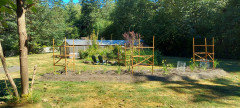
    I posted a few before an after photos here -


    https://www.houzz.com/discussions/6144278/21-years-and-a-labor-of-love-and-sweat


    Any of you that have photos like these of your soil projects please post.

  • 3 years ago

    @ A Mat I have not heard of that.


    https://www.almanac.com/what-hugelkultur-ultimate-raised-bed


    I like it and may use some of the techniques.

  • 3 years ago

    What i described above where I used tractors to cover windrows of material with soil is a form of hugelhultur and is the best way I know of for large scale soil improvement. There's another method well suited to confined space called Keyhole Gardening based on same principles. Amongst other desirable things,wood can be accumulated and stockpiled over a long period without worry of high winds scattering it like leaves that aren't contained. Another way of conserving labor if you have an out of the way area not in a rush to plant is burying leaves as acquired apposed to building additional bins .

  • 3 years ago

    At the moment I have lots of downed trees from a recent snow/windstorm that I'm in the middle of cleaning up. I never burn branches, I stack them up on the edge of the woods and just let them decompose. After reading about Hugelkultur I'm now thinking how I can use them on the slope in a modified Hugelasagnakultur method. :o)

  • 3 years ago

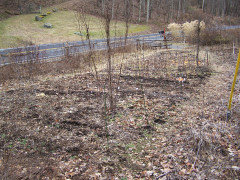
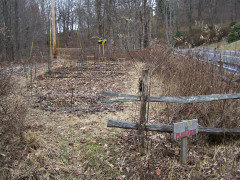
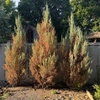
    This is my roadside vegetable garden. Picture was taken today. It started off as a wide road shoulder long time ago. It was fenced off maybe 30 years ago. The last 15 years I have just been adding organic matter on top. No tilling. Just tater digging. That's what God made earthworms and assorted vermin for. It was still a compacted road construction soil base for all practical purposes when I got started


    Several years of wood chips were followed by assorted farm dungs. Now it mostly gets bagged hardwood mulch. Sometimes manures might get thrown in. You can see I am the kind of gardener who just lets thing lay there and rot, so it gets an annual bath of leaves and herbaceous plant debris.


    Now the soil is quite fluffy. I can dig a hole for setting vegetable starts with my hand. The vegetable garden was just pitiful last year. The poorest fruit set ever. I blame it on the weather. July was weirdly cold and wet. The last thing you want for growing fine produce with a very short window of hot to work with. The silage corn down below me was a good two feet shorter this past year.


  • 3 years ago
    last modified: 3 years ago

    My last gardens were built on glacial lake bottom, so varying in grain size from gravel through coarse sand to fine silt, depending on water speed when it was deposited, but little organic matter. Initially I dug in organic matter, but as time progressed, I just put down tractor buckets of composted manure, spread to something like 6” deep, topped with cardboard or multiple layers of newspaper, and then topped that with shredded wood from a wood shop. Most of the organic materials were free as long as I hauled them myself. The gardens do well and require little watering or weeding as long as I renew the mulch periodically.