

Insecticide for svb?
While I whole-heartedly believe in organic gardening, I've lost my last squash plant to these pests. Has anyone found an effective insecticide to beat these pests? I am growing Armenian cucumbers and zucchini this year. Also, does this insecticide address squash stink bugs that seem to go hand in hand with the borers? Thanks.
Comments (13)
 PRO3 years ago
Growing cukes on a trellis can help deter squash bugs since they prefer to be closer to the ground. But if you grow your plants tight, that can make them shadier higher up and be more attractive. I haven't really had problems with squash bugs on trellised plants. A bush habit zuke is more likely to be attacked by squash bugs in my experience. I have for sure had problems with squash bugs on bush habit plants. Knock on wood haven't had SVB problems yet.
A few things I do. I groom my plants. I keep them trimmed out of older leaves and tight cluster spots that can hide blooms from pollenators and create inviting spaces for squash bugs. If I got a bad cluster on a leaf, I'll sacrifice the leaf if I need to. I tend to start using DE around the plants as I plant them in and try to keep up with it during the summer. I sometimes use a floating cover earlier in the season, but I haven't always remembered to do so.
I also do companion planting, specifically to attract beneficial insects that attack the bad guys in the garden. Umbrels are a favorite I like to use a lot. I mix other flowers and herbs in my gardens to help attract good bugs.
 3 years agolast modified: 3 years ago
I've heard it said that Bt works against them, though it will only do so in the larval stage, when they are protected inside the vine. So I wouldn't count on it, if you just spray it on the plant. Stronger insecticides (e.g. Sevin) might kill the flies themselves. Armenian cukes are NOT AFFECTED by SVBs. I used to lose squash to SVBs almost every year. (Never see any stink bugs.) My Armenians are completely untouched, every year. Depending where you live, there are other strategies for SVBs. Down here in the south, SVBs are basically all done in June. So I now cover the plants until then, and then remove the cover for the rest of the summer. Further north, that idea won't be as useful.
Related Professionals
College Station Landscape Architects & Landscape Designers · Clearlake Landscape Architects & Landscape Designers · Magog Landscape Architects & Landscape Designers · Victoria Landscape Architects & Landscape Designers · Panama City Landscape Contractors · Escanaba Landscape Contractors · Nashua Landscape Contractors · Scranton Landscape Contractors · Bend Landscape Contractors · Cornwall Landscape Contractors · Corpus Christi Accessory Dwelling Units · Frisco Accessory Dwelling Units · Hartford Accessory Dwelling Units · Mankato Accessory Dwelling Units · Missoula Accessory Dwelling Units 3 years ago
Depending on where you are there may only be one generation of SVB a year. If you wait to plant squash you may be able to avoid them entirely. Growing a parthenocarpic variety of zucchini/squash under row covers, or hand pollinating the plants under row covers will keep SVB and squash bugs from being able to attack your plants. And preemptively injecting squash vines with BT should also work to control SVB but that's tedious.
An insecticide containing spinosad will work for squash bugs. It kills directly but also has some residual effects. Be sure not to spray the blossoms as it will also kill bees and other beneficials.
Rodney- 3 years ago
I agree with the previous post, and can vouch for the effectiveness of some of those methods.
The SVB egg-laying period here generally ends in early July. Zucchini is fast growing, and if planted then, needs no protection & will bear for several weeks even this far North. I did that last year, with good results.
You can also cover young squash plants during the egg-laying period. The SVB population is very high here; for soft-stemmed squash, I would lose nearly every plant if not covered. I grew a pumpkin last year that way, and had no SVB - and no squash bugs or cucumber beetles either. If you don't mind the hassle of putting up the cover, it is probably the best way to deal with insects on squash. There is an element of timing involved though; place the cover too early, and the vines will outgrow the cover... too late, and the vines may already be infected. The last thing you want to do is trap an egg-laying squash bug under the cover, protected from predators; it would become a squash bug nursery. }:-O
As mentioned, BT will kill the larvae on infected plants... but it needs to be injected into the stems at multiple locations to be effective. You can also use a water pick or similar water jet to flush out or kill the larvae, by spraying into locations where the sawdust-like frass indicates there is a hole there. You can add BT or other water-soluble insecticide to the solution. I did that once for some heavily-infected buttercup squash, and it killed enough for the plants to survive to maturity. But no after-the-fact treatment (which includes removal by surgery) will completely kill all larvae.
I should probably mention that mature SVB larvae will fall from the plant & burrow underground, where they will survive as pupae until the next season. So if you already had an SVB attack, don't plant squash in that location next year. Even covers won't help if the moths emerge under the cover.
Armenian cucumbers are actually members of the melon family, and should not be affected by SVB. Not sure whether squash bugs would attack them (they never attacked mine) but they are VERY attractive to cucumber beetles. Butternut squash are less susceptible to SVB (except apparently in the South) so that might be an organic squash alternative.
Oh, and about squash bugs. Because they are sap suckers, hard to kill with poison - but very easy to kill with soap spray, as long as they are fully wetted down. If you use a spray bottle in Spring & early Summer, and are able to kill the first adults before egg laying has become widespread, it might prevent a major breakout. You can also use an insecticidal soap spray for large breakouts, when you see hundreds of the gray nymphs. You can spray widely, then rinse the plants an hour later. That reduces the chance of leaf burn, and any bug that was sprayed died within minutes.
Hope you're still awake, my apologies for the length. Please bookmark this so I don't have to type this up again with one finger. (lol) - 3 years ago
That's a good point about Moschata in the south. Everyone says that they're SVB-resistant, but they sure aren't down here! Not sure why southern SVBs are fiercer, but so it is.
 3 years ago
Have you tried floating row covers? https://extension.umn.edu/yard-and-garden-insects/squash-vine-borers#chemical-controls-3112162
- 3 years ago
The problem with row covers, like Zeedman mentioned, is that the beasts emerge from underground from the previous year's infestation -- they're just going to fly around and procreate wildly under the covers; I wouldn't even consider row covers for that reason, it might end up making the problem worse.
It's a tough battle. I haven't figured out how to win it yet. I may just forego planting susceptible varieties for a couple year until the population dies down. They decimate my kabocha every year but haven't had any interest in the butternut...yet...  3 years agolast modified: 3 years ago
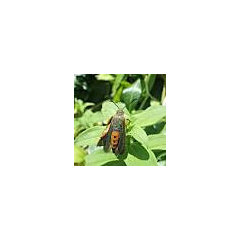
If your growing season is long enough and you have the garden space available then another option is to plant squash twice (over lapping harvests ) during the season. When the first plantings start to bloom then plant a 2nd batch of seeds which will start to produce as the 1st batch dies off. I also keep a bottle/stream/sprayer handy to nail the adult wasp/blackish orange moths when they're resting atop of squash leafs on hot days.
- 3 years agolast modified: 3 years ago
The point about row covers just locking in SVBs when they hatch is an important one, but the simple way to avoid that is to NOT PLANT in an area that had SVBs the previous year. Then covers will work fine. Of course the disadvantage in covers is that hand pollination is necessary, and harvest needs extra effort.
- 3 years ago
Very good advice in post just above with picture of adult moth/wasp. Look close so you will recognize it when you see it and prepared to kill it. No telling how many are passed over thinking they might be a beneficial wasp.
I bury a water tube with an emitter beneath each hill before seed are planted. In addition to cutting evaporation waste,soil surface is drier and doesn't cool underside of leaves as much as surface watering. That's important for squash bug traps I use. Ever notice how well cheap Styrofoam coolers and cups store ice even while exposed to sun? A cooling effect from slight amount of moisture evaporating is partly responsible. I staple wet cotton fabric inside Styrofoam cups and shipping containers placed amongest suqash plants early morning. As bug season peaks,Texas sun is really hot from late morning until late afternoon. Bugs ordinarily find shelter from hot sun beneath leaves (where moist ground from surface watering helps) but my traps are much cooler,esp since I don't water soil surface. Mid to late afternoon I quickly place traps in a black plastic trash bag,tie it closed and lay it where it remains in sun. If traps have been yielding many bugs I lay more traps following morning and allow bugs in bag to roast another day. I leave some traps out and look in them to see if population increases. Crop rotation seems the best defense against bores but a friend once replanted after a bad year and I wrapped base of plants with foil then pulled about 1" of soil up around them. I have no proof my trick was responsible but she had negligible bore damage.
Again I don't know how much it helps but I place solar power path lights in my beds thinking they attract night predators. I got the idea from seeing predators feeding on insects around window screens at night.
- 3 years ago
"daninthedirt (USDA 8b, HZ9, CentTX, Sunset z30, Cfa)Squash vine borer pheromone traps are RIDICULOUSLY expensive. You can buy many yards of netting, and indeed many squash, for one of those."
So are Squash Bug traps, that's why I'm sharing my design for free traps and stem guards.
- 3 years ago
I don't understand what traps them in your traps. A moist styrofoam cup? That/'s not going to trap anyone. If bugs like cool moist stuff, they'll sit on the soil. BTW, we're talking SVBs, not squash bugs. Thems different beasts.



daninthedirt (USDA 9a, HZ9, CentTX, Sunset z30, Cfa)