Software
Houzz Logo Print
ralph_zone8_nc

400 CFM Range hood

3 years ago

Hi,


I am looking to replace my OTR Microwave (400 cfm w mesh filter). Is a 400 CFM range hood with baffle filters more powerful than a Microwave?

Area of install :

The hood will be on a exterior wall above the range.

The gas range is a 4 burner at 41000 BTU -

Burner 1 = 13500

Burner 2 - 13500

Burner 3 - 5000

Burner 4 - 9500


The plan is to use the existing vent, so there is no real bends or long distance to travel.

Can I get away with the bare minimun of a 400 cfm range?

Thoughts?

Comments (13)

  • 3 years ago

    The microwave oven's fan might move 400 CFM in free air (one naively hopes), but certainly not with a mesh filter in front and narrow appliance ducting plus whatever is present as a duct to the exterior.

    Adequacy of flow rate depends on cooking style. Do you fry, sear or cook with a wok, or just poach and simmer?

    P.S. You could save me a lot of typing if you first read a selection of the many hood and MUA threads in this forum.

  • 3 years ago

    Main idea is to get any fish/meats fry odor and/or asian spices smells away. No wok but occasional deep frying for sure. Yes, I am aware of MUA but from what I have read it is a expensive upgrade ($10k - $20k). I am unable to spend that much, so the question is if I can get away with a 400 CFM range hood (which is the allowed cfm without MUA in the city that I live in). It is literally going to vent straight out (15 cm), no turns or anything.

    I will ask my HVAC about the cost of MUA.

  • 3 years ago

    Response just evaporated. I'll try again in pieces.

  • 3 years ago
    last modified: 3 years ago

    MUA does not always have to be expensive. You either have or do not have combustion appliances capable of being back-drafted. This message assumes not capable.

    In such a case, a hole in a wall or roof, a filter, a damper, and a heater may be sufficient. The heater could be an added heater to the room the MUA is dumped into, rather than an in-duct controlled heater.

  • 3 years ago

    If you do have combustion appliances, it is best that they have their own MUA, either directly ducted to them or taken from a room not normally connected to the kitchen that can take air from the outside.

    Depending on the 400 CFM limit to avoid back-drafting of carbon monoxide is a bit chancy. However, without knowledge of what appliances you may have, further commentary on this aspect must wait.

  • 3 years ago

    I've had OTR microwaves with exterior vents and they were pretty much useless. When we remodeled our kitchen I put in a 300 CFM ventahood because that was the maximum I could have without MUA. It vented directly out the wall by the cooktop and it worked great for removing steam, odors, etc. I don't do much frying though I do use a wok and it was fine for that. I had a 36 inch Wolf gas cooktop in that case. I can't stand the fan sound so used it as little as possible but I don't have a decent exhaust fan now and I really miss it as I watch steam waft up on my cabinets.

  • 3 years ago

    Thank you all for the responses. Yes I may have to just settle with a 400 cfm but so far not found one with a good depth, so far one with 400 and rectangle rear vent comes up only till 17.5 inches which is just close to the middle of the front burner.

    Kaseki - The only directed vented appliance I think is my gas-water heater and yes the dryer is vented out. Fireplace, I have no idea but need to check.

  • 3 years ago

    I recommend getting a hood that provides the needed entry aperture size and use an in-line or exterior blower rated at 400 CFM. That should meet the no-deliberate-MUA code, even if it doesn't meet my code. Coverage of the rising plumes takes priority over CFM. Compatibility between the blower's power needs and the provision of power control on the hood is needed. Wolf provides compatible remote blowers and hoods, and I expect that other major manufacturers do also.

    Fireplaces usually (at least historically) take MUA from the household. Various fabricated fireplaces, such as Majestic makes for example, have means for MUA, but I don't think that the means is adequate for wood fires, but might, perhaps, be adequate for gas connected configurations that have limited air needs.

    If your gas water heater takes its air from the room it is in, either the room needs MUA and isolation from the kitchen air, or a ducted MUA setup to the gas water heater is needed. Nowadays many manufacturers of gas heaters and furnaces provide kits for separate MUA. I suggest talking to your gas supplier.

    This is a good idea even without a powerful kitchen ventilation hood system. Conceivably, you could establish a roaring wood fire with sufficient draft to back-draft the gas water heater if their locations are connected by an air path.

  • 3 years ago

    I have ordered this 36” range hood for my 30” range. Maybe a consideration?

    https://www.broan-nutone.com/en-us/product/rangehoods/alt336ss

  • 3 years ago
    last modified: 3 years ago

    kaseki - So my water heater is in the garage and it is "direct vent". The fireplace is a "Heatilator" unit and it is in tne family room. This is an open kitchen plan, so the gas appliance is on the other end of the room. I think the fire-place is direct vented as well, it has a vent visible above the fireplace and a glass panel to the front, followed by a metal mesh like screen.

  • 3 years ago

    Jarmuth - 36" is not an option as I am not going to cut through cabinets to make the range hood fit.

  • 3 years ago
    last modified: 3 years ago

    Back-drafting combustion appliances results from the appliances taking air from inside the house where the kitchen hood is also taking air. Such appliances CAN be safe if they take their air via ducting to the outside, or from a room connected to the outside that is isolated from the kitchen where the hood takes its air.

    Generally, unless well sealed from the room, fireplaces can be back-drafted by any useful hood blower, but this is obvious when it occurs and users will open windows or turn off the hood. Gas hot water heaters are more subtle in their operation, and it is best in my view to be sure that they can't easily be back-drafted. The separate garage would in most cases be considered isolated, but without deliberate ducting of air to the unit, or very leaky doors, a doorway from garage to house interior would allow kitchen hood blower induced pressure drops to influence the garage air pressure.

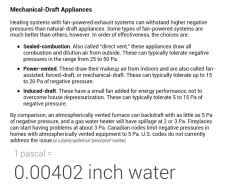
    Here is a handy list from another member here:


    It is possible for even the direct vent appliance to have its negative pressure limit exceeded with a tight house and a strong hood blower.

0