Software
Houzz Logo Print
ariel_rodriguez50

Is my St. Augustine dead or dormant?

3 years ago
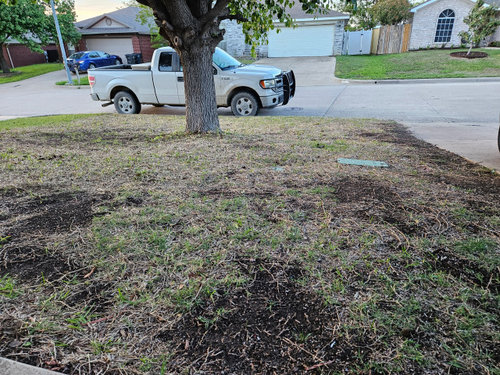
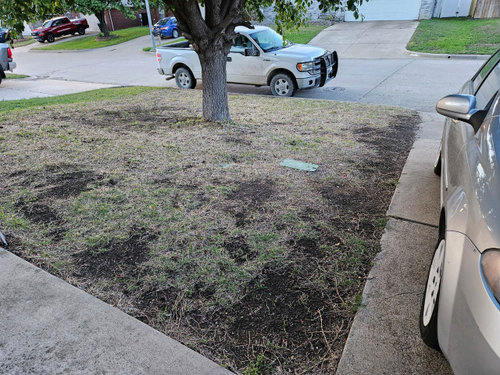
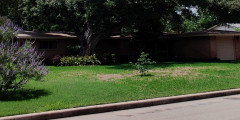
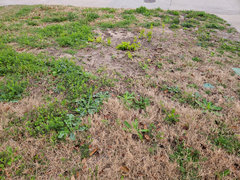
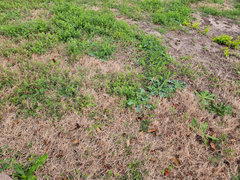
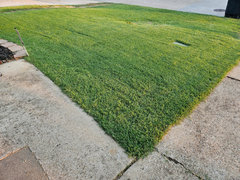
It's May and hardly green and it is thin.

Comments (207)

  • 2 years ago

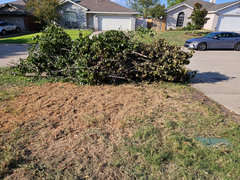
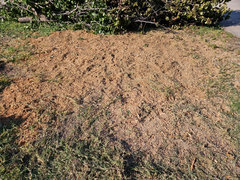
    Here is the new lawn ,no tree. I am going to even out the wood chips and place top soil and fertilize once they pick up the bulk this week.

  • 2 years ago
    last modified: 2 years ago

    At this point I'd consider having the front yard scraped with a box blade and start fresh with new sod. A landscaper could scrape it to perfectly level in 30 minutes.

    Tree company didn't haul away the tree? What's up with that?

  • 2 years ago

    They didn't haul the trunk because I wanted it for firewood. I'll need an axe for this. Idk about a fresh start with the sod. The Bermuda seem to be kicking in and I notice there are quite a few long stolons from st augustine that eventually will kick in. At this point I don't care who wins.

  • 2 years ago

    Here's what's going to happen. The wood chips will decompose for the next many years. As they decompose the surface will turn into a low spot and very likely a bumpy spot. In a few years you'll need top soil to bring it up to level. Low spots tend to hold rainwater and create great conditions for water loving plants like yellow nutsedge. About the only thing you could do about this now is to vacuum off all the wood chips you can and start with fresh topsoil if you end up with low spots. Whatever is left of the stump underground might become an issue for fertilizer retention in the future.

  • 2 years ago

    I'll do like you say remove the chips in the hole and add topsoil now and periodically until it no longer drops and is leveled. As far as the chip I remove can I just spread it around the yard thin so as it decomposes it fertilises on top of the pellets I'll be throwing down?

  • 2 years ago

    Yes the wood on top of the soil will decompose and help fertilize everything. Wood and sawdust are not great fertilizers because they can take years to decompose, but they eventually do. However, they might never decompose when buried under the soil. I realize never is a long time, but the wood needs air to decompose. It doesn't get much when it's buried.

  • 2 years ago

    If I spread it thin around the outside of the hole will grass grow eventually like by next spring? I just like the idea that it can fertilize but I understand too much too thick will take a long time to decompose.

    The ones on my lawn is practically sawdust no chips.

  • 2 years ago

    The sawdust can also suck out nitrogen from the sod as it decomposes vs give correct?

  • 2 years ago

    Wood chips and dust only take nitrogen from the soil if they don't have access to nitrogen in the air. As long as it is on top of the sod, it should not be a problem. But yes, do not mulch the grass and bury it.

  • 2 years ago

    I'm going to take out as much as posible were the stump was and add topsoil and rake up what's around tje yard. Once it is completely fine on the sod I may use a leaf blower to blow as much out to the street.

  • 2 years ago

    Still use topsoil even though the pile looks like more dirt than chips? Plenty of dirt mixed.

  • 2 years ago

    Make it as level as you can. If you have mounds of dirt and holes, then scrape the mounds toward the holes to fill. If you end up with an overall low area, then add topsoil. If you end up with an overall mound, you're probably fine. It will settle.

  • 2 years ago

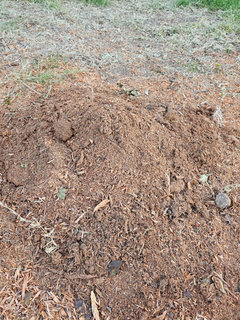
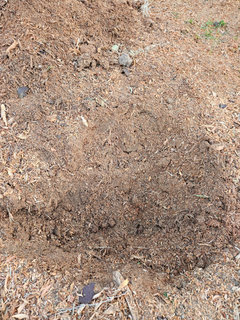
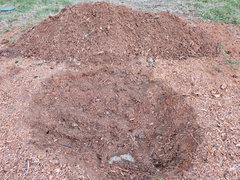
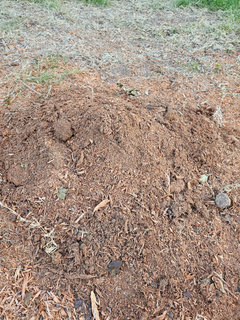
    Here is the hole and mound. At this point since I took out as much as I could I figure I'll fill it with topsoil and make it level BUT what should I do with the mound?

  • 2 years ago

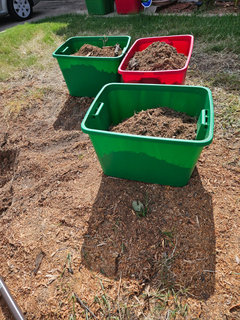
    I placed the mound in these bins to decompose and use as nutrients later. Do I place the bins outside uncovered under all elements including rain or place in my covered patio with the bins uncovered to avoid rain?

  • 2 years ago

    You might ask that question on the compost forum.

  • 2 years ago

    What do you think of Scotts Natural Lawn food. The fertilizer in Scotts Natural Lawn Food is derived from: hydrolyzed feather meal, meat meal, bone meal, and sulfate of potash.

    Use along with Alfalfa pellets.

  • 2 years ago

    It seems all the commercially bagged "organic" or "natural" fertilizers insist on putting potassium sulfate in them, whether you need potassium or sulfur or not. So among the commercially prepared organic/natural fertilizers, Scott's is another one of those.

    Feather meal takes an abnormally long time to decompose. It's on the order of months and not weeks. Once it starts it lasts a long time. Meat meal takes an abnormally short time to decompose - on the order of days and not weeks. Once it starts, it's over. Bone meal is a source of calcium (whether you need that or not). Where I live, on top of 1,000 feet of sea shells worth of pure calcium, I don't need the extra bone meal. I've never used a meat derived fertilizer, so I don't know what it might smell like, but any smell should be over in a few days. I have used excess amounts of corn meal and corn gluten meal and have noticed a lingering aroma there. It's not offensive like spoiled milk, but it is a little funky. Alfalfa pellets do that, too. If you used the Scott's along with alfalfa pellets you should get a quick green-up from the mean, a delayed dose of N from the alfalfa in 3 weeks, and a much delayed dose of N from the feathers in 3 months.

    By the way that stuff must have a very high N content with the feathers and meat.

  • 2 years ago

    Scotts is an 11 2 2. I just think Microlife products are getting expensive.

  • 2 years ago

    I always thought they were expensive. I have only used corn meal and alfalfa pellets on the yard since 2021, and it has improved tremendously. I'm not sure how much I can attribute the improvement to the fertilizer versus just getting care, since the previous owner died and the yard got no good care during the time until we bought.

    Here is a picture of a little tree in our yard.


    Date on that is May 25, 2021


    Date: May 30, 2022


    Date: April 5, 2023


    I don't think Houzz will let me load another picture, but today the tree is considerably taller after our bad heat and drought last summer but with significant periodic rainfall since November.

    So can I attribute all that growth to organic fertilizer? I'd say a lot of it was due to having ANY fertilizer along with regular watering of the adjacent lawn.

  • 2 years ago

    Wow that tree green tremendously and lawn is really green. I know you mentioned not to use corn meal with gluten before but what corn mean brand is there I can look up? You said whole grain?

  • 2 years ago

    Wow that tree green tremendously and lawn is really green. I know you mentioned not to use corn meal with gluten before but what corn mean brand is there I can look up? You said whole grain?

  • 2 years ago

    Corn gluten meal is different from ordinary corn meal. Corn gluten meal is an excellent fertilizer; however, it is useless against the types of fungal diseases that St Augustine gets. For those you need ordinary corn meal. Both have their place. Ordinary corn meal is considerably weaker as a fertilizer compared to corn gluten meal.

    The brands usually go by the local mill that grinds corn into meal. I just ask at the feed store for corn meal or corn gluten meal and I get what they have. Sometimes you have to ask for what you want, because of the similarity of names. Also corn gluten meal costs as much as 10x more than ordinary corn meal. When I first started buying corn meal in 2002 it was $3 per bag. Last year I think I paid $12. It is a commodity, so you have to pay the commodity price plus shipping, which depends on another commodity, gasoline. It's different every year.

    Whole grain corn meal is ordinary corn meal. Corn gluten meal has the starchy part of the ground corn stripped away chemically so they can make corn syrup and corn starch. What remains is the highly proteinacious part of the corn. They used to feed it to livestock, and they still do, but they have also tapped into dog food and other uses for CGM.

  • 2 years ago

    I see. I may get corn meal for fungal and gluten for fertilizer and use along with the pellets. Does gluten corn meal work with microbes too?

  • 2 years ago

    I see. I may get corn meal for fungal and gluten for fertilizer and use along with the pellets. Does gluten corn meal work with microbes too?

  • 2 years ago

    Sorry for the repeated posts just now. Likely froze and I hit it multiple times to send.

  • 2 years ago

    Yes CGM works with microbes. All the organics are decomposed down into plant food by microbes. Some just work faster than others. Blood meal is the fastest. Feather and leather are the slowest. Meat is faster than grains.

  • 2 years ago

    I was reading on corn meal gluten and seems complicated because the timing for weeds has to be right if you also want to use it as a pre emergent. The soil has to be wet a few days before and after application. The soil temp has to be at least 50 degrees for a few days and there are different ideas on when to apply it as a pre emergent especially for crabgrass like I tend to have.

  • 2 years ago

    Forget about CGM as a preemergent. It's worthless for that - WORTHLESS. To demonstrate the effectiveness to myself I used it at 40 pounds per 1,000 square feet once a month for 9 months. I had just as many weeds that year as any year. The idea of using CGM as a preem was studied at the university of Iowa. They have lots of statistics and charts, but one that caught my eye demonstrated that their best result was only 80% effective. That means 20% of the weed seeds still germinated. That's really not very good. And, furthermore, they could not repeat that 80% number year after year. It was a fluke. If you buy CGM get it at a feed store and NOT in a bag with a preemergent claim on it. Get the animal feed version, because it costs less for the same product. It should be in a plain bag.

    If you need a preemergent, use a chemical one. The chemical preems last about 3 months so you can apply NOW and catch all the early spring/summer weeds. Apply again at the end of April for the summer weeds like crabgrass. I would also apply the Spectracide product I mentioned 4 months ago in mid April. In a sense that is also a good preemergent, because it kills the seeds from this years crop of weeds. That stuff is amazing (and more than a little dangerous, so read the label, and reread what I said 4 months ago).

  • 2 years ago

    I bought the spectrazide back then but didn't use it because I thought on staying organic.

    If I go ahead and use it now as a pre I would rather spray the entire lawn to kill what isn't out yet but the fear is it may kill of St Augustine and some of my Bermuda mix.

    The cardboard won't be useful if I plan on attacking what I don't currently see.

  • 2 years ago

    Don't use Spectracide with atrazine as a preemergent. Just use it in April against actively growing weeds and enjoy the side effects of the seed killing next fall and spring.

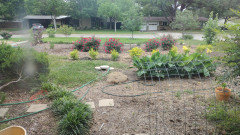
    The cardboard was used to protect plants, grasses, etc., from the Weed-b-Gon spray. I use it with RoundUp, also when necessary. We are still transitioning from a mostly grass yard to an Asian jasmine ground cover, and we have a lot of weeds growing in the mulch. I don't like using the chemical sprays, but when you have an entire yard of weeds, you have to play catchup with the sprays. Soon enough we'll have the small lawn and larger jasmine area with the plants you see in the pictures in the middle.

  • 2 years ago

    If I spray the Atrazine in April that covers summer and fall until I spray next April again?

  • 2 years ago
    last modified: 2 years ago

    Yes it will take care of those living weeds and the seeds. Occasionally rain in late summer will sprout a few weed seeds. I believe the directions on the bottle allow a second spraying in one year, but read them carefully. And next spring you should see a much better weed situation, so you don't need to spray again.

  • 2 years ago

    That's good. I bought 4 bags of Scotts Natural Lawn food to try out. I'll throw it down in mid April, June, August and fall.

  • 2 years ago

    How devastating is it if I apply spectrazide Atrazine to the entire lawn one time and use organic fertilizer along with it?

    Will the organic help reproduce more microbes despite some being killed off?

  • 2 years ago

    I would apply the fertilizer roughly 3 weeks before spraying if possible. That gives the fertilizer time to "activate" via the microbes. What that does is to fertilize the weeds, because healthy weeds will take up the herbicide better than weeds in poor health.

    And yes, the organic fertilizer feeds the microbes, and yes, some will suffer from the herbicide, so if you want to do them all a favor, you could fertilize again a week or so after spraying.

  • 2 years ago

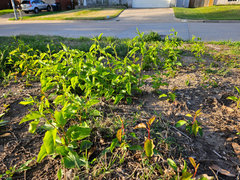
    Are these weeds a good sign that the soil is good for sod growth eventually as spring gets here?

    I don't remember my front lawn having these many tall weeds before this early.

  • 2 years ago

    Those weeds can only germinate in a thin soil. You had so much shade from the old tree, that the turf canopy was open to the deposition of all the weed seeds. Then the thinness of the canopy allowed light in for germination. I have exactly the same thing going on in my yard. We've had another one of those crazy Texas winters with a few days of freeze and the rest rainy and warm. Normally we would have waited until the Texas mountain laurel plants bloomed before putting out preemergent, but it seems like we're just going to have to do it by arbitrary calendar. Next Christmas put it out and again in mid to late March. It's supposedly good for 3 months so that should carry you into spring and the new grass.

    If you are able you could try the Spectracide with atrazine in March instead of April. I've got a torn up quad muscle, so I'm not doing anything this spring.

  • 2 years ago

    Thank you. I hope you feel better soon. I want to avoid spectrazide if possible since I spent so much money on the Microlife and this year I'm doing Scotts natural fertilizer instead. (I don't mind it in the backyard here and there since I already have established turf that's thick)

    What I think will happen as the bermuda/st augustine grow it will choke out most of the weeds. There is an area in my backyard that isn't thin but does have weeds and every year the grass chokes them out.

  • 2 years ago

    These suckers are from the tree that was removed last fall. I'll cut them but will they eventually die? Bradford Pear tree.

  • 2 years ago

    That's a question for the tree forum.

  • 2 years ago

    I'll ask there. I went ahead and clipped them as close to the root and also pulled out and cut out more of the tree roots.

    For the weeds I bought a product called Fiesta. Apparently it is a heavy iron natural weed killer. I heard great stuff. We will see.

    Have you heard of it?

  • 2 years ago

    I applied alfalfa pellets over 2 weeks ago. I also applied Miracle Gro lawn 6 days ago and will be applying more miracle gro lawn in 4 weeks and in between more alfalfa and the scotts natural food. Not bad I guess considering how it was last year. From oldest to newest April 11,18 and 22.

    I am tired of only organics. I just had another soil test and the n,k was low despite all the organics. Hybrid is better than all chemical in my case.

  • 2 years ago

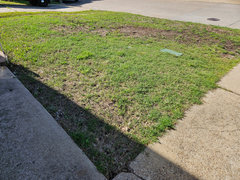
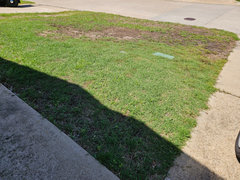
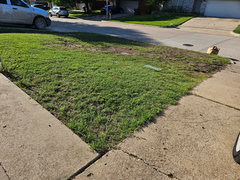
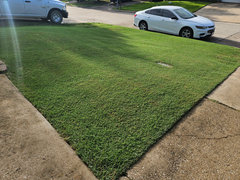
    If someone told me it would look like this I would have not believed it. A huge night and day improvement from a year ago.

    I fertilize, water and mow low every 4 days.

  • 2 years ago

    Now that you're pretty happy, what would you say was the key to getting this result?

  • 2 years ago

    I would say the frequent mowing every 3 to 4 days and low cut. Water too of course.

    Now as far as the fertilizer it's hard to say which. I had applied MicroLife for 2 years and likely that played a great part with the health. At the same time I've been applying alfalfa pellets and scotts natural fertilizer so I am sure has kept the green healthy look.

  • last year

    Reel mowing at 3/8" every 3 days. Its come a long way.

  • last year

    DUDE! You gotta be proud as you can be. Two years ago you were the guy with that lawn. Now you're the guy with THAT lawn!

    The grass looks like it's all bermuda. St Aug does not look that good when mowed that low.

    One thing we never talked about is insect damage. In particular chinch bugs can be a problem in bermuda. They require very warm soil, so they usually show up in July or August. They appear first at the corner of two concrete slabs and usually near the extra warmth of the street. They never appear suddenly in the middle of the lawn unless you have a buried slab or boulder you don't know about. They can be treated, but you should wait until you see the symptoms and verify they're there. If you wipe the palm of your hand along the grass the chinch bugs will flick backwards from the direction you're wiping. Put a piece of paper down and flick the bugs onto the paper. You should not have to treat the entire yard if you catch them early. They kind of look like a dry spot, which also can occur where warm masses of concrete meet, so do the flick test to be sure you are treating the right problem.

    Are you still using a mix of organic and chemical fertilizers?

  • last year

    Thank you! It wasn't easy but it is very rewarding. Yes it is all bermuda. After cutting frequently and at 3/8" I would see St Augustine runners here and there so with each mow I'd pull them out. Whatever is left you can't detect and eventually will disappear.

    I should have chinch bugs under control along with other insects because I threw down some insect killer because I found fleas on my dog. The killer takes care of a multitude of insects and that includes chinch bugs.

    I stopped using MicroLife fertilizers because they become expensive. The last organic fertilizer that I bought was Scotts Natural Lawn organic fertilizer so I am using what is left of it and be done.

    At my local feed store I bought a bag that contains ammonium sulfate and urea and if you ask me that is why it is so green. I'm alternating with Scotts Natural Lawn organic fertilizer every 6 weeks for now.


    My neighbor keeps asking me how did I get it that way. I tell him the secret is to mow as low as the mower allows but with a reel you can go lower especially if you have a flat lawn and to cut every 3 to 4 days. The rest is watering and fertilizer. Fast forward his looks the same because he cuts only once or twice a week despite my advise lol.


    How is your arm/shoulders?

  • last year

    Ammonium sulfate and urea will definitely create green in bermuda. Other grasses might burn, but not bermuda. Do you use it monthly, every 6 weeks, or what?

    I don't know if it's what I feed them or the organic fertilizer, but my dogs have never had fleas. Now I've probably jinxed it.

    While you're at the feed store getting the rocket fuel for bermuda, you can also pick up some alfalfa pellets (rabbit chow, not horse cubes) to use as organic fertilizer. The application rate is 15 pounds per 1,000 square feet. You can use it any day of the year including the days you use the ammonium sulfate/urea. Organic fertilizers do not interact with chemical fertilizers, but they help to keep the soil microbes healthy. Alfalfa pellets are a lot cheaper than commercially bagged organic fertilizers.

    I understand about your neighbor ignoring you. It is very hard to give advice to friends, neighbors, or relatives. Did you tell him about overdosing on fertilizer? One of the most common mistakes is watering too frequently. That will turn most lawns brown.

    I'm not sure what I said about my arm/shoulder, but I did get a hip replacement and tore a quad tendon last spring and summer. I didn't do a thing to the yard, so this is a year for catching up on bermuda trying to take over. All the rain really helps while we're still only allowed to water one day per week. I don't think we've watered for 2 months and might make it through July before turning on the sprinklers.

  • last year

    I just started with AS and Urea last month. I am alternating every 6 weeks with Scotts natural lawn fertilizer this season until I am out of scotts. I have used those rabbit pellets that you mentioned but ran out. I plan on resuming those after I no longer have scotts. The bag I got has AS but with slow release urea so that's good a fast jolt of AS while spoon feeding with urea.


    I did tell my neighbor to fertilize but to apply per label as it can burn his lawn and to water deep but infrequently while keeping up with his cutting schedule, low and frequent. He has also seen and knows about my rabbit pellets from last year but he doesn't really keep up although he means well.


    I am glad you are better and able to maintain your lawn.