Software
Houzz Logo Print
canaanjs09

Any PIlea depressa experts? Need help with leaf drop.

3 years ago
last modified: 3 years ago
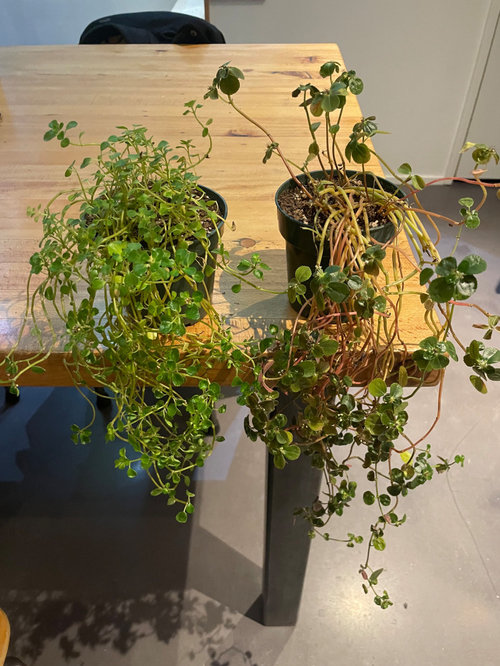
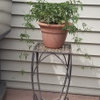
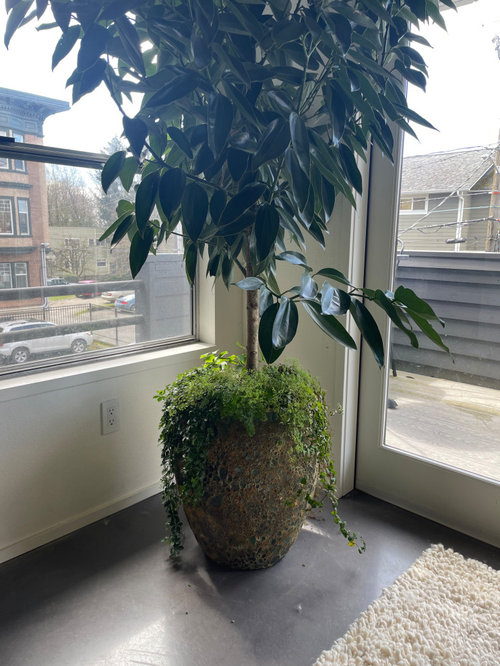
I have two varieties of Pilea depressa and over this last fall and winter they both lost the majority of their leaves. The first photo is of the current state of the plants and the second photo is the location they were in. The leaves would become pale/yellow and fall off and I think some of the vines might have lost color too. The plants never really looked droopy and I saw no other real signs of sickness besides the paling and leaf drop.


Here’s some info about the conditions:


Light - The plants are in a southwestern corner, right between windows on the south and west walls of the corner. There is overhang on the exterior of the building at ceiling height that extends about two feet out and there is a taller building about 12-15 feet away on the south side. I think the plants get pretty ideal indirect sun all day with some direct sun in the afternoon. I have several tropical plants and ferns in this corner that are all thriving.


Water - I water them only when the soil is dry pretty much all the way to the bottom, which in the winter was consistently every two weeks. This is a technique I use successfully for nearly all my tropical plants.

Fertilizer - I fertilize somewhat liberally by giving them a splash of very diluted (2x the amount of water instructed) organic liquid fertilizer (Espoma brand) every other time I water (once every 2-3 weeks in the spring and summer and once a month in fall and winter).


Additional Info:

- The plants were thriving for probably 6 months before the trouble started.

- The plants were slightly up-potted maybe 3 or 4 months before the trouble started, just from small 4” pots to larger 4" pots.

- I’ve checked the soil and roots and see no obvious problems and I see no signs of pests on the plants.


I’m no expert horticulturist, but I have many plants in my home and actually do botanical design and maintenance professionally, so I consider myself to have a pretty informed green thumb. These are the only two plants in my home that I haven’t been able to make happy. I LOVE Pilea depressa and would like to get more so I’m really hoping I can figure this out.


Any tips would be much appreciated. I’m puzzled!


Comments (15)

  • 3 years ago
    last modified: 3 years ago
    The first thing that strikes me is that they are etiolated, ie they have not had enough light.

  • 3 years ago

    agree significant lack of proper light..


    i would propagate some pieces.. then i would give it a good hair cut.. and then i would put them outside for summer.. in full bright shade.. if possible..


    many plants can cope with lower winter light indoors if they have a few months outside to recover. .


    if outside is not an option.. a grow light would the next best thing...


    and all that is from looking at the pix only ....


    ken

  • 3 years ago

    Thanks for the tips! I was also thinking light might be a culprit since it did happen over fall and winter.


    Does anyone know if Pilea specifically need A LOT of light. Because while the days do get short and gray here in the winter, the plants are in a very sunny spot with nearly all day sun from the south and west. (I've added a photo of the former location of the plants.) Generally we find that tropical plants do well here if they're close to an unobstructed window, even an east facing one. They can get a little less vibrant and full in the off season, but still generally happy and healthy.

  • 3 years ago

    Pilea, in situ, are forest floor plants which grow in primarily deep shade with a dapple of sunlight here and there. Most sources suggest the plant be grown in bright, indirect light; so it would appear that the spot where they are sited is adequate and probably more than adequate to support good health. Additionally, if light were the issue, you would likely have seen symptomatic evidence of that during the 6 months they did so well. You can talk that out with the others, but I don't have confidence enough to put all my eggs in that basket.


    Questions:

    Have you recently installed or does your home utilize an ionic exchange water softener (uses salt as the exchange medium)?

    What fertilizer do you use and what are its NPK %s? Where I'm headed with this question is in the direction of nutritional deficiencies. Nitrogen, potassium, phosphorous, and magnesium are all mobile in the plant; i.e., the plant can borrow these from one of its parts (an older leaf, say) and use the nutrients as the building blocks required by new growth, followed by shedding of the old leaf. Only a very small fraction of hobby growers understand nutrition and tend to err decidedly on the side of far to little fertilizer.

    Is the medium you used when potting up different than the medium the plant was growing in? If yes, does the new medium contain, or is it based on, a large fraction of coir?

    When you water, are you sure you're wetting the entire soil column, and at least 20% of the volume of water applied exits the drain hole(s)?

    By what metric do you determine when it's time to water? Are you actually using a 'tell' (wooden probe) to monitor moisture levels at the pot's bottom?

    How deep is the soil column in the pots?

    Have you used any product other than tapwater and fertilizer?

    Al


  • 3 years ago

    Hi AI. Thanks for the insight on the light!


    Here are the answers to your questions:

    - I water with distilled water which I fill up on at my local co-op.

    - I use Espoma indoor liquid plant fertilizer. The NPK is 2-2-2. I fertilize somewhat liberally by giving them a splash of diluted fertilizer (2x the amount of water instructed) every other time I water (once every 2-3 weeks in the spring and summer and once a month in fall and winter).

    - I'm not sure what the original medium the plant was grown in was but it looks like a peat based soil. When I potted up, I used Black Gold by Sun Gro which does not list coir in the ingredients.

    - When I water, I place their pots in a saucer, I top water until a good amount of water comes out of the bottom and then allow the plants to soak up that water through the drain holes over an hour or two.

    -I use a moisture meter to determine when it's time to water (along with a general understanding of a plant's tells).

    -The soil column is about 5 inches deep.

    -I have used no other products besides distilled water and fertilizer.


    Thanks for your help!


    Canaan


  • 3 years ago

    Al, I can't thank you enough for this! This is so helpful and easy to follow, and it all makes complete sense.


    One is the reasons I allow my plants to soak back up the drained water is that some of them are pretty tightly potted and just barely make it through the week to their next watering. (I have a personal policy of doing plant maintenance only once a week.) So I do it to fully saturate the soil. For those plants, I'm thinking I could flush the soil (water until 20% or more of the water applied comes out of the drain holes without a pathway to come back into the soil) and then add a bit more water when the plant is in a saucer for the sake of complete saturation.


    Many of my potted plants are vining plants that are "installed" behind a trellis so they're impossible to move and cannot be flushed. This is what led me to start using distilled water. So I will definitely change my fertilizer. I have already purchased Foliage-Pro 9-3-6. Thank you for the recommendation. Let me know if you have any other tips for maximizing the potential of plants in that situation. But it sound like healthy fertilizing and the right watering frequency with distilled water are probably all that I can do.


    I was aware of the limitations of moisture meters and that they're measuring conductivity. So I don't follow them blindly and do use them in tandem with other observations of the plant and the soil. I have relied on them to some extent, though, and have many robust, years-old plants in my home and haven't had issues with overwatering. But, the fact remains, they're not actually measuring moisture, which certainly makes them ill-fitted for the task. I will definitely get a tell, start using it and see if I can make the switch.


    I will definitely read your post about media as well. Do you have an online presence anywhere where I could follow you?


    Thanks again! I really appreciate you taking the time to offer your expertise to a stranger in need! I'll be using the insight you've given me for years to come and will continue to strive to be a more informed gardener!


    Canaan

  • 3 years ago

    For those plants, I'm thinking I could flush the soil (water until 20% or more of the water applied comes out of the drain holes without a pathway to come back into the soil) and then add a bit more water when the plant is in a saucer for the sake of complete saturation. Or, you could make 2 watering basses. Water slowly, covering the entire soil surface, until water starts to exit the drain hole. Allow the pot to rest while the entire soil column wets itself by diffusion and salts are dissolved into solution. Water a second time to flush the soul, using the 20% (approximate) guideline. Whatever you decide, the important part is the flushing and no pathway back into the soil.


    I think, if you can't make it through a week without leaving a reservoir of water in the collection saucer, it would be better to leave the saucer empty after watering, but add a measure of water mid-week to be absorbed. Limiting the length of any period of soil saturation at the bottom of the pot as much as possible promotes better root function due to better oxygenation ..... but, your call. I'm speaking from the perspective of the plant and how you order your priorities trumps that.


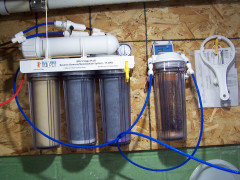
    .... the right watering frequency with distilled water are probably all that I can do. Ever consider an R/O filtration system? It is an easy set-up - have one in my basement.

    I use it for plants, drinking water, for cooking, and especially for coffee/tea.

    https://www.bulkreefsupply.com/5-stage-premium-plus-100-gpd-ro-di-system-bulk-reef-supply-bundle.html


    Do you have an online presence anywhere where I could follow you? No, sorry. I spend too much time online as it is. I really enjoy helping people get more satisfaction from the growing experience. I think that in large part it's because information wasn't always right at my fingertips when I was learning, and now that I have the basics under my belt and am learning more each day, helping others to quickly acquire the basics seems like a natural extension of my own growing experience. Today, someone can learn in a month of investigation what took several years to acquire when a text book was the only source of info, so it's pretty easy to consolidate the most important things in one place.


    Good luck. I like your attitude!


    Al

  • 3 years ago

    Or, you could make 2 watering basses.

    Aww I like this solution.


    I have considered an R/O system, but was overwhelmed by the options and the anticipated learning curve. This looks pretty straight forward. Thanks for the recommendation! It would make sense for me since I'm already purchasing distilled. Would probably save me money in the long run.


    I followed you on here (which I hadn't realized I could do). Really glad I posted my question on here and got a response from you.


    Hey one more question. I just read your awesome post about soil media/water retention. When you purchase a plant (or up-pot a plant) do you remove as much of the soil media that it came in as possible?


    Canaan

  • 3 years ago

    I have considered an R/O system, but was overwhelmed by the options and the anticipated learning curve. This looks pretty straight forward. Thanks for the recommendation! It would make sense for me since I'm already purchasing distilled. Would probably save me money in the long run. The link I provided is a step up from the unit I have, as mine only makes 75 gallons per day. It's what I would buy if I were buying one today. This one is even faster https://www.bulkreefsupply.com/5-stage-premium-plus-150-gpd-water-saver-ro-di-system-bulk-reef-supply-bundle.html if you don't mind spending the extra $40. I think it comes with a saddle tap that allows you to tap into any copper cold water supply line. The tap has a valve, so if you move you can take the system with you, but the tap stays. It's really simple to install as all the fittings are slip fittings and the tubing is flexible poly.


    Thanks - I appreciate you following me.


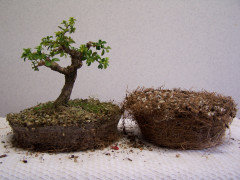
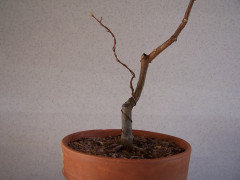
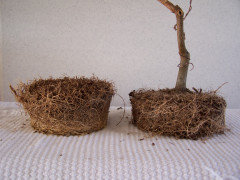
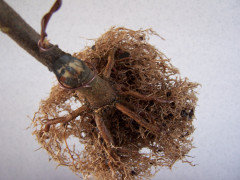
    When you purchase a plant (or up-pot a plant) do you remove as much of the soil media that it came in as possible? I bare-root most of what I repot except for conifers. I've had a lot of repotting practice (>5,000 repots) so unless you're practicing bonsai, you needn't be as harsh as this sequence.


    Another sequence: This Japanese maple tree (from seed) is in the process of being air layered off of a very ugly root system (roots and trunk flare are an important feature of quality bonsai trees)


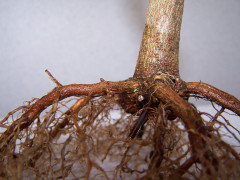
    In the image below, you can see the old ugly roots and the new roots perfectly spaced and radiating horizontally away from the trunk.


    Below, all the root pruning is finished and the old roots sawed off of the tree. Note the tourniquet wire that was part of the layering process

    If you have any questions about repotting, please ask before you jump in. Timing is important and it is species or genera dependent. There are other tips and tricks I can share as well.


    Good luck! Thanks again for the follow!

    Al

  • 3 years ago

    This is blowing my mind. Bare root. Sheesh. :) I'm about to repot a big camellia from its growers pot into a ceramic container. Let me know if you have any tips. I typically just loosen the root ball at the bottom. Something tells me that could be improved...

  • 3 years ago

    How big is big? Do you have a sense of how congested the roots are?


    Most growers have an innate fear of doing anything to disturb the roots of their plant, thinking that messing with the mysterious appendages cloistered in darkness in the soil and of sight will surely kill the plant. In reality, the stress of root congestion is many times more likely to end in the plant's demise than an appropriate repot that includes root pruning. Potting up, even if you prune off the bottom of the root mass and trim around the perimeter, only partially relives the stress of root congestion. The "uptick" in growth rate and vitality you see after potting up shouldn't, under any circumstances, be viewed as a "growth spurt"; instead, it reveals how the plant could have been growing all along has the grower understood how limiting root congestion can be.


    I put together a numerical method of comparing the difference between repotting with appropriate rootwork and potting up.


    Repotting vs Potting Up

    I often explain the effects of repotting vs potting up like this:

    Let's rate growth/vitality potential on a scale of 1-10, with 10 being the best. We're going to say that trees in containers can only achieve a 9 because container culture is inherently somewhat limiting. Let's also imagine that for every year a tree goes w/o repotting or potting up, its measure of growth/vitality slips by 1 number, That is to say, you pot a tree and the first year it grows at a level of 9, the next year, an 8, the next year a 7. Let's also imagine we're going to go 3 years between repotting or potting up.

    Here's what happens to the tree you repot/root prune:

    year 1: 9

    year 2: 8

    year 3: 7

    repot

    year 1: 9

    year 2: 8

    year 3: 7

    repot

    year 1: 9

    year 2: 8

    year 3: 7

    You can see above that a full repotting and root pruning returns the plant to its full potential (within the limits of other cultural influences) for as long as you care to repot/root prune.

    Looking now at how woody plants respond to only potting up:

    year 1: 9

    year 2: 8

    year 3: 7

    pot up

    year 1: 8

    year 2: 7

    year 3: 6

    pot up

    year 1: 7

    year 2: 6

    year 3: 5

    pot up

    year 1: 6

    year 2: 5

    year 3: 4

    pot up

    year 1: 5

    year 2: 4

    year 3: 3

    pot up

    year 1: 4

    year 2: 3

    year 3: 2

    pot up

    year 1: 3

    year 2: 2

    year 3: 1

    This is a fairly accurate illustration of the influence tight roots have on a woody plant's growth/vitality. You might think of it for a moment in the context of the longevity of bonsai trees vs the life expectancy of most trees grown as houseplants, the difference between 4 years and 400 years lying primarily in how the roots are treated. Most perennials we grow as houseplants are capable of outliving their counterparts in situ, but how often have you ever seen that to be the case?


    Al

  • 3 years ago

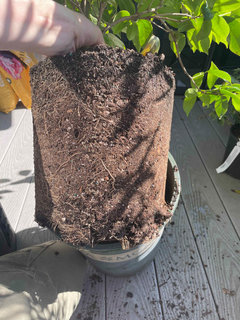
    That all make sense! Below is a photo of the root ball. The roots are established, but don't appear to be super congested. The new container is 2.5 to 3 times larger than the growers pot. I'm planting ground cover over a the top of the pot with the objective of it covering the surface and trailing down the side of the pot, so I want to it to be repotted for the long haul.


    So with proper root pruning, can a plant live in the same sized pot indefinitely?


    Any guidelines to follow for root pruning?


    I can't tell you how helpful this is!


  • 3 years ago

    Your plant isn't going to like being over-potted. Root congestion at that stage has already limited growth and vitality. If it was my plant, I'd saw the bottom 1/3 off the roots, rake out the perimeter of the remaining root mass to expose about an inch of roots, then trim those roots back with sharp scissors before returning it to the same pot with a bit of fresh soil at the bottom and sides, and wait until next year to do the repot. You could slip the nursery can into the pot you had planned and establish separate plantings for your other plants.


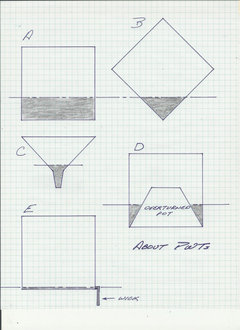
    When you repot, I would either buy a smaller pot or make sure you use ballast in the bottom. Ballast takes up space and when used correctly, can do a very good job at reducing the amount of excess water a planting can hold. Example:

    Compare D to A to see how helpful ballast can be in reducing water retention. The shaded part represents perched (excess) water.


    Al

  • 3 years ago

    If it was my plant, I'd saw the bottom 1/3 off the roots, rake out the perimeter of the remaining root mass to expose about an inch of roots, then trim those roots back with sharp scissors before returning it to the same pot with a bit of fresh soil at the bottom and sides, and wait until next year to do the repot.


    Why would you wait until next year to do the repot? Do you mean that next year you would change the vase?

Sponsored
AIS Renovations
Average rating: 4.5 out of 5 stars15 Reviews
Custom Craftsmanship & Construction Solutions in Franklin County, Ohio