Software
Houzz Logo Print
hz64

Fake chimney as vent

3 years ago
last modified: 3 years ago

I just built a house. My architect put all vents (HVAC, dryer, etc) through a fake chimney on the roof. My contractor told me it is kinda dangerous and he was worried about debris from the dryer trapped in the chimney which could cause fire.

Is this a valid concern? Should I re-route the dryer vent through another openning on the roof? My architect was pretty adament in not having extra openings. But again, he also wanted the vent hood in the kitchen to go there through a longer distance, instead of having a straight up vent, which I chose to do, so I am not sure he was being practical.

Comments (15)

  • 3 years ago
    last modified: 3 years ago

    Your architect sounds like he is more about style than practicality, safety and function. Is the kitchen vent hood at an exterior wall? Ours is for example, on a side wall not the front. Our exterior is all brick and stone, so the vent is installed to be harmonious with the brick. Our dryer vent exhausts to the roof, but it is a vent that serves it, and only it. Very essential to have it regularly cleaned to prevent the accumulation of lint indeed catching fire. Your contractor sounds like he is trying to take care of you and your investment.

  • 3 years ago

    Roof-top dryer vents are the worst route for several reasons, including dryer efficiency. Dryers should be located on an exterior wall for the venting path being direct through as short as possible. Mine is such that I can reach through the hood and the very short ducting and touch the dryer's blower wheel, which is at the outlet port on rear of the dryer. I can dry a set of queen size sheets with four pillow cases in 13 mins + cool down time.

  • 3 years ago

    The dryer is in the mud room which does not have an external wall except a narrow side door. It's kinda too late for that now. My question is more about whether a fake roof chimney is safe vs a separate opening. I am not particularly familiar with how fake chimney works, but from outside look it has a cap. There might be some air circulation for it but my contractor said for bigger debris (such as possibly from dryer) it could accumulate over time and become a hazard.

  • 3 years ago

    "Your contractor sounds like he is trying to take care of you and your investment."


    Yes. I already paid him everything and moved in, and he just told me he has been thinking about this and got concerned. He is a good guy.

  • 3 years ago

    Lint is always discharged from a dryer exhaust. The machine's filter doesn't catch all of it.

  • 3 years ago
    last modified: 3 years ago

    At the least, dryer efficiency will be severely impacted. At worst, you'll have a fire. Air circulation above a bunch of exhaust vents doesn't change either of those conditions.


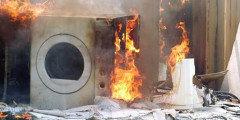
    A bit of lint. Big deal! credit: Green Building Media

    Our current house was vacant for a year as a previous owner re-built it after a dryer fire.

    Ironically, the dryer we took over has a long twisty corrugated exhaust to a vent designed for air only. I clean it out every three months max.

  • PRO
    3 years ago

    We simply don’t have enough detail. Does each appliance have its own duct all the way to the exterior of the fake chimney? If so absolutely no problem. Does the dryer, a few baths, and a kitchen vent hood all join into one masonry duct up to the roof combining lint, moisture, and grease into a flammable miasma? Terrible idea.

  • 3 years ago
    last modified: 3 years ago

    Second-floor laundry rooms, the go-to look for larger new homes, fuels some of these terrible designs--long runs and no easy way to clean the outlet.

    In our current house mentioned above, the dryer duct exits at grade but hadn't been cleaned in years--I dug out 8-10 inches of lint stretching from the vent cover to inside the ducting.

    Not to mention the front-loading washer with a detergent tray black with mold. The house was home to two physicians!

  • PRO
    3 years ago

    Dryer vents normally do not vent out of a roof surface. Only vents that normally vent out a roof surface should go into the fake chimney.

  • 3 years ago
    last modified: 3 years ago

    In case anyone might be interested, although the common definition of "vent" is "an opening that allows air, gas, or liquid to pass out of or into a confined space", for US building systems, a distinction is usually made for gravity plumbing & gas systems vs fan powered indoor air systems, the former called "vents" and the latter called "exhausts".

    IRC Chapter 15 Exhaust Systems (clothes dryers, range hoods, & mechanical ventilation) doesn't use the term "vent"; it's only found in the plumbing and gas appliance chapters.

  • PRO
    3 years ago
    last modified: 3 years ago

    IMO the architect is wrong to vent or exhasut the dryer through the roof I have no ide what a fake chimney is since this seems to be an actual chimney used to vent stuff so IMO an actual chimney ot flue


    A flue is simply a passage for conveying exhaust gases from an appliance to the outdoors. A flue may be a duct, pipe, vent, or chimney. An unlined chimney is technically a flue, even though an unlined chimney is a fire hazard. This can cause confusion, as many view flues not just as a passage for venting, but as a safe passage for venting.

    .

  • PRO
    3 years ago

    There are airflow calculations for both the kitchen hood and dryer vent. These should ahve been supplied by the architect to support this design as a part of the permit plan review. The dryer vent should be inspected regularly & likely cleaned.


    Simple is better for both vents.

  • 3 years ago
    last modified: 3 years ago

    The IRC requires an exhaust from a clothes dryer to be in a 4" nominal diameter metal duct (min. 28ga.) with an exterior termination with back draft damper as specified by the manufacturer. It cannot exhaust into a flue and I don't see how an approved termination could be mounted inside a fake chimney.

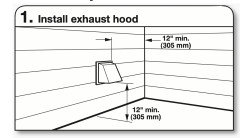
    Here is a typical manufacturer's exhaust termination restrictions:


    I've not seen the installation instructions for a roof top termination.

  • 3 years ago
    last modified: 3 years ago

    The dryer exhaust termination should be moved if it can't be easily cleaned or it's too close to something. A photo would help.

    But from your description, "all vents (HVAC, dryer, etc)", I'm not sure what else is actually up there.

    What do you mean by "HVAC"? Is there a range hood exhaust or a fireplace or water heater gas vent? I assume there's no chimney for a wood burning fireplace.