Software
Houzz Logo Print
triplelake

HVAC replacement quote - Rheem vs Bryant

3 years ago

We are replacing the 2 old HVAC systems in the house, one is 2 ton and another one is 5 ton. We are down to the following 2 quotes. Both installers have similar good ratings on yelp.


Quote 1: Rheem: $25K

1 RHEEM R801T 050 3A14 UHSNSA upflow 80% 50,000btu furnace

1 RHEEM RA14 AZ24AJ1NA 410a 2 ton 14 seer condenser

1 RHEEM RCF 2414STAMCA 2 ton cased coil

1 RHEEM R801TA 125 524 ZSB downflow 80% 125,000btu furnace

1 RHEEM RA14 AZ60AJ1NA 410a 5 ton 14 seer condenser

1 RHEEM RCF 6024STAMCA 5 ton cased coil

Quote 2 Bryant: $21K

Installer didn't provide the exact model numbers

Furnaces are 801SA.

Air conditioners are 115SAN.

Coils are CVPVA----XMC.


Quote 1 Rheem has an upgrade option for extra $4K:

1 RHEEM R802TA 125 1524 ZSB downflow 80% 125,000btu 2– stage furnace

1 RHEEM R802TA 050 1314 ZSB upflow 80% 50,000btu 2– stage furnace


Quality wise, are Bryant and Rheem similar? Which one of these is the better option? Is 4K a fair price to upgrade to 2 stage?


Comments (11)

  • PRO
    3 years ago

    The Rheem and the Bryant listed above are both rated to be at least 14.2 SEER2 depending on configuration and overall capacity of the machine in question.


    The Rheem model(s) you posted is a basic entry level condenser at the current minimum threshold for efficiency the 2 ton will rate higher efficiency wise because of it's smaller capacity. It appears the 5 ton could hit somewhere in the realm of 15 SEER2 which isn't bad for an entry level AC unit, depending on configuration of the system and other factors.


    Rheem makes another unit with HP at the end of the model number, which includes high and low pressure switches that shut the unit off in case of a high pressure or low pressure event (refrigerant pressure). As the unit ages these switches can often times become problematic, but they can also save a compressor. So it may be worth asking about this if this is a forever home.


    The Bryant looks to be quite similar in efficiency to the Rheem. It's a matter of choice and a matter of opinion... at the end of the day they all break. So to say one is better than the other in terms of reliability? I wouldn't go that far.


    Yelp: the bigger the family you have, the more likely you win with yelp. The price of not requiring your posters to be verified. If you're not verified you don't know the reviews are real... in a fake world. Caution trusting some place like that.


    Service & knowledge of systems is what primarily dictates a good experience from a bad one in HVAC. (There may be those who don't like this type of statement and it's likely because they don't offer real service... so take it for what it is if other opinions cloud your decision further.)


    Service after the sale is a thing, especially now because the refrigerant these systems use to cool is about to go extinct for two new refrigerants that aren't quite here yet. (2025 currently)


    If you're in the position to wait this out... it won't end there either as in order for the US to reach the Kigali amendment targets the two new refrigerants won't hit those goals. The common rebuttal to this is hey I have a warranty. If the system springs a leak, there is no warranty on refrigerant from any manufacturer. 3rd party extended warranties don't cover it either. Most people don't read the fine print, make sure you know what you're getting into. Limitations and exclusions are a big part of any warranty scheme.


    I have a 5 part series on the subject if you want to see why all this is happening. (I know you probably are going to have to pick something, but because of what is coming a brand name doesn't mean much these days in the grand scheme of things.) Service is where things drop of a cliff in this business.


    I service the Katy, Texas area.

  • PRO
    3 years ago

    If you'd like a summary of the phase down of HFCs without the political bias and cartoon characters, EPA published a very readable 8 page document that will bring you up to speed--and in a lot less time https://www.epa.gov/system/files/documents/2022-12/TT%20Rule%20NPRM%20Fact%20Sheet%20Final.pdf

  • PRO
    3 years ago

    "The Rheem model(s) you posted is a basic entry level condenser at the current minimum threshold for efficiency the 2 ton will rate higher efficiency wise because of it's smaller capacity." Efficiency ratings (SEER or SEER2) are independent metrics that aren't capacity related. Stated otherwise, SEER and capacity ratings have nothing to do with each other. The 2 ton unit won't rate higher efficiency wise because of its smaller capacity.

  • 3 years ago
    last modified: 3 years ago

    What is the size, age, and location of your house? I am skeptical you need 7 tons for cooling and 175,000 BTUs of heating. If you are in a cold climate then I question installing 80% efficiency furnaces. If the installers only want to copy the current sizes then you need the find an installer who will do a load and duct sizing calculation. I suspect the equipment is over sized and the duct work is undersized.

    Once you have the proper sizes then you can concentrate on specific equipment features. Quotes which do not provide equipmemt model numbers are incomplete in my opinion. I view this as a negative on the contractor.

  • PRO
    3 years ago
    last modified: 3 years ago

    The 2 ton unit won't rate higher efficiency wise because of its smaller capacity. (from the builder above)

    The rebuttal:

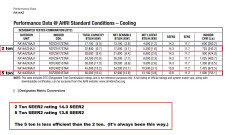
    Then this RHEEM white paper is wrong Charles... please contact Rheem tell them they made a mistake. (I'm sure it was an "honest one" --- you know like the mistakes you make on a regular basis... ha, ha.)

    click to enlarge. (put on your reading glasses Charles)


    SEER2 just as with SEER --- the larger the number the more efficient it is.

    (PS: the efficiency rating is and can be effected by a number of factors (regardless whether you use SEER or SEER2 calculation... this chart only takes into consideration the coil and condenser.)

    The EPA lied to you before about R410a being environmentally friendly. The government lies to you about a host of other things just recently (like the past 2 years as a prime example). The video I provide holds them and everyone else accountable.

    You can always do as you wish... if you're building new, the builder is not likely coming back after about 2 years 9 times out of 10.


    You'll never be able to say that I didn't warn you about what is coming in HVAC. ~Ray Austin.

    If you do --- I will point you to the video that will probably be much longer later. (developing story, some call it history.)


    *Buckle Up*

  • PRO
    3 years ago

    HVAC manufacturers produce systems in a variety of configurations. You can purchase a 2-ton capacity system in a range of efficiencies. Ditto for a 5-ton system. A smaller capacity system isn't inherently more efficient. SEER rating and capacity are independent metrics. Here's a link that explains it. Check back if you need help with any "big" words. https://learnmetrics.com/ac-seer-vs-tonnage/#:~:text=A%2016%20SEER%20unit%20can,5%20tons%2C%20and%20so%20on.

  • PRO
    3 years ago

    Charles you can spin your lies / blow your smoke anyway you want, that doesn't make them any more truthful.


    In this example above we are comparing two of the same models with different capacities. The smaller capacity unit is more efficient for the exactly the reason you said it wouldn't be. If you're not happy about your inadequacies Charles there's a lumber stack some where that you can beat some nails to death to take out your frustations. (ha, ha)


    You're a builder --- you can pretend to be more than that... but it's still pretending.


  • PRO
    3 years ago

    Ray,

    Whether you intended it or not, your statement "..the 2 ton will rate higher efficiency wise because of it's smaller capacity." The word "because" indicates a causal relationship between efficiency and capacity. There isn't any. The 2-ton unit may be more efficient, but it's not because of its smaller capacity. The confusion of efficiency and capacity is fairly common and your post is evidence it's not limited to consumers.

  • 3 years ago
    last modified: 3 years ago

    My observation has been that larger capacity condensers (all other things being equal) struggle to meet the efficiencies of their smaller capacity brethren. But back on topic, both systems would appear to be lower line systems, for which the prices quoted seems pretty steep.

    Edit: The Bryant may be the better performing.

  • 3 years ago

    You posted options to upgrade the furnace from single stage to two stage. If you did that, shouldn't it the upgrade be accompanied by an upgrade of the condenser from single stage to two stage (e.g., RA14AZ24AJ1NA to RA1724AJ2NA)? I have a two-stage package heat pump. Most of the time it operates in stage one which allows the blower to operate at low speed and makes the system almost silent. When it switches to stage two, the blower runs at a higher speed and one can hear the whoosh of air from the registers. Of course, whether such an upgrade is worth it would depend on the length of your cooling season and other factors.