The spring rose flowering is done. The warm climate roses around the house, the first to bloom, have made new growth and entered on a modest second flowering, the roses less full, and more deeply colored, than those of April and May. DH and I are rebuilding a pergola.
This is the one that runs along the perimeter of the paved terrace in front of the second house. The paved terrace doesn't look as paved as it used to. It's overgrown with grass, clover, and weeds that sprout from the cracks: a good thing in my view, as the vegetation dampens the intense heat that comes from the interplay of sun and stone. The terrace has turned into the home of my pot ghetto, after we had foundation work done on our main house last year and had to move away the plants that lived under the wisteria pergola in front of the house; so off they went to the paved terrace. And there they stayed, as I like having a living space in front of the house under the rebuilt--not as well as I could like, though it is sturdy--wisteria pergola. The living area is still potential only, but I hope to tidy and furnish it one day.
The pergola of the second terrace was built to accommodate the roses living under the wall that holds up the terrace, they having grown and grown: 'Mrs. B.R. Cant', 'Duchesse d'Auerstaedt', and, hugest of them all, 'Mme. Alfred Carrière'. (First in line is 'Mme. Antoine Mari', but she lives up to her reputation as one of the smaller Teas and is only about two meters in all directions.) DH built the pergola several years ago out of whatever he found to hand, a motley collection of rebar, bamboo, and lengths of wood. Lately it has been showing signs of weakness and decay, and I decided it was time to rebuild it, in a more orderly fashion. Off went my order to the local rebar factory, and yesterday I picked it up, stout stakes of 1m x 12mm, and 3-meter pieces, shaped as an L, with the short side 1 meter. These L-shaped pieces are tied or bolted either to the terrace railing or to the stakes which are driven into the terrace (the holes were drilled for the original pergola), then the overlapping short sides tied together at the top, making a shape two meters tall and a little over a meter wide. These U-shaped forms are then tied together with horizontals made from whatever is at hand, mainly the rebar from the old pergola or bamboo. Most of the ties are baling twine. This is a material that exemplifies all the virtues and vices of modern materials: it's strong, practically eternal, and easy to tie; also cheap or rather, free, since we live in an agricultural area and can scavenge it. After starting taking apart the old pergola I think DH is ready to swear off plastic-coated wire, to which he has always had an irrational attachment.
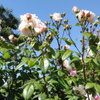
I've been cleaning old growth out of the pergola roses. It was due, particularly 'Mme. Alfred Carrière', as she's so large that I really need to apply myself to her: casual snipping just isn't enough. Armful after armful of yellowed aged canes are going down to the compost heap below the terrace. Once I've gotten most of the aged growth out, I can think about retraining. A good deal of MAC is arching down onto the pittosporum and buddleia below her, and that's fine, as long as there are enough canes to cover the pergola as well. She's also getting into the semi-columnar oak that we planted by the pergola on the inside edge. I guess I'm going to find out whether MAC is actually indeterminate as someone on the forum--was it Kim?--once claimed. She's perhaps twenty feel wide and deep, a little less vertically perhaps. Big. She's a big gal.
'Mrs. B.R. Cant' makes a fine climber. I'm hopeful that 'Duchesse d'Auerstaedt' will continue to make new growth as she's been doing this year, and return to being the vigorous climber she used to be. I cut her back hard once in pre-pergola days as she was sprawling all over the terrace, and she didn't like it and has been puny for several years. This year may see a change for the better. She's a fine rose when happy, rich golden yellow, very full.
A little further along under the paved terrace is the bay laurel. This is a massive, multi-trunked tree that gives important shade and protection from wind. It grows out and out and has been shading areas where I wanted other things to grow, so recently, as best I could, I gave it a haircut. Parts of it I just can't reach, but I cut pendulous branches higher, working with loppers from the ground and then from a stepladder set up on the level ground below the laurel. and shearing the laurel where it was encroaching on the terrace above. It gives as much shade as before but there's more space below it now, a world of its own. Years ago I planted a bed of Ruscus hypoglossum below the laurel, a handsome foliage plant that will grow in the driest of dry shade, which is exactly what you find under a mature bay laurel. Last fall I extended the bed with more of the Ruscus, which when it will have matured will give the area a more complete look. I'm thinking about more Ruscus in other blank areas under the bay laurel, and Alexandrian laurel, another dry shade foliage plant, for a larger empty spot. A little further out are two plants of Daphne odora 'Aureomarginata', rooted from cuttings and planted years ago in another bed terraced in masonry by DH, and grown into as handsome shrubs as anyone could ask for. I've wanted another one below these, and over the winter I managed to root some more of the Daphne, so will be able to add the plant to fill the hole. Between one thing and another, if nothing goes wrong, I think it will be quite a satisfactory area.
.


 3 years ago
 3 years agolast modified: 3 years agoMelissa Northern Italy zone 8 thanked Ingrid_vc zone 9b, San Diego Co. inland


User