Software
Houzz Logo Print
upperbaygardener

mysterious redwood (Sequoia sempervirens) leader issue

3 years ago
last modified: 3 years ago

Ok...without rehashing the endless discussions over the past 20 years on GW concerning the hardiness of Sequoia sempervirens, I'll say I'm asking about a specific odd phenomena that is going on with one plant of one cultivar in my garden. No S. s. has ever been seriously injured here, and it hasn't been below 0F since I started gardening at this location.

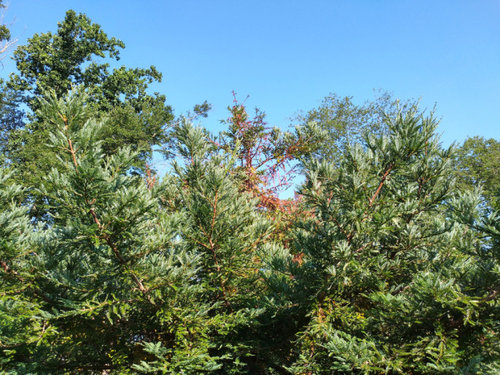
Here is the top of my 'Soquel':


This plant was growing normally before the polar vortex winters. NB that in another, equally low and cold spot in the garden, I have a 'Chapel Hill'/'Swarthmore Hardy' that DOES NOT have this issue, although it started as a smaller plant, and has remained smaller, although it's now probably approaching the height of this one, if not higher.

In PV-1, 2012-2013, its top was clearly burnt. The odd thing is since then, it's as though it has NEVER fully recovered! That was 10 years ago! The plant just keeps getting wider and wider, and only slowly growing upward. This dead needle look has been there, on and off, since then.

So here are the possibilities to consider:

1) it's just not hardy enough and this tip damage is going to be an on-going manifestation of that (the bboy/embo preferred answer, no doubt)

2) the top of the trunk was somehow damaged in the freeze and the plant is still struggling after 10 years to deal with the damage. Taking a chainsaw and cutting back to undamaged wood might help it 'reboot' and start forming a new, correct leader

3) this is some kind of 'insect preferentially attacking a conifer's leader' issue, which is known to happen with Picea abies on the east coast, although I completely forget the details. It was something spruceman used to discuss.

4) some nutritional or other biotic factor is discouraging it from re-forming a leader promptly

3) this is actually spring freeze damage. I highly highly doubt that is the case, because there are so many spring freeze sensitive things nearby. This Dunkeld Larch has been there as long as the Sequoia and has NEVER needed to have a split leader trimmed.


Also nearby is my larger Abies firma. It only lost a leader one year since 2010.

Since 'Chapel Hill' is fine and has a normal narrow Christmas tree shape, it could simply be that, although they superficially seem similar in hardiness, 'Soquel', collected near the southern end of the species range, is just somehow not suitable for my climate. I'm fine with that because...

The final ironic twist is that since this is an an area of a garden with - in fact this tree is literally surrounded by:

1) Taxodium X 'T406'

2) Taxodium X 'T502'

3) Abies pindrow

4) Abies firma

5) Larix X eurolepis

I've decided that if it were to grow to large size, it would make things too gloomy. So I'm probably going to remove it anyhow. HOWEVER, the scientist in me (!) wants to get to the bottom of why it has taken on this ridiculous 'wide Putin' growth habit. (google it for a fun meme)


BTW my rough estimate would be that it's about 10' tall at this point, but 12' wide!

Comments (7)

  • 3 years ago
    last modified: 3 years ago

    Wow, didn't know you were successfully growing some coast redwoods. Obviously, I have no experience. Redwoods are good sprouters -- are any side branches below the dead part trying to curve upwards? Could you try tying up one of the side branches to the dead part to encourage it? I know, 10 ft up could be a problem, but I did that to my southwestern white pine (borer damage) at prb'ly 8 ft up. Can't really see the trunk-displacement on it today.

    UpperBayGardener (zone 7) thanked bengz6westmd
  • 3 years ago
    last modified: 3 years ago

    You know, on second thought, it's not so dramatic as I made it out to be.

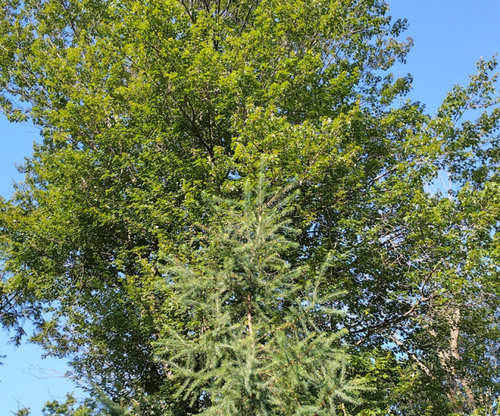
    This tree is on a slight hillside ending in the lowest spot of my property, which according to google earth has about 25 ft. of elevation change from highest to lowest. Because of that I'm usually standing 2-3' higher than the trunk when viewing it. It creates an illusion it is shorter than it is. It is probably closer to 15'-18'. It is recovering a leader, the question is just why it is going about it so slowly.

    Here's a pic taken from a ladder on the other side to balance things out. To the right is the perfect cone shaped top of my Abies firma now hitting 30'.


    At any rate, it's fate is still sealed. I'm going to try to ground layer it starting this weekend. That process could take up to 2 years, but once I have well rooted replacements, it will get the chop and be ground up in my tree guy's fearsome gigantic Vermeer chipper to make what I'm sure will be some nice smelling mulch. There are just too many large trees in this area - there are others I didn't even mention earlier. A clone will be planted in a less critical part of the garden where the 'Chapel Hill' is growing well. This is the 'prestige woodland' area with my best rhododendrons, BLEs, etc. so I can't really afford plants that are in some way not performing here. If 'Soquel' continues to pull a 'wide Putin' in the new location, it will be deaccessioned as in some way unsuitable. Nobody wants a redwood tree to be short and squat LOL.

    (which reminds me when I removed a branch of a huge maple to the right of this view, all the rhodies now behind this Sequoia flowered better.)

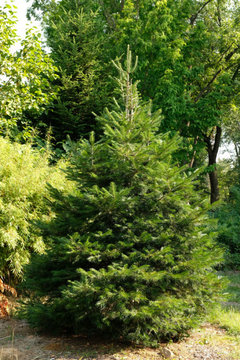
    Here's a closer pic of the Abies pindrow just to show how it's coming along. Along with the A. firma there's only been one year its leader was so damaged by a spring freeze I had to restore it to a single. This was about 2' when planted, the firma was 6'.


  • 3 years ago

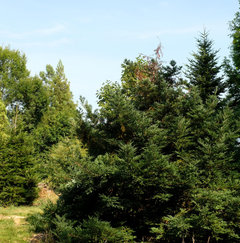
    Stunning collection of conifers. On the 1st pic of your second post, what are the 2 conifers that tower upward about 1/4 of the way right from the left edge? One looks like a cryptomeria? And the other a pine?

    UpperBayGardener (zone 7) thanked bengz6westmd
  • 3 years ago

    ' There are just too many large trees in this area '


    Reason enough imo. Time to 'Edit'.

    UpperBayGardener (zone 7) thanked BillMN-z4a
  • 3 years ago

    Yes beng, the Cryptomeria is my one 'Yoshino'. The other 2 large Cryptos I have elsewhere in my garden are 'Radicans'. Main difference seems to be that the 'Radicans' are a little bluer, though surely not blue enough to be considered glaucous.

    The pine appears like it might be in front of the Crypto, but it's actually behind it! It's needles are so big it creates another illusion of being closer. It's my likely 'Sonderegger pine', meaning a hybrid between longleaf and loblobby. I think mine might just be 25% longleaf.


    To the very, very far left you can see just a bit of foliage of my 'Sekkan Sugi'. Interesting story about that. There used to be a huge, 80' hemlock in the middle of this garden. The variegated sugi had lost all it's variegation. Embo at one time mentioned this was a known issue with some [large] variegated taxodicaceae although I don't specifically remember whether he mentioned it was related to shade. Anyhow, it's been about 4 years since I cut that hemlock down, and the variegation on the 'Sekkan Sugi' (which I think just means yellow sugi tree in Japanese) is coming back! Although it still starts fading in summer. I took a pic this spring from another angle, I'll post if I can find it, that shows off the yellow sugi. I was close to cutting it down because it seemed like a dud without the variegation...glad I didn't!


  • 3 years ago
    last modified: 3 years ago

    Yes, a "longleaf-like" look was my first impression of the pine. What caused you to cut the hemlock, the adelgid?

    I'm impressed by this planting of cryptomerias at Homewood rest/nursing home near Williamsport, MD. I never saw any browning even after a very cold winter. Not sure what cultivar -- prb'ly Yoshino.


    UpperBayGardener (zone 7) thanked bengz6westmd
Sponsored
J.Holderby - Renovations
Average rating: 5 out of 5 stars4 Reviews
Franklin County's Leading General Contractors - 2X Best of Houzz!