Software
Houzz Logo Print
webuser_995476270

Curbless shower to LVP transition

3 years ago
last modified: 3 years ago

EDITED: I really started this post looking for potential out-of-the-box thinkers, early adopter approaches, not more of the same old ”it can’t be done” because ”blah, blah, blah”. Think along the lines of Invisicook. If you don’t know what Invisicook is, you are NOT my kind of peeps!


ORIGINAL POST: Is there any new & improved way to transition from a tiled curbless shower to waterproof LVP flooring so that I don’t have to tile the bathroom floor?

Comments (25)

  • PRO
    3 years ago
    last modified: 3 years ago

    No can do. When creating a wetroom, the whole room has to be waterproofed and tiled. Now, if you don't have to raise the bath floor too much to accomplish the curbless, you can use a VINPRO at the threshold.

    Debi Lopez thanked DeWayne
  • 3 years ago

    In bathrooms with curbed showers or tubs/showers LVP is being installed all the time these days. I personally know a dozen people who have installed LVP in their bathrooms, just not those with a curbless shower. My understanding is that LVP is floating, therefore there would be no waterproofing underneath, is that correct?

  • PRO
    3 years ago

    Worse than no waterproofing underneath is where the waterproofed meets the unwaterproofed. Guaranteed water infiltration unless a long way from the wet area.

    Debi Lopez thanked Lomo
  • 3 years ago

    How is this topic related to kitchen Appliances?

  • PRO
    3 years ago

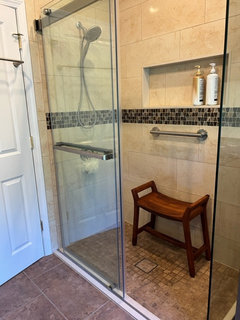
    The curb creates the barrier between the 2 flooring materials. When you are doing curbless - technically the same tile would go from outside the shower into the shower. You should be able put a quartz or granite saddle in the floor ( similar to a door saddle ) to transition between the 2 materials. It's not truly curbless - the saddle would stick up about 1/2 " - 3/4" depending on the thickness of the stuff around it. The shower glass then sits on the saddle.

    Of course this idea must be run by whomever is doing the work since they are liable for the outcome!

    Debi Lopez thanked Debbi Washburn
  • 3 years ago

    This is an ”aging in place” home design, so a saddle would totally defeat the purpose. I know I’m not the only home owner on the planet who HATES tile [grout lines - eew 🤢, slippery when wet - which is also not ”aging in place/senior friendly”, and is bone breaking hard on fragile seniors] and wants to carry the LVP throughout the entire home AND totally believes tile installers and flooring installers are someday going to come up with a solution to this dilemma. I was hoping maybe that time was now and I could be an ”early adopter” of this new technology.

  • PRO
    3 years ago

    You hav a curbless shower which means you have a wet room and that IMO only works with proper waterproofing on the floor and tile . Right now no way would I install LVP in this situation . BTW LVP just as lippery as tile when wet

  • PRO
    3 years ago
    last modified: 3 years ago

    You are stuck in the past and understand nothing at all about tile if you think it is slippery. Proper tile that is rated with a DCOF for a wet area, is not slippery. Modern high performance grouts, coupled with proper ventilation, make it easy to maintain.

    You also are not understanding the construction details of a curbless shower, which requires a continuous surface from room to shower floor There is slso a lack of any understsnding about the lack cushioning of vinyl installed on slab. It provides zero cushion.

    You have a lot of assumptions and beliefs that are not real world facts. Your kitchen and bath designer needs to have an education session with you about modern construction practices and modern materials.

    A properly built aging in place home has grab bars in multiple locations. If falling is still an occurrence even with high traction floors and grab bars, then independent living is no longer an option.

    Debi Lopez thanked Lomo
  • 3 years ago
    last modified: 3 years ago

    We are using micro-cement throughout our bathroom to include the curbless shower for aging in place. I don't have pics yet as work starts next week, but here is our contractor's website (and if you Google "micro-cement" you'll get other examples). It comes in varying degrees of "roughness" and a ton of colors. We're also doing it up the shower walls in a smooth finish. Also, NO GROUT! ;-)

    https://athertonmicrocement.com/about/

    Debi Lopez thanked BPMBA
  • PRO
    3 years ago

    A porous material that wicks water into your framing is a poor choice. Without an additional waterproofing layer, and a capillary break, micro cement is asking for water damage everywhere.

  • PRO
    3 years ago

    Your concept sounds great, but is not doable at all. Those vinyl floor float which means that water can get underneath them. And from there will suck up into the walls and you will have a major mold problem. The grout lines actually help with the grip of the floor. There are also tiles that texture and grip to them so they are safer for wet areas. Today there are grouts that don't need to be sealed - they are stain and mold resistant - you will want that. as far as being softer under foot, I would suggest really great floor mats that are non slip .

    As for the saddle in the floor - it does not stick up that much at all:


    Good luck with your project!


    Debi Lopez thanked Debbi Washburn
  • 3 years ago
    last modified: 3 years ago

    @Lomo - obviously there's a waterproofing layer going down first. It's also waterproof/sealed to be waterproof, depending on which product you pick & how you use it.

  • 3 years ago

    @Lomo You also seem to have a lot of assumptions about me. First, of course, grab bars (amongst many other features) are integral to aging in place design. I have been reading, studying, researching for two years BEFORE the design phase began. I have been speaking to professionals in all the trades, picking their brains for the best of the best ideas to implement in the house plan phase. Both my husband and I are in our mid 60s and neither are in need of these features now. However, we hope this is the last home we build and hope to live in it for as long as possible. We’ve included every aging in place feature, including an elevator, we can think of. We may never need any of them, but if either of us does, it will be there. We are now in the building phase, foundation is going up, and most of the design features have already been made. I’ve looked at so much tile, I KNOW what’s available.

  • PRO
    3 years ago
    last modified: 3 years ago

    Well, you have evidently not done enough research at all if you think a vinyl floor will prevent a broken bone from a fall. It won’t. It is actually slipperier than tile, so you would be more at risk for falling and breaking a bone with a vinyl floor than a tile floor.

    You also have not done enough research if you are making silly uninformed comments like “grout lines - eew 🤢, slippery when wet” Because that is wildly inaccurate. More grout lines provide more traction, which equals less slippery.

  • 3 years ago

    We are currently fighting with our tile and floor installer over this very issue! The tile guy installed a 1/2" thick piece of white Corian between the LVP and the stone shower floors leaving a ridge that would be both a "toe bumper" as well as requiring a person to lift a walker over the ridge. We have suggested using a piece of ceramic floor tile that matches the LVP as a transition strip in the threshold. Any thoughts?

  • PRO
    3 years ago

    Unless the lvp is glued directly to a concrete floor slab I wouldn't recommend using it in a bathroom with a curbless shower. Even then water will get up under the lvp and possibly create a mold problem.

  • PRO
    3 years ago

    Get that vinyl OUT of the bathroom. It doesnt belong. To do curbless requires a continuous, properly waterproofed, floor of the same material, from room floor to shower floor. Too many hacky contractors are trying to do curbless totally improperly, which WILL mean future water damage.

  • 3 years ago

    Thank you everyone for your opinions! I have checked with our LVP manufacturer Coretec and have been given the proper and acceptable construction details in which to accomplish what we desire. They are recommending a base of 100% silicone caulk be applied under a trim piece of our choice. This might be a strip of ceramic tile or Schluter profile or a piece of Coretec Trim or Transition.

  • 3 years ago

    Epoxy grout is the best in shower IMHO, no mold.

  • PRO
    3 years ago

    The detail given by the manufacturer is problematic. It will not prevent water damage. Water splashes outside of a small shower. If you do not have a waterproofing system into the room, then you get water damage. Your shower would need to be a minimum of 48” deep, with a trench drain at the far wall, to get a 2” fall from entry to drain. That is the only way to not have to waterproof the room as a wetroom. You need that 2” drop. You would still need to take waterproofing into the room 5”-6”, with a capilary break.


    Vinyl is only ”waterproof” in the sense that liquid water on top of it won’t hurt the vinyl. That ”waterproof” description is a lie, because water vapor underneath readily condenses into liquid water, and creates mold which damages it.


  • PRO
    3 years ago

    We do flush tile to LVP & tile to hardwood when possible so likely its the same detail except none of ours are near a shower.

  • 3 years ago

    The VIM Products folks are my plumber and tile guy - we did our curbless by recessing the concrete and then installing the VIM layer and water proofing. We them epoxy floor coated over the entire thing into the bathroom. Seamless - one flooring material throughout. The actual "waterproofing" stops at the shower glas wall though.


    If you are going for a curbless shower, I would recommend one material in your bathroom. Otherwise - you are asking for a bump / transition. Usually that's tile and that's what I would recommend here for a truly smooth floor.

  • 2 years ago

    People will tell you that you cannot combine flooring bathroom, but they will also say it is okay to have another floor in the next room. What really matters is the transition is well beyond the edge of your shower splash zone. With a curbless shower, the floor is sloped toward the drain. Think about the distance of your splash zone. If the entire area has a slope, and the entire splash zone is tiled, and you have really good water proofing in the transition so little to no water will ever get in the cracks, I think it is technically feasible. In my case I have a mudroom, bathroom, and sauna all next to each other. I am thinking of waterproofing and sloping the three small rooms as one floor, but with three drains. as long as every surface is waterproof, and every surface slopes to a drain, and I have no transitions anywhere close to a splash zone, I think it should work.

  • 2 years ago

    I've done a curbless bathroom (and researched and passed on Invisacook, since it just isn't there yet). Grout lines absolutely give better traction--that is why you see so many 1-inch square tiles in the shower. Falling on LVP is going to be slightly softer than falling on tile, but as others have pointed out, you are going to have problems with water underneath it.


    What about pouring an epoxy floor? That would be softer, and I would think avoid the water issue. You would need to build some traction into the top surface, but i imagine there are additives that will work. Go check out a nursing home and see what they do.


    Elevators are not the great things that you think they are and can be dangerous, particularly when grandchildren are in the picture. Add one later if you actually need it, but just stick closets in the spaces for now. Your property taxes will thank you, and you will have one less thing to worry about.