Software
Houzz Logo Print
bill_mn_z3b

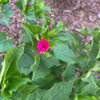
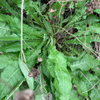
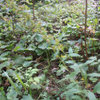
Aesculus of some variety?

2 years ago
last modified: 2 years ago

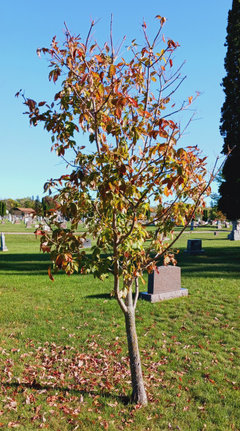
Saw this while biking through a cemetery today. 8-23-23:

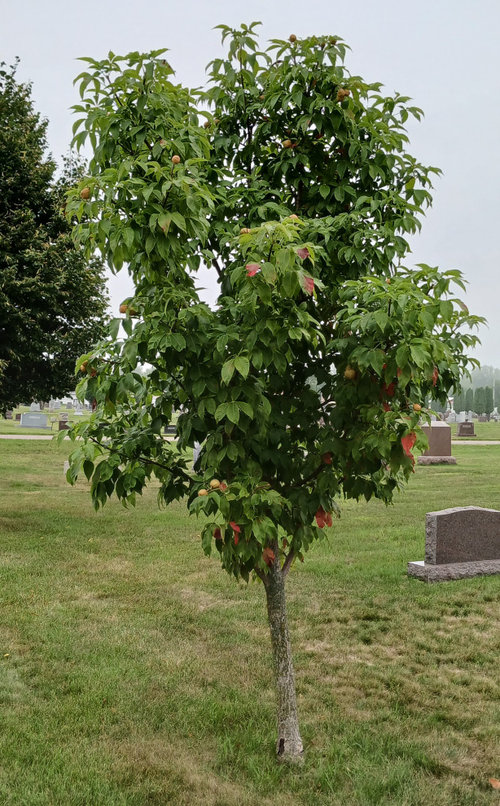
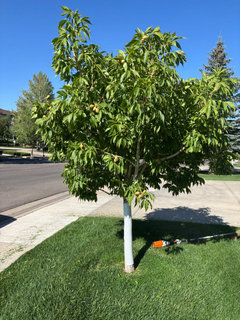
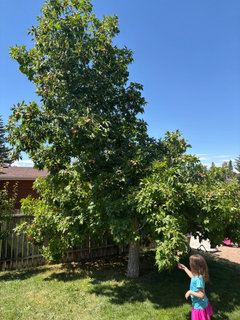
Whole tree:


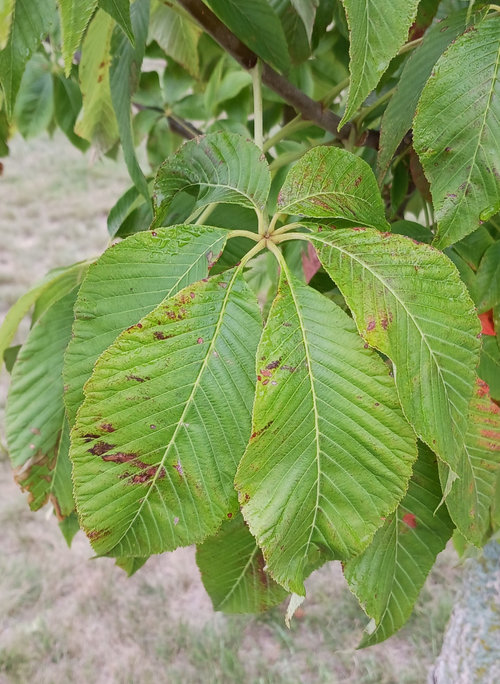
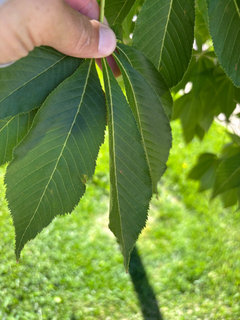
Opposite compound Leaves:


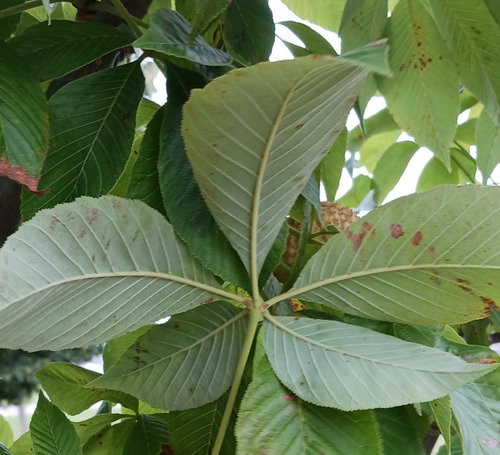
Leaves underside:


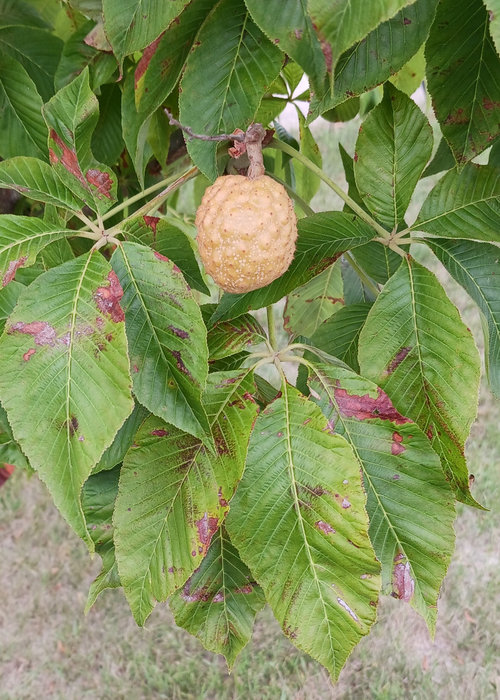
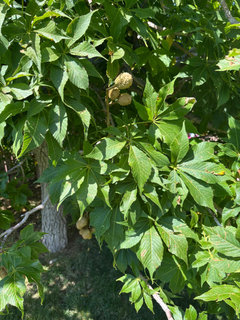
Leaves and Fruit:


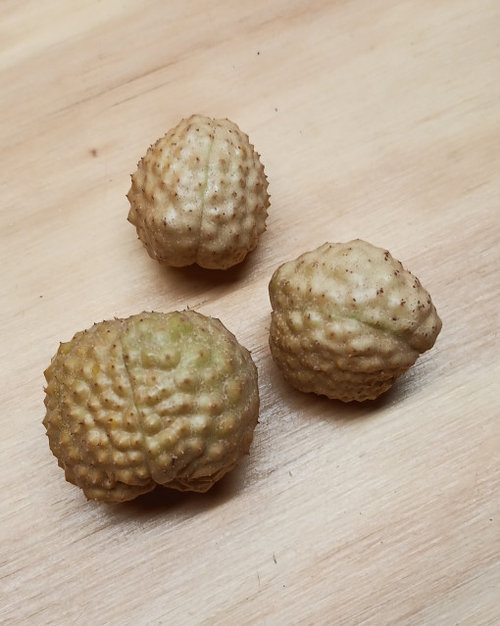
Fruit picked earlier this month:


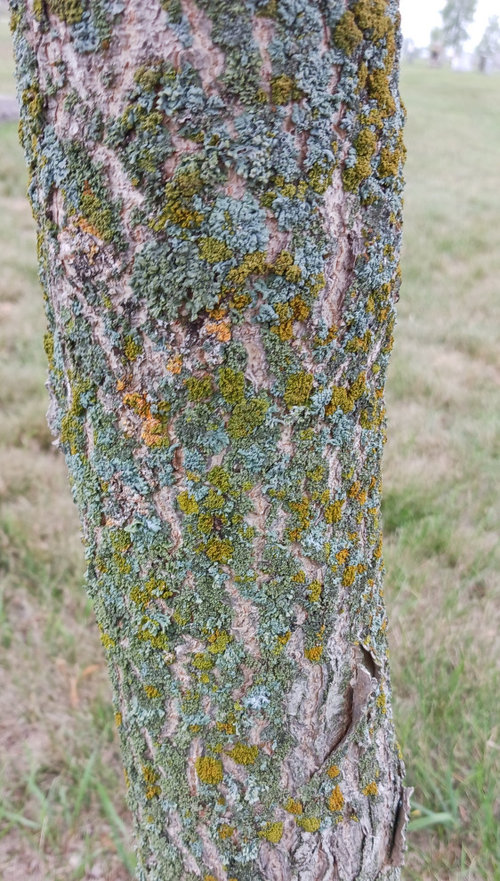
Trunk:


Any help making an accurate identification appreciated. ;^)

TIA:

Comments (107)

  • 2 years ago
    last modified: 2 years ago

    I'd see new leaves on yellow buckeyes well before the typical last frost and as frosts occurred see no damage and later bloomed normally.

    BillMN-z4a thanked bengz6westmd
  • 2 years ago

    That's good to know.

    I'm still struggling with whether or not I should plant this particular tree. But then I'll have time to think about it even after it's in the ground and growing.

    The final determination is whether or not any of these nuts germinate in the first place.

    Either way I'll have a nice planting spot for something next spring.

    ;-)

  • 2 years ago

    10-1-2023:

    Checked out the A. glabra tree today. There was conkers on the ground, husks broken open and scattered around. I first thought maybe the squirrels had beat me to them and possibly they had to some extent.


    The tree looked almost bare, but I lightly shook the trunk and the conkers just rained down. I was glad I had a helmet on. Some of the conkers husks were splittling open right on the tree and when they hit the ground, they broke open and scattered the buckeyes in the area.


    So, these nuts should be completely ripe and ready to plant in the ground.


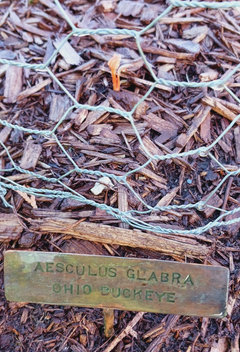
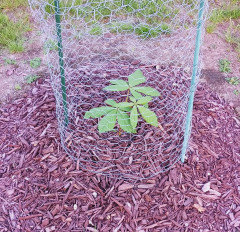
    I planted 4 nuts, one in the middle of my mound and the other 3 in a circle around that one, a few inches out from the center. Watered them down good and placed a squirrel deterrent over them.

    They should be able to meet the cold stratification requirements of 120 days.

    See you in the spring! :-)

  • 2 years ago

    10-7-2023:

    And just for 'Backup', and to check the germination rate of the seeds I collected over weeks, I planted several of the later picked buckeyes in a couple of pots and put them in a tote outside to stratify them, until next spring (these seeds were covered with an inch of moist peat moss on top of the peat based potting media).


    All put into a tote with a couple other test articles of green plants.

    Set out by the house and covered with several bags of wood mulch.


    Not as well insulated as my old in the ground cold frame.

    The seeds for stratification will be fine, the test will be to see if the couple of green, growing plants survive. I suppose it will make a difference if we get early snow and how low the temps go until spring.

    :-)

  • 2 years ago

    10-11-2023: just for the record.

    Went past the tree I collected nuts from yesterday and the tree was completely devoid of conkers. Nothing on the tree nor the ground. Didn't see any husks or anything except some leaves. It appears that Mr. squirrels were hard at work last week.


  • 2 years ago

    4-19-2024:


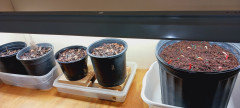
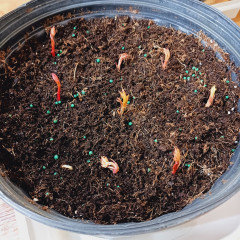
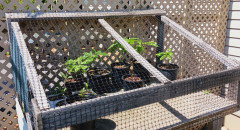
    With the warmer than normal winter/spring and the fact that back in March I had to steal a bag of mulch that was covering my tote 'cold frame', I moved everything from the tote over to the outside plant table about 3 weeks ago. Nice sunny days with no freezing temps at nights the whole time.

    Now with 3 nights in a row of 27df forecast, I moved all the pots into the house last night.


    The little first year lilac (syringa vulgaris, left) from last fall, did defoliate in the cold frame but then sprouted new little leaf buds by the time I removed it from the tote early April. Hardy!


    Next left to right, Picea glauca seedling, I grew on the bench all last summer, is a little off color but has buds that have been swelling now that its outside with warmer temps.


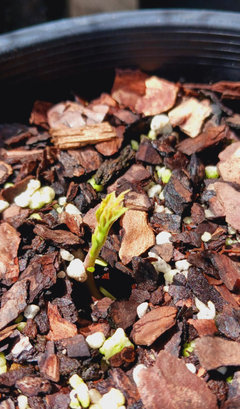
    The 3rd pot is an Aesculus glabra seed in bark mix (511) that so far has not shown a sprout.


    The Fourth pot next to it is a Black walnut seed found in the yard last year (511) no sprout yet.


    Last (right) is the pot I planted (peat moss) the extra randomly collected buckeye seeds that were collected during the last 2-3 of weeks before the squirrels put an end to the harvest by removing all signs that seeds were ever there. ;-) <continued below>


    There were 9 seeds total. So, let's see, 9 divided by 9 = 1 x 100 = 100% ;^)


    I don't know if these results are enough to dispel the myth that aesculus germination rates are on the low side but does give you an idea of what proper (long) cold stratification can accomplish.


    Just wanted to provide an update on what happened to all this in the tote since last season.

  • 2 years ago
    last modified: 2 years ago

    5-6-2024:


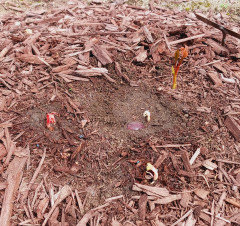
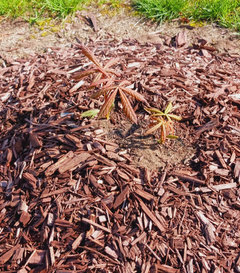
    Noticed one of the Aesculus Glabra that was planted outside last Fall poking up this AM. ;-)


  • 2 years ago

    5-8-2024:


    All 4 aesculus glabra that were planted outside are up (I had to dig a little to find the center one). 4 sprouts divided by 4 seeds = 1 x 100 = 100% ;^)


    The Juglans nigra made its debut last night.

    That's all for contents of the tote cold frame.

  • 2 years ago
    last modified: 2 years ago

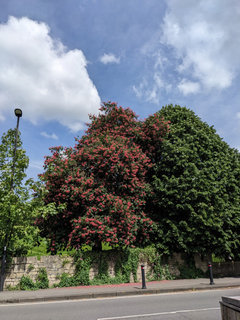
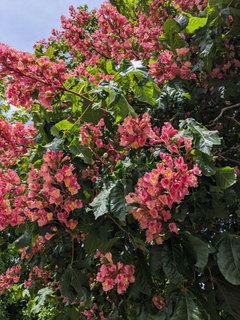
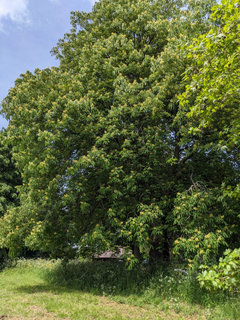
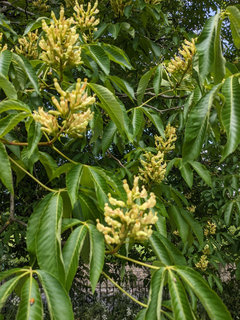
    Hippocastaneum has finished and indica is only just starting but these two are at their peak today.


    BillMN-z4a thanked floraluk2
  • 2 years ago

    Bonuses ...

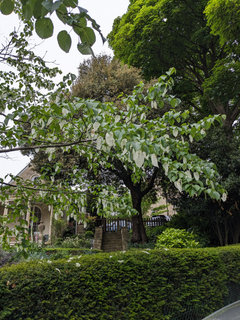
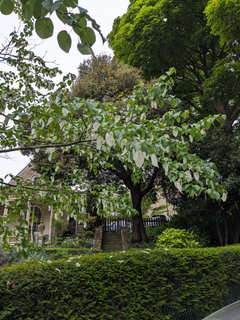
    Davidia yesterday.


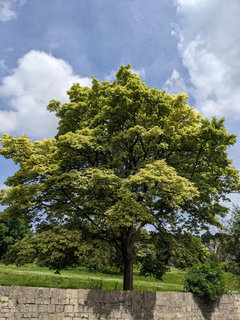
    Variegated Acer pseudoplatanus today. Don't know the cultivar.


    BillMN-z4a thanked floraluk2
  • 2 years ago

    Sorry about the repeated pix. Houzz on my phone has trouble with editing posts.

    BillMN-z4a thanked floraluk2
  • 2 years ago

    Thanks floral!


    This reminded me to go outside and check my new sprouts.

    I've removed 2 of the 4 originally planted last Fall but should remove one more but wanted to make sure they both were going to grow on before doing so.

    Of course, the one closest (1") to the center of the mulch ring turns out to be the smaller/later of the two left.

    Should I remove the smaller and leave the larger, even though the larger is ~3" off center? Or won't it matter after a few months pass? TIA


  • 2 years ago

    Oh, and just FWIW:

    My SIL is taking the extra 5 OB plants that I potted up, also the Juglans nigra that sprouted recently.

    The end. :-)

  • last year

    5-28-2024:

    Just for the record, I left the largest OB in the planting site. Now we wait...or better yet just forget about it and get on to other things. We have a whole growing season ahead of us. ;-)


  • last year

    I pulled many seedlings out of places this year. Interesting, my neighbor said he never used to get buckeye seedlings on his property until I moved in and started taking better care of the yard.

    BillMN-z4a thanked L Clark (zone 4 WY)
  • last year

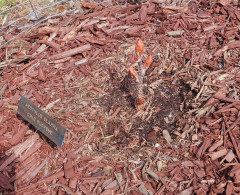
    4-21-2025:


    It's alive!

    It had swelling buds for a couple of weeks now, but the nights have been cold enough to slow its progression.

    Hope its 'Frost Hardy'.


  • last year
    last modified: last year

    Those are always among the first trees to leaf out here

    BillMN-z4a thanked L Clark (zone 4 WY)
  • last year

    Buckeyes are shockingly freeze tolerant. My house came with a huge one in the front yard and I’ve never seen it damaged even down to 19 degrees with foliage emerging.

    BillMN-z4a thanked pennlake
  • last year

    Thanks pennlake, good to know.

    We should be past any below freezing temperatures but could have that one late frost in May.

    Its small enough I can cover it for this season if necessary.

    Some sources say z3, others z4 but I'm in the ballpark. ;-)

  • last year

    Same! it has gotten well into the teens and these things are not even bothered by it in the spring. The leaves looks droopy and dead, but they bounce right back. It’s remarkable

    BillMN-z4a thanked L Clark (zone 4 WY)
  • last year

    Thanks,

    That's the kind of tree I'm looking for. :-)

  • 9 months ago

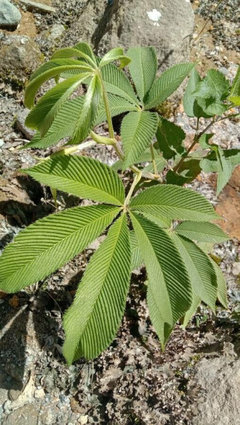
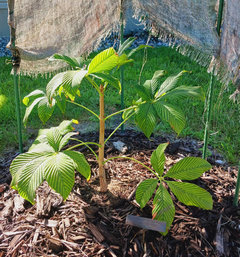
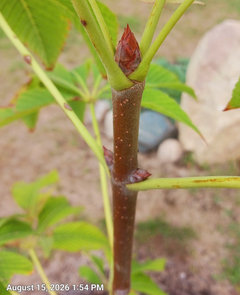
    8-19-2025:

    Picture taken 7-8-25:


  • 9 months ago
    last modified: 9 months ago

    Leaves don’t look quite like ohio buckeye to me. I think in another thread someone posited it could be a hybrid. I’m starting to think that’s true

    BillMN-z4a thanked L Clark (zone 4 WY)
  • 9 months ago
    last modified: 9 months ago

    Idk, Lane. But one must not be too quick to jump to conclusions. 8^)

    I've looked at many websites pictures that all have similar ribbing to different degrees.

    Here's one: Listed Aesculus Glabra. So, the ribbed trait must be there in A. glabra, which can be variable, I suppose.

    What does yours look like?

    :^)

  • 9 months ago

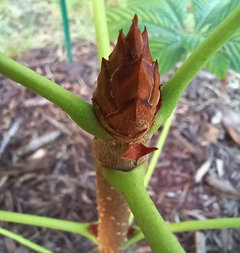
    What does that fat terminal bud feel like, @BillMN-z4a ?

    BillMN-z4a thanked ViburnumValley central KY Bluegrass z6
  • 9 months ago

    A bit prickly, like a pinecone.


  • 9 months ago

    Dry...or sticky?

    BillMN-z4a thanked ViburnumValley central KY Bluegrass z6
  • 9 months ago

    Dry.

  • 9 months ago

    Thanks VV.

    Nice to know what tree it is that I have.

    Ohio Buckeye!

    :-)


  • 9 months ago

    Here’s one I planted at work


    BillMN-z4a thanked L Clark (zone 4 WY)
  • 9 months ago

    Nice!

    Lane, Was that a certain cultivar or straight species?

  • 9 months ago

    "the ribbed trait must be there in A. glabra, which can be variable"

    Ohio buckeye is definitely a variable species, so one would assume the texture, or "ribbed" look of the young foliage is also variable depending on provenance and growing conditions. And the terminal bud would indicate A. glabra. But I don't think I've ever seen mature foliage on Ohio buckeye that has that same texture, which leads me to question whether your seedling, which appears to be well established, is pure A. glabra. I'm guessing that perhaps because you're providing optimal growing conditions, that has helped maintain the "ribbed" texture of its foliage(?)

    "Here's one: Listed Aesculus Glabra" - I believe that photo is from a European website that includes hundreds of leaf photos of "A. glabra", some of which are clearly not glabra, but other Aesculus species and/or hybrids.

    BillMN-z4a thanked arbordave (SE MI)
  • 9 months ago

    Just the species.


    here is the one at my house.... oh man this poor tree. I probably should have cut it down, but I let it stay. It was destroyed by a tornado in 2009; lost every branch from my understanding, and then lost all, but one big branch in a mid June blizzard in 2020. It has fathered many seedlings lol


    BillMN-z4a thanked L Clark (zone 4 WY)
  • 9 months ago
    last modified: 9 months ago

    Thanks, arbordave!

    Yes, every tree wishes that I owned it. lol

    I even make sure they have what they need down to the macro and micronutrients.

    And any seed grown plant can produce varieties, to some level, plus there's always the cross-pollination thingy. ;-)

    But whether or not it's certified OBE or not, it's fine with me (close enough and I'm happy). :-)

    That terminal bud was the key for identification in this case. And the fact that if it would've been resinous, the possibility of A. hippocastanum was still there (thanks! VV).

    Yes, I thought that leaf picture might have been hokey, as are many posted on the web.

    My leaves are showing some late season lackluster even though I've had a sunshade on it most of the season. It's only the second season in the ground so may improve as the root system elongates.

    Clark,

    That's a beautiful tree you have in your yard.

    It's soldiered on after huge difficulties and has become strong and full in appearance.

    I would be proud of it!

    Thanks for the showing.

    ;-)

  • 9 months ago
    last modified: 9 months ago

    Bill - I wish my tree had leaves like yours. Looks cooler imo. Like a horse cheatnut. But I bet yours is Ohio buckeye, there does seem to be a lot of ’genetic variability’ that affects appearances.


    Btw, I want to give a horse chestnut another shot, but they struggle even on the Front Range

    BillMN-z4a thanked L Clark (zone 4 WY)
  • 9 months ago
    last modified: 9 months ago

    Have you tried Gymnocladus dioicus? Kentucky Coffee Tree?

    Rated down to zone 3, salt tolerant and higher alkaline tolerant.

    Can take it dry after established.

    I guess it can take winter winds well because of its sparse branching and rugged root system.


    Another tough tree once used in the Great Plains Shelter Belt back in the '30s.

    gleditsia triacanthos enermis

  • 9 months ago

    Yeah, I’ve planted about 10 or so honeylocust at work. all are doing great!


    Someone planted a few KCTs about 5-7 years ago and they are all doing pretty dang well. Also a definite possibility for me. attractive trees too. Only draw back is thwy leaf out so late


    BillMN-z4a thanked L Clark (zone 4 WY)
  • 9 months ago

    Leafing out late can be a good thing, in areas where late frost is common.

    Here's an interesting and easy read when you get time:

    https://news.unl.edu/article-GreatPlainsSheterbelt:


  • 9 months ago

    How many trees do you grow with (Go Big) Blue flowers?


    Can't go too far wrong with plants with Kentucky in their name...

    BillMN-z4a thanked ViburnumValley central KY Bluegrass z6
  • 9 months ago
    last modified: 9 months ago

    2 cents, my coffeetrees do not like hot, dry weather. Doesn't permanently hurt them, but they drop alot of leaflets after a hot, dry spell. But then so do a number of other trees on my lot, like sugar maples, black cherries, black walnuts and birches.

    BillMN-z4a thanked bengz6westmd
  • 9 months ago

    All those great eastern North American species that are dialed into the vagaries of seasonal wetness and driness: I'll add Hackberry, Bitternut Hickory, and the echoes of White Ash past...


    Black Locust is also notable -as an introduced species here - for this trait.

    BillMN-z4a thanked ViburnumValley central KY Bluegrass z6
  • 9 months ago

    Did you say Black Locust (Robinia pseudoacacia) is an introduced species?

    I thought it was native to Ky as well as other places in the US.


    And let's not forget Quercus bicolor, we have a few outliers even in MN.

  • 9 months ago

    Bill, I think B locust was mostly an Appalachian tree when the settlers arrived -- now it's everywhere. It was often planted outside that range for fence post wood.....

    BillMN-z4a thanked bengz6westmd
  • 9 months ago
    last modified: 9 months ago

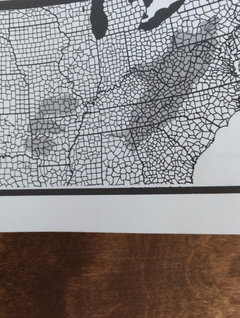
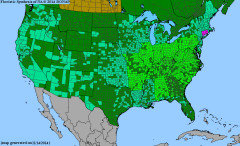
    I will post a distribution map for Robinia pseudoacacia.


    While Black Locust is a North American native - like Maclura pomifera - it wasn't here in the Inner Bluegrass of central Kentucky nor westward in the state. But it wasn't far away, and as Ben notes, it's utility and it's promiscuity on disturbed and abused ground has led to it being relatively ubiquitous over a lot of the eastern U.S.

    BillMN-z4a thanked ViburnumValley central KY Bluegrass z6
  • 9 months ago

    According to AIGL, this is where it exists today: Woody Invasives of the Great Lakes collaborative. I think I saw some along the bike trail a few weeks ago.


  • 8 months ago
    last modified: 8 months ago

    I don’t know if I’ve ever seen black locust. I’d probably mistake it for caragena

    BillMN-z4a thanked L Clark (zone 4 WY)
  • 8 months ago
    last modified: 8 months ago

    While this thread is up, something about horsechestnuts to mention. Since seeing the breathtaking A. indicas at Kew on my first visit in 1993, this has been a 'holy grail' plant for me. I could never figure out why they are so rare in American commerce, or even botanical collections. I finally got to see the one at NCSU, in bloom, this year.

    https://jcra.ncsu.edu/horticulture/our-plants/results.php?search=indica

    It's in a terrible spot shaded out by other trees...the scape looked a little smallish, but with a straggling specimen like that, the lowest was 15' high at least, so I couldn't examine it closely without a ladder. And it might be smallish because it is shaded out! If it really is a 'Sydney Pearce', I don't why they wouldn't put such a rare (for the US) tree in a more prominent position. I can't drive down to NC just to check how it resists scorch, but if you're down there, feel free to check on it for me!

    I feel like there's room for more breeding to improve these. I have A. turbinata whose leaves are very scorch resistant. I'm hoping it will cross with my 'Ft. McNair' to produce an 'indica' look-alike, or even first cross my A. turbinata with the A. chinensis at Scott Arboretum, since the Chinese trees have a better habit and somewhat showier flowers. Maybe one reason there hasn't been much crossing of them is they are agonizingly slow. I suspect my A. turbinata is still at least 3 years from flowering...after about 10 years in the ground. I might even treat my 'Planteriensis' with oryzalin to see if I can turn it into a crossable hexaploid.

    So many plans for plants, so little time! lol

    BillMN-z4a thanked UpperBayGardener (zone 7)
  • 8 months ago
    last modified: 8 months ago

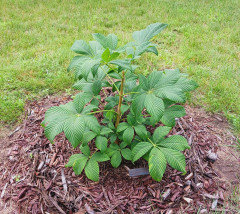
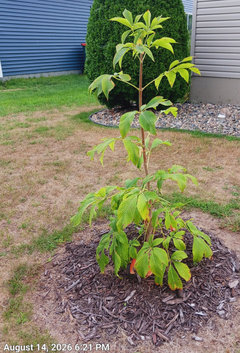
    8-25-2025:

    Here's mine, pretty much done for the season.

    With the sun angle 13d less than the June equinox, I can probably remove the sunshade now. 41df last night.


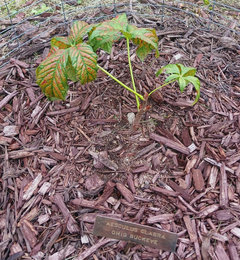
    The below is my Aesculus g. from last August 23rd, 2024: Showing there is much improvement this season. ;-)

    I gave one of these seedlings and a BW seedling to one of my daughters, spring before last, she's very happy with the way they're growing out at her and dh place. The BW is the more robust grower of course.


  • 8 months ago
    last modified: 8 months ago

    I'd guess that big, thick stem on such a young'in in the top pic is the result of a big embryo in the big seed.

    BillMN-z4a thanked bengz6westmd
  • 8 months ago
    last modified: 8 months ago

    Yeah, I'm not that advanced to know what you mean. :-|

    Not having the plant die is my first goal, then I take it as I go, after that. :-))


    eta: I'm keeping it consistently moist, at least until the temperatures drop even more.

    Forecasts say mid to high 70's for the next 10 days and not quite as cool for nights so we should see root elongation for a good month or two.