Software
Houzz Logo Print
mike_smith5315

Freezer cools properly. Compressor stops and won't turn back on.

3 years ago

I have an older Liebherr closed system fridge/freezer CS 1640.
The fridge portion works fine but the freezer can't maintain it's temperature.
While the unit is pretty old now, since the fridge still works well I want to see if I can save it from the scrap yard by fixing the freezer.
Initially I kept finding ice forming at the bottom of the freezer floor. I'd chip it off and just close the door again, but the same scenario kept occuring. Eventually I opened the back panel to find the drain frozen over.
Defrosted everything and let it dry out.
After a week or the freezer alarm triggered because the freezer temperature was falling. I found that the freezer compressor was not turning on.
I removed and checked the start relay and overload protector. They seemed ok.
After plugging back in the unit and turning on and off the power button the compressor turned back on.
However, after reaching the temperature set, whether I put it at -18 or all the way to -24C, the compressor will turn off and not restart again until some combination of turning it on and off a few times, running it first through the diagnostic test program then turning it off and on, or unplugging and re-plugging.
The diagnostic program didn't trigger any errors. All four temperature sensors in the fridge and freezer return readings that are pretty close to the ones I get off a temperature gun.
I also pulled out the main PCB and visually inspected for any blown capacitors or fuses. There was no signs of any damage anywhere. Although there is some part that rattles when you shake it. It's hard to tell which part has causes that sound though.
Evaporator fan runs.
I can keep resetting the freezer once it warms back up and getting the compressor to turn on and get very cold but obviously this is an annoyance. Other than getting and maintaining ice, I wouldn't be comfortable putting food back in.
So I'm pretty stumped if there is anything else left to do.
Liebherr doesn't even make parts for this unit any more.
Just seeing if anybody has any experience with a situation like this and found a solution.
Any suggestions appreciated.

Comments (11)

  • 3 years ago

    Not my field, but have you checked at the compressor whether the compressor is being fed power when it is supposed to be on?

  • 3 years ago
    last modified: 3 years ago

    Thanks for commenting. How would you check if the compressor is being fed power?

    I unplugged the unit a few times and test for continuity of the compressor pins. I also checked the overload protector and the start relay.

    They all seem to work as far as I can tell. I believe it's probably main PCB issue because resetting the circuit by unplugging, pushing the on/off power button, or running it through its service diagnostic program eventually kicks the compressor back on.

    So eventually the compressor through manual intervention always come back on by doing this, reaches the temperature set (recently I set it to -24C and it got there no problem), but then just turns off after that.

    Normally as the defrost cycle ends it would kick on again but this is the issue; it doesn't restart the compressor power on its one as the temperature warms up again. I have to manually do one of the three interventions mentioned above then it will come back on only to rinse and repeat the same scenario. Doesn't help that Liebherr doesn't make any of these parts for my model anymore and I can't even find used ones online either.


  • 3 years ago

    I would use sharp probes into the power feed wires to see if the expected voltage is present. I was thinking that one possibility was the motor start capacitor, either flakey or failed, and the motor started without the start capacitor when the ac phase was just right to give it an impulse.

    As you note, the most probable failure is on the circuit board; I just wanted to put to bed any lingering possibilities otherwise.

    In the interest of saving the unit, and given that the freezer has its own compressor, perhaps you can wire up a thermostat-compressor circuit outside the PCB. Mechanical thermostats must still be available for old Amanas and like models.

  • 3 years ago
    last modified: 3 years ago

    Appreciate the suggestion but I think that would be outside my comfort zone to attempt.

    Currently my freezer is still working even right now. I've basically been setting it as cold as it will go (-26C) at night then letting it slowly rise back up to around -1C. This takes almost a full day. Then repeating. This way at least the freezer alarm doesn't go off in the middle of the night.

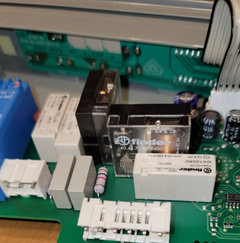
    Upon closer inspection of the PCB it looks like to me one of the power relays may have burnt out. I see some haze on it. And I think that is the part that rattles when I give the PCB a little shake. Could a burned power relay on the PCB cause this type of effect?


  • 3 years ago

    A relay that, for example, has lost its capacitor protection will arc on the contacts when they open, thereby making the next contact resistance higher. The long term effect will be intermittent connectivity. Capacitors across the contacts can minimize this, and sometimes they fail. Some degradation over time even with nothing wrong should be expected -- in other words there is a contact actuation count rating.

    If the relay has part number data on the shell, replacement might be possible. Replacing such a relay if soldered to the board would require suitable skills. If it plugs into a socket, less skill is needed.

    Small capacitors that can be determined to be wired across the contacts should be checked to to determine if any have failed.


  • 3 years ago
    last modified: 3 years ago

    You may be able to see in the picture on the bottom-right of the Finder power relay the hazy area I mentioned. It's soldered onto the board. Even if I could resolder a new one though, I can't even find the exact part number online.


  • 3 years ago
    last modified: 3 years ago

    By the way the Finder model number is 40.41.7.012.2400. I looked for it awhile back but it wasn't available anywhere I looked online.

  • 3 years ago

    Call Finder's US rep and ask where you can get it. You might also search on "relay cross reference" for a site where alternatives may be listed. At worst, you can solder in wires (insulated) and connect them to a "flying relay" you can mount somehow, even with some silicone adhesive to the top of another relay. We aren't dealing with microwaves here. You may not be UL compliant though, after the mod.

  • 2 years ago

    Just an update. Messaged Finder who responded saying the 40.41.7.012.2400 "had only a NC contact". And that the only replacement they can offer is a relay with a change over contact which means you can wire it to be either NO or NC contact.


    Their suggestion was model number 40.31.7.012.001.


    I'm checking with their local distributor to see if they have this unit but I'm not an electrical person so I don't know how to "wire it to be either NO or NC contact" nor am I positive this is an exact power match for the 40.41.7.012.2400 because I can't find information on this power relay online anymore and there is another type of white relay on the board that blocks voltage/amps information when I physically remove the PCB to look at it.


    If I had the exact same component and just had to remove it and solder the new one on, I think I could accomplish that. Having to wire it to be either NO or NC, I don't know what that means.

  • 2 years ago

    Normally open vs. normally closed. There may be a schematic on the body of the relay. NC is when no power is supplied to the coil and the relay arm (pole) and NC contact are connected. Relays of this type, assuming that the new one will fit the PC layout, likely will have the NC contact going to the same PC location, and the NO contact to a pin that, if the board is drilled for it, is not connected to anything.

    So if you looked at the relay schematics, the difference would be whether or not an NO contact was brought out to a pin.

    I thought the errant relay was the white plastic one with readable markings in the foreground.

    I think you are a bit into the weeds here, and may need to find an EE, E-tech, ham, or other electrical hobbyist to help you.