Software
Houzz Logo Print
christine_bellondersma

Using Cast Iron Griddle on Bridging Burners

We have a new GE Cafe induction top range. It has two bridging burners and I just bought a rectangular Lodge cast iron griddle to use over the two burners.


Those who have done this, how well dose it work? How does it heat up evenly on the part between the burners? The reverse side has ridges and I am worried that the magnetism wont conduct properly. Lodge does say it works on induction.


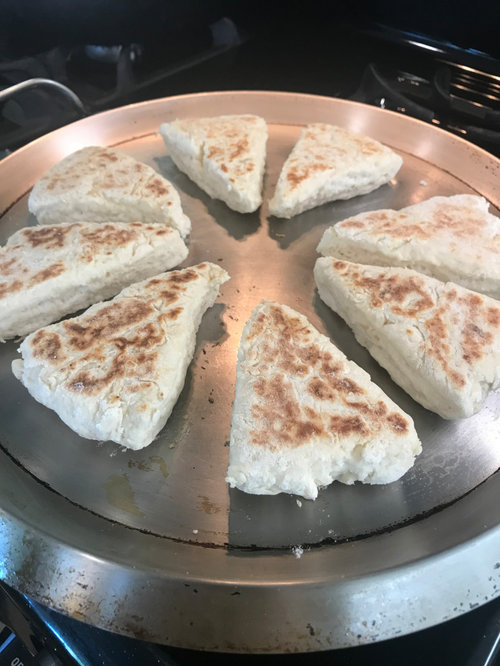
i would be using it to replace my beloved 44 yr old heavy Cuisinart griddle (as in pic) to make Scottish “girdle scones” (not a

typo) and Scottish tea pancakes. Sadly it does not work on induction. Tried using an infuser and although the pan heated, it was too difficult to control. Gave it to my daughter. She is thrilled.


Thanks for any answers


Comments (6)

  • 2 years ago

    What a beautiful pan. I can see why your daughter is thrilled to have it.


    Off the top of my head, I thought I saw some reviews at Amazon that Cafe induction didn't work well with the Lodge griddle with grill underside. You might want to double check that though.


    I bought an antique griddle, the kind with two gate marks on the bottom. (Gate marks correspond to the slits where iron was poured into the mould back in the 19th century.) The gate marks are less than 1/4 inch high, so the griddle doesn't sit flat in direct contact with my Wolf cooktop. And yet it cooks fine. The electromagnetic field rises above the glass a bit & interacts with the griddle. Maybe your Cafe will work too. Hope so!


    How well does the griddle on a bridge work? Fine enough by me. There is a "cool" spot in between the elements. But it still gets hot enough to cook. Whatever is cooking in the middle doesn't brown as quickly as food on the ends do, but it's still thoroughly cooked. I just have to leave the middle foods on a bit longer, or shuffle them around with the end foods. So far, no one has complained because their third pancake isn't as golden brown as the first two.

  • 2 years ago
    last modified: 2 years ago

    You'll face two problems. Uneven heat across the surface and uneven heat over time. With some practice and effort you can work around these. In my experience it's best to keep your burners as low as possible (you still may need to adjust occasionally as you go) to acheive what you want and give it a long (45-60 minutes or so) time to slowly heat up. When making scones for instance it won't recover as quickly between batches so a bit of time to allow recovery can help.

    Your scones look wonderful. I've never seen pie shaped girdle scones before, only round. Did you do them in a pan before the griddle?

    For others considering this: https://bamasotan.us/griddle-faq/

  • 2 years ago
    last modified: 2 years ago

    For an induction-capable 12-inch round griddle pan there is also the product of that name from HexClad. While slightly convex to handle high oven temperatures without warping (thus causing liquid eggs to settle towards the edges when frying at moderate temperatures),* with more solid items such as scones behavior should be closer to that of the pan in the image above.

    Unlike the true planche/plancha high thermal mass type griddle, the HexClad has a more typical thin pan configuration, but with the near immediate power changes possible with induction, it should serve well for a number of functions. (I haven't gotten to testing hamburger flipping yet.) It cleans much easier than cast iron.

    Thanks @opaone for the link to your griddle FAQ.

    ___________

    *In spite of being 12 inches in overall diameter (about 11 inches in effective egg-cooking pan base diameter), when used on a 10-inch hob the egg white cooks about the same at the edge as it does a couple of inches closer to the center. So radial heat distribution is adequate for this purpose. But I don't have a thermal camera to quantify it.

  • 2 years ago

    I have a rectangular griddle that I use to span two induction circles of different sizes. It works fine, but you do have to set the heat differently and may require some experimentation to figure out optimal settings.

  • 2 years ago

    For a real residential induction plancha, one would want a theoretical quarter-sized unit not presently made by Cooktek. Parameters would would be roughly 240V, 3500W, 40 lbs, and 16 x 16 inches. Such units are more commonly available in Europe. Some links I've found are:

    https://adventys.com/en/cooking-range/100-bgic.html

    https://www.restomateriel.ch/634-grillade-induction-garland-35kw.html

    https://www.politec-france.com/110-plancha-induction-professionnelle-t3500.html

    These typically cost well north of 3000 Euros.

    For an in-USA source ($4588),

    https://www.restaurantsupply.com/equipex-bgic3600-oryx-15-1-2-wide-electric-countertop-induction-griddle-with-multi-layer-single-zone-surface-208-240v-3-6kw

    Pre-C19 there was a source in Connecticut that imported a French-made induction unit with claimed excellent temperature stability. I cannot find that link today.

  • 2 years ago

    We have the GE Profile induction range, and the same Lodge griddle you mention. Sadly it does not work - either because it is too short to fully cover both bridged burners, or because of the grill lines on the bottom, the range does not consistently detect the griddle.