Software
Houzz Logo Print
dblmnt1x

condensation and mold in basement

2 years ago
last modified: 2 years ago
Hey all,
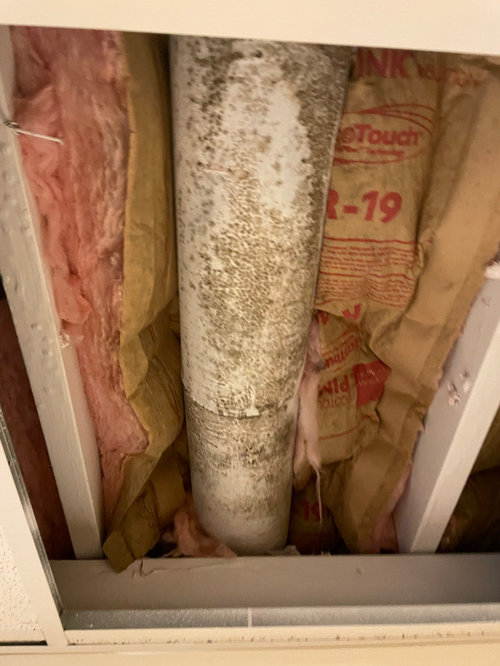
I could really use some help as I’m totally out of ideas to help my parents. They have been having major humidity issues in their basement the past few years and constantly run dehumidifiers in the basement. Now that it’s fall, they don’t have this issue but I just noticed some of their HVAC pipes are covered in mold (sigh). Apparently these pipes are where they saw the major condensation. The ceiling is covered with the typical ceiling tile.

We have called everyone and no one can get to the root of this. The only difference I can draw back to is that the HVAC was replaced a few years ago. Multiple reputable companies have come out and told us the HVAC was installed just fine. Attaching a picture to give you an idea of what we’re dealing with.

Please help! Who should we call? I've called a plumber, mold company, HVAC. No one can seem to figure it out. Appreciate any insight / clue you can provide to help me solve this mystery for them.

Thank you!!!


Comments (8)

  • 2 years ago

    They have been having major humidity issues in their basement the past few years and constantly run humidifiers in the basement.

    Did you mean dehumidifers and not humdifiers?

    Is the pipe a supply duct? If it is what is likely happening is water is condensing on the cold surface of supply duct when the AC is running. A simple fix would be to cover the duct with insulation. The duct should be cleaned first. I recommend using good duct tape to keep the cold air from penetraing.

  • 2 years ago
    last modified: 2 years ago

    Hi @mike_home So sorry, yes I meant dehumidifier! I updated the post to reflect that :)


    I’m honestly not sure what kind of duct it is. I’ll share your advice with my parents and have them do this after they take care of the mold (unless you recommend a professional should do this). Do you recommend duct like this?

    Very excited you responded to my post as I found some great advise you shared with another user. You mentioned in an older post for the person to find out the size of their AC condenser and see if the HVAC tech can slow down their blower speed as slowing down the air flow will help dehumidify. This advice reminded me how much stronger the air flows of their vents after they got their hvac replaced (it was never that strong before). In fact, sometimes I will see condensation around the vents on the main floor of their house (the vents are on the floor). Should we also explore this option? Is there an acceptable blower speed it should be set at?

  • PRO
    2 years ago

    Basements typically have small heating and cooling load requirements. In summer, basement temperatures are often cooler than air conditioning set point temperatures so they get little, if any, dehumidification from a central HVAC system. Supplemental dehumidification is required. The mold in the void space above the suspended ceiling is likely due to poor air circulation in the void space. As a consequence, the relative humidity inside the ceiling void space can be much higher than in the open volume of the basement--even if a dehumidifier is operating. Those conditions can be favorable for mold growth.

    You don't need an HVAC tech. You need someone knowledgeable of building science principles.

    dblmnt1x thanked Charles Ross Homes
  • 2 years ago

    Slowing down the blower speed is a possibility. However slowing it down too low coiuld cause the coil to freeze. A competent HVAC tech should be able to do an airflow measurement and determine what could be done. Airflow is usually set at 400 CFM per ton of AC size.

    It is possible the new AC is larger than the old one and it may be oversized. An oversized AC usually means short cycles and higher humidity.

    I am wondering if the batt insulation with the vapor barrier is making the situation worse. Charles Ross Homes may have an opinion on this.

  • 2 years ago
    last modified: 2 years ago

    Thanks @mike_home! Can you clarify what you are referring to as the vapor barrier (are you referring to the ceiling tile? the white paint on the duct work?) Very interesting point you make about the insulation! The only areas they do NOT see the condensation is where the ducts are covered with the insulation and has the ceiling tile/cover. Areas which are completely open (no insulation or ceiling tile) do not have this problem. Curious what @Charles Ross Homes thinks as well as I see that you two provide a lot of great insight for situations like this! Thank you so much!!

  • PRO
    2 years ago

    Hi, dblmnt1x,

    You've got a couple of issues and a couple of potential remedies, all related to the higher moisture levels which are typical in basements.

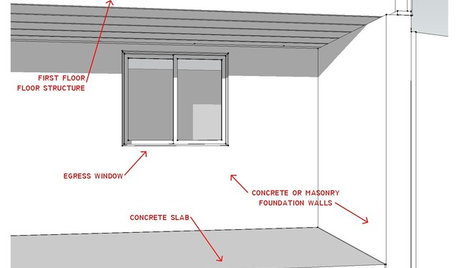
    Moisture makes its way into basement spaces through masonry walls and concrete slabs which can both hold and transport moisture. The moisture raises the local relative humidity and can create favorable conditions for mold/mildew. Minimizing moisture by proper grading and drainage around the home, waterproofing basement walls, installing gutters and downspouts to direct storm water away from the foundation, and installing vapor retarders under concrete slabs are all ways to reduce the amount of moisture that makes its way into the basement space. While those are easy to do in new construction, they're not always easy to implement afterwards.

    To minimize the potential for mold/mildew growth, you also want to eliminate condensing surfaces like the uninsulated duct work. In air conditioning mode, the surface temperature of the uninsulated ductwork will be around 50F +/- which invites condensation if the dewpoint of the surrounding air is at or above 50F-- a likely scenario in a basement. You could install spray foam insulation in the joist bays with ductwork to encapsulate the ducts and prevent air in the basement from contacting the cold duct surface or you could insulate the ductwork with soft foam insulation glued to the duct. The key is to eliminate the potential for air to contact the cold duct surface. Fiberglass insulation is a poor choice for that and it's currently installed in a way that doesn't insulate the duct. Plus, the binder in fiberglass batts is food for mold.

    As with all living spaces in your home, you'll want to control the relative humidity in the basement to minimize the potential for mold/mildew growth. Ideally, that means limiting relative humidity to 50% +/- That applies to both the volumes above and below the suspended ceiling. You won't do that by introducing air from your air conditioning system if the temperature of the basement is lower than the setpoint temperature in other living areas; it won't ever be calling for air conditioning. You'll need a dedicated dehumidifier for that. For basements which aren't living spaces, portable dehumidifiers will often meet that need. For basements with living areas, I recommend a ventilating dehumidifier which is capable of circulating dry air throughout the space.

  • 2 years ago
    last modified: 2 years ago

    The brown paper on the face of the batt insulation is the vapor barrier. This is intended to stop moisture from collecting on the fiberglass and degrading it. I am not an insulation expert but I will share what I am thinking. The batt insulation traps the moisture and keeps the heat from above from entering on three sides. The ceiling tile allows moisture to pass through. The temperature of the duct stays below the dew point for long periods of time. Condensation collects on the horizontal duct and has no place to go. It seems like an ideal set up to grow mold.

    Where is this house located? Is the temperature and humidity monitored throughout the year? I don't see the need for the celling insulation. It could be making a bad situation worse.

    Your parents may need to install a better dehumidifier and connect to a drain so it can run unattended. They also need to look around the exterior of the house as Charles Ross suggested. Make sure water is draining away from the house and exterior walls are not wet.

  • PRO
    2 years ago

    There's a difference between an "air barrier" and a "vapor retarder." The kraft paper on fiberglass batt insulation is a vapor retarder--not a vapor barrier and not an air barrier. The component that serves as the retarder is the asphalt binder on the back side of the kraft paper. The extent to which the ceiling tile allows moisture transfer depends on the area of openings in the ceiling tiles and the rate of moisture diffusion through the solid tiles.