Software
Houzz Logo Print
stillanntn6b

About the USDA zone map

2 years ago

Yep, it looks as if zone 6b (old map) still applies.

Oh, joy, they said, we're now a zone 7 something.


The maps are made of averages, and then someone chooses which years to average. That may work for annual crops. It's time to stop fooling ourselves.


Talking to someone rose-oriented from France, he say he has three zones. Tropical: where citrus fruir trees live and produce. Where he lives: where citrus trees don't. And a third zone where he wouldn't want to live.


I remember reading about some 'zone' near Calgary Alberta Canada which was defined by what did survive there over time.


We need to define zones based on what lives where. Maybe forget the numbers. Define it by plant survival.

Comments (16)

  • PRO
    2 years ago

    The USDA zone map is about plant survival. The average low temps of an area can help define what will survive that amount of cold. Mostly intended to perennials and if they can survive through winters and cold, and can be used to help calculate required chill hours of some perennials, but also can apply to annuals. Frost and freeze maps can be more applicable to annuals.

  • 2 years ago

    There are two parts to the USDA map - the map itself, and the database of plant survival. We had this discussion years ago, after the release of the 'warm' map. It wasn't that the map was necessarily wrong, but the map and the database no longer correlated in the minds of many people.

    Gardening books from right before the introduction of zone maps referred to a plant's survival in a limited list of cities. IIRC, the list was Washington D.C, Philadelphia, New York, Boston, and Chicago. It took me a while to catch onto what all of these places had in common - large, public botanical gardens who were in a position to trial new introductions, and publicize their findings. So the database was always connected to specific locations, even if that was never explicitly stated. And the zone map is useless without the database. Crunching numbers to come up with the map was always the easy part.

  • 2 years ago
    last modified: 2 years ago

    I am now in a 9a just barely, like on the border of 9a/8b technically lol. I was just bumped up from a 8b. As far as I am concerned, I will continue to err on the 8b side.

    When buying stone fruit trees I err on the 9a side so they still get enough chill hrs if we get a little warmer.

    If sub/tropicals I err on the colder side then protect and/or greenhouse them etc.

    Our winters here have been closer to 8a or 8b from what I've seen and researched the last 10 yrs.

    Our last property was more coastal but still N FL. It was bumped up to a 9b. I believe it because I wasn't even heating my greenhouse the last 4 yrs there. I had zone 10 plants dying back to the ground and returning after light freezes. My banana plants weren't dying back and I had fruit in December. I 'knew' it wasnt really a 9a anymore.


    I think the plant hardiness map is a average of winter temps from the previous 20 yrs. Then they update it every 20 years..at least that was I thought lol.


    FYI there are citrus that can survive zone 6 lol.

  • 2 years ago

    It's ironic that they just updated the maps, and consequently, Portland (Oregon) is now in zone 9 and not 8. I have thought this was pretty accurate as every winter I've lived here for 12 years was zone 9 except for one. That is, UNTIL THIS WINTER. Our highs the last three days were under 20 degrees and the evening temps mid teens. I hope my roses do okay. Sub-freezing temps for over four days is nuts for us (sub freezing ALL DAY). I have several in pots that I protected with some frost cloth, so we will see.

  • 2 years ago

    Robert I hope all your plants are ok! I know you have some tropicals. We are getting down to 20F tonight. This morning they were saying it would rain and then possibly snow! That's crazy for even far N FL lol. I saw it snow in Phx AZ once. It melted before it hit the ground. Haven't seen it snow in FL in the 15 yrs we have been here, although I know it has in the past.

    I have a Little Buddy Propane Heater for the greenhouse. You can screw a little propane bottle onto it or use a adapter hose for a larger propane tank. It works really good on the low setting. I keep it 10ft from the plants so they don't dry out too much. I think it was less than a hundred bucks at H Depot.

  • 2 years ago

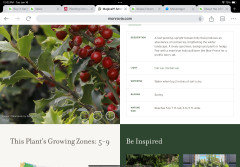
    What bothers me most is when vendors give a big range. In the example below, Monrovia says the plant is for zone 5-9. Well, the USDA map is only for cold hardiness, (minium temps) so if the plant is cold hardy to zone 5, can’t we assume it’s hardy for zone 9? Another plant may be listed for zones 5-8. How is that any different, as USDA is only a guideline for cold hardiness, and says nothing about heat resistance? Both plants should just be listed as zone 5 for cold hardiness.


  • PRO
    2 years ago

    Cold hardiness can also bring into account chill needs. Some plants can suffer or not grow so great without chill hours or a dormancy time. With something like that holly, planting it in zone 10 or higher can mean it does not get cold enough for the plants chill hours or dormancy period. That can mean not breaking into bud or flowering when it gets warmer. This upper threshold isn't often thought of or an issue for a lot of gardeners, the tendency is to worry about the lower threshold.

  • 2 years ago

    Beesneeds,

    I agree with you that Chill hours are an important consideration, but USDA hardiness maps have nothing to do with chill hours. They are just based on minimum temps. For example Dallas (zone 8a) has far fewer chill hours than San Francisco (10A)…it’s simply not accounted for by USDA maps. Peonies which have a rather high chill requirement, thrive in mild winter San Francisco, but not in much colder Dallas.

  • PRO
    2 years ago

    I'm using chill needs sort of loosely. Sorry about that. If a holly meant for zones 5-9 is planted in a zone 10+, it likely won't get cold enough long enough for the holly to do well. It needs some chill time or dormancy time to rest between grows. That's part of why a company has a wide range like 5-9 on a plant. Below 5 is too cold and the plant isn't hardy enough to do well, above 9 isn't cold enough and the plant is less likely to do well. Most people don't utilize the upper thresholds of hardiness, just the lower ones. Some people appreciate knowing the range if they are in a mid-spot on it- then they know the plants can survive and oddly cold year as well as the warmer ones.

    Chill hours as in chill units are indeed something else since they stop counting under freezing. Those are more moot against the zone maps.

  • 2 years ago

    Do any of you live where there are current Sunset Magazine climate zones published? On the West Coast they are VERY useful. They take into account marine effects, topography, chill hours, etc., and their goal is to figure out where certain plants will "thrive", not just survive. Here is a link to a University of California at Davis discussion about them.


    Jackie


    https://www.des.ucdavis.edu/Faculty/richerson/ESP30/Sunset%20Climate%20Zones.pdf

  • 2 years ago

    The weakness of the Sunset zones has always been the corresponding database.

  • 2 years ago

    mad_gallica - sounds like you know a lot about this subject. Could you go into the topic a bit more? I glanced at the plants recommended for Sunset zone 16, where I live (the name of my town on their map had that climate zone number on top of it!). Of course they only mentioned one or 2 cultivars per type of plant, but I did not see any type of plant mentioned that do not do very well around the area where I live.


    The main climate zone map is so broad brush that I do not find it very helpful. It disregards summer humidity or lack thereof, for example. The White Flower Farm catalogue actually has noticed this, and lists plants with zones, and then different zones whether they are in the South or West. I use it mainly to look at the cold number, and if it is 6 or larger then I at least know that plant probably would survive in my area.


    Jackie


  • 2 years ago

    Let's say you have the climate zones George, Mary, Max, and Ophelia. You want to grow R. zonialis. In order to see if this is reasonable, you have to know which zone you are in, and also, where R. zonialis will grow. Figuring out which zone a geographic area is in, is just number crunching from weather databases. The hard part always has been which plants like which zones. For that you need:

    1. People growing the plant
    2. A system for reporting results
    3. Someone analyzing the results

    For thousands of plants. So there exist USDA zone maps of Europe not because USDA zones are such wonderful objects, but because it gives access to the databases. So when Sunset tried to expand their zones to the entire US, they could easily create all sorts of different zones based on all sorts of different criteria, but when it came time to say what plants grew where, they had to revert back to the standard zone information. The Western zones that Sunset made their name on, actually deal with a very small number of plants. It wasn't meant as an exhaustive list, but more a jumping off point.


  • 2 years ago

    Thank you - interesting. I think some of the confusion I have had with the USDA zones are because they are just based on temperatures, and not anything else. We were zone 9, and now are zone 10, but many plant catalogues list plants as "zone 8" which have naturalized all over here, and are obviously thriving. Sometimes the catalogues try to talk me out of ordering certain plants because presumably they want to say they warned me - some of those plants have been growing happily in my garden for decades, so I just laugh.


    I am impressed with Sunset's efforts because at least they try to take all kinds of conditions into account, (such as "marine influence", which we certainly have here, 5 blocks from San Francisco Bay) not just temperatures. They should have stuck to the West Coast, I guess.


    Jackie

  • 2 years ago

    Plants with a top range of zone 8 tend to not do well, or even die, out here in Livermore, just 50 miles inland, though they thrive nearer the coast, mainly because it gets a lot hotter here in the summer. Some examples are gooseberry, blackberry, and rhubarb varieties that my mother could grow productively in Santa Rosa (a lot of coastal influence) that pretty much did nothing when I tried them here (minimal coastal influence; Tay, Logan, and Boysen berries do not produce well here while Ollalie and Marion do, to be more specific). Peonies and lilacs can be very iffy, too, as well as some hellebores and other perennials, either because of lack of winter chill, too much summer heat, or both. Annie's Annuals and Harmony Farms (in Sebastopol), which are located near the coast, can grow species and varieties listed as Zones 4-8 or Zones 5-8 and do sell them; those of us in the hot-as-Hades inland a relative few miles away, have to be aware what the top zone rating of a specific plant is that they are offering.