Software
Houzz Logo Print
steve_k366

36" Bluestar Hood Advice

2 years ago

Does anyone have experience with the BlueStar Pro-Line hoods as well as their external blowers?


I've had a BlueStar RNB366 for 3.5 years now, and am very happy with it.

I am getting ready to add a tile backsplash and am thinking about replacing my Broan E6436SS with the BlueStar 36″ Pro-Line Hood - PL036ML during this project. I may upgrade to the 1000 CFM HYEX 1.0 remote blower, or just stick with the 600 CFM internal blower. My existing duct (back vented) and MUA lines are 8", and both of these options call for 8" ducting, so that's a huge plus.


I cannot find any reviews/feedback on this hood, so I am hoping some of you have experience.

The sales guy at my local shop was recommending VAH, but the BS just seemed more solid, and I like the washable baffles.


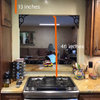
The goal is to get a better grease catch, lower noise, stay with 8" ducts, and raise the hood height to ~35-36" above the range so I have better visibility and access to the range and adjacent cabinets without banging my head.

Comments (6)

  • PRO
    2 years ago
    last modified: 2 years ago

    Firat IMO a 1000 CFM is the min. for what you have for a range . I love my Vent-a hood it is fabulous for extracting both steam and greasy air I run a catering biz from my home and so my range gets lots of use . I clean the innards 3 times year takes about 1/2 hr seems to have done the job for the last 16 yrs . The height of the hood is really decided by what is suggested by the hood maker . Mine is the same size as my 36" range and does the job just fine but it is 1100CFM . Mine vents straight up through the roof of my one story home so no bends at all.

  • 2 years ago

    Thanks for the input. The VAH systems seem nice, unfortunately I think they cannot direct back vent, and my cabinet design requires this.

    I visited a few more shops this weekend, and am still leaning towards the Bluestar with a remote blower (if I can buy the 36" hood without having to also pay for the internal blower).


    If I go the remote route, I need to lock down the duct and blower size: 8" @ 1000 CFM vs 10" at 1000CFM or 1400CFM. 1400 is more than I need, but if there is no functional downsides, I would rather have the excess power available.


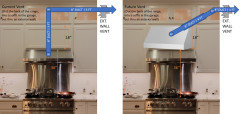
    My Current ducting goes straight back thru the kitchen wall into a soffit in an attached garage, then 90° up towards the ceiling, turns 90° again, then straight out the back wall of the house. I am thinking of rebuilding the soffit to facilitate the installation of the new hood. Still go out the back with a 90 (higher up the wall, just below my glass upper cabinets), then run the duct on an angle towards the exterior back wall to allow more space between the turns, and trade the second 90 for a 23° bend.


    If I am rebuilding the whole exhaust line, I think I would put a silencer in, and I could bump up the duct from 8" to 10" for better flow and to allow a choice between the 1000 and 1400 CFM Abbaka blowers.

    I am curious how the controls are set up for these, as well as the noise level and minimum flow rate for light cooking needs. I'll try BS's tech line for any insights as none of the local retailers I talked to had much experience with the BS hoods.


  • 2 years ago

    You need the Kitchen Forum’s knowledgeable venting advisors, @kaseki, or @opaone to respond.

    Neither of them are fond of Vent A Hood, for a number of reasons. Many of us though, have more recent Vent A Hoods, and are quite pleased with them. Mine is 8 yo, does all it’s supposed to do…42” over a 36” rangetop…and, it’s very quiet…even on high.

    That being said, if DH and I were to do this again, we’d get a hood with baffles. Baffles are so much easier to clean, than VAH’s squirrel cage.

  • 2 years ago

    Some factoids.

    Canopy wall hoods with typically 18-inch height should all have room for a rear duct attachment, but may not be fitted with one, and once one gets to 10 inch duct one is starting to interfere with baffle space. Straight up and then curved is best.

    Wolf hoods are sold separate from blowers, I believe (download a copy of the Wolf Design Guide). I don't know about BlueStar.

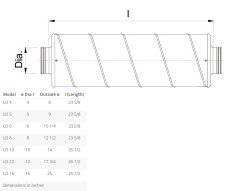
    Fantech silencers are about 4 inches larger in diameter than the duct. See image.


    Your hood intake velocity should be at least 90 ft/min, requiring 90 CFM/sq. ft. So if the hood entry area is 6 sq. ft., you need 540 CFM (actual). Rated CFM should be about 1.5X this value or about 800 CFM. This assumes modest duct pressure loss plus hood baffle pressure loss. For long ducts with a few right angle turns, maybe a bit more for rated CFM. 1000 should be plenty.

    However, this assumes that you will be supplying make up air at a pressure loss that is a small fraction of the blower's cut-off pressure loss. See MUA threads.


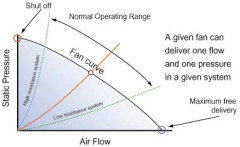
    BlueStar ex Abbaka should have fan curves available. Here is older data:


    As may be seen from the table, more than 1 inch of pressure loss for the HYEX-1.0 will reduce actual flow below that desired.

    So, once the actual flow is estimated, then duct diameter should be such that full speed flow velocity in the duct is between 1000 and 2000 ft/min. You may notice that this is recursive because changing the duct changes the pressure loss.

    Some hood threads to be reviewed:

    https://www.houzz.com/discussions/2328297/range-hood-faq-personal-notes-updated-10-31-2007#n=20

    https://www.houzz.com/discussions/5161173/hood-faq#n=101

    https://www.houzz.com/discussions/6099827/exhaust-hood-faq-ii#n=113

    https://www.houzz.com/discussions/6040827/range-hood-noise-project

    Last advice for now: Do not design the hood system without designing the MUA system in parallel.

  • 2 years ago

    Thanks @kaseki!!

    I am surprised how sensitive the Abbaka HyEx series is to pressure loss. Thank you for sharing the fan curve. BS has curves for their internal blower but i did not see one for the remote blowers.

    I will estimate my pressure at 0.6"H2O based on what I've read and my intended install, so the remote 1400 (on a 10" exhaust duct to stay in the 1000-2000 FPM range) seems about right considering its sensitivity to loads.

    For MUA, I am planning to stay with my 8" OD pressure activated duct that feeds my HVAC return line. This may up the flow resistance a bit, so again the 1400 seems like the right option.

    The threads you linked are a bit overwhelming...I wish my local shops selling high flow hoods had a better understanding of all these factors to help people translate and apply the principals for our specific installations and cooking needs.

    I still intend to reach out to BS for their thoughts on my install plans and the details on some of their fan speed control options. If I learn anything useful I'll share.

Sponsored
Custom Home Works
Average rating: 4.6 out of 5 stars10 Reviews
Franklin County's Award-Winning Design, Build and Remodeling Expert