Software
Houzz Logo Print
daninthedirt

puzzling Swiss Chard damage

2 years ago
last modified: 2 years ago
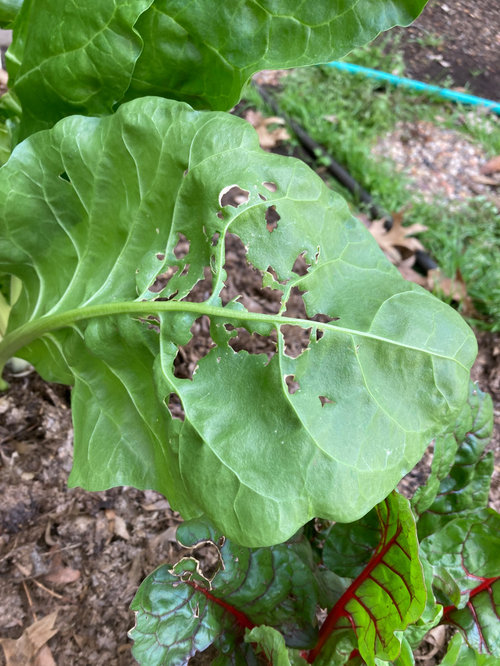
I'm getting some leaf damage on my Swiss Chard that is puzzling. No pests in evidence, and I spray regularly with Bt. I also treat my collards with Bt, and have absolutely no damage on them. Something preferentially likes Swiss Chard, seems to be immune to Bt, and is hiding well. Ideas?


Comments (24)

  • 2 years ago

    Do you think birds might be pecking it? Some of the holes show a triangular shape.

  • 2 years ago
    last modified: 2 years ago

    That's an interesting thought. But do birds actually like Swiss Chard? Also, not clear what they stand on when they do it. These aren't supportive leaves. Our hummingbirds aren't around quite yet.

  • 2 years ago

    The edges of the holes are healed over. Is this still happening? Or is it something that passed through, had a nibble and moved on?

  • 2 years ago
    last modified: 2 years ago

    I'm suspecting that maybe it was caterpillars that ate, and got killed by the Bt soon after. Because that's how it works. The cats have to eat the stuff. But strange that isn't happening with the collards. Historically, collards have been a prime meal for these guys. Yes, these are mostly older leaves, so I'm hoping whatever did this is gone.

  • 2 years ago

    Fair point, except we don't have slugs. I do very occasionally see a tiny snail, but that's rare, and never really on any veggies. I have to assume that whatever did it is nocturnal.

  • 2 years ago

    I grow chard and slugs and snails rarely ever bother it. They'll eat almost any thing else for preference and they don't make jagged holes ime. The usual suspect caterpillars which eat collards are Brassica specific so they wouldn't eat chard.

  • 2 years ago
    last modified: 2 years ago

    Well, that's important that caterpillars are diet-specific. Thanks for that info. But maybe I just didn't hit the chard hard enough with Bt? This time of year I do it weekly, mostly after watering, which likely washes it off. BTW, my Bt is only 2 years old, and stored sensibly, so I'm pretty sure it's potent.

  • 2 years ago

    Imported cabbageworms sometimes do eat chard leaves. I found this out several years ago and there are multiple websites, including university extensions, that can verify this.

    Rodney

  • 2 years ago

    But Bt *should* deal with cabbageworms, no?

  • 2 years ago

    Not birds, slugs or caterpillars. I suspect they are climbing up stems hence bite patterns.

  • 2 years ago

    BT should work

  • 2 years ago
    last modified: 2 years ago

    I think the damage looks exactly like caterpillars. Long ago, before I used Bt, this is the kind of damage I'd get all the time. They knaw out large holes. I just don't understand why my Bt wasn't working. Now, I should add that the damaged leaves are old ones. My newer leaves are spotless. Could it be that Bt isn't as effective in colder temperatures, which we had earlier?

    There is a lot of literature on the growth rate of Bt bacteria as a function of temperature, but what we're applying are dead bacteria. I do see, on doing some literature research, some hints that the insecticidal proteins of Bt are reduced at lower temperatures. Maybe someone has better access to these papers? Also, it's interesting that Bt is much more effective on younger cats (as in, just born) than older ones. So maybe I was seeing a generational effect.

  • 2 years ago
    last modified: 2 years ago

    I noticed the healed looking edges too. Sometimes I see damage that was done early, but seems to enlarge as the leaf grows.

    Slugs and snails are nocturnal, btw. And they love things like chard and cabbage. I use iron phosphate pellets for control and they work well for me.

    Or perhaps the birds were pecking at caterpillars😄

  • 2 years ago
    last modified: 2 years ago

    Interesting that American slugs eat chard. On my allotment chard is very rarely ever bothered by them. They'll eat all the other vegetables before they touch chard.

    And here cabbage caterpillars never bother it either. Maybe they've adapted in America.

  • 2 years ago

    I am lucky that I don't have ANY slugs, and almost no snails. My understanding of slugs and snails, from when I lived in the PNW, is that they are nocturnal in the heat. In cooler times of year, and especially when it's wet, they come out anytime. Yes, that's a good point that damage will grow naturally as the leaf does. So big holes could have started out small. Rodney is right that extension services commonly report that cabbageworms eat chard.

  • 2 years ago

    Earwigs? I always find them on my Swiss chard, and they're nocturnal and hide well. That also looks like the type of damage they cause.

  • 2 years ago

    VERY interesting. Yes, earwigs seem to adore beta vulgaris (chard and beets), according to the literature. Not sure how I would look for them, though. Where do they hide? In the soil? I'll put out some traps.

  • 2 years ago
    last modified: 2 years ago

    I find them hiding between stems near the base of the plant and under rocks, boards, wood, etc. sitting on the ground. They also like to hide in the small gaps between boards of a raised bed.

  • 2 years ago
    last modified: 2 years ago

    The recommended trap strategy for earwigs is to lay out pipes and or rolled up newspaper tubes. they crawl into those. I'll be on the lookout. Thanks! Now that I look, it seems that many local pest control outfits advertise their expertise in earwig elimination, so they must be a common local pest. But it is a little odd that earwigs don't seem to be mentioned in our local garden literature. It is alleged that earwigs seem to very much like soil with a lot of mulch and compost, which I have. Interestingly, earwigs do overwinter. Moistness is more important to them than warmth.

  • 2 years ago

    BT is not working because caterpillars are not the pests bothering your chard. I second earwigs. They shred my chard every year, and last year - my potatoes too. I went out at night with a bucket of soapy water and shook the plants over it. I caught hundreds. I would find them hiding at the base between stems as well. Also - put out small cans (tuna, cat food, etc) of vegetable oil. They will crawl in and drown. They are disgusting, nasty little things.

  • 2 years ago

    I'd try likett's trick above and just place an old piece of wooden board on the moist ground near the chard and check under it daily for any potential critters. At my last home earwigs were a plague and when I'd flip over anything on the ground be it a board, stone, log, etc the ground would look alive with 100's of earwigs or some slugs. I had a freestone peach tree where the earwigs would crawl into the cracks on the stem end, not a nice surprise when eating.

  • 2 years ago

    Just using a board or newspaper would have done little for the infestation I had. Besides hand picking, and hunting them for weeks in a row, I also used oil traps and sluggo plus. Here's a picture of my haul from just one night. I'd go out with my headlamp on, and shake the plants over the bucket. yuk.


  • 2 years ago
    last modified: 2 years ago

    I have put tubes out, and have yet to see an earwig. But as I said, the damage is old. I don't think there are any around anymore. Now, I must admit that I MAY have sprayed some Sevin on when the damage started months ago. I rarely use Sevin, except when nothing else seems to work, but that would account for their disappearance. This is an important lesson, from the experience presented here, and also other advice online, that earwigs like chard a lot!