Software
Houzz Logo Print
webuser_726503983

Make up air set to a certain CFM?

2 years ago
last modified: 2 years ago

I’ve seen this question pop up before on the forum but i couldn’t track it down.

Installing a 1200 cfm blower and same for make up air. is there any way to tell the make up air system to only go on at a certain CFM… like 600 which is per code in my area. Can i have my hood dial set to a certain speed (like medium) that is a set number of cfm?

The ones im looking at have pressure switches connected to MUA. From what i understand, as soon as its on, the make up air damper gets flipped. Is it more likely to make it work if i have an active MUA system instead of passive? I’ve asked manufacturers and noone seems to know (or says it cant happen). Am i trying to find something that doesnt exist?

I am leaving out all other details because I just need to know if its possible, and if so, how the heck do i make it happen.

Comments (13)

  • 2 years ago
    last modified: 2 years ago

    First, having a 600 CFM threshold for the MUA system tracking the hood system is not a preferred approach due to the issues (see other threads) related to household negative pressure.

    Second, there are many ways of controlling MUA air flow vs. hood air flow, or household pressure deficit, or just having two blowers more or less track each other. These include: flow sensitive sensor in hood duct, differential pressure sensor measuring kitchen pressure and outside (or protected outside equivalent) pressure, motor RPM measurement, motor voltage measurement, etc. Almost any complicated algorithm for controlling MUA blower performance based on some sensor measurement will require an industrial processor or a dedicated PC.

    My unfinished MUA system is based on pressure differential because I have two kitchen exhaust blowers, three bathroom blowers, and a (little used lately) fireplace. I'm presently making do with a passive subset of the final MUA system. But I also have a fully sealed, MUA and exhaust-wise, furnace system so I don't have a back-drafting risk.

    If one had two equal blowers, say Fantech type with the low voltage control feature, and had the MUA pressure loss somehow set to approximately equal the hood system pressure loss exclusive of the MUA pressure loss -- example: same ducting and filter losses -- then one could have a simple circuit wherein the hood blower control voltage was also applied to the MUA blower control voltage. Where pressure losses vs. CFM and/or fan curves are different, then more complex controllers are needed.

    The literal answer to your question is that if the drive voltage to both blowers is the same, and direct current, then diodes or zener diodes could be used in the MUA control to remove part of the control transfer function. Better would be a relay circuit of some typexxx (offset differential amplifier might work) that kept control voltage from the MUA blower motor until it exceeded the desired threshold. You would need to know some rudimentary electrical engineering to figure out the best approach, once you better defined just what is to happen when the threshold is passed.

  • 2 years ago

    “Better would be a relay circuit of some time (offset differential amplifier might work) that kept control voltage from the MUA blower motor until it exceeded the desired threshold”


    Yes, that’s kind of how i envisioned it in my mind.


    I have zero electrical experience so i wont take this on without help… i also dont know if my electrician knows what to do with this.


    Basically, i need the MUA for code. My HVaC guy wants to push the intake into the return via damper (which seems to be what every HVAC person here wants to do with it). I originally wanted to purchase a fantech active MUA system and dump it into the kitchen BUT theres alot of variables there to with not just heating but cooling the air, and alot of it is getting pricey.


    I will use the 1200 maybe a few times a year. I will most likely use 2-3 burners (out of 6), that majority of the time. I would likely need to sit in the sub-600 cfm range most of the time.


    I would love to have a system that doesnt turn on MUA every single time i throw the hood on the 1st speed to cook eggs or a stew that slow cooks for 4 hours…. AND meets code because I like to have more than i need and love torturing myself with all this added stuff just because i want the option to go higher 😬. Thats what i am ultimately looking for.


  • 2 years ago

    Well I guess I didn't proofread sufficiently; 'time' --> 'type'

    I think the consensus is that MUA of any significant level not be introduced into the HVAC system return.

    You haven't addressed the back-draft combustion appliance situation. What have you got; does it have its own MUA?

    Perhaps an imperfect but adequate passive (no blower) approach would be sufficient, and when the hood is running a low CFM, so will the MUA. Don't pull air through wall cracks.

  • 2 years ago

    Keep this in mind:

    Mechanical-Draft Appliances

    Heating systems with fan-powered exhaust systems can withstand higher negative pressures than natural-draft appliances. Some types of fan-powered systems are much better than others, however. In order of effectiveness, the choices are:

    * Sealed-combustion. Also called “direct vent,” these appliances draw all combustion and dilution air from outside. These can typically tolerate negative pressures in the range from 25 to 50 Pa.

    * Power-vented. These draw their makeup air from indoors and are also called fan-assisted, forced-draft, or mechanical-draft. These can typically tolerate up to 15 to 20 Pa of negative pressure.

    * Induced-draft. These have a small fan added for energy performance, not to overcome house depressurization. These can typically tolerate 5 to 15 Pa of negative pressure.

    By comparison, an atmospherically vented furnace can back-draft with as little as 5 Pa of negative pressure, and a gas water heater will have spillage at 2 or 3 Pa. Fireplaces can start having problems at about 3 Pa. Canadian codes limit negative pressures in homes with atmospherically vented equipment to 5 Pa. U.S. codes do not currently address the issue (in a plainly spelled out "prescriptive" number).

    1 pascal = 0.00402 inches, water column

    1 atmosphere = 407 inches, w.c.

  • 2 years ago
    last modified: 2 years ago

    Thank you for all your info Kaseki.

    Furnace is brand new, i believe it is direct vent. I purchased a heat pump water heater with this in mind. Fireplace looks like a wood burning but converted to gas. Its not functional at the moment. Home built in the 70’s. Definitely not air tight. The majority of the ceiling and half of the walls in the interior cane down with this renovation so im trying to better air seal as we go. It will never be a ”tight” home.

    I have seen that there is consensus to not bring the intake into the central system. I hear it can cause condensation issues, maybe other things, but i dont actually understand it. Plus every HVAC guy ive voiced my concerns about dumping into the return always say its fine. 🤷🏼‍♂️

  • 2 years ago

    With a 1200 CFM blower (possibly moving 800 CFM) you are asking the furnace to deal with a house with open windows in the winter. There appear to be subtle effects also, but I'm not a HVAC specialist, so I don't know about them. You might find some information associated with comments made by @opaone.

  • 2 years ago

    MUA airflow should always match range hood airflow 1:1. Not that airflow is measured not what marketing lit says. You don't want your range hood pulling air in through various wall cavities nor do you want to over pressure the interior and blow moist interior air in to the wall cavities. From an energy standpoint it's less expensive to temper air at the intake than to have it entering wherever it wants.

    A good MUA should be capable of either variable speed or 3 configurable speed settings. Our Electro-Industries has 3 speeds.

    In a winter environment the MUA needs to be tempered. In our case we've set it to 45°f IIRC. If you feed it directly to the kitchen then it should be more like 67°f.

    We do feed our MUA in to our air handler (HVAC). This generally works fine. A key to this working is that whenever MUA is on then the air handler must be on and the kitchen zone active. Any competent HVAC contractor should be able to do this. This takes care of final filtration (MERV-16), dehumidifcation/humidification, and final tempering (heat/cool).

    Feeding directly to the kitchen is best but not by a significant amount in most cases.

    More: https://bamasotan.us/range-exhaust-hood-faq/


  • 2 years ago

    Great advice apaone. Thanks.


    So to confirm, you have a heater that gets your air to 45 F before going into return? Is your MUA active or passive? Guess the next question is… can i heat passive air by simply putting in a heater inline? If so, is it direct link to the damper… such that when the system is turned on the damper opens and triggers the heater? How do you deal with hot temps in summer (or which climate are you?) Not sure if hot temps entering the HVaC are as important as cold.

  • 2 years ago

    With any range hood above about 400 CFM you want mechanical (active) MUA. Passive requires much too large of a duct from outside.

    Our current MUA is a packaged MUA from Electro Industries that includes pre-filter, heater and blower. In our prior house the blower and heater were separate because we didn't have room for a packaged unit.

    FWIW, our range hood blower and MUA (and range hood lights) are controlled with our Control4 system. This allowed me to do some custom programming to tie these in to other systems for convenience.


  • PRO
    2 years ago

    Hi, Scott,

    Make-up air (MUA) systems are intended to maintain the pressure balance in a home relative to the outdoors. I suggest that is your objective--not delivering a particular volumetric flow rate to comply with code. MUA systems can be active (involving powered blowers) or passive (motor-operated dampers and ductwork connecting the exterior and interior of a home.) I've installed both type of systems.

    I think you're getting really bad advice from your mechanical contractor regarding introducing make up air into the return side of an air handler. The need to heat or cool the large flowrate of outdoor make-up air will result in a grossly oversized HVAC system which perform poorly under normal operating conditions. My experience in a coastal VA climate is that neither pre-heating nor cooling of MUA is required when introducing the make-up air in the kitchen. A cold climate zone might require a MUA heater. I suggest you try out the system and retrofit a MUA heater or cooler dedicated for that purpose if you find it's needed.

  • 2 years ago
    last modified: 2 years ago

    For reference, my MUA heating is performed by a water-to-air heat exchanger connected as a zone to my hydronic (wall baseboard) heating system (oil burner furnace). The temperature of the air on the interior side of the heat exchanger switches on the "zone" heating circulation below 65F. I live in southern NH, USA.

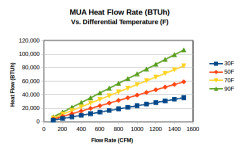
    The Energy Kinetics System 2000 furnace is configured to produce a nominal 120k BTUh. Requirements on MUA heating may be derived from this graph. (Click to enlarge.)


    Scott thanked kaseki
  • 2 years ago

    Thanks Charles. I’ve also had a mechanical engineer draw me a plan that was to take MuA direct to return but it was going to be conditioned. The price tag was $25k. I feel like noone knows what they are doing around here. Which puts me in a bit of a pickle.


    I agree with you completely on having this set up for balance… but as seemingly no one knows how to get this done around here in my city or the cost is outrageous, I feel like i can get by with a what goes out must go in apporach knowing full well its not perfect…. and im getting to the point where a decision has to be made on this cause its holding everything up. Ive tried to convince my hvac guys to dump it in the kitchen or figure out a way to disperse that… but noone seems interested (even the hvac engineer was concerned about tempering the air appropriately). I live in midwest climate. More hot than cold days forsure.