Software
Houzz Logo Print
chris_tice

HELP: Newly-installed natural maple flooring starting to look gray

2 years ago
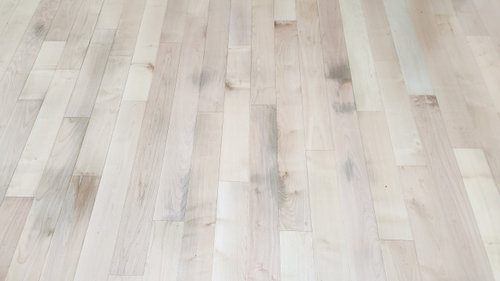
About 9 months ago, we had 500 sq ft of natural maple engineered hardwood flooring installed throughout the living room on the first floor (ground level). The flooring was installed on a layer of plywood subfloor which was sealed with T-35 adhesive. Below that is the concrete slab foundation which was sealed with T-100 adhesive (according to the installation receipt I was given).


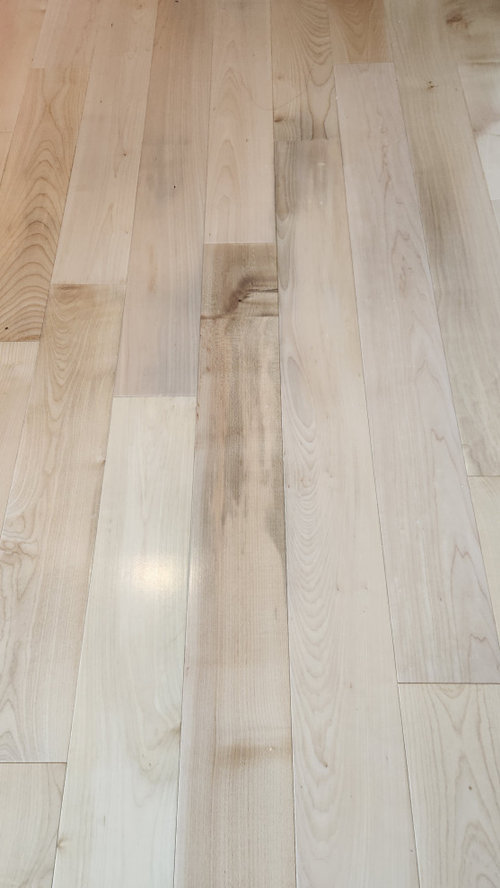
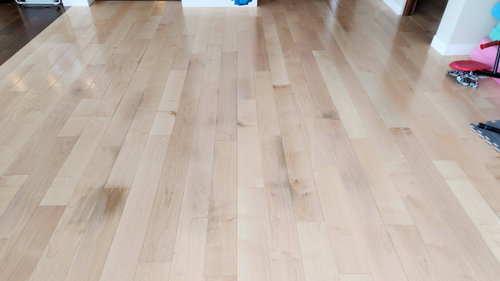
Just recently I noticed areas of the new flooring that started to look more gray. I tried cleaning the surface thinking it may have been the result of a spill of some kind but I'm unable to clean it. Also the gray areas are not concentrated in a single spot, it is spread across a wide area. We don't have any pets. We have the same type of flooring installed on the second floor and I have not noticed any graying issues upstairs. I have a pin-less moisture detector and when I test this area of the floor it reads generally higher (30-40%) than other areas on the first floor (10-20%).


I was suspecting water damage based on the discoloration of the wood. I do not believe I have a leak though since I have a Flume water monitor that has not detected any leaks, and our water usage is normal. We have an irrigation system that runs a couple times a week, but I don't see any pooling water near the house or other signs of a leak. Any other ideas of what it could be? I'm wracking my head over this one since I don't want to replace the flooring without knowing what the root cause is so it doesn't just come back again. Could water somehow be coming through the concrete slab and penetrating the moisture barriers beneath the flooring?


Any help would be appreciated in figuring out what might be causing this. Thanks!


Comments (26)

  • 2 years ago

    Your testing suggests moisture from below. Did your concrete slab get a 6 or 10mil vapor barrier put down before the pour? That's the standard. If not, you are relying on an applied seal material. This appears to be either failing or improperly applied. Get the guys who did the work in to evaluate your data. I don't see an easy solution to 30-40% moisture readings.

    Chris Tice thanked dan1888
  • PRO
    2 years ago

    That instalation methodology is wack. I've come across it before, and there's always rotten plywood underneath the wood. Slab on grade concrete requires engineered wood, glued down with a polyurethane floor adhesive. All other methods are trouble waiting to happen.

    Chris Tice thanked Minardi
  • 2 years ago
    last modified: 2 years ago

    This looks like moisture coming from underneath. You need to call your floor person ASAP and they need to test moisture in the wood. and plywood below using a pin-style meter with insulated pins.

    Chris Tice thanked Timothy Winzell
  • 2 years ago

    @klem1

    Thanks for the follow-up questions. I have a Flume water monitor installed and haven't detected any leaks. I had a leak detection company come out and they reported no leaks as well. I think the foundation is graded to prevent water ponding, but I will follow-up to see if I can get someone to take a look at it. The A/C and water heater is on the other side of the house so doesn't seem like an issue?

  • 2 years ago

    @dan1888

    I'm not sure the barrier thickness. On the receipt I have it says:

    * Adhesive T-100 All-In-One Moisture and Sound (TD) - Adhesive concrete to plywood subfloor

    * Adhesive T-35 (TD) - Adhesive for subfloor to wood flooring


    I had the owner of the flooring company over to inspect it and he said he's never seen this before and that they installed it via their standard procedures for hardwood on slab.

  • 2 years ago

    @Minardi

    Thanks for your comment. I believe the sealant used was a polyurethane floor adhesive. The receipt says Adhesive T-35 (TD) which Googling tells me is polyurethane so not sure what happened.

  • 2 years ago
    last modified: 2 years ago

    @Timothy Winzell

    Thanks for your comment. I had the installer over to inspect and he said he's never seen this happen before. I have a pin-less meter that I used for testing and it showed elevated moisture levels compared to the rest of the first floor (obviously not as accurate as the pin-style meter but there was a relative difference).

  • 2 years ago

    It wouldn't be unusual to find that the T100 used to glue down the plywood wasn't spread properly and doesn't have 100% coverage of the concrete, allowing moisture to migrate into the plywood and wood floor. It seems likely that this will continue to get worse, eventually requiring full replacement.

    If your contractor isn't willing to look into causes, you might have to hire an independent inspector who will probably want to remove some floor and subfloor to determine a cause.

    Chris Tice thanked Timothy Winzell
  • PRO
    2 years ago

    I agree with Timothy Winzell. Improper adhesive converage is properly the culprit. Also, was the subfloor shot or screwed in? That may have compromised the entire sealant system. You may not have good adhesion between floor and subfloor either.


    You do not need standing water to have a moisture issue. Most issues are caused from moisture vapor and condensation over time. The last photo shows that your floors are cupping.


    Moisture readiings should not exceed 9%. If, everything is air tight and dry. The normal reading will be around 6-7%. Subfloor should not exceed 12%.

    Chris Tice thanked G & S Floor Service
  • 2 years ago

    Wow, those T-100-for-plywood instructions are really detailed: Full plywood sheets must be cut down; kerfs must cut; sheets must be placed a certain pattern; a specified trowel must be used; product coverage must be 100%. Do installers really pay attention to all that?

    Chris Tice thanked wdccruise
  • 2 years ago
    last modified: 2 years ago

    To me, it looks like this is a removal and replace situation. All because the vapor barrier wasn't put down before the concrete pour. I would be onsite with inspection of the sealing when this is redone. I'd carefully prequalify the contractor on this point. Go over fully the procedures required by the product manufacturer.

    Chris Tice thanked dan1888
  • PRO
    2 years ago

    Vapor barriers below the slab do not prevent moisture vapor migration through the slab. They get punctured during the pour with wire or rebar, or the plumbers, etc


    It will always come down to a labor warranty, because the manufacturer's instructions for anything will never be fully followed. You will never win a claim. Also, most installers are not going to tear up 80K in a hardwood install that has problems, so you are out of luck with most installer's warranty as well.


    At least with an engineered glue down, the stability of the product protects it from a lot of installer flub ups. Solid on concrete is always a disaster waiting to happen.

    Chris Tice thanked Kimberli Saunders
  • 2 years ago

    Kimberli Saunders: "Solid on concrete is always a disaster waiting to happen."

    What does "solid" refer to? The OP placed plywood over the concrete using the SikaBond-T100 which, "When properly applied in accordance with Sika guidelines, SikaBond-T100 provides unlimited moisture vapor protection." Assuming that the plywood was installed correctly using SikaBond-T100 and the engineered wood was placed over the plywood using SikaBond-T35, why would there always be "a disaster waiting to happen"?

    Chris Tice thanked wdccruise
  • 2 years ago

    @wdccruise

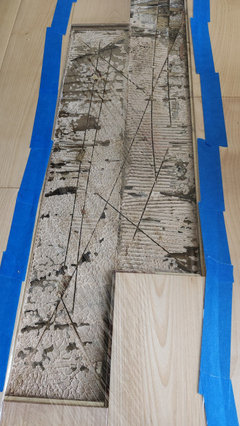
    Thanks for your reply. That's what I'm confused about. It seems like the installer did the correct things but clearly this is moisture coming from somewhere and I'm trying my hardest to figure out where. We tore up a couple planks of hardwood to expose the plywood subfloor. It looks to me like there is very minor mold growth (like tiny black dots) but I'm not sure. Otherwise the plywood is dry to the touch. My moisture meter reads about the same as the hardwood above it.

  • PRO
    2 years ago

    There are air pockets in between flooring and adhesive, allowing condensation to build.

    A specific size trowel is needed in order for it to act as a moisture barrier. The glue needs to be at a specific film thickness, also. And you need 100% adhesive coverage on the back of the flooring.


    When you removed the flooring in the affected area, are you able to see bottom or all glue?


    If, you rule out that it is not a installation issue. Then it is a product issue - call Sika to send a rep to investigate.


    Chris Tice thanked G & S Floor Service
  • 2 years ago
    last modified: 2 years ago

    G & S Floor Service: "When you removed the flooring in the affected area, are you able to see bottom or all glue?"

    He'd have to remove the flooring and the plywood to check for that since it was the T-100 adhesive's job to prevent moisture from rising up from the concrete slab.

    Chris Tice thanked wdccruise
  • PRO
    2 years ago
    last modified: 2 years ago

    Check under the flooring first. That’s where it is visible, before tearing out the sub. Cleaning could have caused this also. Go through the process of elimination. The very last layer of protection is the vapor barrier in the slab. You have several layers of protection before that. Inspect top -down.

    Chris Tice thanked G & S Floor Service
  • 2 years ago

    > Cleaning could have caused this also.


    I thought that could have been it too, but we have the same type of flooring installed upstairs and haven't seen any evidence of graying there!


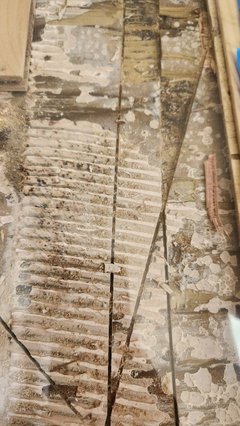
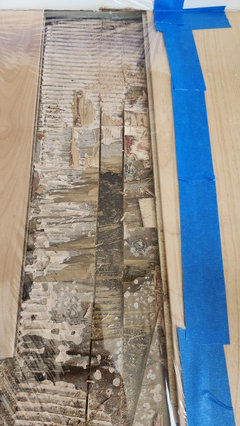
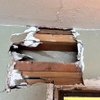
    Attached are some photos of the bottom of the hardwood and plywood subfloor.


  • PRO
    2 years ago
    last modified: 2 years ago

    Your first photo is part of your issue, out of flat, glue does not cover the back of the flooring 100%. Glue is not acting as moisture barrier as intended. Air pockets causing condensation and mold.

    On the final photo, I would cut that section of the sub out and inspect underneath. It looks like the sub has issues , also.

    Chris Tice thanked G & S Floor Service
  • 2 years ago
    last modified: 2 years ago

    The T-35 Product Data Sheet (flooring adhesive) states,

    "SikaBond®-T35 is applied to the properly prepared substrate directly from the pail and uniformly distributed by trowel as described on this Product Data Sheet. Press the wood floor elements firmly into the adhesive so that the wood floor underside is sufficiently wetted. The elements can then be joined together using a rubber hammer and an impact block and/ or rubber mallet."

    Photo two does appear to show that the flooring merely touched the peaks of the troweled T-35 adhesive rather than being beat down into it which is what I assume "wetted" means.

    I wonder how the plywood was adhered to the concrete using the T-100 adhesive whose job was even more critical to the prevention of moisture transfer from below.

    Chris Tice thanked wdccruise
  • 2 years ago

    What do you think the next steps should be?


    Should I reach out to another flooring company to see if they recognize the issue and would be able to do a proper installation?


    I could try to work with the same installer but how do I know they won't make the same mistake again.


    I found this service: https://covaltleveling.com/moisture-guard/ which seems relevant since they put down a epoxy sealant on the concrete before the flooring company does its work. But then I need to pay for another service plus the flooring installation. I'm just not sure if flooring companies should know how to do this.

  • PRO
    2 years ago
    last modified: 2 years ago

    The installer that put in the flooring owes you a warranty. Call them to fix the problem or pay for a new installation. This is a installer issue, not a product issue.

    Chris Tice thanked G & S Floor Service
  • PRO
    2 years ago

    Those photos is yet more hard evidence of why you do NOT do solid over concrete. Especially without the required recording of moisture testing at every single stage of everything. Engineered, sure.

  • 2 years ago

    Except that the OP said, "we had 500 sq ft of natural maple engineered hardwood flooring installed throughout the living room on the first floor (ground level)."

    Not known is if a moisture test was done on the slab before hand.

    Chris Tice thanked ci_lantro
  • 2 years ago
    last modified: 2 years ago

    Minardi: "Those photos is yet more hard evidence of why you do NOT do solid over concrete...Engineered, sure"

    This is the second time you've used the word "solid" without explaining what "solid" is...and what does "Engineered, sure" mean? G & S Floor Service explains, based on the photos, that the problem is with the installation, not the products (plywood, adhesives, flooring) that were used.


    Update: Based on another comment "Solid" refers to solid hardwood but you installed engineered flooring so the comment isn't relevant.

    Chris Tice thanked wdccruise