Software
Houzz Logo Print
janet_andreopoulos

Proper Ventilation for 36' Wolf Duel Fuel Rangetop with griddle

We are about to embark on a remodel in Arizona and have purchased cabinets to go with the Wolf 36" Duel fuel rangetop with griddle. The appliance guy suggested the Best 42" sleeve to go inside our cabinet above the cooktop. The cooktop puts out 77,200 BTUs and the hood has a max blower of 670 CFM and requires 8" duct work. I admit we purchased this without knowing the implications of proper venting and the contractor did not bring this to our attention.


We currently have 5 inch duct work above our cooktop and our current BTUs are at about 42,000. What is the proper way to ventilate this cooktop. The appliance and hood are against a wall in the middle of the home. The contractor said that the HVAC guy will install a barometric damper and grill above the range in the kitchen and that it would look like a small return air grill with a filter in it and this would flow through to the roof. This seems odd to me that we would have another vent in our ceiling near the cooktop. If this is supposed to bring in make up air - isn't it going to be hot? Can't the make up air flow through the hood if there is enough space in there? Thanks for your input and please go easy on me as I am new to all of this.

Comments (19)

  • 2 years ago

    You increase the duct size all the way to the exterior. And get a bigger CFM fan than recommended if you intend to use the griddle for burgers or searing meats. Your MUA flows into the mechanical room.

  • 2 years ago

    I am no makeup air expert but I believe makeup air is not suppose to flow into the hood but into the room. It is basically replacing the air that is being exhausted out by the hood.


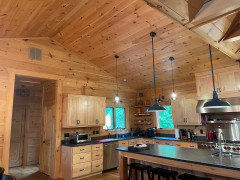
    Our makeup air is not located right near our vent hood. You can see the grill up on the wall and it's location to the vent hood. It is 12 inches and has a damper which is controlled by a sensor on the hood.


  • 2 years ago

    Zumi - Not sure I understand...what mechanical room? I only have an attic above my kitchen that is not really accessible to me. In other words it is not a finished attic.

  • 2 years ago

    Vinmarks - what kind of air is that is the make up air pulling in? Is it conditioned or just plain outside air? My concern is that if they place another duct through my attic and through my roof that we will be pulling in very hot air and affecting the a/c efficiency of our home.

  • 2 years ago

    It is not conditioned air just plain outside air. It hasn't been an issue for us. It is not like the hood is on for hours. There are systems for conditioned makeup air but it is not cheap.

  • 2 years ago

    vinmarks - may I ask what part of the country do you live in? I am concerned by taking this cheaper route I will pay in the long run with a hotter home in Phoenix.

  • PRO
    2 years ago

    The MUA should be ducted into your HVAC if you are worried about introducing 120 heat into the home. This requires assessment and engineering from your HVAC company. Where is your HVAC blower, water heater, etc located? That is your "mechanical room", which should be in conditioned space. As should your ducts be in conditioned space.

  • 2 years ago

    I am in NC. You probably get much higher temperatures then we do.


  • 2 years ago

    This forum is replete with topics discussing cooking ventilation and MUA requirements. I will add some links below. Highlights re OP's OP questions:

    • Not less than 90 CFM/sq. ft. of hood entry aperture -- actual -- choose a blower rated for 1.5X the calculated CFM.
    • Aperture extending beyond the perimeter of the cooking surfaces (pan bases for induction; pan sides for gas) by about 6 inches, or the cooktop area by 3 inches. Also front-to-back on front side if wall mount. Side skirts or cabinets may allow a bit less.
    • Duct velocity at actual flow to be within 1000 ft/min to 2000 ft/min. Set diameter accordingly.
    • MUA should be as turbulence free as feasible when it reaches the cooking area. Insert into the kitchen or nearby hall using a diffuser (longer blades than a register). Insertion into HVAC has its own can of worms you would have to work out with your HVAC person.
    • MUA is sometimes delivered next to commercial hoods, but is directed across the room away from the hood.
    • MUA will need its own blower unless the house is free of combustion appliances using kitchen connected air. Generally, blower or not, the MUA duct will need to be at least the diameter of the hood duct.
    • Take MUA from anywhere not down-wind of the hood exhaust. MUA will need to be heated in the winter in NC. I can provide a theoretical heating "cost" chart if you want. Note that most house heating systems are not sized for what is effectively a giant open window in the winter. You may need deliberate MUA duct heating, electrical, gas, hydronic, whatever.
    • MUA will need bird screening at a minimum; recommend a furnace filter for dust, bugs, etc. It will also require a damper that is energized with hood blower operation or by house pressure drop.

    Some references:

    What you are trying to accomplish with residential equipment (first 12 or so pages may be enough). https://www.tagengineering.ca/wp-content/uploads/2015/02/KVSApplDesign_catalog.pdf

    FAQs

    https://www.houzz.com/discussions/2328297/range-hood-faq-personal-notes-updated-10-31-2007#n=20

    https://www.houzz.com/discussions/5161173/hood-faq#n=101

    https://www.houzz.com/discussions/6099827/exhaust-hood-faq-ii#n=113

    https://www.houzz.com/discussions/6040827/range-hood-noise-project

    https://bamasotan.us/range-exhaust-hood-faq/

    Others

    https://www.houzz.com/discussions/5888450/seeking-muas-advice#28657635

    https://www.houzz.com/discussions/6078111/cost-to-add-a-make-up-air-system-for-kitchen#n=65

    https://www.houzz.com/discussions/6184577/need-advice-800-cfm-range-hood-and-make-up-air#28926574

    In addition, keeping up with ventilation threads here including looking back through several pages of topics will provide additional insights.

  • 2 years ago

    kaseki - thank you for sharing all of that valuable information. The more I read about it, the more it stresses me out. We were ill informed and I don't think I can move forward with this gas stove knowing that we do not have the proper ventilation. My fear would be that we would go to sell the house one day and it would not pass inspection. Even if we had the funds to have the proper ventilation I don't know if it's even possible as there maybe other hurdles in the attic. No one has gone up there to assess the situation. I called Wolf and they suggested an induction range. We are exploring that option now.

  • PRO
    2 years ago

    Induction only requires marginally less CFM for ventilation. It's about the cooking potential, not the method of cooking. Gas creates more bypass heat, and a bit more combustion particulates to exhaust. Induction creates high heat, aerosolized grease particulates, and a big huge plume of smoke when you burn things. Because most user burn things when first using. It's capable of just as high searing heat as gas, which produces the same cooking byproducts in the air. And needs the same ventilation for those cooking byproducts. And the same MUA system.

  • 2 years ago

    I never understood why people think because you have induction your ventilation needs are that much different. Smoke is smoke, grease is grease, You still get both from cooking on induction.

  • 2 years ago

    The reason I came to this conclusion is because the Wolf representative said that a 300 CFM is needed for their induction range/cooktop and said that that we would not need any modifications to our duct work.

  • 2 years ago

    I would be curious about Wolf's rationale for this case. Maybe 300 CFM would do for the case of cooking nothing more energetic than simmering bacon. For just what configurations do they think Wolf provides up to 1500 (rated) CFM blowers?

    Let me answer that question for them. I use Wolf's largest Pro Island hood to cover a 36-inch induction cooktop and nearby induction wok hob. I use their 1500 CFM blower, which is likely in my pressure loss conditions actually moving around 1100 CFM, and providing around 100 CFM/sq. ft.

    If I only had the induction cooktop, I would use a less wide Pro Island hood, potentially only 42 inches wide, but given some cross drafts, larger could be argued for. Scaling the 42 to the 66 implies that my blower should be rated at about 1000 CFM for the narrower hood, providing an actual flow rate of roughly 600 CFM (with adequate ducting and MUA), twice the CFM that Wolf recommended (likely as a rated not actual CFM value).

    Perhaps Wolf, like many other cooking appliance manufacturers wishing to not lose sales due to the potential for MUA requirements making kitchen renovation a nightmare, has in mind the 300 CFM Code limit in some areas for no deliberate MUA, and successful cooking plume capture and containment is not the basis of their comment.

  • PRO
    2 years ago

    There are no stated performance criteria for exhaust hoods in the 2018 International Residential Code, which forms the core of most statewide building codes. Indeed, the IRC doesn't even require an exhaust hood be installed when the range or cooktop is gas-fired. It does require a make-up air system to be installed in the event an exhaust hood is installed (and I advocate they should always be installed) and its flowrate exceeds 400 cfm. Absent any code-mandated performance criteria, appliance manufacturers can tell consumers whatever they want to hear and/or limit the capacity of exhaust hoods to 400 cfm to get around the make up air requirements.

  • 2 years ago

    Chispa- thank you so much for your comment. My question to you is do you have make up air in your new home?

  • 2 years ago

    To tell you the truth, I have no idea! We built a custom home in 2021 and did a more complex hvac system than most, but it was all engineered based on plans. Did they calculate the make-up air into the engineering? I don't know!

    Next time the hvac people are at the house I will ask them!

  • 2 years ago

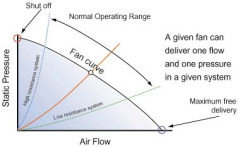
    No one should forget that there is always make-up air matching hood flow rate. It can be deliberately supplied, or accidentally supplied -- eked from house leakage. In all cases the house interior pressure will change as needed for the house intake to match the hood output. Please see the "fan curve" below to understand how flow reduces as pressure loss (in the path from outside to inside to outside) increases. Adding a deliberate MUA path reduces pressure loss; adding a blower-driven "active" MUA path reduces it further. The hood blower should be selected to deal with the conditions it has to work with.