

ZZ plant not growing
I rooted more than a year ago some zz plant cuttings and plant them I wasn’t expecting any growth early on however it has been over a year and I see no progress regarding growth m. Plant looks super healthy and shiny green, but no new growth. I have it indoors w indirect sun and water it perhaps once per month. I live in Florida so most of the time AC is on.
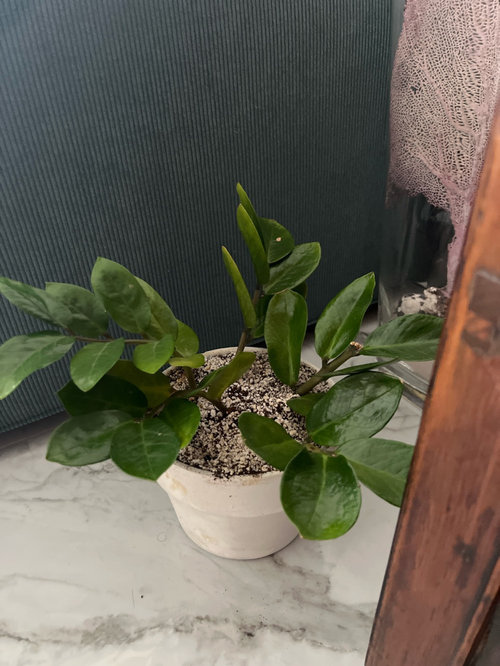
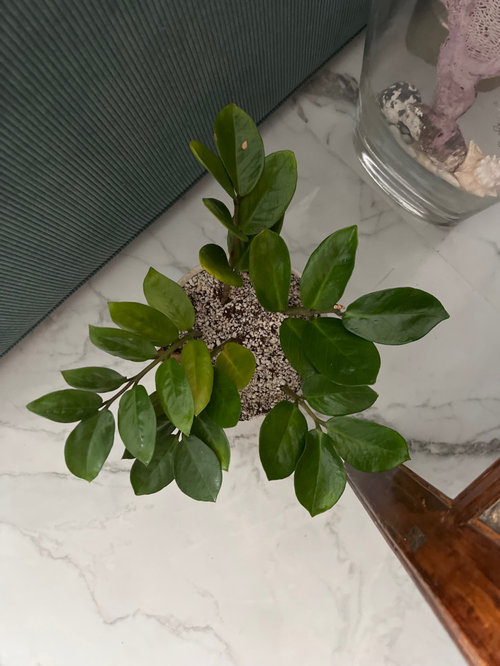
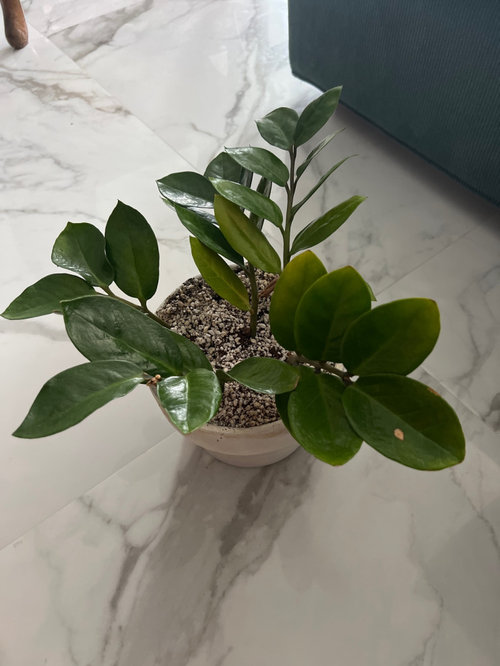
Comments (13)
L Evve (Miami)
Original Author2 years agoNo fertilizer.
Miracle grow with a mix of perlite.
Yes the clay pot has a good size drain hole.
Not very close to the window but my house has good lighting from outside… it’s a bright house facing north west. I was under the believe that this zz plant was better with no direct light.
When the pot feels light and the soil feels dry.
About 6”.
Related Professionals
Hartford Landscape Architects & Landscape Designers · Panama City Landscape Contractors · Lawton Landscape Contractors · Kearney Landscape Contractors · Vancouver Landscape Contractors · Shreveport Interior Designers & Decorators · Jackson Interior Designers & Decorators · Beckley Interior Designers & Decorators · Kirksville Interior Designers & Decorators · Watertown Interior Designers & Decorators · Harrisburg Landscape Architects & Landscape Designers · Lancaster Landscape Architects & Landscape Designers · Galveston Landscape Contractors · Hilo Landscape Contractors · London Landscape Contractors 2 years ago
Indirect sunlight can be misleading and the faint yellowing of the leaves suggest a lack of light or possibly fertilizer. It may be bright but in your house but levels of photo-synthetically active radiation (PAR) may be to low, and what plants needs to photosynthesis and make food as Tapla stated.
Your ZZ plant requires a daily light integral (DLI) of 5-10. A DLI is a total count of the number of light particles, or photons, received during during a 24 hour period. An example of source with a 5-10 DLI is where I live in Minnesota on a typical day in December. Sun intensity is low and days are short and the most a plant would get would be 5-10 in a single day on average, so DLI depends on intensity and time. It may seem bright on a typical day here but barely enough to grow a ZZ plant. Florida will have an average DLI of 25-30 in December outside, but Inside your house the DLI may be less than what I get outside during the winter. Now in the summer my DLI is higher than Florida because days are longer and sun Intensity is higher.
Indirect is defused light, or in the shade of bright sun, so you many want to relocate the plant where intensity is higher in the shade. If a seeding won't grow where your plant is sitting it's to dim for you ZZ plant.
 2 years ago
No fertilizer. If your aim is a healthy plant, it's essential that you adopt a regular nutritional supplementation program, and it's best if you use the number of times you have watered to determine when it's time to fertilize. IOW, in summer you might fertilize every 3rd or 4th time you water while in winter, every 4th or 5th time. It's also essential (to the good of the plant) that you water such that the entire soil column is completely saturated and at least 20% of the total volume of water applied exits the drain hole. The 'flushing action' carries dissolved solids (salts) out of the soil, which is very important. An accumulation of dissolved solids/salts in the soil A) limits water and therefore nutrient uptake, and the skewed ratio of nutrients in the soil that comes with inappropriate watering practices causes antagonistic deficiencies - where an excess of one nutrient limits uptake of one or more other nutrients. Let's say you're using a bloom-booster fertilizer which are ridiculously high in phosphorous (for use in container culture). The excess phosphorous can cause deficiencies of calcium, potassium, iron, copper, and zinc.
I highly recommend Foliage-Pro 9-3-6 fertilizer, now made by Superthrive. It has a number of attributes only a very fer fertilizers can lay claim to. It has ALL nutrients essential to normal growth and provides nutrients in the same ratio at which the average plant actually uses them. It also contains a form of nitrogen (nitrate) that is readily used by plants w/o the risk of ammonium toxicity that comes with fertilizers that derive their nitrogen from urea.
If you have ANY questions about fertilizing, please ask as it is a critical consideration. Keep track of how many times you have watered by dropping a marble, button, other, in the pot each time you water. The number of items in the pot can be used to determine what should be ever-changing fertilizer intervals.
Miracle grow with a mix of perlite. Miracle-Gro "potting" soil? M MG potting soil products are based on very small particles, which makes them excessively water retentive. Perlite can only minimally reduce water retention unless it is a very large fraction of the medium. Clear evidence that your soil is too water retentive is in the fact that your medium holds water enough to provide monthly watering intervals. When I make the soils I use, I start with a VERY porous medium and add only enough fine material to provide 3-6 day between watering, and for me, 6 days is on the 'too long' side. Your plant's roots are dealing with 2-3 weeks during which the roots are completely inundated, which by default means they are being deprived of adequate oxygen during that entire interval. The death and regeneration of roots that over-watering causes demands that all (or nearly all) the food/energy your synthesizes should go to root regeneration, leaving nothing left for growth.
I can provide you with some tricks that will substantially reduce the amount of water your soil can hold if you have interest. At some point, you might wish to consider altering what you use for a grow medium by including a large measure of pine bark. I can help with that if you want to talk about it.
Not very close to the window but my house has good lighting from outside …. Light diminishes by the square of the distance from its source. A plant situated 5 ft from a window receives only 1/25 as much light as a plant 1 ft from a window. If you have a brighter spot closer to the light source but not in direct sun, it would be better. Also, the best one can hope for with regard to how much natural light is provided after it passes through a glass window is about 70%. If the windows are tinted or have a low-e or reflective coating, it drops even more. 40-70% is about the range depending on glass thickness and other factors.
When the pot feels light and the soil feels dry. When the pot feels light is a good gauge, but using a wooden "tell" would be better. See below for more on using a 'tell'.
About 6” Most commercially prepared potting soils hold from 3-6" of perched (excess) water. This means that in any size/shape pot, the bottom 3-6" of soil will be 100% saturated after a thorough watering. MG products are always on the high side of the 3-6" because of the fine-textured materials they use in their product. If was say your soil holds 4" of perched water, that leaves only 2" at the top of the soil column that isn't saturated. A root mass can only function normally when an adequate supply of oxygen is available and that occurs when all air space between soil particles are free of excess water. The 'tricks' I mentioned above can be very helpful in mitigating excessive water retention. Ask if interested.
Using a 'tell'Over-watering saps vitality and is one of the most common plant assassins, so learning to avoid it is worth the small effort. Plants make and store their own energy source – photosynthate - (sugar/glucose). Functioning roots need energy to drive their metabolic processes, and in order to get it, they use oxygen to burn (oxidize) their food. From this, we can see that terrestrial plants need plenty of air (oxygen) in the soil to drive root function. Many off-the-shelf soils hold too much water and not enough air to support the kind of root health most growers would like to see; and, a healthy root system is a prerequisite to a healthy plant.
Watering in small sips in order to avoid over-watering leads to a residual build-up of dissolved solids (salts) in the soil from tapwater and fertilizer solutions - which limits a plant's ability to absorb water – so watering in sips simply moves us to the other horn of a dilemma and creates another problem that requires resolution. Better, would be to simply adopt a soil that drains well enough to allow watering to beyond the saturation point, so we're flushing the soil of accumulating dissolved solids whenever we water; this, w/o the plant being forced to pay a tax in the form of reduced vitality, due to prolong periods of soil saturation. Sometimes, though, that's not a course we can immediately steer, which makes controlling how often we water a very important factor.
In many cases, we can judge whether or not a planting needs watering by hefting the pot. This is especially true if the pot is made from light material, like plastic, but doesn't work (as) well when the pot is made from heavier material, like clay, or when the size/weight of the pot precludes grabbing it with one hand to judge its weight and gauge the need for water.
Fingers stuck an inch or two into the soil work ok for shallow pots, but not for deep pots. Deep pots might have 3 or more inches of soil that feels totally dry, while the lower several inches of the soil is 100% saturated. Obviously, the lack of oxygen in the root zone situation can wreak havoc with root health and cause the loss of a very notable measure of your plant's potential. Inexpensive watering meters don't even measure moisture levels, they measure electrical conductivity. Clean the tip and insert it into a cup of distilled water and witness the fact it reads 'DRY'.
One of the most reliable methods of checking a planting's need for water is using a 'tell' (more reliable than a 'moisture meter'. You can use a bamboo skewer in a pinch, but a wooden dowel rod of about 5/16” (75-85mm) works better. They usually come 48” (120cm) long and can usually be cut in half or in several pieces, depending on how deep your pots are. Sharpen both ends of each tell in a pencil sharpener and slightly blunt the tip so it's about the diameter of the head on a straight pin. Push the wooden tell deep into the soil. Don't worry, it won't harm the root system. If the plant is quite root-bound, you might need to try several places until you find one where you can push it all the way to the pot's bottom. Leave it a few seconds, then withdraw it and inspect the tip for moisture. For most plantings, withhold water until the tell's tip comes out nearly dry. If you see signs of wilting, adjust the interval between waterings so drought stress isn't a recurring issue.
Al
- 2 years ago
Foliage-Pro 9-3-6 fertilizer! I forgot the name so I've been looking for a month on old threads but couldn't find it. I mix my own fertilizer for my own outdoors use but mix up a fool proof liquid simple fertilizer for three seniors (mid 80's) to help them grow tomatoes in pots with no complications and they just add what I take them every two weeks.
Right now I use general purpose soluble miracle grow with the same ratio 3-1-2 but it doesn't have calcium or magnesium and no nitrates, along with to little potassium for tomatoes. So I need to send bags with the additional fertilizers with the bottles and sometimes they forget something. Using foliage-pro will allow me to just add potassium nitrate in the bottle to get it perfect so it's just a bottle every two weeks. Thanks Al.
P.S. Works great without ever having a problem and takes the plants all the way to the first frost. The tomato plants I take to them produce 400 to 600 2oz tomatoes and a bullet proof variety they all love.
 2 years ago
These shoots won't grow themselves. Their purpose is to create/feed the rhizome below the soil line which will eventually create a new shoot. It can take a long time, but have faith, it will happen eventually. As long as these shoots look good, the rhizome is growing below. ZZ plant propagations have to grow the little rhizomes below the soil line into decent sized "potatoes" before they will put out a new shoot.
You could pull them out to see how big the rhizome is. But I just suggest patience and optimism!
L Evve (Miami)
Original Author2 years agoPopmama!!! This makes all sense! Thanks for the knowledge sharing!
- 2 years ago
Since you live in Florida could you put it outside for a spell? Even here many houseplants spend the summer outside where they get good light, fresh air and refreshing rain.
- 2 years agolast modified: 2 years ago
Let's say you're using a bloom-booster fertilizer which are ridiculously high in phosphorous (for use in container culture). The excess phosphorous can cause deficiencies of calcium, potassium, iron, copper, and zinc.
Partially off topic. @tapla (mid-Michigan, USDA z5b-6a), I know you don't grow orchids, but you're the man to answer! Phalenopsis are grown (in most cases) in pine bark (size 12-18 millimetres). Orchid fertilizers have a high phosphorus content to promote flowering. I, who am not an expert grower, use an NPK 4-5-6 fertilizer all year round, but more experienced growers use different fertilizers depending on the time of year and at the time of flowering they use some in which the phosphorus content is even higher (example: NPK 10-30-20). My question: since there is no water perched with the bark, does it still create the problem of salt accumulation? Obviously I imagine that the same answer also applies to the two soils (gritty mix and 5:1:1 mix) that you historically recommend since these two soils also do not have perched water.
- 2 years ago
The average plant uses about 6x as much N as P. If there is any credible information that orchids use more P than N, I'd need to see it. A 4-5-6 fertilizer provides 2.8x as much P as the average plant can use (relative to N usage), and 10-30-10 supplies 7.8x as much P as the average plant can use. Leibig's Law of the Minimum states that a plant's rate of growth, the size to which it grows, and its overall health depend on the amount of the scarcest of its essential cultural requirements available, meaning it's the most deficient of cultural factors which limits plant performance. It further states that increasing the supply of non-limiting factors will not increase plant growth rate, size, of vitality levels, and only by increasing most deficient factor will the plant performance improve. There is also an optimum combination of the factors and increasing them, individually or in various combinations, can lead to toxicity for the plant.
I CAN say that Michigan State University developed 2 fertilizer formulations for orchids, one formula for those using well water, the other for growers using R/O water. The NPK %s are, respectively, 19-4-23 (roughly a 5:1:6 ratio) and 13-3-15 (roughly a 4:1:5 ratio). These fertilizers were highly researched with collaboration between John Biernbaum, PhD, of the Horticulture Department at MSU, along with Bill Argo, PhD, of the Blackmore Company and Larry Metcoff of GreenCare Fertilizers and have produced many award-winning plants. READ MORE HERE
Based on what these researchers have discovered, and the orchid community is discovering, I'd suggest that perhaps it's more likely that K levels need special attention as opposed to P levels which the %s and ratios suggest is needed at % LOWER than the average plant.
since there is no water perched with the bark, does it still create the problem of salt accumulation? Accumulations of dissolved solids from tap water and fertilizer solutions is driven almost entirely by watering practices. Consistently watering in small sips will ensure higher TDS/EC (total dissolved solids/ electrical conductivity) and skewed nutrient ratios in the soil solution, whereas flushing the soil as we water (over the course of several waterings) is something akin to resetting the TDS/ EC levels to near zero. This helps ensure the plant is actually getting nutrients in the ratio at which they are utilized, which also helps to keep TDS/EC levels at their lowest levels possible w/o nutritional deficiencies.
The gritty mix, ingredients appropriately screened, holds little to no perched water which is it's most valuable asset. The 5:1:1 mix will hold SOME perched water, but far lass than most commercial mixes which normally hold 3-6" or more. Too, that is adjustable for water retention by varying the ratio of the listed ingredients or by incorporating additional materials.
Al
- 2 years agolast modified: 2 years ago
"Orchid fertilizers have a high phosphorus content to promote flowering"
This is a myth with no scientific evidence to support the claim. 50 years of nutrient management studies have shown a ratio of Phosphorus to nitrogen over 1 for any orchid genera had no additional benefit for growth or flowering.
The genera Phalenopsis has been extensively studied over many decades, and older conclusions have continuously been validated with newer studies. They all show high phosphorus levels provide no benefits and actually limit growth by decreasing availability of other nutrients to the plant. For Phalenopsis orchards studies have shown the optimum amount of phosphorus is only 15% to 20% of the total amount of nitrogen used with little benefits seen over this amount. Applying levels of phosphorus over 40% of total nitrogen actually start limiting growth due to fertilizer antagonism.
The reason fertilizer companies are selling orchid fertilizers with such an outrageous amount of Phosphorus in them is merely to capitalize on the myth. A ratio of 2 parts nitrogen to 1 part phosphorus is the most they would ever need, and they have no special need for crazy amounts of the stuff. Miracle grow must have read some study results and almost got the NPK ratio right (30-10-10) but it should be closer to 30-10-20. The nitrogen they used is urea and useless to the plant if the media lacks the 3 specialized bacteria needed to convert Urea into a nitrogen form the plant can use. They should of used Ammonium Nitrate and the MG also has no calcium. Orchids need the same nutrients as any other plant, (also shown in studies) and proven through leaf analysis. I don't know what Mircle grow was thinking. Maybe $$ signs.
The best product would be Foliage-Pro 9-3-6 fertilizer Tapla recommended with the right ratio, the right nitrogen source and all the nutrients.
- 2 years ago
@tapla (mid-Michigan, USDA z5b-6a) and @outpaientzero, thank you for your comments. I don't know if I will find a fertilizer with the ratio you indicated, but I will look for something similar now that my old NPK 4-5-6 fertilizer is running out (it also contains guano and I know what Al thinks of organic fertilizers). I don't know why but here in Italy even expert orchid growers (they have hundreds) also use organic fertilizers (among other things I don't know if there are bacteria in the bark), fertilizers with a high phosphorus content. Furthermore, they argue that different fertilizers should be used depending on the type of orchid and the time of year. Yet they seem to have a very scientific approach: do you think they use the conductivity meter to decide how much chemical fertilizer to add to the water: by the way, does that make sense?
My question: since there is no water perched with the bark, does it still create the problem of salt accumulation?@tapla (mid-Michigan, USDA z5b-6a), I'll try to explain better this question I asked you a few days ago. I had foolishly thought that a vehicle that does not contain perched water does not present the problem of salt accumulation. Instead, even if there is no water perched, there will still be accumulation of salts, right? Simply the absence of perched water allows you to rinse the vehicle better without too many problems.
- 2 years ago
I have grown a few terrestrial orchids but I'm not familiar enough with orchids to be giving advise re how best to grow them. I do know that I highly doubt there is any justification for supplying several times more P than a plant can/will use. Please don't forget that Liebig's Law of The Minimum is firmly grounded in science.
As far as organic vs synthetic fertilizers, at the point in time when nutrients are assimilated by the plant, they are taken up as salts in exactly the same form as that provided by synthetic fertilizers. One form (synthetic) is predictable insofar as what nutrients are available and offers virtually complete control over what a plant gets (in terms of nutrient ratios) and when those nutrients are available, the other provides none of these advantages.
There are Fertilizer Solution Calculators available online for help determining solution strength based on PPM.
TDS/EC are primarily used to determine the total amount of dissolved solids in the soil solution for nutrient and non-nutrient solutes, which doesn't take into consideration the %s or ratio of each nutrient to the others.
.... even if there is no water perched, there will still be accumulation of salts, right? It depends on watering practices employed. Simply the absence of perched water allows you to rinse the vehicle better without too many problems. Yes, it is extremely difficult to over-water a very high % of plants in a medium that supports little to no perched water, which significantly reduces any risk associated with flushing the medium and makes maintaining a very healthy root system much easier. The trade-off is the need to water more frequently when using highly porous media.For our friends in Europe looking for a 3:1:2 ratio fertilizer, try a product called PLNTS Nutrition. It is a complete fertilizer in a 3:1:5 ratio. Find it at https://plnts.com/en/product/plnts-nutrition-500ml
I think we've managed to wander off topic a bit, so I hope L Evve will grant us a reprieve for our detour.Al






tapla (mid-Michigan, USDA z5b-6a)