

AC: Electric vs. Gas Heating - Which HVAC System Is Best?
We are in the middle of remodeling our home and have to decide if we go with a gas system or an all-electic system with a heat pump for our new HVAC. What do the HVAC experts here recommend? The home is the SF Bay Area, so the climate is pretty moderate compared to the rest of the country. As a family we tend to use both the AC during the summer and the heater during the winter.
Comments (56)
 2 years ago
If you lived in a cold climate I would suggest getting a high efficiency gas furnace. You are in a mild climate location and in a city and state which is trying to eliminate all fossil fuels. For those reasons I would recommend a heat pump.
How is the house currently heated and do you plan to have any other gas appliances? You should look into whether having a dual fuel system and gas appliances add or detract to the value of similar houses in the Bay area.
 2 years agolast modified: 2 years ago
Living in a mild climate and in the SF Bay Area, I too would go with an air-to-air heatpump with electric strip backup. The system will exceed its useful lifespan long before R410a becomes unavailable (or prohibitively expensive).
Pass on the dual fuel option - not cost-effective in your climate and political location.
Related Professionals
Morgan City Home Remodeling · Springfield Home Remodeling · Hot Springs Kitchen Remodelers · Hackettstown Kitchen Remodelers · Pittsburgh Kitchen Remodelers · Phoenix Kitchen Remodelers · Bainbridge Bathroom Remodelers · Bennington Bathroom Remodelers · Elizabeth City General Contractors · Green Bay General Contractors · Sarnia General Contractors · Bowling Green Home Remodeling · Sioux City Home Remodeling · Lancaster Home Remodeling · Oxnard Bathroom Remodelers PRO2 years agolast modified: 2 years ago
The system will exceed its useful lifespan long before R410a becomes unavailable (or prohibitively expensive).
We don't know what the cost will be, nor do we know what will OR won't be available for a market like California due to "legislation" of that state.
So what legislation?
On September 30, 2022, California Governor Gavin Newsom signed into law Senate Bill (SB) 1206, which prohibits the sale or distribution of bulk HFCs that exceed a specified GWP. This means that in the near future, it will no longer be possible to buy virgin refrigerants, such as R-410A, R-404A, and R-134a, and reclaimed refrigerant will be the only option to service existing air conditioners and commercial refrigeration equipment.
Under the new bill, starting January 1, 2025, the sale of bulk refrigerants exceeding GWP 2,200 GWP ― such as R-404A and R-507 ― will no longer be allowed. As of January 1, 2030, the GWP may not exceed 1,500, so the sale of bulk R-410A will be prohibited, and on January 1, 2033, the GWP may not exceed 750 (e.g., popular refrigeration retrofit refrigerants such as R-448A and R-449A).
It should be noted these rules will effect more than just R410a refrigerant.
If only reclaimed refrigerant is allowed? once that runs out? A good amount of equipment is replaced because?
The equipment is devoid of refrigerant. Reclaimed refrigerant does not come magically. It comes because it's reclaimed from equipment being replaced and in some minor cases of repairing it.
I service Katy, Texas area. (So why pay attention to what happens in California?)
 PRO2 years agolast modified: 2 years ago
Decreasing the environmental impacts of HVACR is a worthwhile goal. Efforts to do so are ongoing. They are not political conspiracies. In the case of chemical refrigerants, we've survived various phase outs before and I'm confident we'll survive the phase down of R410A, too. You can curse the transition, you can promote fear among those who know even less than you or you can get on with it.
Daikin, LG, and Goodman all offer residential heat pumps in the U.S market which utilize R-32. R-32 has zero ozone depletion potential and a GWP of 675. So, a heat pump with R-32 should have refrigerant available for its life expectancy and then some-- in California and elsewhere. For the record, R-32 has been used in residential heat pumps elsewhere in the world since 2012 so it's not new and untested. One of the spillover benefits of the transition is that R-32 is 12% more efficient than R410A which will save consumers on operating costs and decrease demand on the electric grid. Given your state's fragile electric grid, Ray, I submit Texans will be well served to follow California's lead and get on with the transition.
 2 years ago
Now that those of you no closer than 2000 miles away have offered your views, it's my turn, as a SF Bay Area resident, to offer mine. These are my views so I'll express them using first person.
With the one exception should this person live in one of the few areas with cheaper than PG+E municipal electricity, I would never in a million years use split heat pump equipment for home HVAC as long as there remains a choice. Unless I had adequately sized solar panel equipment installed too. And, perhaps with the consumer-unfavorable changes that have been made with respect to <-> pricing/reimbursement for PG+E customers, maybe not even then. PG+E electricity rates are astronomical and going north.
Natural gas remains the cheapest way to heat. Furnaces are not expensive and with the limited use here, unless this is a full-on gut remodel, high efficiency models that are not plug and play installs when replacing 80% ones are an added and avoidable cost. Straight air-conditioning equipment that works one way (conventional) rather than two ways (heat pumps) are cheaper to buy and maintain and last longer. Natural gas usage is not being "phased out" for existing equipment.
The information gap for those of you pretending to look over the Rockies to see what's here is obvious. The SF Bay Area is known for its microclimates. On the same day, there can be a swing of 20 degrees F on a trip of a lesser number of miles. As this person describes themself as being an air conditioning user, that eliminates the possibility of their living in the city of San Francisco or in other bayside locations that have cool (not hot) summers. Other parts of the area, especially inland or separated from the cool water by hills, different story - heat with low humidity.
Unless those of you carping about the environment drive only electric vehicles charged from non-coal sources, I'd say there's some hypocrisy at work. Worry about your own practices first before adopting a "do what I say, not what I do" approach.
- PRO2 years ago
Elmer,
You can disagree with the regulations as much as you'd like, but they reflect the current reality in your area. It will be illegal to install a gas-fired hot water heater and a gas-fired furnace after 2027 and 2029, respectively. If you need to replace either of such systems before those dates, you have the option to choose gas vs. electric. Eventually you won't have that option--at least without changes to the regulations. While I can't predict future utility prices, I anticipate some sort of carbon tax will be levied on fossil fuels to further incentivize their phase out.
At present, there are both state rebates and federal tax credits available which incentivize conversion to heat pumps. If conversion to heat pumps is inevitable, taking advantages of the available rebates and credits now might be a smart choice. The OP will be well served to contact their local utility, as previously advised, to help them make an informed choice.
- 2 years ago
The question is for 2024, not 2027 or 2029. I was answering the person's question for the most economical route to go NOW. Repeat, NOW. Not using a scare/fear tactic to upsell to higher costs easily avoided and beyond what's needed
" taking advantages of the available rebates and credits now might be a smart choice. "
HVAC equipment in our mild climate gets light use and often lasts 25 years or more. Your suggestion is as likely or more likely to be a dumb choice.
Something like half of in-state generated power comes from gas-fired power plants. If there's a carbon tax, it will apply there too. The best gas plants are something like 65% efficient, easily exceeded by even the old standard 80% typical of gas furnaces. They're not going away as the only significant non-combustion power source available here is solar and until batteries are in widespread use, the base load is carried by combustion plants.
No one is shaking from your manufactured doomsday threats.
- PRO2 years ago
Elmer,
I'm neither an activist nor an alarmist. I haven't advanced any doomsday threats. I have submitted that past phase outs of refrigerants didn't result in the end of life as we know it. I don't think the R-410A phase down will either.
The OP indicated they need both heating and air conditioning, so their investment decision is heat pump vs. air conditioner plus furnace. Deciding which is the more economic choice requires both the initial investment and the cost of the utility (gas or electric) over the life expectancy of the system to be considered. The initial investment, net of any rebates and tax credits, is easy to estimate. The wild card in the economic analysis is what escalation rate to apply to either utility, and what, if any, carbon tax may be applicable in the future. To the extent that carbon capture technology can be implemented at power plants, the carbon tax may not be applied equally to natural gas and electricity generated from fossil fuels.
The OP's utility company should have resources available to help them crunch the numbers and make an informed choice.
Ray's R410A issue--which would qualify as alarmist in my opinion, is moot point now that R-32 heat pumps are available in the U.S.
- 2 years ago
The Eddie Haskell approach, backing away from the gloom and doom, eh? Let me know Mr. Cleaver's response.
- PRO2 years ago
I'm content to let houzzers review the posts and conclude what they will, Elmer. I invite them to weigh in.
- PRO2 years ago
According to the Bureau of Labor Statistics, the June 2024 cost of electricity in the SF area was $.419/kWh and natural gas was $2.137/therm.
- 2 years ago
Yes, of course. The problem is when comments are made that while not untrue can all the same be not completely true and said in a way the colors their importance, people can be misled. I think your comments were less than fully objective/factual, were misleading, and didn't factor in the realities of this person's location.
Here's a calculation that's not rigorous and I'll admit could be overly simplistic. There's rarely more than 20 degrees difference between indoor and outdoor temperature during AC season, and rarely more than 25 degrees difference during heating season, in the SF Bay Area.
When running full time (set temperature not yet achieved), I can operate my furnaces for 1/2 the cost for one hour as running the AC. The furnace produces hotter air (maybe 95-115 deg) than a heat pump would (maybe 85-90) and so can achieve the set temperature in less time. How could the heat pump, needing to run longer, be less expensive to operate? Before considering its shorter useful life than a furnace.
- 2 years agolast modified: 2 years ago
Tier 1 is/was .43/kw….213 kw. Tier 2 is/was .54/watt from my July 2024 bill. plus taxes/fees.
- 2 years agolast modified: 2 years ago
I wasn't going to get into the details. Another happy PG+E customer. A Mat?
These people from Heat Pump Land don't seem to want to see things objectively. Many of them too live in areas without natural gas service.
- 2 years ago
Re ban on natural gas…courts have ruled no. Berkely for example.
Maybe the OP should post where their home is…..Concord climate is very different than Oakland - PRO2 years ago
The economic analysis would consider both the initial capital cost (net of any rebates and tax credits) of either system and operating costs over the life expectancy of each system.
The coefficient of performance of a heat pump is typically between 3 and 5. Let's call it 4. At that COP, the heating or cooling energy output is 4X the electrical energy input. So the breakeven cost of electricity would be 4X the cost of the natural gas equivalent. I calculate that as $.29/kWh if combustion were 100% efficient. Assuming a 92% AFUE furnace, there is a ($.419/kWh - $.29/kWh) * .92 = $.12/kWh premium for heating cost for the period of time the heat pump operates in heating mode. The cost of cooling is the same for either scenario.
The OP will need to weigh the difference in initial cost (net of rebates and tax credits) vs. operating costs over the life of the system. I submit that it's reasonable to expect the price of either utility to rise at the expected inflation rate plus an additional cost for a carbon tax. Make your best guess, crunch the numbers and make your choice.
- 2 years ago
Your math is akin to saying 5 apples - 2 grapes= 3 peaches.
I don't know if you do know how these calcs work and your intent is to be misleading, or perhaps you don't understand.
Electrical "efficiency" and gas combustion "efficiency" are two different measurements that can't be compared because they're different.
Let's talk BTUs. I kWh of electricity using resistance produces 3.4K Btus. That's called "100 % efficiency" for electric heating BY DEFINITION. For comparison to other outputs using only electricity.
Depending on the outdoor temperature, a heat pump can produce 3-4 times as much as resistance. . Use 3.5 (honest people making comparison calcs round down). So where we are, 43 cents of electricity can produce 3.5x 3.4 or 11.9K Btus. To get to 100 Btus would take 100/11.9 or 8.4 kW. At 43 cents for half and say 54 cents for the other half, that's 48.5 x 8.4 = $4. Actually, all of it would be at 54 cents because the lowest tier baseline would be already used up so really 8.4 x 54= $4.53. But half and half is fine.
100,000 Btus gross in gas cost me $2.70 at the blended pricing in the period Feb - March of this year. My 80 percent furnaces need 125K Btus in to produce 100K out, so 2.70 x 1.25= $3.30. A 95% efficient furnace would use 105Btus gross so 1.05 x $2.70= $2.84.
Heat pumps are simply not competitive to produce heat in the SF Bay Area. Except for people with adequately sized solar installations (an expensive way to get electricity) and the lucky souls who have Palo Alto or Santa Clara city utilities.
- PRO2 years ago
Options other than R410A are now available in the U.S. It's time for the fear mongering over the cost and availability of R410A to stop.
- PRO2 years ago
@Elmer,
There is indeed a higher operating cost for heating using a heat pump vs. gas furnace based on the current utility costs in your area. For anyone considering replacement of a furnace with a heat pump, an economic analysis will inform the decision. That analysis should consider both the capital (installed cost) and operating (utility and maintenance) costs of both systems over their expected lifetime. Your math considers only the cost of the utility. The capital cost of both systems would be net of any rebates and credits (local rebates wouldn't apply, but federal tax credits may apply for upgrading the efficiency of an existing furnace or air conditioner.) Those initial costs are easy to estimate (contractors will typically provide them at no cost.) The future costs of utilities is the wild card. I don't know what inflation rate to use for either utility and whether there will be a carbon tax at some future date, but the analysis can be run assuming different escalation rates for comparison. The folks at the local utility should have data they'll share from actual replacement case studies with their estimates of future utility costs. I suggested the OP do that in my first post. They may have already done that by now.
- 2 years ago
" The folks at the local utility should have data they'll share from actual replacement case studies with their estimates of future utility costs. "
Nope.
The Rockies provide a barrier. Stay on your side and don't guess about how things are where you can't see.
- PRO2 years ago
I don't think the Rockies create a barrier to making informed choices about alternative energy, but the SF bay might. Consumers just south of the bay area can make use of an excellent online tool for evaluating whether conversion to a heat pump makes sense: https://www.helpelectrify.com/heatpumpcalculator
If it's not obvious, the rebates and utility rates in the online calculator apply to the indicated service area only; consumers in the bay area would need to adjust for any differences. Consumers looking for information on federal and statewide rebates can find it at
https://www.energysage.com/heat-pumps/california-heat-pump-incentives/
- 2 years ago
My Minnesota electric rate is $0.1313 per KWH peak and no Tier BS, and when I looked at PG&E rates I nearly fell off my chair! If I had an all electric vehicle with a metered charging station I could charge it Off-peak for $0.0490 per Kwh but the best PG&E in CA can do is $.30 a KWH?
In Canada's populated areas it's averages 20 cents peak, Pacific power in Oregon and CA averages 28 cents peak and Arizona is 16 cents and in line with the national average so who is sucking the sweat equity out of PG&E consumers? It isn't the cost on Nat gas to fire those power plants, as a distributor there cost for nat gas is a fraction of the retail price.
Comparing apples to grapes my cost for Nat gas including basic service, delivery charges, adjustments and taxes is $1.35 per therm. So PG&E's price is not cheap, and the sour grapes are in the actual cost of gas to PG&E. The actual Cost of Nat gas delivered to my provider is 39 cents a therm so PG&E's cost would be comparable so I just wanted to throw sour grapes into all your computing.
Why does PG&E charge 3 and 4 times the electric cost than my provider when the cost of living in California is only 40% higher then Minnesota excluding housing? It looks like they're a branch of the Mafia controlled government with an illusion of utopia but boarders on dystopia. You voted for the sh*t sandwich so eat it and please don't move here.
Yes the gas is cheaper to heat with and yes Elmer is right on all points.....and really pains me to say this but I'm a honest guy. My semi genius Idea isn't something I'd do here either but figured all Californians were brainwashed thinking gas BAD electricity GOOD....ugh. But I'll still stick to my recommendation for for a Nat gas backup generator.
- 2 years ago
"Why does PG&E charge 3 and 4 times the electric cost than my provider when the cost of living in California is only 40% higher then Minnesota excluding housing?"
California has inadequate hydroelectric power resources, little chance of continued fossil fuel power generation and even less chance of nuclear power station development. Add to that PG&Es liabilities for future forest fire litigation and you have......... $0.30+ per kWh.
- 2 years ago
Thanks Kevin. I hope we can agree on more in the future.
sktn, my understanding is that litigation and liability costs cannot be recovered in the rates.
- 2 years ago
As most utilities are subject to governmental regulation, rate oversight and reporting, there are no mysteries about power sources and costs.
A quick search disclosed this about Minnesota:
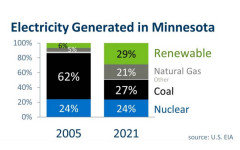
In the renewable category, wind power is the majority and provides 25% of total generated electricity. (Not 25% of the 29% sector total). So from top to bottom, cheap, more expensive, cheap and cheap.
In California,

One third of power consumed is "imported" and for that, market price is paid.
The state's PUC approves rates based on detailed applications for the reimbursement of procurement costs. Because of deregulation, the investor-owned utilities don't own the generating assets anymore and must buy (at "retail) from the companies they had to sell them to.
Also, it's a very large state and it consumes a lot of power. More people live in the SF Bay area than in all of Minnesota. Also more in LA County. Also more in Orange+San Diego counties.
- 2 years ago
the Kigali Amendment mentions phasing out HFC's and I believe R32 falls into this category. The plan was to phase out 45% of HFC's by 2024 but it hasn't happened with any of the members who ratified the amendment and was just a promise. California will phase out and ban the sales of 410A in 2030 but doesn't mean it can't be used it or even brought into the state.
Will Newsom set up road blocks to keep 410A out along with gas mowers from entering the state? R22 has been totally banned now but virgin refrigerant can still be bought for a price and there is 150 million pounds of reclaimed gas still sitting around so it's going to be a long time before it's all gone. R410A in California will still be available for decades after 2030 so I don't think the OP as anything to worry about.
Nothing to lose sleep over and by then Natural refrigerants will be back in use. If it's CO2 (R-744) Ray will be happy because of the high pressures required or cascade compressors will means more parts to break. If it's H2O (R718) oxicool It might not make him so happy, but if if R290 is allowed with higher charges it's business as usual with just a few explosions a year and a small price to pay to save the planet. I believe accidents will be well below the fires caused from propane grills so not a big deal.
- 2 years ago
My friend replaced her heater and AC about a year ago. The company she chose to do the work convinced her to change heater from gas to electric. We live in California’s Central Valley. She lives in a 2 story house. The heater is unable to provide enough heat to be comfortable. She has had 5 different companies come out to troubleshoot the situation.
They all told her the same thing, “That’s how it is, there is nothing wrong with your heater.”
I would NOT change to an electric heater, and I live in a single story home. - 2 years agolast modified: 2 years ago
Depending on your SF neighborhood (I lived in the Richmond and didn't even have AC), I'd do as much as possible to avoid those PG&E summer time-of-use peak rates(e.g., insulation, energy-efficient windows, shading, cool roof, etc.). I have a two-stage package heat pump and definitely recommend two stage to reduce the "whoosh" of air movement, decrease noise, and improve dehumidification.
- PRO2 years ago
Dehumidification is an important consideration in HVAC design; California is no exception. By way of illustration, the 2018 International Residential Code (IRC) 2 1/2% summer design temperatures for San Francisco are 77F d.b. and 64F w.b. Those conditions are 64.3% relative humidity. Cooling air with those properties to, say, 73F without dehumidification would elevate the relative humidity to 73.4% That is outside the graphic comfort zone of ASHRAE standard 55 (2017). In addition to comfort considerations, that relative humidity would be a concern for mold/mildew growth.
- 2 years agolast modified: 2 years ago
There is little humidity in the Bay Area
SF has very few days of 77 degrees. Relative humidity is 50%, 60 degrees.
Maybe you do not know nor have any experience in the Bay Area - 2 years ago
Please stick to what you know. These comments show what you don't know.
Air conditioning in SF is rare, as others have said.
Right now, at 5:00pm, it's in the high-80s at my Silicon Valley location and 35% humidity. In San Francisco, less than an hour away, it's 62 degrees F. What's the relative humidity there? Who cares, it's cool and damp as normal. This is typical weather in each location (and typical difference in temperature between the two) for this time of year.
- 2 years agolast modified: 2 years ago
Knock yourself out.
Try weather underground for a large number of weather readings for any location. I stepped outside for the first data and did a quick look for the second.
In the old days when both the SF Giants and SF 49ers played in Candlestick Park, which was located at a wind tunnel gap in the coastal mountains and so was very breezy, you needed warmer clothes to go to a summer Giants game than to go to a Fall 49ers game. Giants have since moved downtown to a warmer location, 49ers to Silicon Valley to a much warmer location. Just 35 miles away but a world of difference.
Edit to add - most Californians who know SF, certainly all of us in the Bay Area, know what summertime SF weather is like year in, year out. People from 2000 miles away, like you - less likely so, as you've demonstrated about many things in this thread.
- PRO2 years ago
While it may be comfortable in any given locale on any given day, code requires HVAC systems to be designed based on 2 1/2% design conditions. That is, conditions which are exceeded only 2 1/2% of the heating or cooling hours in a heating or cooling season. High relative humidity might be rare in your locale, but it occurs often enough to be a design consideration for design of a code-complinant HVAC system.
- 2 years ago
Give up, stop struggling to salvage something from your very uninformed comments. You don't know what you're talking about and you keep striking out. Residential AC is rare in a city with cold summers and old houses. Whatever the stat is, and who cares, is skewed by modern and high rise construction that's taken place in the last 20 years. For the existing housing stock of Victorian and post WW2 era single family housing, as with this fellow doing a big remodel, it's relatively unknown.
I'm done with you here. Get yourself a beer and try next time with something you know something about.
- PRO2 years agolast modified: 2 years ago
Elmer,
You don't need to live in SF to design a code-compliant HVAC system where the design conditions are prescribed. You just need to be a competent HVAC designer and have a copy of the applicable code requirements. The 2 1/2% design conditions are what is prescribed in the code. The summer relative humidity associated with the design conditions for SF is conducive to mold/mildew growth so dehumidification is an important consideration based on physics, not personal opinion. If you'd like to take issue with the code, you'll need to take that up with the International Code Council, which, incidentally, is not based in California. I'm sure they'll be amused by your argument.
- 2 years agolast modified: 2 years ago
Having acutally lived in San Francisco and experiencing the differences among neighborhoods (Richmond, Sunset, downtown, Pacific Heights), the comments from Elmer and A Matt lead me to the conclusion that neither could even find the city on a map. It could be cloudy and cold at 45th and Geary, and warm and sunny three miles east.
(It's 62 and 83% humidity in SF at 10:00pm).
- 2 years ago
Hah. i wonder if you're deflecting too. You didn't answer my question about where in CA is there a summer heat and humidity problem.
- 2 years agolast modified: 2 years ago
Foggy sea air. You got AC on at 62 degrees? SF is damp and cool, no argument from me.
PS- 10 pm? It's 730, more BS from the East Coast? - PRO2 years ago
(It's 62 and 83% humidity in SF at 10:00pm).
An air conditioner trying to "control" humidity in a home at these conditions would be a lost cause. You'd be better served to install a dehumidifier.
Trying to reduce humidity with an AC with the above conditions you'd be hanging icicles from your ears. (AC is for comfort, not discomfort. Try again? better yet quit.)
An air conditioner is designed to control temperature more so than doing anything about humidity. At lower ambient temperatures outside? It's going to far exceed temperature drop than if it were in the heat of the day.
This situation rears it's head here in Katy, Texas every so often. The complaint usually goes something like this: I'm smelling something funky coming out the AC vents. It's cooling fine, but it's smelling funky.
Why an air conditioner doesn't "control" humidity. It wasn't designed to do that because of the conditions listed above. (Temperature and humidity run independant from one another)
Yeah lets turn this thread into another long winded humidity vs temperature thread. The builder thinks he can design his way out of this box. How long is the builder on the hook for? 1 year? 2 years? Go ahead place your bets. - PRO2 years agolast modified: 2 years ago
Cooling and dehumidification are separate, but related functions of an HVAC system.
The 2 1/2% summer design conditions for San Francisco (77F d.b. 64F w.b.) have a corresponding relative humidity of 64.3% That's above the minimum required for initiation of mold/mildew growth (and once established mold/mildew can propagate at 50% r.h.) and outside the 35% to 55% range recommended by the NWFA for stable hardwood floors. So, even if 77F is considered a comfortable indoor temperature, the need for control of relative humidity is indicated. Unfortunately, attempting to decrease relative humidity by cooling from 77F to say, 73F will likely result in short cycling of the system, little if any moisture removal, and cool-and-clammy conditions. (My psychrometric table indicates the relative humidity would be 73.4% if the system produces cooling without dehumidification.)
The summer design temperatures for San Francisco aren't unique experiences for folks in the Bay area. They are similar to conditions we encounter in our coastal Virginia area for two to three weeks each spring and fall when there is little demand for either cooling or heating. During these "shoulder seasons," controlling relative humidity requires a dehumidifier. I have a dedicated dehumidifier integrated with the HVAC system on each level of my home. They aren't code mandated, and they don't operate often, but they are an investment I chose to make for a healthier indoor environment and more stable hardwood floors and trim.
- 2 years ago
I had vision of people drilling 350 holes a mile deep and over a 6 mile deep magma cavity, and then fracking the holes at the bottom to make more steam and it turned into a disaster movie. The lava flow moved down a valley between two mountain ranges towards the big city by the ocean and it had to be stopped at Santa Rosa, but the solution wasn't code and not environmentally friendly!
So how many tons of cooling will be needed to stop the Magma flow down US101 when the Geysers pop the surface from all the fracking in an anti fracking state. Without a code to address the problem nothing can be done, and of course the crisis wouldn't go to waste and abused. I'm sure a solution will come from a guy 4000 miles away in Iceland where lava flow containment is a common occurrence, they have the talent. The big question is will the overlords allow gasoline powered water pumps to cool the lava without a referendum to raise taxes, and will battery powered pumps be mandated? Will San Fransisco bay fill up with magma coming down US101 from the geysers or will an outsider stop the lava? It's not it but when, considering earthquakes are increasing in the geyser area with higher magnitude levels so this is something to fear, not if R410A will be available in ten years so which one would make a better disaster movie?
- PRO2 years ago
(It's 62 and 83% humidity in SF at 10:00pm).
The builder immediately shifts focus to smoke screen cover.
[quote] The 2 1/2% summer design conditions for San Francisco (77F d.b. 64F w.b.) have a corresponding relative humidity of 64.3% That's above the minimum required for initiation of mold/mildew growth (and once established mold/mildew can propagate at 50% r.h.) and outside the 35% to 55% range recommended by the NWFA for stable hardwood floors. So, even if 77F is considered a comfortable indoor temperature, the need for control of relative humidity is indicated. Unfortunately, attempting to decrease relative humidity by cooling from 77F to say, 73F will likely result in short cycling The 2 1/2% summer design conditions for San Francisco (77F d.b. 64F w.b.) have a corresponding relative humidity of 64.3% That's above the minimum required for initiation of mold/mildew growth (and once established mold/mildew can propagate at 50% r.h.) and outside the 35% to 55% range recommended by the NWFA for stable hardwood floors. So, even if 77F is considered a comfortable indoor temperature, the need for control of relative humidity is indicated. Unfortunately, attempting to decrease relative humidity by cooling from 77F to say, 73F will likely result in short cycling... [end quote]
Let's see if the builder changes the subject again.... - PRO2 years agolast modified: 2 years ago
The question which Elmer posed was "Where in California do you live where dehumification (sic) is an issue?" The implication was that the need for dehumidification in California is rare. It's not. The example I used to illustrate the point is San Francisco where there is little need for air conditioning, but there is a need for dehumidification. I believe the point has been sufficiently made.




Charles Ross Homes