Software
Houzz Logo Print
webuser_354410108

Should rain enter the house when it has been wrapped?

last year
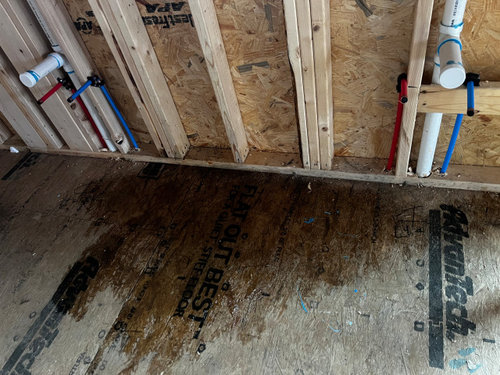

Our house has been wrapped, no siding and has the roof installed. There have been places where rain has leaked in at the wall. I’ve read that house wrap is water resistant but should rain have been able to get inside?

Comments (26)

  • PRO
    last year

    The rain is getting in somewhere else and it behooves you to find out where now. Could be nothing or could be major. Can’t tell from one photo

    HU-354410108 thanked HALLETT & Co.
  • PRO
    last year
    last modified: last year

    What did your builder say?

  • last year

    He’s expressed concern but not as concerned as we would prefer. Said he would send someone to check on it but then there was a miscommunication and I’m not sure if he went

  • last year

    Here are more pics


  • last year

    Better that you've seen it now than later.


    Yes, it is a problem that should be addressed.


    JLC details all the likely suspect causes. Let alone, if it's not Typar or Tyvek, it's subpar.


    I build with masonry and never depend on housewrap alone, but have the masons use builder's paper as well. But if this is not a custom build, you're stuck with the builder's bare Code standards.

  • PRO
    last year

    Something is wrong if it’s leaking and the windows are installed.

  • PRO
    last year

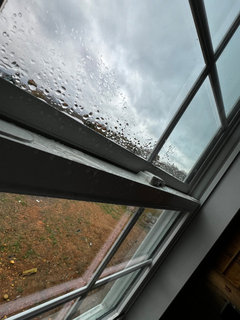
    The image of water on the window sash eliminated the possibility of it being a large neighborhood dog.


    ('eliminated' used on purpose)

  • last year

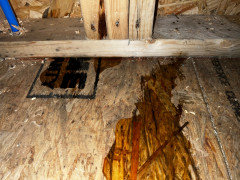
    Looks like it may be coming in under the sill plate. Bottom plate. Should have a sealant under there for draft control. But seeping in frofrom outside at the bottom of the wall. Have you tried to find the problem yourself

  • PRO
    last year

    ^ no there is water on top of the interior of the window sash… so the water is coming in above the windows. Maybe they aren’t taped yet but shouldn’t the contractor know that?

  • PRO
    last year

    Oh I agree with you Jake, I was just pointing out that it’s not just the sill plate (though that could be leaking too!) and maybe windows aren’t fully installed. Without minimally exterior photos we are guessing

  • PRO
    last year

    It's housewrap, not flashing. When the siding is properly installed and flashed, there won't be any water. A week or two of wet wood isn't going to hurt anything.

  • last year

    @Joseph Corlett, LLC

    I'm sorry but that's exactly the wrong answer. This is the drainage plane. It is what waterproofs the house, not the siding. The siding is simply a cladding that certainly sheds the bulk of the water but the drainage plane is never the siding.


    If you are unclear on this, simply Google the YouTube videos showing repairs after improperly installed house wrap.

  • PRO
    last year

    Jake, having been in the construction business for 40 plus years, one of the first things I've learned is to not have the customer watching the sausage being made. It is silly to believe that unprotected housewrap could somehow function as properly installed flashing and siding, even temporarily..


    Among other things, this water could be the result of wind blown rain which won't happen when the siding and flashing are properly installed and the housewrap can resume its functions while properly protected as the manufacturer requires.


    "Is house wrap waterproof?
    House wrap is a moisture barrier, but it is not 100% waterproof. If it is directly exposed to water for too long, that water can get through. Since it is underneath the exterior siding of a home, being completely waterproof is not required."


    https://radiantbarrier.com/what-do-you-need-to-know-about-house-wrap/#:~:text=Is%20house%20wrap%20waterproof%3F,completely%20waterproof%20is%20not%20required.

  • last year

    You should post photos of the exterior especially at housewrap penetrations, edges and layering. What kind/brand of housewrap is it?

    A housewrap can leak for a number of reasons, including:

    • Improperly lapped joints
    • Incorrect or poorly installed fasteners
    • Tears and rips
    • Poorly sealed penetrations and edges.
    • Excessive exposure to UV rays
    • Cold temperatures
    • Presence of surfactants (surface-contaminates)
  • PRO
    last year

    Contact the manufacturer of the building wrap and tell them their product is failing and causing severe damage to your home. Ask them to send out a technician to solve the problem. You need someone that is knowledgable and able to see first hand all the conditions that could contribute to the problem, and advise accordingly.

  • last year

    Yes, we need photos of the outside, particularly around the windows but really any penetrations. All of those leaks are around windows.

  • last year
    last modified: last year

    @Joseph Corlett, LLC

    That information that you linked to is misleading to the point of being not at all accurate.

    Do you need "house wrap": no - but you do require some type of moisture barrier that's not the siding. In most homes that dry to the outside, that barrier also has to be vapor permeable. In older homes (and some newer homes) that was asphalt saturated felt paper or fiberboard. It could also be something like the ZIP system.

    Building methods and codes have changed. Older homes were built before OSB sheeting or even plywood sheeting on the exterior. They also had no insulation in the walls and if a little water got in, it would dry out quickly because they leaked air like a sieve.

    Now the exterior sheeting is almost always OSB or plywood. Both are moisture sensitive, but particularly OSB. If you trap moisture in OSB it will delaminate and rot.

    "Is house wrap waterproof?" It's supposed to be rain proof. Meaning water - even driven rain - should not penetrate the house wrap. Is it in practice? Oftentimes no.

    Contractors are using poor quality materials and very poor installation and the result is very predictable. OSB rot is so common that there are companies who do only that work - and that's all they do.

    Siding is exterior cladding. Yes, it will shed water, but it's never rainproof even after the best installs. And 10 years after install it's certainly not. Caulk dries out, windows leak at joints, planks expand and contract opening up gaps, bumps with lawnmowers, baseballs, hail, etc. all open small holes.

  • PRO
    last year

    " but you do require some type of moisture barrier that's not the siding."


    Fair enough, but that's not HU's question. That is: " I’ve read that house wrap is water resistant but should rain have been able to get inside?"


    The answer to that question is: Without properly installed flashing and siding, yes.

  • last year

    The simple answer is that it's not possible to judge the quality of this particular housewrap and its installation from interior photos.

  • last year
    last modified: last year

    The answer to the OP's question is very simple. Once the windows are in, the house should be rain tight.

    There is no flashing, or anything else that gets added at this stage that you can do to make it rain tight.

    Even if the angled cuts for the windows weren't taped for some odd reason, it wouldn't be that much water.

    That's the answer to the OP's question.

    We need photos of the outside to fully confirm what we suspect.

    But the OP is warned not to allow the contractor to proceed until this is fixed. Certainly not get bamboozled by the idea that siding or flashing or some other added thing is going to fix this problem.

    Again, We need confirmation with exterior photos, But the windows will likely have to be removed at the minimum. I can't imagine how they could be fixed properly without rewrapping the house.

  • last year

    " There is no flashing, or anything else that gets added at this stage that you can do to make it rain tight. "


    Exactly. Small water infiltration would be one thing. This is obviously pretty serious water as it is sitting on the window sash and frame. I would not be happy about the contractor continuing on until this has been investigated further. Also wondering why the OP has not been back as he seemed pretty hot to get advice.

  • last year

    "Also wondering why the OP has not been back as he seemed pretty hot to get advice."


    I can imagine that the builder is giving them some dog and pony excuses. And it would be difficult to be an owner in that position. The owner is not generally an authority on these types of issues and the builder presumably is. They are going up against a builder who is potentially looking at having to pull all the windows (and possibly re-wrapping) a house they are trying to get "blacked in" as we used to call it - because some folks on the internet said it was wrong. The builder is trying to get crews going inside, and the outside done before the weather turns.


    The "source of truth" on this are the installation instructions provided by the manufacturer of the products involved (windows, wrap, sill pans, tape, etc.). And that's what the owner needs to insist on.


    This is a multi-hundred thousand dollar investment for the owner. The consequences of not getting this right are well known, and very serious. And it will be the owner who is left holding the bag, because it won't be noticed until mold starts showing up on the interior walls or hardwood floors start warping long after any warranty period.

  • last year
    last modified: last year

    There is no context except close-up pics of water. The presence of housewrap does not indicate anything more than the walls are up, it doesn't mean it is dried in, even with windows. Sometimes builders will put the housewrap on the wall prior to raising it (meaning while it's being constructed laying on the floor) and may not be taped, overlapped, or fixed from being wind blown until siding. Just because the shingles are on, doesn't mean that the roofer has come back to put the boots over the rough-in pipe penetrations on the roof. Scheduling has a lot to do with it.

    Just to impart some little details about the building process - though it doesn't answer or explain any of this situation because not enough info is known - wood getting wet during construction is common. Trusses or lumber can sit outside unprotected through rain (even before delivery at the supply house or on the train). Some plywood floor sheathing products have "gutter channels" built in so that when it rains it doesn't pool on top and runs down to the floor below. Sometimes window sashes are left open or removed pending delivery of drywall.

    A myriad of reasons that should be very obvious to pinpoint at this stage if you are walking through the house, not looking at close-up pictures of water.

  • last year
    last modified: last year

    ^^I spent eight years as a general contractor, I do have a pretty good idea about job phasing and what to expect at various points.

    From the OP we know these things:

    1. "The house has been wrapped." From this statement we can assume:

    a. They are using house wrap, not Zip, or some other system.

    b. The job is complete

    2. The windows are in. That also suggests the wrap is complete.

    3. There are significant amounts of water intrusion:

    a. on the top sash of the window

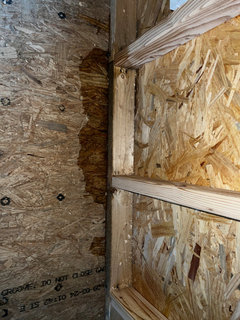
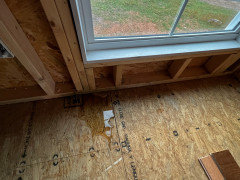
    b. at the bottom plate on either side of the windows - as if water ran down the studs.

    c. At multiple locations, not just one window.

    We are not terribly concerned that the OSB or studs got exposed to water during construction. All of it can tolerate getting wet for a while. That's not the issue.

    Again, we need outside photos to fully confirm - but there is nothing in the information that we have to suggest anything like a window being open, a boot being off a stink pipe or the wrap being partially applied.

    What is very common is for contractors to pay little attention to both the materials used and detailing around windows, doors and other openings when using house wrap. And the origins of most of that is that Tyvek marketing initially was emphasizing being an air barrier. Contractors don't get that it - not the cladding on the outside - is the drainage plane.

    Is it possible there is another explanation? Possibly but not likely. Photos of the outside will certainly tell us.