Software
Houzz Logo Print
rhoda_melnicoff

Walking feet? compare and contrast

last year
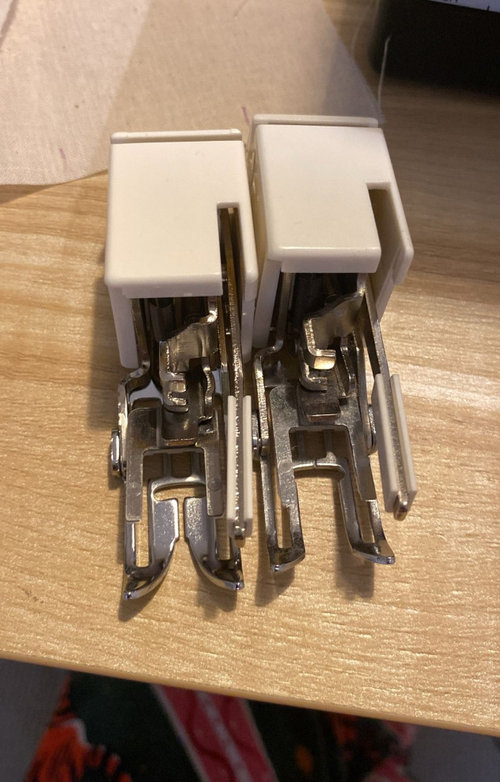

My daughter who lives across the USA sent me this photo and asked if there are different uses for these walking feet. She has a Janome sewing machine that is maybe 2 years old. I think one of these might be from my 15 year old Janome 6500 that I gave her because I always forgot to use it.

Comments (16)

  • last year

    Yeah. The open one helps you with things you have to see, as well as cording and other kinds of fancy stuff. The closed one is for a better grip on slidy stuff and sandwiches where keeping the layers running together is harder. Even if the machine isn't brand new, she should be able to get a demo at her local service center. …. Or, I'd bet there are plenty demos online.

    Rho Dodendron thanked plllog
  • last year

    I agree with pllog. i sew a lot and use the closed one almost all the time on most fabrics Perhaps it isnt necessary, but i use it anyway.

  • last year

    Thank you both for your ansers. For some reason there was a like button for plllog but not Sheeshie.

  • last year

    You might get some really good answers if you ask on a sewing forum.

  • last year

    IC, I don't think those fora are active anymore. This was cross posted to sewing and quilting.

  • last year

    Well, a quilting forum is where you use the walking foot a lot.

  • last year

    True. I'm a quilter.

  • last year
    last modified: last year

    I have a Walking Foot attachment similar to the ones above. I think it might be the closed toe.

    I have a Pfaff 1222 that has a walking foot. Recently I responded to an ad (or two) for a robust walking foot sewing machine. For the sort of WF shown above, they can be helpful when doing that long straight stitch quilting.

    Rho, did you give up on the free motion quilting? I took a few stabs at it and my practive results were much like yours. People say it takes regular practice. There are lts of YouTube tutorials online with a variety of machines. They make it look so easy —and it probably is easy once you’ve mastered it; a lot of muscle memory.


    ➡️ https://www.canoeridgecreations.com/2013/03/straight-line-quilting-tips-techniques.html

  • last year

    Free motion is more about courage than anything. And you have to have a tight stretch to get pretty. It's easier to start with free-motion embroidery. Just add some enbellishments to your block. Some texture on hair or fur, a ribbon, a curlicue. Don't start with figures like flowers, but work up to them. Also, don't be scared when you move to quilting, to have humility stitches. Do avoid toe-hangers, but if you have a jog or sharp angle let it go. Remember, a strong tradition in quilting is that only G-d is perfect, And if you do have a toe-hanger, go back over it, or come back later and take a couple hand stitches over it—ripping out is bad for the quilt and annoying to your soul. Save that for if you get a bobbin snarl. Free motion is the opposite (duh) of walking foot. You do have to have your sandwich tight and stable (lots of pins facing every which way, and maybe a hoop), and it's easier with thinner batting and fewer seams, but freedom to just go is lovely!

  • last year
    last modified: last year

    I am lousy at D-3 or sometimes 2-D sketching, even a stick figure is a challenge. I am decent at many things, but drawing or doing anything like that is frustrating.

    I fear I am best described by that PLAN AHEA….D sign. Except with my brain and eye hand visual coordination, it is not a matter of planning — I just have the darnedest time making a reasonable representation of something. I cannot seem to convey 2-D and especially 3-D to paper.

    Give me a messed up batch of knitting and dropped stiches or a tangle of jewel chains and I can straighten it out. Ask me to fix a boat or a broken gadget; or ask me to cook. I envy people who can draw or depict things visually. I am the worst at that sort of thing. Boo hoo.


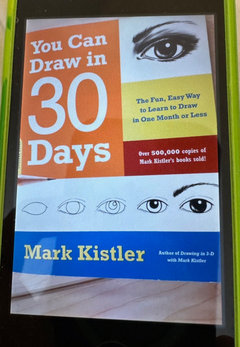
    maybe this book will help.


  • last year

    If you want to do free motion, it doesn't have to be figurative. Curlicues and worms can look great and are a lot of fun. Just try to keep the distances kind of even. If they're all, for example, 1/4”-3/8” between lines of stitching, it looks intentional, no matter how random. If you want to do figures, you can trace them from pictures in your phone or from books, and mark as you would for hand quilting. Use a colored pencil to plan your line of stitching on the tracing, but be willing to improvise a little when you make a booboo.

    As for the kinds of practice I mentioned, they're even more important if you're not good at drawing. Start on scraps. If they come out well, you can add them to a quilt or whatever. My first free motion embroidery (way back in the dark ages) came because I'd made a little patchwork block for a charity raffle quilt, and it looked all muddy since the pieces were small. It needed something to separate the colors, but I had to turn it in and had no time for hand embroider. There was a paragraph on how-to in a book, so I followed the directions (drop the feed dogs, etc.) and just went. Adding some texture to the horse's mane and tail, just back and forth, in random, organic loops, did the trick, along with some regular machine setting outline stitches.

    If you have a Sunbonnet Sue, you can do curly hair below her bonnet, or, fancier, go short back and forths to make a pigtail. Add a ribbon—straight lines back and forth—to separate the brim from the poke. Add some crosshatching to the front to make a gingham apron. Or if you have a pinwheel block, make a ”flower” on each blade out of circles, like doodling. Fill in the center.

    You need courage, not drawing skill, to start. Just think it through, where you'll be going (like for a minute, not an hour) so you don't panic, put your hands flat on the surface of your fabric/quilt, maintaing even pressure for control, and keep your fingers away from the needle!

  • last year

    YouYou’re a great advocate, plllog! Maybe i’ll free-motion embroidèr a pocket or something to test things. ”Keep your fingers away from the needle!” is funny but valuable sdvice. Got a picture of something? Please?

  • last year

    Yea! Go for it. I don't have any accessible pictures. Nothing digital. I'm sorry. It's been quite awhile since it was my business. Do heed the fingers warning! I've never sewn mine, but it's too easy to get caught up in the design and forget to watch where one's hands are in relation to the needle.

  • last year

    I know that’s true. I hate to admit it, but i really did catch my left index finger under the needle once. I dont remember what i was guiding so closely, but i sure wasn't paying attention to my finger!


    What was your business, if you dont mind.

  • last year

    I was more of a generalist than a specialist, and things kept evolving, so it's too long a story for this forum. Recently, I've been getting a lot of signs that I should start quilting seriously again.

Sponsored
High Point Cabinets
Average rating: 5 out of 5 stars21 Reviews
Columbus' Experienced Custom Cabinet Builder | 4x Best of Houzz Winner