Software
Houzz Logo Print
webuser_42320756

condenser dryer vs heat pump dryer to replace vented dryer

last year

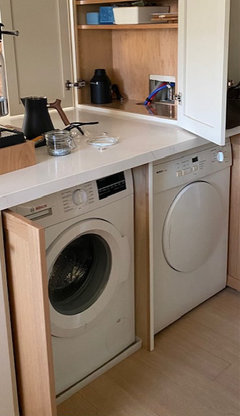
Hello, I have a Bosch Axxis dryer (2006, WTA4410) that no longer works. The Bosch Axxis is a compact dryer 4.0 cu feet (24 in wide, 24 in depth) with enough back clearance (my closet is 36" deep). Because my set up (4" vent duct) is for a vented dryer, I looked for a replacement, but seems like the vented dryers are fizzling out of stock.


My question is: condenser dryer vs heat pump dryer. I believe I'll have enough back depth/clearance (36") which was one concern I had because my impression is when people complain about clothes still being wet after hours in the dryer it is because there is not sufficient air flow.


The following are all "compact" 24" / 4.0 cu feet dryers. Looking at:

1. Electrolux ELFE4222AW

2. Bosch 500 WTW87NH1UC

3. LG DLHC1455W - heat pump dryer


Any input?


Lastly, what do I do with the 4" hole after I get a new dryer? How do I properly seal/close it as I do not want unnecessary air draft? Do I need to hire a handyman?


Comments (23)

  • last year

    Consumer Reports has reviews of compact dryers ($10/month digital). The Samsung DV25B6900EW is a vented dryer that earned a CR recommended rating. Ignore the customer ratings on the Home Depot website for this model because they mistakenly refer to the heat pump model whose model number (DV25B6900HW) differs by only one letter.

    Miele ventless dryers also tested well but owners who reported on the AJ Madison website are not fond of them.

    (I have the discontinued, compact, ventless LG condenser dryer which works okay though one must be careful not to overload it to prevent sheets from balling up.)

  • last year
    last modified: last year

    If you want something reliable, or as reliable as this segment offers, Miele is the best choice.

    i have had their T1 heat pump dryer for over five years now, has 9000 operating hours, and not any breakdowns. we previouly had a Siemens condensor. Heat pump is superior in every way.

    Most loads are done in about an hour give or take depending on type of clothes.

  • last year

    We've had an LG washtower and it works fabulously, and our electric bills went down from about $500-600 a month to $300-350 a month, so it's more than paid for itself in the past year.

    We do live in the most expensive rate town in the US (SDG&E), but I imagine a similar % decrease would happen if you do a lot of laundry and don't use A/C or heat pump a lot. (We almost never use our heat pumps, one of the upsides of living in SDG&E territory is a fabulous climate.)

  • last year

    Thanks for all the feedback. I haven't pulled any trigger yet. The odd thing is I did purchase the Samsung (vent) DV25B6900EW dryer to replace the Bosch Axxis (vent) dryer, but the installer said it wouldn't work, and because it was unboxed I got refunded. Fine with that other than the time-lost annoyance cuz i'm leaning towards a heat pump dryer anyway. I have a heat pump HVAC as well so I'm comfortable with heat pump technology. And yes, I do read alot of good reviews about the Miele T1. From my understanding the base model (TXD160), mid-model (TXI680) and upper-model (TXI860) are basically the same machine, just more bells/whistles when going up in tier?


    @luna123456, which T1 do you have? do you also have a Miele washer, or another brand?


    I don't necessarily want to ditch my current operational Bosch 300 washer (WAT28400UC), but at the same time don't know how 'compatible' different brands (Bosch 300 washer, Miele T1 heat pump dryer) are especially when the original installer said the Samsung wouldn't work!

  • last year

    "I did purchase the Samsung (vent) DV25B6900EW dryer to replace the Bosch Axxis (vent) dryer, but the installer said it wouldn't work"

    Unless you were attempting to stack the Samsung dryer on the Bosch washer he's wrong. Unless washer and dryer are stacked, you can use any washer with any dryer. HOWEVER you must have electrical outlets with the voltage and amperage required by the appliance. Your old Bosch and both Samsung dryers require a 240 volt, 30 amp circuit while Miele dryers require a 120 volt, 15 amp circuit.

  • last year

    @hb

    I have the TWI-180. This is one step below the top, touchscreen based model in the USA. The only possible issue could be slower spin speed/low g-force extraction with a non-Miele washer. This would extend the dry time somewhat, depending how well your exsting washer removes water during the final spin.


    I have a Miele WWH-860 AND a Miele WXI-860 (yes two washers).

  • last year

    it may be that the docking of the two is the problem . Even within a mfg it is impossible to dock anything over a few years old .


    we have a Miele heat pump set since 2017 and it works great . Everyday laundry takes about 60 minutes in both the wash and dryer . Never get backed up .

  • last year
    last modified: last year

    Following up on the above, I'm curious about why the installer said the Samsung vented dryer would not work. HB, does your laundry space have only a single 240v-30Amp outlet? Your Bosch washer (300 series model 28400 washer) needs a 240v power supply, same as a dryer. If your laundry space is wired for two separate 240v outlets (one for the Bosch washer and another for the dryer), then any vented dryer should work in the space. However, North American laundry rooms rarely have two 240v circuits. For as far back as I can remember, Bosch dryers here have accommodated this limitation with a socket on the dryers' backs for plugging-in a Bosch washer's cord. As each machine pulls no more than 15 amps, they can share a standard 240v-30Amp dryer circuit.

    So, If the laundry space has only a single 240v outlet, then the choices seem to be these:

    • Add another 240v circuit to the laundry space. That allows you to install pretty much any kind of dryer you choose (vented, ventless condenser or ventless heat pump) while keeping your Bosch 28400 washer. Depending on your space, the cost could be anything from $$ to $$$$$ and might or might not be feasible at all.
    • Buy a Bosch dryer and plug your washer into the receptacle on its back. You listed a Bosch WTW87NH1UC model as one you are considering, but AFAIK, that model has been discontinued. You might look at either the 300 series ventless condenser model, WTG86403WH which runs about $1150, or the 500 series ventless heat pump model, WQB245B0UC, which runs around $1500. (Bosch has some more expensive heat pump models, too.) Use the gardenweb search function to look for user reports here. Also, you can search for discussions on the laundry-machine-enthusiast site, AutomaticWasher.org. Those discussions are often very detailed and include comments on European versions.) That site also has had a number of detailed discussions of heat-pump versus condenser dryers. You also might want to look at this recent wirecutter/NYT review of compact washers and dryers if you haven't already seen it.
    • Buy a Miele heat pump dryer which, in the North American market, all run off standard 120v outlets. The model TXD160WP seems to be the least expensive in the line, priced at around $1600. (Lowe's used to sell it for $1500 but presently only seems to offer it when purchased with a Miele washer.) There are a couple of very long, very detailed and very long running threads here on Miele laundry machines including this one: Miele W1/T1 Washer & Dreyr. (Luna 123456 has contributed a lot to those discussions.)

    As for your question about what to do with the unused vent duct, you can insert something to block air flow (I'd stuff the end with some fiberglass insulation batting) and then slide a 4" diameter vent cap ($8 to $10) over the open end of the duct at the wall. Most hardware stores carry caps. Here's a randomly chosen example of a vent cap.

    HB thanked jwvideo
  • last year

    Thanks @jwvideo@luna123456 @wdccruise @D Ahn @delray33483!


    In hindsight I think the Samsung vented dryer should have worked but the installer didn't have the patience or investment to investigate how the Samsung dryer could be installed.

    This installer was a 3rd party vendor hired by Lowe's, and it was apparent he wanted to be in/out in 5 minutes. Not too much criticism as he had a handful of installation jobs to be done in a few short hours. A case of too much to do in too little time. Once he saw the Samsung vented dryer did not have the same receptacle backing as the original/dead Bosch vented dryer - it was a done deal for him and the quickest answer was "this is not going to work." At the time I knew so little of electrical connection I simply took him at his word especially as he assured me "don't worry the Samsung dryer can be returned, no problem"


    And yes! I've come to learn as of ~2022 the latest Bosch 500 heat pump dryer is WQB245B0UC, which Lowe's carries (online sites still have the 'older' 500 heat pump WTW87NH1UC listed as available).


    My original post was 2 weeks ago, and now I've been trying to decide whether Bosch WQB245OUC vs Miele TXD680WP (mid-tier heat pump). I put a deposit on the Miele T1 TXD680WP - but haven't pulled the trigger. As you might tell, I have a major case of analysis paralysis :) The Miele TXD680WP is new but sold at a discount because of cosmetic damage (minor scuffs to the dryer door), and the seller is called The Appliance Hub so not an authorized Miele dealer. I was also pulling out my hair trying to figure out how the electricals would work: Bosch washer is 240v (3-prong) and Miele is 110v. My receptacle is 240v-30Amp (4-prong), but I do have another nearby 110v (don't know if it's 15A, 20A or 30Amp) electrical receptacle where the Miele heat pump dryer, I hope, can go.


    If I go the Miele T1 heat pump route I need to get a Bosch dryer power adapter (WTZPA30US) so the Bosch washer plug can go into the 240v wall receptacle.


    Going down all these rabbit holes I've become very curious about the Miele heat pump dryers. Cost-wise it'll be the same if I purchased the Bosch WQB245OUC heat pump dryer vs (discounted, "new" but cosmetically damaged) Miele TXD680WP T1.


    Thank you all for the suggestions on how to block the 4" diameter hole! I found the 4" diameter vent cap and purchased some special tape (looked like aluminum foil material) and will look into the fiberglass insulation batting!


    Appreciate everyone's inputs and suggestions! This is not a done deal so haha I can always listen to more thoughts :)

  • last year

    "In hindsight I think the Samsung vented dryer should have worked but the installer didn't have the patience or investment to investigate how...Once he saw the Samsung vented dryer did not have the same receptacle backing as the original/dead Bosch vented dryer - it was a done deal for him and the quickest answer was 'this is not going to work.'"

    This is ridiculous.

    • Both the Bosch WTA4410 and Samsung DV25B6900EW require a 240 volt, 30 amp circuit. The outlet and power cord can be 3-wire or 4-wire; the installation instructions for the Bosch dryer and Samsung dryer describe how to attach the power cord -- a separate purchase -- to the dryer.
    • The dryers both have a 4" exhaust duct. The Samsung's default vent connector at the center-rear but can be re-routed out the left or right side. The Bosch's vent connector is on the left-rear but can be re-routed out the left side. All connectors are near the bottom of the appliance.

    There's no reason that someone with even the tiniest of brains couldn't figure out how to replace the vented Bosch with the vented Samsung.

  • last year
    last modified: last year

    Actually, the Samsung dryer could not have worked in this situation (only one 240v outlet for a pair of 240v appliances andn no socket for piggy-backing/connecting the Bosch 240v washer). The Samsung compact vented dryer's installation instructions expressly require a 30 amp connection. The installer has to follow that specification. So, using the Bosch adapter/splitter and putting a three-pin dryer cord (with NEMA 10-30P plugs) on the Samsung would not have made any difference because 10-30p prongs simply won't align with the 15 Amp NEMA 6-15 slots on the Bosch adapter.

    And not to niggle too much more about this, HB, but you've probably had enough frustration. So, if you decide to go with a Bosch splitter, the part number you want for your 4 prong outlet is WTZPA20UC. (The one listed above is the splitter for 3-prong sockets.)

    Be sure to check back in to let us know how things work out.

  • last year
    last modified: last year

    Thank you @jwvideo for the correction!! I know I have a 4 prong (found a picture!) but can't believe I thought the correct Bosch splitter was the 3-prong WTZPA30US. Clearly very tired. And greatly appreciate the correct part WTZPA20UC mentioned!

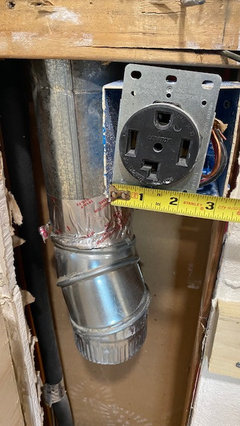
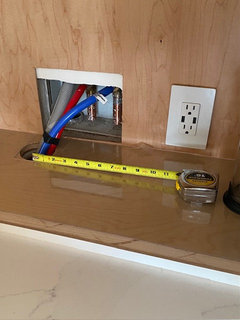
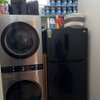
    I zoomed into the picture below and my 240/250 wall receptacle is a NEMA 14-30A 125/250V. Your first paragraph response I'm kind of following but because I don't know the technical detail specifications (15A vs 20A vs 30A, NEMA specifications) - I'm aware manufacturers and their parts are compatible, other times not. The last picture I'll include is the second wall receptacle I plan to use for the Miele heat pump 110v plug. I know it's only a picture but does anyone have any thoughts whether it will work? Everyone has been incredibly help


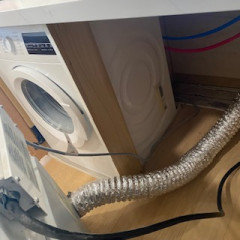
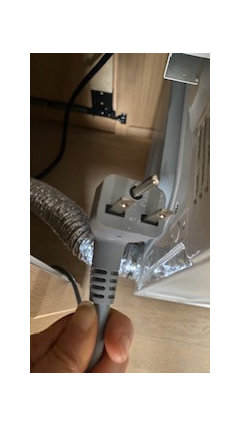
    Here are a few more pics:


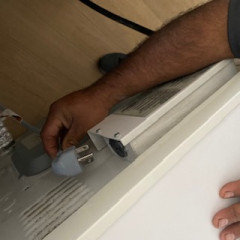
    Below picture (hairy arm) is the installer who told me the Samsung DV25B6900EW

    vented dryer would not work.


  • last year
    last modified: last year

    Sounds like you've got it figured.

    Regarding your question about the 120v outlet in the last photo, it looks to me like an older style 15 Amp GFCI outlet. The specs for the Miele T1 TXD680WP call for a 120v 15 Amp outlet, so that should be fine.

    If that outlet has been upgraded to a newer-style AFCI outlet or circuit (I don't know enough to tell just by looking at a photo), be aware that some brands and models of AFCI outlets sold in North America seem to be overly sensitive and prone to nuisance tripping with laundry machines. There have been a number of reports about this in threads here including (IIRC) in the long one on Miele W1 - T1 laundry machines. Should nuisance tripping happen with that T1 dryer that you've ordered, the solution seems to be replacing the offending AFCI outlet with a better model.

  • last year

    jwvideo: "Actually, the Samsung dryer could not have worked in this situation."

    jwvideo doesn't know what he's talking about. The Bosch WTA4410 requires either a 3-prong or 4-prong 240-volt, 30 amp power cord. You have a 4-prong outlet (NEMA 14-30) so you would have used a 4-prong power cord as described on page 8 of the installation manual. The Samsung vented dryer requires exactly the same cord as described on page 28 of its installation manual.

  • last year
    last modified: last year

    wdccruise. its time to skip needless insults. Instead, please tell us how to power two separate 240v appliances --- washer and dryer --- when there is only one, single 240v outlet in the laundry space. Tell us how you think HB could power his/her 240v Bosch washing machine (which still works and which HB wants to keep) once that new Samsung dryer was plugged into the laundry space's single 240v outlet? Do you think the installer "should" have told HB to go get a new power cord for the washer and constantly swap plugs in and out depending on whether HB wants to wash or dry?

  • last year

    jwvideo: "wdccruise. its time to skip needless insults."

    You are correct. I didn't know the washer was 240-volts and that she has only one 240-volt circuit since she showed a photo of the 240-volt outlet adjacent to the dryer vent pipe. So...

    • If she wants a Bosch dryer, she can plug it into the WTZPA20UC 240-volt, 15 amp adapter which she already has.
    • If she wants a Miele dryer, she has to plug it into a 120-volt outlet which she shows in the fourth photo above.
  • last year

    Given that the space behind the dryer is open and that the Bosch dryers ($1150+) and Miele dryers ($1600+) are much more expensive than the Samsung vented dryer ($800), I'd get a quote for a second 240-volt, 30-amp circuit before selecting an appliance.

  • last year
    last modified: last year

    HB -- if the deal on the scratch-n-dent Miele dryer doesn't work out for you and you decide to go with a Bosch heat pump dryer, you may find that a "WTZ" adapter/splitter is included with the dryer. Just saw a Bosch dryer listing at Home Depot with a features list that started with:

    • Comes with 4-prong power adapter, 3-prong adapter can be ordered
    • Adapters power both Bosch washer and dryer and plug in 30A outlet

    Worth checking further if you decide to go that route.

  • last year
    last modified: last year

    Im guessing that adding a second 240v circuit to thenlaundry room will easily be $700-$1000 or more. Prices for copper have been crazy high for a while. Running a new circuit through a finished space will much more expensive than a new build or fully open basement.

    It is not ”legal” to have more than one 240v receptacle on the same circuit. Most electric dryers will consume 20-25 amps on a 240v circuit and most dryer outlets are NEMA 14-30, which is a 30amp circuit.

    The best solution here is either another Bosch OR switch to Miele for 120V (if there is another 120V circuit present).


    Keeping the washer, since Bosch is 240v, will mean changing the power cord on the washer to a NEMA 14-30. Can probably take the cord from the dryer and move to the washer to plug into the wall outlet. Then, if a nee Miele Heat Pump dryer is used, plug that into the 120V outlet.

  • last year
    last modified: last year

    luna123456 --

    -- "if there is another 120V circuit present"

    Is there a reason HB should not plug the proposed scratch-n-dent Miele T1 TXD680WP dryer into that 15Amp 120v GFCI (AFCI ?) outlet seen inside the cabinet in HB's 5th and 6th photos above? Or did I read too much into "another?"

    "changing the power cord on the washer to a NEMA 14-30"

    Not necessary if HB buys (maybe already has bought?) the Bosch "WTZ" splitter. To be sure, a DIY-install of a readily available off-the-shelf 14-30P cord would be less expensive ($20 to $30) than the Bosch adapter/splitter ($69) and there would be no expense at all if HB can swap on the 14-30P power cord from the old dryer as luna suggests. Plus, DIYing the swap also could put the washer back in operation immediately. However, if HB has to pay somebody to change the washer's power cord, though, the adapter seems a simpler, quicker, plug-n-play solution.

  • last year

    I'm wondering why the old Bosch dryer can't be repaired? Vented electric dryers are simple beasts and are usually easy to repair.

  • last year

    Good to hear.