Software
Houzz Logo Print
kendrahhendra

Is this work done right? Do I pay the contractor yet?

last year
last modified: last year
An electrician completed his work but I haven't paid yet. Do I pay him and let him go on his way or is there more work to be done?

The goal was to replace the subpanel in our condo unit cause it was a Zinzco from the 60s, (the main panel for our unit is in the basement) and make the outlets in our apartment grounded without having to open up the plaster walls and having to run new wires.

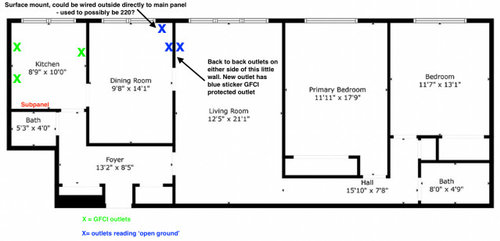
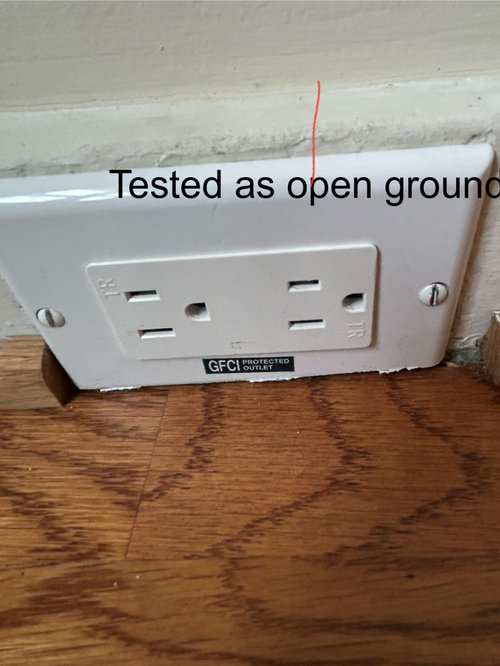
I went to the apartment last night with my outlet tester and saw that everything but two outlets were reading as "correct", according the three little lights on the end of the $5 doo-dad from Home Depot. These two outlets are adjacent to one another - just a few feet apart:

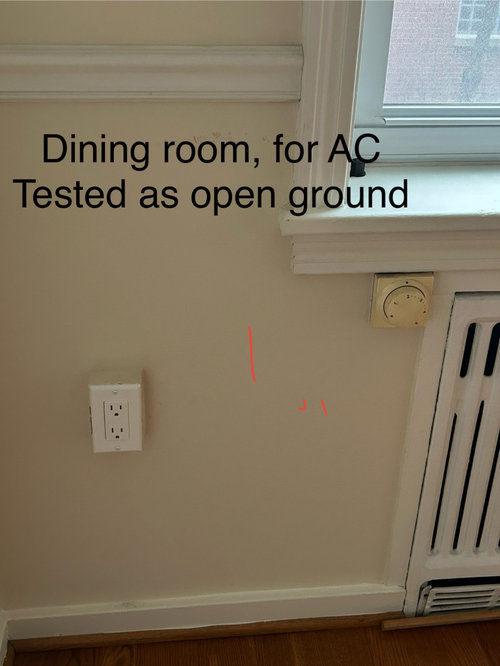
  • One outlet read "open ground" and had a little sticker on it that said GCFI protected outlet. This is the main outlet we will use for laptops. We might also need to plug an air conditioning unit in there.
  • The second outlet that read as "open ground" had no sticker on it. It is a surface mount outlet that the former own put in - I think for a window AC unit. A few electricians who came for estimates wondered if it was a 220 outlet. It had three prongs and the top to prongs looked like crying eyes - lines with a little horizontal line coming out of them. They have now changed it to a regular 3-prong outlet. Someone said that the wiring ran outside on our building and directly to the main panel in the basement not to the subpanel in our unit.

Is it ok if these two separate outlets are OPEN GROUND? These are in the dining room, which is next to the kitchen. All three kitchen outlets are GFCI. And the subpanel is located in the kitchen. Do I pay the electrician and have him go on his way?


Comments (16)

  • PRO
    last year
    last modified: last year

    I am not sure what the electric is done where you live but open ground means not grounded as far as I know This is the write up of the fact about installing a new panel if done this way then all will be grounded but the plugs all need to be wired properly yo read gounded at the receptacle

    Yes, installing a new subpanel should make all the outlets and receptacles within the circuits supplied by that subpanel grounded. The subpanel's ground bus needs to be properly bonded to the subpanel enclosure, and the grounding wire from each circuit should be connected to this bus.This creates a continuous ground path back to the main panel, ensuring safety and proper functioning of all devices.


    Yes, a ground wire is generally still necessary for proper grounding at each electrical receptacle. While it's possible to ground an outlet without a ground wire in certain situations, especially in older homes where the receptacle box itself might be grounded, running a dedicated ground wire is the most reliable and safest method.
    This is why you are getting open ground readings on some plugs . So your electrician needs to come back and reinstall the plugs properly with the ground wire

    Kendrah thanked Patricia Colwell Consulting
  • last year
    last modified: last year

    I too think it means not grounded. MANY of the outlets in the unit were not grounded and they were orignally talking about adding an "upstream" GFCI in each room to act as some kind of protection to the down stream outlets in that room. Turns out they said that they didn't need to do that and the outlets were grounded. They all test as grounded too.

    But, only these two are reading as open ground. If they are not grounded but are GFCI protected, what are the practical implications of this? Using a laptop or AC unit in these GFCI protected outlets.

  • PRO
    last year

    Call the electrician! They make mistakes sometimes, or maybe there is a reason. How can we help?

    Kendrah thanked HALLETT & Co.
  • last year
    last modified: last year

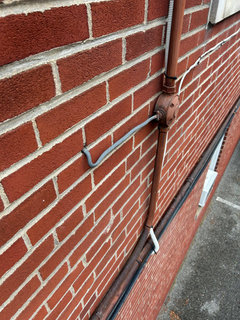
    I ducked my head out the window and saw that the surface mounted outlet has wiring coming directly out the brick wall into some kind of metal casing that runs down the building and into the garage where the main panel is located. So it seems like the surface mounted one is likely not connected to a GFCI but just to the main panel. So it seems like it is totally ungrounded and not GFCI protected either. I'll ask about that.

    @HALLETT & Co. - I just wanted to educate myself before talking to them. Dudes feed me bullshit all the time just to take the money and run and I'd like to have an educated conversation if I can. But, I get this might not be enough info for you all to go on.


  • last year

    If anyone in the future reads this thread, I suggest visiting reddit - Im getting so much help over there from electrcians who have a forum that you can ask them questions on. It is a gold mine of info.

  • PRO
    last year

    Definitely reach out to the electrician. Seems odd that an outlet that may have been a 220 line set up for an ac unit is now just a 120 outlet. The open ground is always a concern ( but it could be a very simple fix - loose wire, wasn't connected to the box properly etc etc )

    Good for you to go ahead and buy the tester. Better safe then sorry.

    Good luck

    Kendrah thanked Debbi Washburn
  • last year

    So my take on this is that for the first outlet it is properly labeled as not having a ground and GFCI protected. Whether it is safe - not as safe as if it were grounded - but it depends on what is plugged into it. Does your laptop have a two prong or three prong plug?

    For the second outlet it sounds like it isn't even connected to the subpanel in your condo - so I would say that it is "out of scope" for the work you hired the electrician to do, replacing your old subpanel. You could hire them to come back and rewire it but that probably would need to be coordinated with your condo association. I have no idea what "prongs looked like crying eyes" means - were the people on Reddit able to tell you?

    So I say that you pay them. Just my two cents!

    Kendrah thanked dennisgli
  • last year
    last modified: last year

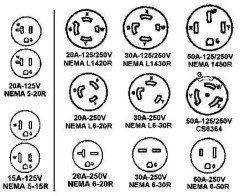
    If the prongs on the old receptacle looked like this or like that , it was a 220V receptacle, and I would advise you to check the voltage with a voltmeter before plugging anything into it.

    If the prongs looked like this on the old receptacle, it was rated for 20 amps and you can use it without any problems.

    Kendrah thanked w0lley32
  • last year

    Note that on 220V receptacles, the right side prong, when the ground prong is on the bottom, is horizontal and on 120V receptacles, the right side prong is vertical.

    Kendrah thanked w0lley32
  • last year
    last modified: last year

    @w0lley32 is this what you are referring to?

    It seems unlikely that any electrician would just replace that with a 120 volt receptacle as the OP showed above?

    Kendrah thanked dennisgli
  • PRO
    last year

    It is possible to convert a 220v outlet to a 110v, I did it in my last office in the exact situation where they had added 220 for now obsolete window units. It’s also possible an apprentice didn’t know better and just slapped a standard outlet onto a 220 line without making the associated changes.

    Kendrah thanked HALLETT & Co.
  • last year

    We may never know at this point what was there before. But rethinking my previous comments, assuming that the electrician changed the second outlet to a standard duplex receptacle and that it is not grounded, I think it make sense to have them either:

    1. Change it to a GFCI receptacle marked as "no ground" like the first one.
    2. Replace it with an ungrounded, two-prong outlet (if you can still find one!).
    3. Remove the receptacle and replace it with a blank plate.

    To be honest, that whole cable coming in through the brick wall is pretty sketchy to me. I would probably have it removed entirely!


  • last year
    last modified: last year

    If your condo has a mgmt company and you pay HOA dues, the HOA may pay to take care of the outside situation—the image you uploaded of the ”sketchy” area on the brick wall—unless they say that exterior conduit feeds only your condo.

    I would tell the electrician that two outlets included in the scope of your job are not testing properly and request him to come out on a call-back basis before you pay the invoice.

    Kendrah thanked purpleplume
  • last year

    Re: Open ground on receptacles:


    In older homes without a ground wire to each receptacle (which yours looks to be) it is code compliant to install an upstream GFCI to feed the downstream 2-wire receptacles with the provision that a "GFCI protected outlet" label is applied to each of the downstream outlets. This provides downstream protection against electrical shocks without requiring walls to be opened and new romex run. In rooms that typically would only have 2-prong appliances plugged in (example family rooms with lamps, clocks, TV's, some computers, etc.) this is an economical alternative without the large cost of a gut rewire. It is safe to do.

  • last year
    last modified: last year

    I had this issue in a previous ”sleeping porch” that was converted to a ”sun porch” . It turns out the outlet there was run from the original light circuit in the sleeping porch, and that light circuit was so old that it had no ground, just neutral and hot. After consulting various electrical guides, I installed a GFCI receptacle and am comfortable with the safety.

    An ungrounded but GFCI protected receptacle is as safe or safer than a grounded non-GFCI receptacle, although naturally a grounded GFCI is best. ”Safe” means for humans; for some sensitive equipment, a ground is important.

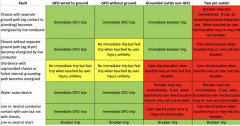
    See scary table below. Note I am not so reassured by ”immediate breaker trip” because the breaker won’t trip until you have 15A running through you . . .


    So I would test the “GFCI” labeled receptacle (push button), and be ok with it. Well, I’d want to see if there is some easy way to run a ground from whatever panel that receptacle is wired to - but I would guess “no”.


    For the other receptacle, the mystery one that was used for an AC, this chart may help figure out what it was.


    If it was 120v with no ground, then installing a GFCI receptacle and/or running a ground wire would be good. If it was 240v with ground, then that could be converted to 120v with ground by switching one of the hots to a neutral and labeling. If it was 240v with no ground (is/was that even done? scary) then I guess it could be converted to 120v with no ground then GFCI’d. Anyway, I would want that either grounded or GFCI.