

Septic System Advice needed
We have a very old septic holding tank sitting on ledge near a cottage on cement post which have shifted in the past and down a path that no truck or heavy machinery can access. The plumber we spoke to suggested building a road to the cottage for digging to put in a bigger holding tank than we have. This is going to cost 10s of thousands. The cottage is downhill from the tank and the there's a given height at which the outflow pipe from the cottage is.
So, how hard is it to pour your own cement tank? We could use the existing, corroding metal tank as a form?
What are the downsides of putting in a sewage extractor pump up the hill to the leach field, as opposed to having a sewage holding tank?
Are there any other creative options? How do I find a contractor who is open to creative ideas, rather than someone who will quote the cost of doing the standard thing on a very non-standard lot?
Comments (29)
 last year
If you're hoping to do something "non-standard" you'd better be sure your local Board of Health is on board lest you find yourself digging it out and starting again.
Where I live $15-20k is the entry level for a new septic system, going up from there on more difficult lots.
I'd get proposals from several local competent professionals (plumbers don't usually do septic systems) and choose the least bad option. The tank is typically one of the cheapest parts of a system, not an opportunity for great savings.
Sigrid thanked rwiegandSigrid
Original Authorlast yearThe core problem is the guy we talked to delivers standard tanks by crane and was suggesting building a road to get his crane to our spot. Then, putting his standard-sized tank in would require digging, which quite possibly means dynamiting some ledge. So, a hell of a lot of money before we get to a tank. We've never needed a road to this summer cottage, it's a quite walkable, if steep path to get to the house. The only reason it's needed is for heavy equipment, like a crane and a big digger.
We don't need a whole new septic system, we need a new holding tank in a tough spot.Related Professionals
Aberdeen General Contractors · Fayetteville General Contractors · Anderson General Contractors · Augusta General Contractors · Trenton General Contractors · Jamestown General Contractors · Hot Springs Basement Remodeling · Springfield Basement Remodeling · Kansas City Basement Remodeling · Palm Desert Basement Remodeling · York Basement Remodeling · Toledo Bathroom Remodelers · Duluth Home Remodeling · Norfolk Home Remodeling · Newport Home Remodeling- last year
As someone stated, the first hurdle is finding what you are and are not allowed to do. From what you have said it sounds like a mini-ex could dig and lift old tank out then set a fiberglass replacement in hole. No need for new road or heavy equipment. Pumping uphill is accipitral from operational standpoint.
Sigrid thanked klem1 Sigrid
Original Authorlast yearWe have to pump uphill, because the cottage is close to a lake that's drinking water for a large population. Our house is too close to the lake, but grandfathered in. The soil is sandy. No one is going to allow us to replace the septic system with anything that isn't up the hill and I don't think I'd want to, given the current purity of the lake water.
 PROlast year
Sounds like composting toilets and no showers are in your future if you don't do an above ground system. Yes, those cost more. " the cottage is close to a lake that's drinking water for a large population " SEVERELY limits acceptable options that will be able to get a permit from your Health Department. And if you haven't already involved them, then you are way behind. You are going to have to do some soil samples for them, as a minimum. You run the risk of having huge fines, and having the residence condemned if you don't get proper approval for human waste disposal.
Sigrid
Original Authorlast yearWe're trying to get a replacement holding tank, which doesn't require a permit or testing, not a new system. The existing system is underground, but we don't think we can dig further down. if a new tank doesn't fit. I've read the requirements for the water district and the town doesn't have a health department.
Composting toilets require a leach field, so we couldn't put one in, if we wanted to, which we don't. The current system has a holding tank near the house and pumps the effluent to the leach field at the top of the hill, far from the lake.
I'm trying to find a workable solution because the existing tank has not failed, but it looks like failure is not far away. We dug everything up and pumped the tank out because the float switch on the pump failed and we wanted to figure out what was going wrong, which is why we think it is the float switch. If that gets replaced and works, we'll know that's the problem. Currently, the system works, the pump just has to be turned on and off manually. PROlast year
You are saying a “holding tank”, but the sewage isn’t just held. You have a municipal sewage system with pump to get it to the pipes uphill from the house?Or is it treated. And the composted liquid effluent from the tank gravity distributed, or pump distributed?
It honestly doesn’t matter, as any repairs or changes to any sewage system, whether public or private, requires permits and oversight from that Health Department. Even in areas where there is no construction inspections, the Health Department oversight of septic is a big thing. Proper waste disposal is one way that many diseases were eliminated. Typhus. Cholera. Campylobacter. Etc.
You 100% have to have county or state health department and permits involved for any of this. Your neighbors WILL turn you in. Bacteria in their drinking water is not going to be a ”feature” of lake living to them.
- last yearlast modified: last year
Virtually everyone on here has told you that you will need to work with the permitting office - if that's the town or the county. They will tell you what is permitted in your area. I have never seen a situation where any significant part of a septic system did not have to be permitted.
Although the town may not have a Health Dept, I promise you the county does and it's going to be responsible for enforcing water quality and waste systems. They may be over-extended and underfunded, but when the feces hits the fan (or the lake), you will most certainly hear from them.
Re-reading your posts: To be clear, that "holding tank" is an active and very important part of a septic system. It's not just a reservoir. Waste goes into this tank where organic solids (poop) settles to the bottom and are broken down by microbes. Then the mostly clear effluent moves to near the top of the tank and goes to the leach field where further microbial action in the soil breaks down the remaining waste and nutrients and is filtered by the soil.
Solids that don't break down and liquify tend to build up in a septic tank over time. That's why they have to be removed every so often by pumping (requiring large truck access nearby).
Organic solids must not reach the leach field or it will quickly clog it. That's why modern septic tanks usually contain internal baffles to prevent that from happening. The tanks and leach field are sized based on the number of occupants, so that the poop has enough time to separate. Again, if you size that wrong, organic solids will clog the leach field. You can not pump your waste directly to the leach field or you will destroy it. You also can not just pour your own concrete holding tank using the previous tank as a form - for both structural reasons and because you don't know how to design septic systems.
Probably the only "creative solution" available to you is a pre-packaged treatment system that replaces the septic tank and may also allow a smaller leach field - as I mentioned earlier. These are active systems with aerators and such.
My guess is that unless you have replaced the leach field recently, it's probably in bad shape also. You need the entire thing evaluated - I'm guessing none of it was built to standards in the first place and now it's 50 or more years later.
Look, your situation is not unique by any means. It's supper common and well known by every rural health department and lakefront community. Old seasonal cottages with septic systems never built to reasonable standards in the first place are completely failing and the current owner is looking at a huge bill to fix it to proper standards. There may be limited access, limited leach field size, too close to the water, etc. In addition, the seasonal cottage is now "hot" and the community is seeing way more visitors than ever before. The 3 BR cottage with one bath is seeing eight people staying there for a week and the septic system was never designed for that.
Sigrid
Original Authorlast yearWe've talked to two different septic contractors, neither of which has a good solution for replacing the tank. Both are very familiar with local rules (It's the water district, not the health department and you can be very sure the water district cares a lot about the safety of the drinking water) and soil. They've looked at our system, which has a holding tank near the house and a pump to pump the effluent up to a septic system at the top of the hill. Both think the system is not problematic, other than a holding tank that needs replacement before it fails. Neither thought the water district would have a problem with replacing the tank, so we haven't asked, as we haven't figured out what to do.
Given that plenty of people have houses like ours, on a steep lot on sandy soil close to the lake, I'm sure that our system is pretty typical, especially since many of the houses were built by the same developer in the 60s. They put in a ferry and developed the whole island.
One contractor suggested getting a pump that will pump the sewage, not the effluent up to the septic tank at the top of the hill. We like the current arrangement because if the pump fails, we have a tank so that we figure out the pump isn't working before we have an overflowing toilet.- last year
From beginning to this point each thing you add (if not repeating) further tangles your story. You are obviously out of your league and consequently your element when it comes to septic systems. Therefore it's question and answer time if we are to ever make sense of what you are saying.
One contractor suggested getting a pump that will pump the sewage, not the effluent up to the septic tank at the top of the hill. We like the current arrangement because if the pump fails, we have a tank so that we figure out the pump isn't working before we have an overflowing toilet.
This is the first time you've mentioned a tank being at top of the hill, up to now you always said you are pumping from cabin to leach field at top of the hill.
(1) Approximately how many gallons will present tank at cabin hold?
(2) Approximately how many gallons will present tank at top of hill hold?
(3) How long does water and waste remain in cabin tank before it is pumped uphill?
(4) Which tank do you think is about to fail?
(5) What is the evidence said tank is on brink of failure?
(6) Most important and relevant of all, why are you not asking neighbors how their septic is designed and whether they've ever made changes to original and if so,what company did it for them ?
Those answers should let us stop repeating the same wishful thinking time and again then move forward. Sigrid
Original Authorlast year1) The current tank at the house holds 500 gallons. I'm interested in what the impact would be on replacing it with something smaller. What is 500 gallons in the context of daily usage in a 3 br house with no washing machine?
2) I don't know about the tank at the top of the hill. We have no reason to believe there's any problem there. It's a septic tank attached to a leach field.
3) I don't know how long the waste remains at the tank near the house. Right now, because of the pump switch has failed and we know it needs to be replaced, we pump it daily. Before the pump switch failed, it automatically pumped the effluent. I have no idea of how much of the 500 gallon tank was full at any given time. When it pumped out by a septic guy (meaning sludge, scum and effluent) the tank was pretty full, because the switch had failed and we hadn't figured out the pump still worked.
4&5) The holding tank at the house is the one that is not in great shape. We opened it, it's metal and has significant rust. It's around 60 years old, well past its expected life. It's currently intact, but clearly, the rusting will continue.
Finally, I'm not asking someone to design a new system, just hoping to get clarity on options and understand some pros and cons of possible changes, like:
Putting in a smaller tankNo tank, pumping everything up to the septic tank
Getting a contractor (what type?) to cast a new concrete tank.
- last yearlast modified: last year
Since you're playing it close to the vest I have to ASSUME cabin is only used intermittently which requires much less capacity than full time home. 500 gallons is more than adequate for this,esp if intermittent use is by fewer than 5 people. Cutting to the chase, you don't need heavy equip[ment,semi-tractor trailer trucks nor dynamite. Measure diameter and depth of old cabin tank then order a fiberglass tank that will fit inside old tank. When new tank arrives, hire 2 high school athletes to roll and drag it alongside old tank. Pump old tank then cut top out and scoop remaining trash out, cover floor with 3-4" sand before dropping new tank inside. Plumb new tank same as old one was for 60 years and you are back in business for another 60 years.
I want to make it clear that I'm keenly aware sewage must undergo aerobic or anaerobic processing to become effluent which is then drained/pumped to leach field. I've attempted to establish where that has been happening for past 60 years but you don't know. Bottom line is that it worked for 60 and will work another 60 if done as laid out above.
Question(s)?
Sigrid thanked klem1 - last yearlast modified: last year
" I'm not asking someone to design a new system..."
It's really helpful for us to have all of the information up front. You have been really unforthcoming about the details. Without knowing some specifics you aren't going to get good information. You've wasted a lot of our time.
You have been saying "holding tank" but what hasn't been clear to us this entire time is that you have a septic tank at the top of the hill. If that's correct, you need a pre-packaged sewerage ejector pump lift station. This is the tank, the pump, and controls. Ejector pumps are designed for septic tanks - rather than a grinder pump used for lifting to municipal sewers.
You will need the HP of the pump to be sized to be able to push the sewerage up the hill (the head, in feet).
You are looking for a tank size that will fit in your current hole. The tank should be sized so that it can easily handle all of the possible outflows from your house at a given time.
A larger tank would give you a little bit of cushion in case of power outage but you have to be careful because you are "batch feeding" your entire septic system. It takes about 24 hours for solids to settle out - so if you suddenly hit your septic tank with 300 gal of sewerage after a power outage, for example, you are much more likely to send solids into your leach field. You are also sending 300 gal to your leach field that isn't designed to for that at all. It's designed for much smaller quantities spread out over time. You really don't want to be manually running your pump and sending very large batches to septic system. You want to be sending batches of 20 gal or so - as you would with a working float switch.
Don't forget that your septic tank MUST be pumped every few years to remove the sludge at the bottom and keep it functioning.
Here is a 200 gal fiberglass tank with a 1 HP ejector pump. I'm not endorsing this setup, just giving it as an example. It would lift 53' of head before it shuts off - so something considerably less than 53' is appropriate.
You are looking for a reliable pump. You are also looking for redundancy / alarm function on the float switch(es) and control panel.
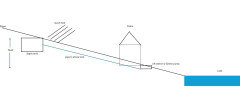
- last year
First things first Sigrid, read your state statutes and county ordinance concerning septic systems and holding tanks! There will be a section in the state statutes and county ordinances directly related to lake shore requirements.
You can not make your own concrete tank, period. I'm going out on a limb here but there is no way you'll make a tank that does not leak or crack and it will not be code complaint . A concrete holding tank manufacturer must certify that their tanks must meet regulatory requirements for structural integrity and water tightness with the design and construction approved by the state through registration. So forget about making your own tank.
Because the lake home is grandfathered in does not mean a sewer management system is grandfathered in and must meet all present codes and ordinances when you work on it. You can bet your horse on the fact a permit will be required, and the holding tank must meet code.
There are all kinds of 500 gallon holding tanks available that meet regulatory requirements and come in all kinds of shapes made from plastic and fiberglass that are light weight and can be carried by a couple of strong men. The question; is a 500 gallon tank still permissible by code or must it be larger? State statues and county ordinance will tell you what's allowed.
- Read the statutes and ordinance.
- get a permit
- Buy a tank ($1000 to $2000). Buy the right pump.
- Dig out the old tank, 500 gallons isn't that big.
- set the new lightweight plastic tank in place.
- connect it to the pipe running to the drain field.
- connect the wires up for the new pump
- back fill.
- have a beer.
Sigrid thanked outpaientzero - last yearlast modified: last year
The more I think about it, the more I think that you really do have to know exactly what you are dealing with - meaning what size the septic tank is at the top, what condition it's in, what size your leach field is, how old it is. Is the tank at the top really a septic tank - or is it a buffer tank for the leach field. Is it full, or does it mostly empty out over time?
Here's the thing: A modern septic tank would be 1000-1500 for a 3 br house. Why would you have a 500 gal "holding tank" near the house when a 200 gal or less would be more than enough for a lift station (assuming a 1000 gal septic tank at the top). One possible reason would be that the "holding tank" is half of a 1000 gal system - in other words, the first chamber where the bulk of the solids settle out.
Or, the 500 gal "holding tank" near the house IS the septic tank (very undersized) and the tank at the top mostly just buffers the outflow of the effluent to the leach field - since it's being batch fed from a pump.
Where in the holding tank is your pump positioned? At the bottom - or about half-way or more up?
Here's the thing: If you don't understand what you have, you may make some assumptions and ruin your leach field - at which point you will have to start completely over.
Sigrid thanked Jake The Wonderdog - last year
As someone who lived thru replacing an old septic system at our (non-lakefront) cottage, I am here for Jake, Kevin and Klem's septic talk!
Our neighbor had to do exactly what Jake shows when they built their cottage. Old regulations that would have allowed as an old fashion holding tank was no longer allowed.
The upside is you have time to contact the appropriate agencies to plan. Sigrid
Original Authorlast yearThank you all. This has been very helpful once I answered questions. I wasn't "withholding" information, I was unclear on what information was important.
- last year
Yes, I think you probably are the only one who thinks that.
I think this is someone who is very worried about opening up an expensive can of worms.They don't want to involve code enforcement and they are playing the details very close to the vest. They want to take care of the immediate problem and assume everything downstream of that immediate problem is going to be okay - or at least they can remain blissfully ignorant.
 PROlast year
They are someone with a 60 year old system that is past it’s useful life in all respects. If that tank is rusted out, the one at the top of the hill will be too. And the leach lines will be filled. That is the precise reason that old systems require permits to repair. It leads to an inspection of all the components, which leads to upgrading the system modern system rather than patching a dead one.
- last yearlast modified: last year
I have to agree. Unless there were some updates that we aren't aware of, this entire system is past its useful life - not to mention probably not being adequate in the first place.
You are right about the tank at the top of the hill - it would be rotten also.
I'd also bet that it hasn't been maintained - with regular pumping every 3-5 years. I can't imagine that the leach field is still in good shape.
What's more, we don't know, for a fact, how this system was designed. Is that 500 gal "holding tank" the septic tank? Is it half of a septic tank? Or is it just a sump pit? Looking at the entire thing, the right answer is to redesign and replace.
- last year
If we are summing up on this thread, I wouldn't classify it as scam but I agree with Kate in thinking it doesn't smell right from start to finish. Comes across more like a prank or folly which we see increasing by newbies every day. What strikes me is that Sig has been here long as anyone in this conversation and undoubtedly knows better. I confess to occasionally making an airheaded observation but it's always after realizing folks aren't invested in any fashion whatsoever. I'm breaking from convention which says "there's no such thing as stupid questions", if people try hard enough they can think of some.
- last year
Right klem1, no such thing as as stupid questions but there are a heck of a lot of stupid answers.
I have no reason to question the validity of Sigrid's lake home predicament and will guess it's 99.8% true. He didn't ask about the system on top of the hill but only the holding tank at the cabin level and it's none of my business what condition the system is in, or do I care.
I'll tell you about my septic system I had built 27 years ago. It has two 1000 gallon concrete sludge tanks and a 1500 gallon concrete lift tank that is pumped up to a raised mound drain field. The sand used in the mound was washed and sized to a specific size to provide the best performance the mound system can give. It was designed for a 5 bedroom home but I only have a 3 bedroom house, and bottom line I went overkill on the project, and it will last until I die, I don't like do overs for being cheap.I've had it pumped 3 times in 27 years, the state, county and city requires every 3 years but also gives the option to having the sludge measured. If it's below a specific level you can go another 3 years, and another until the sludge meet the limit. But ME with my overkill and the 2nd tank could theoretically go 18 years before having it pumped to prevent sludge in the 1500 gallon lift tank. I could argue this point with the city code department with a good chance they would cave, maybe I should since I have an extra tank.
Sigrid's sludge tank and drain field on top of the hill may be in excellent condition, and depending on the systems load it may go a decade or three before needing pumped. But It's his system and it can turn to rubble and slide into the lake for all I care. Want to know what the county tells us to do at the hunting cabin when the outhouse hole is full? Did a new hole, period.
- last yearlast modified: last year
@ kevin9408 - So what, exactly, is your point other than you built a way over-spec'd septic system?
If someone wants advice, I'm going to try to provide sound advice that's consistent with the overall goals. The overall goal here is a safe septic system that doesn't contaminate the lake, wells, or the ground and meets local codes. I'm not going to intentionally give someone advise to ignore what is likely an EOL system just because they would prefer to engage in magical thinking. If they don't like what I have to say, then they don't have to take it.
IF he inspects the tank at the top and it checks out okay, and IF it's 1000 gal or more and IF it's not full of sludge, and IF the leach field seems to be functional (dye pack test anyone?) then a relatively inexpensive lift station of 100-200 gal with a properly sized ejector pump is fine. But that's a lot of IF's, and the age of the system doesn't make that too likely.
- last year
I have no point Jake, not even a blunt end. I'm as dull as they come with nothing to say that matters at all and just making noise.
Now to the show with real life Monty python movies playing out on every thread I read and so unbelievable I don't know whether to laugh or cry. Just like the python movies it's the dumb leading the dumber for laughs but the dirty little secret here is everyone is so serious with thin skin.
I'm not sure what got you worked up because I thought you were one of the few normal people on the dying forum. So sorry.
- last year
I get it when people advise getting permits and complying with local ordinances. Majority of society is clueless on what constitutes solid construction and safe procedures, therefore must look to government for direction. Ordinances and codes help protect consumers from unqualified labor and sub-standard material. Not perfect but it's the best we can do in real world circumstances. A homeowner doesn't need to know nor understand the first thing to go this route and let licensed pros handle everything.
On the other hand I get it when someone feels they can bypass ordinance and still have safe and durable construction. To consider this the homeowner needs to understand how their system works and explain before asking questions. Sig has been here more than long enough to know all this, hence my remark this sounds like a joke. Then of course there's guys wanting to skirt rules strictly to save a buck with no regard for neighbors but let's not discuss this group. Sigrid
Original Authorlast yearFirst of all, all your commentary and questions have helped me understand my system. So, despite the fact that you're ragging on me for not knowing everything in advance, your often very critical posts are helping me understand the system and the options.
Second, my concern is not so much to avoid following code, but to avoid any issues with the current system, which may be inadequate and is now dug up and exposed so the inadequacies are visible. Certainly, our current metal tank is no longer legal and it has some rust issues. While we and the contractor who pumped the tank and looked at it don't think the rust has progressed to the point of compromising the integrity of the tank, if the code enforcement officer claimed it was, it would be tough to appeal that decision. And, it's not implausible that a code enforcement officer would take no more than a casual look and say, "Yikes! look at that rust, who ever put a metal tank in in the first place, those are illegal" and shut us down.
A friend had a minor fire (an idiot renter tossed a cigarette and burned a hole in the deck, despite smoking not being allowed). The fire department was called and code enforcement came down so hard, no one is allowed to occupy the house and all deficits (hers were not septic, the big one was stairs, but the chimney is also an issue) have to be remedied within 90 days, unless she gets an extension. Try hiring any contractor to tear down and rebuild stairs in 90 days is impossible. (None of the code issues had anything to do with cause of the fire).Since she does not live within a driving distance of this summer house, dealing with the problem when she can't sleep in the house is made so much harder. She inherited a very funky cottage with many items out of code and worked to improve them, so this is really frustrating for her.
Our cottage is on an island, and if we could not stay here while dealing with the septic system, it would be extremely inconvenient, especially since, so far, the contractors have sometimes not shown up, not shown up on time, etc. So, my desire is to find a contractor certified by the water district who can implement a workable solution and then get permission for that solution. Right now, finding that contractor is not going smoothly.
I certainly have no desire to do something not up to code or not permitted and have to tear it all out. PROlast year
You need to PROACTIVELY replace ALL of the old failing system to the current code, in order to not be behind the 8 ball with something declared uninhabitable and condemned. If that happens, you get to own a lake lot, but not a lake house. Just replacing the holding tank will likely trigger the review that makes that happen, ”or else”. Goodbye CO. Get in front of that, by dealing with the whole problem, not a piece of the problem.















Jake The Wonderdog