Software
Houzz Logo Print
scottcj_peets

Has Anyone Had Fire Blight? Help! Need to know what to do

11 months ago
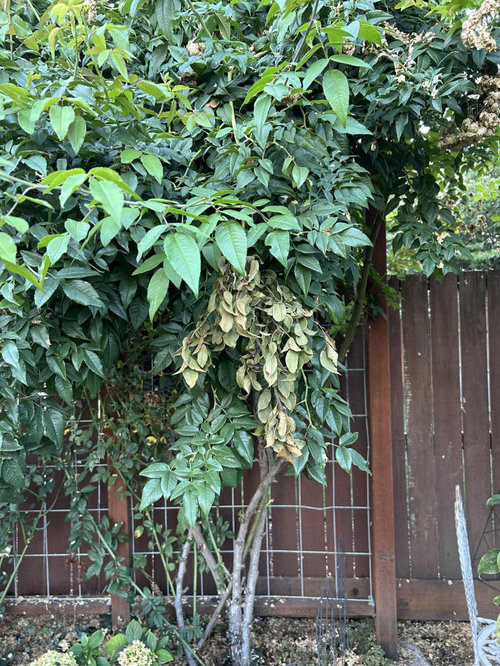
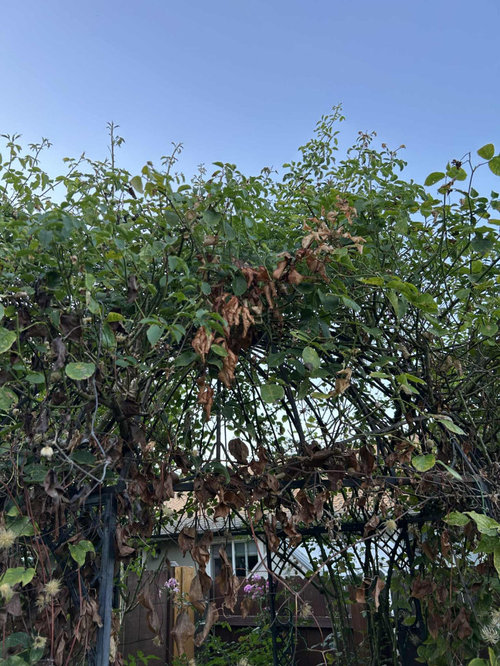
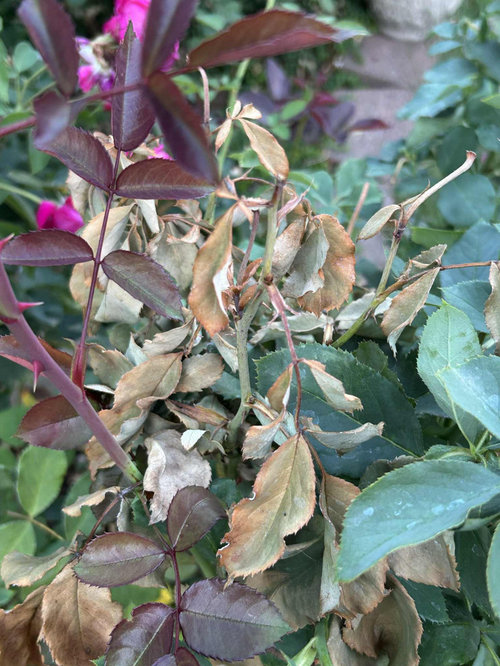
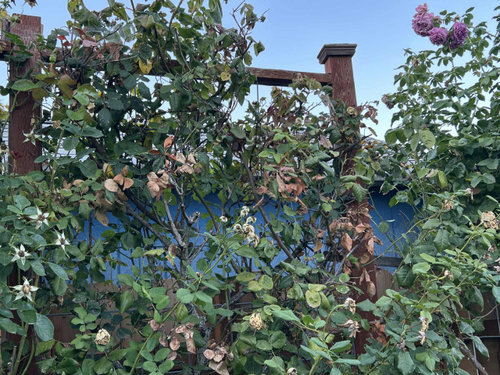
An apple tree got Fire Blight in our garden and now at least five of my roses are showing signs of the infection, which is not curable. Everything I read about and see on youtube say that it doesn't usually affect roses, but extension office said that it is. What to do? I'm not sure and I don't want to lose all of my eighty roses. Please help!


Comments (39)

  • 11 months ago

    Ouch! I'm sorry! Did the Extension Office offer any suggestions for control?

  • 11 months ago

    The extension service confirmed it was fireblight? Doesn't look very symptomatic of that at all. The timing seems to be off as well.

    Prune out all the diseased stems/branches as soon as they become evident and destroy (no composting). Rake up and dispose of all fallen leaves before winter. A copper sulfate spray in early spring before leaf out can help, as well as a couple of antibacterial sprays on the market. Avoid fertilizing, heavy pruning and water only enough to avoid drought stress.

    Scott CJ Peets thanked gardengal48 (PNW Z8/9)
  • 11 months ago

    If they were my roses, I would use Phyton 27, as a drench or thorough drenching spray after following gardengal's advice on removing the affected branches. Phyton 27 is a bacteriocide and fungicide. Google offers lots of information on this product, so you can check it out. It was used extensively in this area, SW Idaho, when Boise roses had an epidemic of bacterial cane canker a number of years ago. Diane

    Scott CJ Peets thanked Diane Brakefield
  • 11 months ago
    last modified: 11 months ago

    So sorry, Scott!!! I feel your pain. I had a 2-year old apricot tree suddenly die, and then my nearby DA Heritage died. Experts at 3 nurseries said fire blight. Extension never returned call or email. So I removed everything & put it all in trash (not green waste or compost), and then dug out some of the soil in the tree hole and all of the soil in the oak barrel that contained the rose bush, and then spread the soil out in the meadow so sun could kill things. I got rid of the oak barrel (friend used it for beach bonfire!). I haven't used the Phyton 27 before - will have to look into that. I usually spray all of garden in Dec & Jan w copper & then sulphate. I let the hole for the tree sit for a year. Then planted a hardy native in that space last spring. So far so good. Knock on wood. I wish you the best as you deal with this!

  • 11 months ago

    Roseseek -- Most of the effected roses are climbers as I believe the wind blew it from that apple tree which was in the vicinity. The extension officer said that I should use alcohol on my pruners between every cut and did mention copper sulfate early in the season. But she didn't tell me how to cut it out. I've read that I am to cut 12 inches to 18 inches down, but it's on some miniatures and so that would remove the whole plant. I have a Christopher Marlowe that I will probably just remove and trash. Breaks my heart. Thank you for your comment.

  • 11 months ago

    Phyton 27 is copper based. Our state chief horticulturist recommended this product. When I need to use alcohol on my pruners, I use the 70% strength. You can also use a chlorox-water solution for cleaning pruners. Diane

    Scott CJ Peets thanked Diane Brakefield
  • 11 months ago

    Does disinfecting your pruners rust them? I was reading that using teflon coated pruners will resist rust. I use the Felco brand, but the blades look discolored now that I've stepped up the disinfection...

  • 11 months ago

    Deborah, nothing rusts here. I use ARS Japanese steel pruners. They are the best! And never need sharpening. They are used for Bonsai even. I don't normally disinfect pruners because I don't have infection problems. For a while, I did disinfect, and it was just an extra hassle, but I used the 70 per cent rubbing alcohol. Diane

  • 11 months ago

    Thanks, Diane. I've started growing dahlias, and apparently they are rife with viruses...a downside, for sure. But such pretty blooms when all the roses are more quiet!

  • 11 months ago

    Deborah, what viruses do dahlias seem to carry most? I thought about growing a few, but I don't need extra hassle at this point in my life, so I'll probably not try them. I've grown a few in those pre- planted arrangements several years ago, and they were no problem. Diane

  • 11 months ago

    Deborah, why don't you post a few of those exquisite dahlias on this forum? Let everyone seethe with envy--me the most envious of all. Diane

  • 11 months ago

    Gosh, I was hoping all of these comments here were to help with my fire blight and losing my roses. I'm sure that all the dahlias are beautiful, maybe post on the dahlia forum.

  • 11 months ago

    Scott, I asked Deborah to post the dahlia pics on the forum, not on this thread. She's a friend, and we were trying to help you, by the way. Diane

  • 11 months ago

    What Extension office said the rose ailment is fireblight? I know nothing about it, but I'm asking because I see what both gg and mm wrote before your last comment, Scott - and I know their comments should be seriously considered.

  • 11 months ago

    Scott, you received a reply from Dr. Malcolm Manners, one of the world's premier experts on rose diseases (and all things horticultural). I'd concentrate more on that, rather than a couple of random comments about dahlias. With all due respect.

  • 11 months ago

    Susan9 and Diane - Thank you for your advice and for telling me whose who. It is most helpful and I sincerely appreciate it.

  • 11 months ago
    last modified: 11 months ago

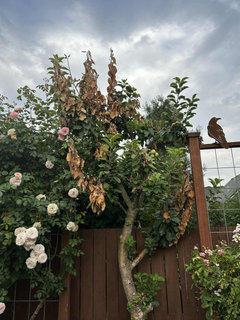
    malcom_manners and rifis - Oregon State University Extension Office, Corvallis, OR. I did not have confidence about it though because I have searched the web and found nothing pertaining to roses and fire blight. Could the bacteria have adapted? Here is the photo of the apple tree with the fire blight inspection which is near all of the roses that are showing symptoms which are all climbers--disease carried in the wind? I proof my roses for two years in large pots to gauge their traits, including resistance to diseases. I do not spray. Earlier in the season, all of the roses had their best year. I do not fertilize heavily. In 25 years, I hv not seen any like it and it appears similar to what was on the apple tree. The tree has been removed. Not sure what to do with the roses. Should I cut off the branches that are infected or wait to cut during dormancy and cool weather? I don't want the disease to spread. Thank you all. CJ

  • 11 months ago

    Forgot the apple tree picture -- We had already previously cut down 18 inches on the branches but it spread anyway. It has been removed. To the left is two Edens that are unaffected thankfully.


  • 11 months ago

    I would cut off any afflicted branches and dispose of them in your trash.

    Dr. Manners knows everything. Listen to him.

    Scott CJ Peets thanked Sheila z8a Rogue Valley OR
  • 11 months ago

    I agree that both the timing and the outward appearance are suggestive, despite conventional wisdom.


    I would like to see high resolution photos, Scott, of one or more cross sections of your affected rose canes. Descriptions of what one sees when viewing similarly oriented cross-sections of apple tree branches infected with fire blight are available online.


    Be sure to disinfect your pruners between cuts.

    Scott CJ Peets thanked rifis (zone 6b-7a NJ)
  • 11 months ago

    I may not be an expert, but I'm pretty sure fire blight is not a disease of roses; could this be insect/borer damage if not a different disease?

    Appearance struck me as verticillium wilt.


    Steven

    Scott CJ Peets thanked MiGreenThumb (Z5b S.Michigan/Sunset 41) Elevation: 1091 feet
  • 11 months ago

    MiGreen - I proof my roses for disease for two years before putting them in my ground. I have 80 and have been growing them for 25 years. I'm familiar with most rose diseases and bug issues (aphids, caneborers, etc) have never seen anything like this. Two of the roses which have been most affected are Austins: Crown Princess Margareta and Lady of Shalott (she's has it the worst). I have one branch on Aimee Vibert, cut it and haven't seen anything since. Not sure what to think. May contact some folks at the Rose Garden in Portland, OR. I'm near Salem.

  • 11 months ago

    How fantastic for you, Scott.

    We all encounter new things never seen before, it seems.

    I'm in a similar realm of experience with 26 years experience (since age 13) and had over 113 different varieties (not individual roses) in my previous garden along with asparagus, peaches, raspberries, currants, and gooseberries (most Americans don't have a clue about Ribes).

    I've never used precious time "proofing" my plants before planting, and have never had similar issues as I do my best to proof the suppliers I order from to begin with. Plants will either survive or die.

    Reputable nurseries that take the time to properly inspect, prepare, treat, and pack their plants are so critical.

    I apologize, for you seem very knowledgeable, so I don't fully understand the nature of your response other than background and we as rose lovers always get a touch defensive (shall I say "prickly?) about our experience or knowledge because it is our pet subject.

    You received a great direct response from an expert- Dr. Malcolm Manners, and I agree with him regarding it not being fire blight.

    An unusual issue you are facing, no doubt.

    I look forward to your sharing of the root cause should you discover it.

    Scott CJ Peets thanked MiGreenThumb (Z5b S.Michigan/Sunset 41) Elevation: 1091 feet
  • 11 months ago

    From a PDF I cannot link here, from University of Arizona, roses are NOT fire blight susceptible themselves, unless a unique mutation has occurred as you postulated.


    Steven

  • 11 months ago

    You sound just right to me, friend Deborah. I have noted over the years that many rose gardeners will show up here on the forum and ask questions. When they get their answers, they are gone, never to post again, and often never with even a thank you. I would much rather have friendly discussions with plenty of knowledge shared, but a a little something extra like true friendliness that sticks sticks around. Much more knowledge is shared when we are friends. Diane

  • 11 months ago

    Exactly Diane!

  • 10 months ago
    last modified: 10 months ago

    Scott,

    May I suggest that you cut each damaged cane back to where it emerged, flush cut at the canes' origination sites, be the canes lateral growth or basal canes. Disinfect your pruners before and after making each cut. Take the cut canes and carefully strip them of all their leaves, placing the stripped leaves aside for later inspection if needed.

    Cut the canes, into pieces, proceeding slowly and with great concentration, starting down from their tips. Go along in two inch increments, pausing at each cut for close examination of the just cut cane piece's center and side, to check for stem borer or stem girdler damage. If evidence of such insect damage is discovered, then perhaps you have found the cause of your perplexing dilemma.

    Moses.

    Scott CJ Peets thanked Moses, Pitt PA, cold W & hot-humid S, z6
  • 10 months ago

    For years, whenever I read about rose midge, I thought ”I’m glad we don't have that here”. After I found it in my yard, I was surprised to learn the first published description of it arose from its discovery in NJ in the early 1900s.


    It’s deja vu all over again.


    From the Royal Entomological Society, seen at Wiley Online:

    (rose stem girdler)


    “The first definitive, published record of A. cuprescens as a North American pest was from Assistant New Jersey State Entomologist Weiss (1914) who discovered it during routine nursery inspections with pathologist E.L. Dickerson in August of 1913. Weiss (1914) suspected the pest was imported in Rosa nursery stock from Holland, noting that most damage was found on stock that had previously been imported in spring of 1913.”


  • 10 months ago

    MiGreen Thumb - Wow thank you for all the information. My post about all the details was to give you more background, not defensive--just desperate to figure things out. In the research so far, those that do say that a rose can get it, also say that they don't die from it, so that made me hopeful. To hear that someone else on this thread had a rose with it that was also an Austin makes me wonder if Austins are susceptible. I have several so that would be an issue. Thanks again for your responses.

  • 10 months ago
    last modified: 10 months ago

    I had always believed that roses could get fireblight, but that they rarely did. I have never seen it on roses, and over time grew about 300 roses on a property that had a pear infected with fireblight (which I removed) and a loquat with a long term low grade disease which I am pretty sure was fireblight. Loquats do get it.

    Looking back in references I have used in the past I see no mention of roses getting this disease in online material. Then I checked my faithful Compendium of Rose Diseases, 2nd edtion. The only mention there says that while the organism that causes fireblight affects a number of members of the rose family, there is scant documentation of it affecting roses themselves. I really do need to get the current edition.

    What ever disorder your unfortunate roses has, you can be sure it is not fireblight.

    Speaking as a master gardener who volunteers for my own state's extension services, I can say that while we are trained and have good reference material, and most of us are very careful, we still don't know everything. Nobody does. (Though honestly Malcolm Manners comes as close as anyone I know. I'd take his word on anything that has to do with horticulture.)


    Rosefolly

  • 10 months ago
    last modified: 10 months ago

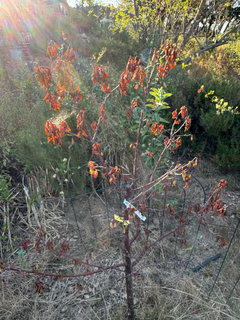
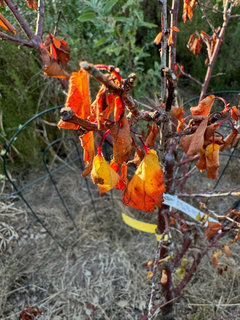
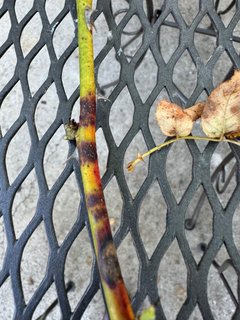
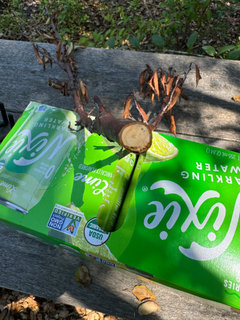
    Since we have experts here -- I found my photos of the Apricot tree as well as a photo of the last living cane of the DA Heritage. As I said above, my extension agent never got back to me. Complex -- the San Luis Obispo person explained that SB doesn't really have extension staff, but some volunteers? Anyway -- owners/experts at 3 local nurseries that sell fruit trees and roses thought fire blight. I didn't think it was fire blight, though now I can't remember why, and that's why I sought out 3 opinions. In the end, I removed everything and put it in the trash, not compost or green waste. Thoughts? Here are the photos:


  • 10 months ago
    last modified: 10 months ago

    There are at least two other "tells" for FB besides the "burnt leaves" most people associate with it. Almost always, there will be a "shepherd's crook" at the tip of the affected shoots. The end of the shoot bends down almost back on itself (from sudden wilting) before completely dying/browning/hardening in that position. The other tell, which is harder to ID, is sunken, dark cankers on branches and trunks, often with reddish-brown streaks underneath the bark. The dark streaks in the cambium layer are very indicative of FB, but not ALWAYS present. But if they're there, it's FB.

  • 10 months ago

    Sometimes it's what's going on underground with the rose's roots that manifests itself in the foliage. Is there anything going on that has stressed out the roots of your roses?

    Moses.

  • 10 months ago

    Scott: does the last photo depict a rose cane in cross-section, rather than apricot tree branch? You said you found a photo of Heritage (rather than 2).


    If it is rose cane, the focus is unfortunately on the print of the green sparking water box, rather than on the cambium layer.

  • 10 months ago

    Rifis, the photo above you mentioned is from Deborah, not Scott. It’s from her apricot tree and not a rose.

  • 10 months ago

    judijunebugarizonazn8 -- I do believe the last couple of Deborah's photos are of the last living cane of her DA Heritage rose. Am still wondering if DA's have more of a propensity since two of mine that were affected are DA's.

  • 10 months ago

    Sorry -- I posted photos slightly out of order. The skinny cane against a black lattice background is the cane of DA Heritage. The other 3 photos are of the apricot tree. Yes, the focus is not the best for the branch of the tree -- I'd already removed it at that point, and had taken that photo just for...I don't even know.