Software
Houzz Logo Print
ntguru

Vent hood for tall guy part 2

last month
last modified: last month

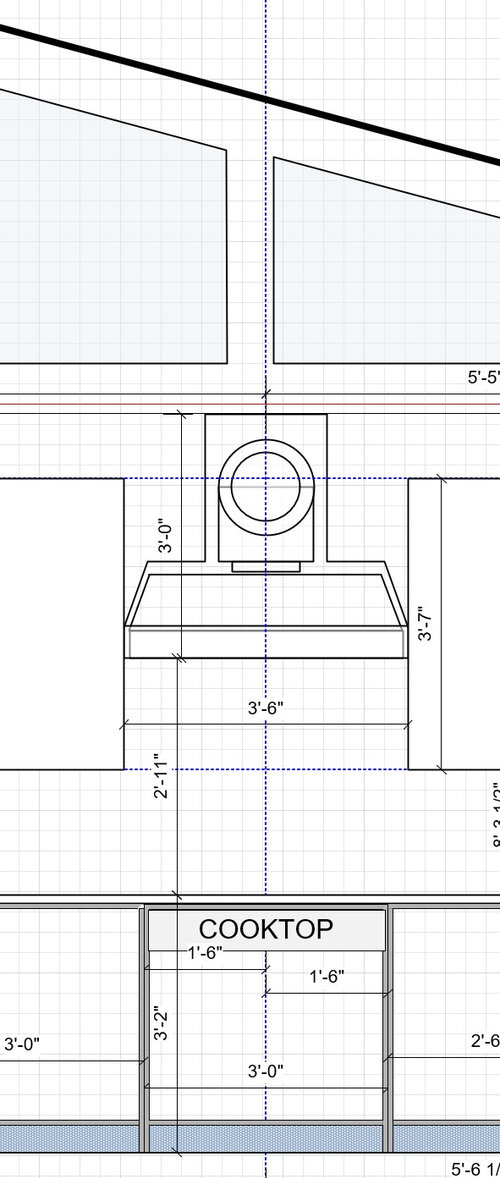
Hi everyone, I posted here before about trying to get a quiet ventilation system for a complete kitchen reconfiguration. We're moving along nicely toward finalizing design and I could use more help and advice. I cook regularly and am 6'5"+. We will be doing a 36" induction cooktop set into counters 38" off the floor and all cabinets are fully custom. I'm planning to do a 42" wide hood, preferably a liner/insert built into a custom enclosure matching the cabinets.


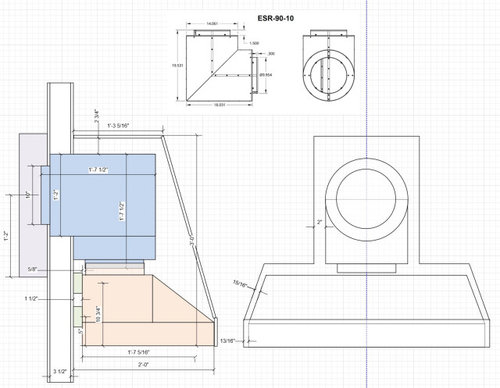
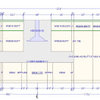
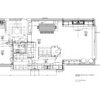
The ceiling is vaulted with large windows "above" the kitchen wall, which limits how "high" the hood stack/duct can go (see attached images). This makes the FanTech straight line silencers basically infeasible. On HVACQuick's website, I found the ESR-90-10 which is a 90deg elbow silencer similar to the fantech 8/10/12 LD series. With a relatively low-height hood liner (such as the Wolf Pro 22/24" deep shown in orange below with the 900 CFM remote blower shown in purple), I should be able to keep the stack low enough under the windows. I would run the blower on half or less power except in extreme circumstances when I would crack a window (the existing 6" MUA ducting being insufficient).


I've done testing using a cardboard box cut to size. If the hood is effectively 24" deep (ie, same as counter and like the aforementioned Wolf Pro liner), it is substantially in my way and/or a head-hitting hazard unless it's 37-38" above the counter/cooktop surface. If the hood is only about 19" deep (like a Wolf Pro 19" or the FanTech HL42), then I could go as low as 30" above, although 32"ish would be notable better.

So my main question for the experts (kaseki et al) is which of these would you prefer:


1) 42"W x 22/24" deep hood at 37-38" above, or

2) 42"W x 19" deep hood at 32-33" above


Secondarily, do you see any problems with the profile drawing and effectively not using any actual ducting? I reached out to FanTech about their liner/ESR/remote blower combo a few days ago and haven't heard back yet. Any other thoughts or recommendations?


Comments (26)

  • last month

    At 6’ 5” you will probably want counters and rangetop higher than 38”. Mock up a countertop at different heights and see how the ergonomics work for you. The so-called standard 36” kitchen counter was established in an era when women did all the cooking and people were shorter than today.


    I’m only 5’ 11” and have my range on casters to get it at 40”, and countertops a similar height.


    With a higher rangetop the distance to the non-head-banging vent hood will be less than the 37” you have.

  • last month

    Hi John, that's a good idea but we're a dual-cook household and my wife is "only" 5'7". We did 38" counters on the floating vanity in a recent primary suite bath remodel. It made a big improvement for me and I'd love another 2" higher, but she feels anything above 38" would be uncomfortable for her. The cooktop will be in a long, continuous modern line of counter, so I don't think there's an opportunity to elevate just the cooktop area.

  • PRO
    last month

    I recommend that you bend over 6"-12" and measure your head height then. Because no one looks inside a pot standing parade attention upright.

  • last month

    First, for each candidate concept, draw the cooktop with a maximum pan on it (for an edge hob) and determine the angle to the hood front edge of the capture aperture. Capture is a priority. The larger angle from vertical wins. The cooktop design may influence the result, so check the hob configuration.

    Second, plan on a metal plate deflecting plume effluent from getting behind the hood insert where you show blocking.

    Third, building on @Minardi's suggestion, draw a stick figure cook in your candidate side views and draw a waist-to-head length arc centered on the waist to check interference.

    Fourth, examine all air interfaces to be sure that either interfaces properly nest like ducts, or can be clamped together using (e.g.) Fantech clamps.

  • last month

    Minardi, that's effectively what I was doing. I had a helper hold the cardboard "hood" at various possible heights while I stood at the counter, leaning over an imaginary induction cooktop (Bosch Benchmark 36" being a primary contender) using actual cookware to stir/saute, flip, etc. The cooktop helps because the controls are flat on the front instead of up higher at the rear like on our current standing 30" range. This testing is where the 37-38" above came from. At 36" (74" from floor), when I lean forward a bit like I normally would, the top of my forehead hits. At 37", my hair brushes. At 38", I'm clear. This is in socks. I think this makes sense: with ~24" D hood and 25.5" D counters, I have a few degrees of forward lean before the plane of the front of the hood. If the hood were deeper still, then it would be a fully-upright or "stand under" situation (roughly 78" from the floor or 40" above cooktop). If the hood were less deep, it gives me more degrees of lean before the plane and thus a lower hood height. I contemplated adding an option 3 which is a 27"+ deep hood mounted 78-79" above the floor (40-41" above cooktop) but am not sure the Mrs. would approve the aesthetic side.


    Kaseki, great minds and all regarding the cooktop burner location and configuration. I spent a while last night looking and, at least for Bosch, cannot find a diagram that shows the distance from cooktop front edge to center of front burners. I may have to find it on display at a local store and measure. This may also be a good argument for the Benchmark Bosch (over the 800) so that both sides have fore-aft flexibility (ie, I could push front pans back a bit). Good catch on the gap behind the insert. I had to do that blocking non-flush with the existing wall studs to avoid having to cut a 14" hole for the silencer elbow and having it protrude fairly far outside the exterior wall. The Wolf hoods have only 5/8" between the exhaust collar and the back of the insert. Victory and Fantech have an inch or more, which helps with that problem.

  • last month
    last modified: last month

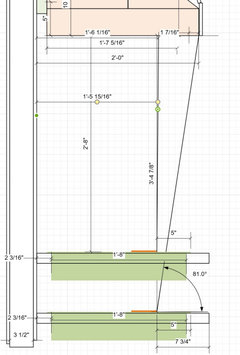
    So, I'm too tired right now to try an actual mathematical proof, but just using any reasonable estimate for depth to front burner/pan edge and tossing this into Visio and playing, I think it's safe to say that a deeper and higher hood is always going to win in the angle of capture game. Assuming cooktop is mounted as far back as possible results in about 5" between front of cooktop and front edge of pan and 7.75" to front edge of counter, (and measuring relative to front vs back so lower angle is BETTER):

    17/19"D hood at 32" is basically 90 deg (vertical)

    22/24D Hood at 38" is about 84 deg

    24/27D hood at 41" is about 81 deg

    Without the 1.5" (2x4) blocking (which depends on a given insert's vent duct fore-aft position), that adds about 2 deg to any of these.


  • last month

    Some inserts allow rear duct discharge. Then you can raise it up even higher than 38" above cooktop, given you account for higher cfms.

  • last month

    3onthetree, that’s a possibility but would require removing the silencer. I think some of the Wolf and Victory hoods have the rear option.

  • last month

    Just picking one, I think the 42" Vent-A-Hood K series is 330cfm rear conversion at 7.4 sones. Noise has to be reconciled with cfms, and the higher you go away from the cooktop the more cfms you should have.

  • last month

    If deeper (in proportion) increases faster than higher, then deeper wins. Otherwise, lower wins.

    81 degrees (9 degrees from vertical) is better than 84 degrees (6 degrees from vertical) for plume capture. 6 degrees might be sufficient depending on what is cooked and what the vertical velocities of the edge plume rays are. Note that induction does not have hot combustion products (unless a flambé is in process) so the plume volumetric rate as well as its velocity distribution will be lower than with gas cooking.

    As I explained in https://www.houzz.com/discussions/6099827/exhaust-hood-faq-ii#n=147, the wider angle plume rays have lower velocities making it easier for the hood airflow to redirect them upward into the hood (see plot at end). Also, wall hoods have an advantage where the effective hood capture aperture is a virtual area below the hood tilted downward at the wall.

  • last month

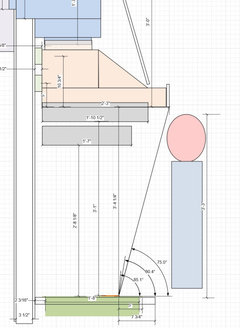
    Thought this might be illustrative.....


  • last month

    I think not whacking one’s head on a hard metal edge is pretty darned important. Or getting back pain when cooking.

    You are having a fully custom hood made, with an insert, right?

    Can you draw/mock up a hood that is high enough that you can stand *under* it, and extends out far enough for a good ”angle”?

    Also, I found that side panels made my hood even more effective. I took them off because I didn’t need them, but it was interesting.

    Since you are going custom, you have the ability to shape the hood edge. It does not have the be the same height all around. It can drop down at the sides.

    (You know what the world needs? A motorized hood that raises and lowers to accomodated different height users. Kind of like a motorized sit-stand desk.)

  • last month

    Well, John, given that commercial ducts have to be welded, one would need a considerable extent of duct (usually called bellows) made from corrugated steel that had the required range of compression/expansion. Residential ducts don't need to be welded, but one would still desire low leakage, so sliding part extensions would have to fit well and remain radially aligned as the hood was moved by whatever motor/screw drive was practicable.

    However, if the highest position is designed for good capture, lowering the hood wouldn't provide any advantage, it seems to me.

  • last month
    last modified: last month

    John, I agree. But there are constraints everywhere.

    I'm doing more testing and interestingly, have found there's a particularly dangerous middle zone when it comes to hitting my head that's a factor of both floor height of the hood and its depth. Below a threshold, it's clearly visible and I generally work around it. This is the current situation ( 19" deep chimney hood mounted 31" above the surface with 36" counters or 67" above the floor). Sometimes if I'm in a hurry and/or coming in at a weird angle, I'll still whack myself, but generally not. A 22-24" deep hood needs to be substantially higher, realistically 76"H. In the 70-75" range, I'm liable to whack my head even if I'm actively thinking about it. Above about 78", there's no concern and hood depth doesn't matter because I can stand under it (77" tall). But in between, it's high enough that I don't "see" it, but can still whack myself pretty good.

    While there's a master carpenter involved who can build basically any wood box enclosure we can design, the hood inserts (or liners, as they seem to properly be called) are relatively minimal in options and sizes. It seems most liners are either 19" deep or 22-24" deep and several searches for deeper liners of any brand haven't yielded much. Wolf has some 27"D hoods, but not liners. Victory, Best, etc, seem to max at 24 for hoods and/or liners. FanTech has only 19" liners.

    Then, there's my "stack" height limitation of 110" (9'2") due to the windows above. The Wolf Pro liner (22"D) is about 14" high and the silencer elbow I'd like to use is 19-20"H. So, that combo can be mounted a max of about 76" off the floor (110-14-20) or 38" above 38"H counters. The FanTech liner is only 5"H but sadly only comes in 19" depth, so it would need to be mounted as low as I could tolerate (31-32"), under the danger zone. The Wolf Pro 27"D Hood (no liner option) is around 20"H which means a max floor height of 70" and on which I will surely bang my head (middle danger zone). I could lose the silencer and use a regular 90 elbow and save 6-7" of height, or vertical back vent it, which would allow me to put the 27"D Wolf hood high enough to stand under.

    As of now, I'm leaning toward the Wolf 22" liner at 38" above cooktop (76" above floor). That gives about 9 degrees off vertical, allows me to operate largely without fear of hitting my head, and includes the duct silencer. I could gain 3-4 degrees more and have basically no chance of hitting my head by going with a non-liner Wolf Pro 27" deep at 78-82" off the floor (depending on top vs back venting), but would lose the silencer and presumably have to run the fan higher (ie, even more noise).

  • last month

    On a related note, I asked HVACQuick about their 90deg elbow silencer ESR-90-8 and ESR-90-10 and pasted it below. I think this is the stake in the ground I needed to make including it a priority.


    Q: Hi, can we use this elbow silencer to connect directly to the hood (mounted on an exterior wall) on the one side and the exterior remote blower on the other? With such a short run, will it still dramatically reduce noise? Thanks!
    A: Yes, this is a common application for this silencer. You will still get the same noise attenuation. Metal duct does not attenuate noise so the duct length is irrelevant.

  • last month

    There was a recent thread about using a liner at the top of a metal box to provide more reservoir volume and capture area. In your case, to do this the liner would have to be sideways and any sound suppression would be lost.

    I suppose using an island hood with fancy duct passing the windows and exiting to an attic where the silencer would be installed is infeasible.

  • last month

    The attic above the vault is engineered trusses and therefore fairly spacious and accessible. So, I had thought about going all the way up. The ceiling is 13'-14' (still sloping up) at the point where the cooktop is and the total open space left-to-right under the vault is about 47' and it's all open and windows. I don't know that I would be able to handle the visual of whatever cladding is possible on a 10" duct. I think it's even less likely the significant other would. The cooktop isn't centered on one of the spaces between each upper window, and even if it could be, the width is less than a clad 10" duct.

  • last month

    Kaseki, I don't know how my adjustable hood idea could be done . . . I just think it would be Jetsons-groovy.

  • last month

    I'm short and the only times I have hit my head on the sharp edges of a hood are when I am cleaning. When cooking you are only moving a certain way to handle the pots/pans, but when cleaning the area you tend to forget that there will be a sharp edged obstacle as you lift yourself back up and out! Ouch! I have probably done it at least once in each house I have owned.

  • last month

    I didn't explain a previous comment of mine well.

    You have talked a lot about, and gone into fine detail, of dimensional clearances in words and drawings. The height of the hood seems to be priority #1, take no prisoners.

    However, you have not talked much about noise, and it's importance to your lifestyle during cooking times.

    So, in that sense, you have to reconcile your need for clearance vs your need for acoustic mitigation. You are not going to achieve optimality for both at the same time with these constraints.

    Also, note that you are using an elbow silencer only. That is an inherent tradeoff right there. If you were to go through the roof and have a long straight duct silencer, then there would be more mitigation.

  • last month

    Fair point. It’s a variation of the triple constraint — you can have quiet, comfortable, effective but not all three together. The height of the hood isn’t the absolute end all be all, but being able to not damage my head on it is. So, I can do something like our current setup which is 19”D hood 31” off the cooktop. But apparently, 22”D at 38” would be more effective at capture and, from real life testing, would be the same or more comfortable. As far as quietness, we’re unfortunately limited by the open, contemporary design. That said, from the spec sheets and from the seller (who sells both straight and elbow silencers), the elbow is more effective than straight, and having more regular duct length has no benefit as far as as the silencer goes. Obviously, having the remote blower further away would be a benefit to having longer ducting.

  • last month
    last modified: last month

    @3onthetree: While Fantech silencers have published attenuation data,* I didn't see any for the ESR-90-10 proposed by the OP. If one cut an LD10 diagonally and welded the parts together in a 90-degree configuration, one might expect roughly the same attenuation, albeit with greater pressure loss. Are you aware of a link to ESR-90-10 acoustic attenuation data?

    ------

    *buried in https://www.fantech.net/en-us/products/fans-and-accessories/inline-duct-fans/accessories-for-inline-duct-fans/silencers?sku=411286#tech-specs-specification

  • last month

    kaseki, I was going off of this from the main page description for the ESR-90-10 (italics mine). I don't think I've found the detailed specs like they have for the straight versions. FWIW, it also indicates there's no pressure loss penalty, either.


    " Typically used with kitchen exhaust systems, the ESR round elbow duct silencers dramatically reduce the noise of any inline exhaust fan. Thanks to their elbowed design, these silencers offer greater noise suppression than straight silencers, without sacrificing airflow. "

  • last month

    I did see that. Without data conforming to the same test procedure listed for Fantech's offering, one can only assume that there should be significant attenuation.

  • last month

    Regarding the elbow making more noise, that was me making a statement based on inherent design of the turbulence of the turn, not published data from their product. I would mark the manufacturer's statement to marketing. This is notwithstanding friction or length, just the fact of turning compared to straight. This is a critical design point in ductwork we design for uses where noise is a concern (again, notwithstanding friction of large duct sections).