Software
Houzz Logo Print
brooke4355

Soft materials for bathroom?

9 months ago

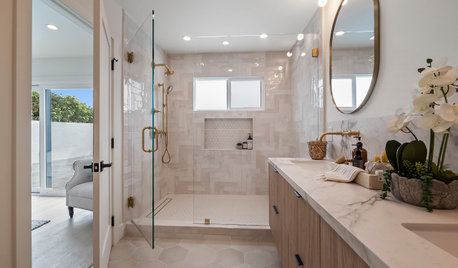
I have epilepsy, and am building my own house. I look at all the new designs that are supposed to be more ”acessible” but all I see is Danger - glass, sharp corners and hard surfaces. Has anybody added something that will actually be safe from a fall for a person with a disability? Or is it just lip service for wheelchairs a.k.a cleaner lines.

Comments (16)

  • 9 months ago

    I believe the Epilepsy Foundation has addressed this subject ( re making homes safe for epileptic persons, things like soft flooring, pads on furniture, monitoring devices, etc , good luck, sorry I don’t have any other suggestion.

  • 9 months ago

    Don't use a glass door. Use a shower curtain instead.


    You can specify that a fabricator make rounded corners on a vanity top and eased edges.


    They make softer floor mats to ease a blow. I presume you could adhere them to the walls as well.


    It is advised to sit when taking a shower, so make sure that the handles and shower head are located near the seat.


    Most importantly, for anyone who is a fall risk, make sure your bathroom door opens out so if you fall in against the door, someone can still open it outwards to come in and assist you.


  • 9 months ago

    ^^^^ K Laurence - I assume that you need to move this comment to a different post.

  • 9 months ago

    I’ve considered cork on floor, but never on walls. Thanks for everything this is very helpful

  • 9 months ago

    I was interested in K Laurence's suggestion, so I checked the Epsilepsy Foundation website's search function for "home" and/or "design" (without the quotation marks). I found a tiny bit of guidance in a couple of old forum posts and one brief article, but it struck me as not especially thorough, let alone inspired. I think Kendrah and palimpsest have already covered the suggestions you would find at EF, and with more and better ideas.


    That said, it can't hurt to check https://www.epilepsy.com, as I may have missed something. Personally, though, I would avoid the EF's suggestion to carpet your bathroom floors! I second palimpsest's idea of cork flooring, coated as mentioned. Or you might look into rubber flooring.


    By the way, I think there's something to be said for cork on walls, but IMO not in a bathroom and certainly not in the shower! I do wonder sometimes what Frank Lloyd Wright was thinking …

    brooke4355 thanked amystoller
  • 9 months ago

    One more thought! Kendra mentioned adhering pads to walls. Have you looked into acoustic padding? Some sound-proofing panels are quite attractive. If they are also soft enough to help guard against injury, they might be worth considering.

    brooke4355 thanked amystoller
  • 9 months ago
    last modified: 9 months ago

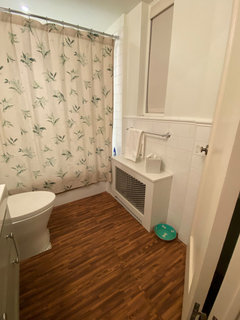
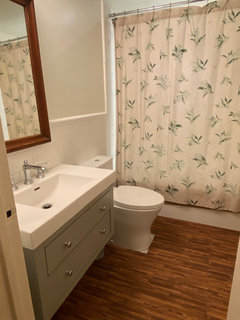
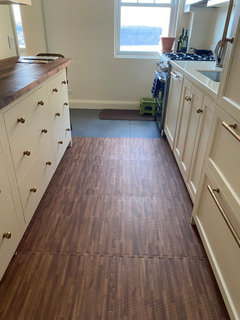
    I need extremely shock absorbing material because of a joint condition. My husband installed these interlocking foam floor tiles wall to wall throughout our home. Including in the bathroom. They lasted two years before the about a third of them started to pucker and the top layer bubbled. They are inexpensive enough and easy enough to install that even if you had to replace them every two years in your bathroom is wouldn't be expensive.

    Wood looking foam flooring tiles. LINK

    Here's a pic of them on our bathroom floor.


    They are much softer than a typical rubber gym flooring. And for what they are, not too unattractive. I'd love it if they made ones that looked like ceramic hex floor tiles.


    Here is a pic of them partially installed in oir kitchen.


    brooke4355 thanked Kendrah
  • 9 months ago

    You could also do a tile floor for longevity, water resistance and resale, but then cover it with carpet tiles that can be replaced as needed. Similar to Kendrah's idea. Flor sells nice looking carpet "tiles".

    https://www.flor.com/

    brooke4355 thanked chispa
  • PRO
    9 months ago

    Talk to your doctor(s), they may know of other patients that have addressed the same issues.

    Talk to local architects to see if any of them have experience in designing for epilepsy.


    Personally I would be tempted to wear a funky helmet with funky goggles just to scare the neighbors when they see me in the yard.

    brooke4355 thanked Mark Bischak, Architect
  • PRO
    9 months ago

    Here are hopefully some helpful tips from a quick internet search: Designing a bathroom for epilepsy involves minimizing fall risks with grab bars, non-slip surfaces, and curbless showers, ensuring easy exits with outward-opening doors, controlling water hazards by setting low temperatures and avoiding electricals near water, and using accessible fixtures like lever handles and shower seats, all while balancing privacy and safety. Key strategies include converting tubs to level-entry showers, installing temperature-controlled faucets, using shatterproof mirrors, and keeping water levels low in tubs. Flooring & Layout

    • Non-Slip Surfaces: Use rubber or textured flooring with high slip resistance; add non-skid mats in showers/tubs.
    • Curbless Shower: A level, curbless entry shower eliminates tripping hazards.
    • Doorways: Install outward-swinging doors that can't be blocked from the inside, and avoid locking them.
    • Space: Keep the floor clear of clutter and consider wall-mounted fixtures to maximize space.

    Fixtures & Water Safety

    • Showers: A shower is safer than a bath; use a shower seat and handheld wand.
    • Water Temperature: Set water heater to 120°F (49°C) and use thermostatic valves or temperature-controlled faucets to prevent scalding.
    • Grab Bars: Install horizontal grab bars in showers and near toilets for support.
    • Faucets: Choose lever handles or automatic faucets for easier use.
    • Tubs: Keep water levels low, or opt for walk-in tubs with low steps.

    Accessories & Other Safety Tips

    • Mirrors: Use shatterproof or safety glass mirrors.
    • Electricals: Keep all appliances away from water sources; use electric razors over blades.
    • Storage: Use recessed niches or wall-mounted cabinets to keep items accessible but out of the way.
    • Toilet: Consider comfort-height toilets (17-19 inches) for easier sitting/standing.
    • Signage: Use an "engaged" sign or window hanger on the door instead of a lock.
  • 9 months ago

    @brooke4355 please continue to post progress on your build. The son of one of my dearest friends just received an epilepsy diagnosis last week (and just 2 days after his 30th birthday.) As he navigates this major change, I'll be interested to see all the recommendations you get and incorporate.

    Here's wishing you a smooth build process and a home that meets your needs and exceeds your hopes.

  • 9 months ago
    last modified: 9 months ago

    Cushioned sheet vinyl can be soft to fall or drop something on. I would love to replace my kitchen ceramic tile with vinyl like we did in our last two houses, it took a really hard drop to break a dropped glass jar.

    We also did bullnose edges and rounded corners in the bathrooms, as we had very little boys.

    Norwood, I wonder if including additional grab bars near the floor are good idea? Sometimes one doesn’t fall as we think of it, but one can slide off a seat and end up on the floor. One might need a grab bar to pull up? (As I recall from PTs and OTs, if you are on the floor and didn’t intend to be, that’s a fall.)

  • PRO
    9 months ago
    last modified: 9 months ago

    Beyond the obvious of bull nose edges, vinyl flooring perhaps, Touch latch closings on cabinetry, or recessed pulls . Though we would usually advise against, a pocket door entry to the bath!

    Most important seems to me? ROOM to fall more safely. The room should be given top priority for space via extra wide clearance for everything, and as few items jutting from walls as possible unless curved..rounded in some way.

    There are people WORKING on the specific need. , especially for showers.

    Interesting......

    https://industrial.2024.qutdesignfestival.com.au/projects/halo-seizure-safe-shower-harness/

  • PRO
    9 months ago

    This a huge concern that is not easily answered . I look at my bathrooms and see nothing but hard surfaces so now my head is trying to see how that can be fixed . I think rounded corners are better but still hard .The padded toilet seats I always found gross but in this case maybe a good start .I was on a board for a complex for people with either mobility issues or wheel chairs and this issue was never talked about . WOW I sure hope someone can advise a better solution to this pretty obvious lack .

  • 9 months ago

    I understand your frustration and concerns, but ADA accessibility guidelines are not written to meet all the safety needs of every individual with a disability, an "accessible bathroom" refers to a bathroom that meets specific design standards to ensure people with disabilities can enter, maneuver, and use all fixtures independently. Usually we think about standards for wheelchairs, can you get through the doorway, can you pull the wheelchair up to the sink to wash your hands, are there grab bars so you can move yourself from the wheelchair to the toilet without falling.


    Your needs are quite specific and will require more than core accessibility standards. You are trying to prevent injury during a seizure. The best answers are going to be through the epilepsy foundation or other support groups that focus on people with epilepsy.


    They may also have information on assistance programs to help pay for enhancements or modifications that are needed due to your unique medical disability.