Software
Houzz Logo Print
daninthedirt

maintaining soil friability after long, very hot summer

26 days ago
last modified: 25 days ago

Our growing season is nine or ten months long. At the beginning, in February or March, I dig the beds deeply and amend with large amounts of compost. The soil is light, fluffy and friable when plants go in. They grow wonderfully during the summer. But I notice toward the end of the summer, they start to fade a bit. Pretty sure I understand why. When I redig the bed at the beginning of the season, the soil is dense and the shovel penetrates with some effort. That would make it more challenging for roots to grow, and for the soil to be oxygenated. The reason is simple. During the summer, our soil temps reach 90F for months at a time. By the end of the summer, the compost I amended the soil with is completely broken down, and largely gone.

So the question is, how do I keep soil friable through a long and very hot summer? Mulch doesn't work. That just makes the top layer friable. I use loads of mulch. But I can't dig any of it in, because the plants are all there. Responses from gardeners in the deep south would be appreciated. I guess more compost is one answer, but I already put in a lot. I use composted groundup leaves. That stuff is NOT nitrogen rich, so degradation is slower than other kinds of compost. But maybe an admixture of whole leaves would make for slower degradation, and keep the soil looser?

Comments (12)

  • 25 days ago


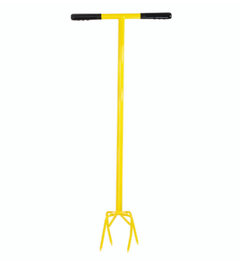
    I use this cultivator religiously. Love it. You could work with it even by one hand , very comfortable design.

    (I have similar from fiscars, but that one is tooooo heavy for me. )

    I 've bought it in dollar general for $10 last spring and never go to my garden without it. It has perfect weight, height, and width of prongs, that let your work the soil very carefully around plants.

    I dont have problems with compacted soil anymore.

  • 25 days ago

    Also, I have a small electric woodchipper. It makes very fine size woodchips (~ 1/4 ") depending on dia of twigs. I trimmed my cedar trees and figs, and make woodchips from their's branches. They don't rot fast. I use them in my container mix.

  • PRO
    25 days ago

    What are the watering habits? What is the earthworm or other dirt bugs culture of the beds? Do you use winter cover crops, and if so, what kind? What method is being used to dig the bed? Do you get weeds, and if so, what kinds?

  • 25 days ago
    last modified: 25 days ago

    Thanks. Wood chips are a good idea. That's sort of a Hügelkultur approach to the problem. Of course, cedar will degrade VERY slowly. I don't have a chipper, but I suppose I could run a lawnmower over twigs. Actually, just burying a pile of twigs might do the trick. Re cultivator, that really only loosens the top few inches of soil, and is satisfactory for only deep-rooted plants. I'm looking to keep the deep soil looser. The whole point is loosening the soil where the roots are.

  • 25 days ago
    last modified: 25 days ago

    In 100F temps the beds get watered almost every two days. No way around that. This is adjacent to an asphalt paved street, so actual air temp can get quite a bit higher. Plenty of earthworms, but they aren't going to loosen an entire bed, and they're likely to high tail it out of soil for which the organics have all degraded. No winter cover crops. My "winter season" is only 2 months long. Winter cover crops would barely get a chance to sprout and would never put down deep roots. I just use a shovel to dig the beds. What difference does that make? Not many weeds. This is an entirely urban plot. Again, weeds don't get a chance to put down deep roots.

  • 25 days ago

    You didn't specify soil type you have and Texas has many. Caliche is so challenging I don't even want to go there. Blackland prairie can act the way you describe but is worth trouble to tame. Assuming blp, huglekulter varents is indeed one of the best ways for growing. Don't chip wood, that ex[oses more surface resulting in faster rot which can tie up nutrientsthen gone in short order. Ideal wood is large log that is easily penetrated with screwdriver or spade. In a true Hugy bed logs can be used whole with gaps filled with leaves, twigs and compost. Top this with compost-soil mix, capped with mulch cures most your complaints and reduces irrigation needed by more than 50% plus buffer in critical timing of irrigation.


    With in ground garden, throw up tall beds, fill furrows with 2"x2' chunks of rotted log w/gaps filled in compost. Bust beds into middles, making old furrows new beds, work compost into topsoil , plant and mulch as usual. In lieu of rotted log , use unchipped twigs up to pencil size with equal bulk divided into large chips and fine chips. A lite sprinkle of amonia sulfate or generous layer of good compost will equalize N use w/consumption. No sand additions to black clay, it makes concrete.


    It can help to pile large twigs mixed w/leaves for 10-12 months before adding to garden.

    Blackland prairie runs on alkaline side and often deficient in minerals so soil testing pays off.


    Cover crops in Texas should go in. before Oct 1 in order to make meaningful growth. That can require cover crop planted amongst fall crops with extra fertilizer.

  • 24 days ago
    last modified: 24 days ago

    Soil type is what we call Edward Plateau, which is limestone and calcareous rubble. Native soil has minimal organics. Mine has a lot. My soil is somewhat alkaline (pH 7.9), but soil tests (I've done several) come out excellent in all nutrients. Not much clay.

    As noted, compost does NOT cure my complaint because with our soil temps, it doesn't last the summer. Mulch breaks down particularly fast, which is why frequent watering is needed. Frequent watering is easier than frequent mulching. Fair point about wood chips having large surface area, tying up nutrients. But unlike a large log which just occupies space, I could, as you suggest, lay down twigs and branches that will mix readily with the soil, and break down more gradually. Roots can thread their way around them. I fertilize with nitrogen every three weeks, so I'm not particularly concerned about organic decomposition robbing the soil of nitrogen. Nitrogen leaches readily, so just watering a lot can leave the soil deficient.

    To be honest, winter cover crops are sort of a joke around here, for home gardens at least. We don't tie up bed area with cover crops while summer crops are growing and, if you don't mind using a shovel, that will penetrate soils vastly better than cover crops will. For real farmland, with shallow till-depth, that's another story.

  • 24 days ago
    last modified: 24 days ago

    Dan has said many, many, many times that compost and organic material breaks down to nothing and adds nothing to the soil. Is this true? The basis of much of traditional gardening is you add organic material each year and your soil should improve over time. It seems very typical that many plants would decline after a hot summer plus the normal pest and disease stresses, that's normal. Plants can look sad by late Summer, is compacted soil the main problem?

    Now Dan has said many times that he fertilizes with chemical lawn fertilizer every three weeks, and that is all he needs. Maybe by overusing artificial fertilizer he has ruined the structure of his garden soil?

    Maybe he could research some organic farming ideas about soil structure and see what could or could not help him. I'm sure Dan will say that is wrong with an indirect post saying the opposite of everything. He could ask his local extension, I'm sure they enjoy talking to him and will help.

  • 23 days ago
    last modified: 23 days ago

    Compost breaks down with time, and ends up as humus, which is a residual that does improve the soil. Humus is quite stable, and can last centuries. But that's a small fraction of the original compost. I think what you end up with after compost degradation is about 10% humus. So yes, compost does improve soil in the long term, but sort of incrementally. When the compost degrades, your soil structure does as well. I said that at the end of the summer my compost is largely gone, and that's correct. I never said it breaks down to nothing nor adds nothing to the soil.

    I don't want to argue about fertilization. I do it because it works well, and I have absolutely no compunctions about using ammonium sulfate. What makes you accuse my soil of maybe being ruined? These are troll-like comments from someone with no perspective on my beds.

    I came here because I thought people might have answers to my questions. I've gotten some good ones, and I thank the other responders for their constructive consideration.

  • 23 days ago

    Wish I had some good info for ya Dan but I don't have that soil problem here. Over the past 22 years I've incorporated about 100 huge piles of homemade compost into our gardens. It does vanish doesn't it, with all of that added compost I would think that my gardens would be raised beds by now, ha, but nope. Anyways, I'm happy with the results and the soil seems happy too. I was lucky enough to start off with excellent chocolate cake topsoil which came with this old farmhouse. Hope you find a simple solution presented by the other posters.

  • 22 days ago
    last modified: 22 days ago


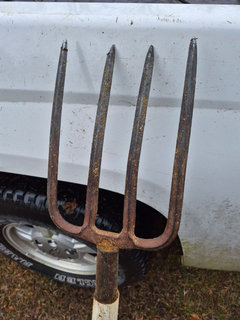
    I have this fork to loose soil . The length of teeth 12 ", so it goes deep enough to bring the air to the most roots. Unfortunatly, I cannot find this kind of fork anywhere anymore to buy another one. Love it so much!

    (I have spade fork from fiskars, but again, their design doesnt suit to me, Too heavy to work with them if you need to cultivate many beds, and their handle is short only, no variant with regular length of the handle.)

    Also, I am doing the trench composting, and plant everything over it next season. No compacting soil problem this way in my garden. I live in the middle of GA, our summer doesnt have mersy . No rain several months, T around 100F.

Sponsored
Boss Design Center
Average rating: 5 out of 5 stars33 Reviews
Reputable Home Renovation Company Serving Northern Virginia