Software
Houzz Logo Print
webuser_4803509

what could be under this vinyl siding?

9 days ago

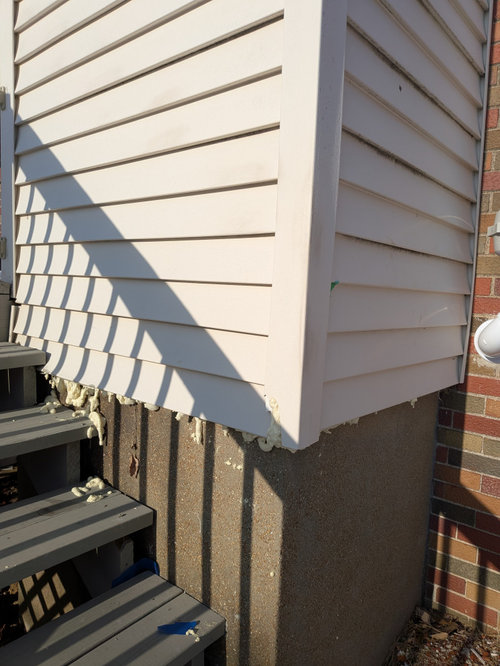
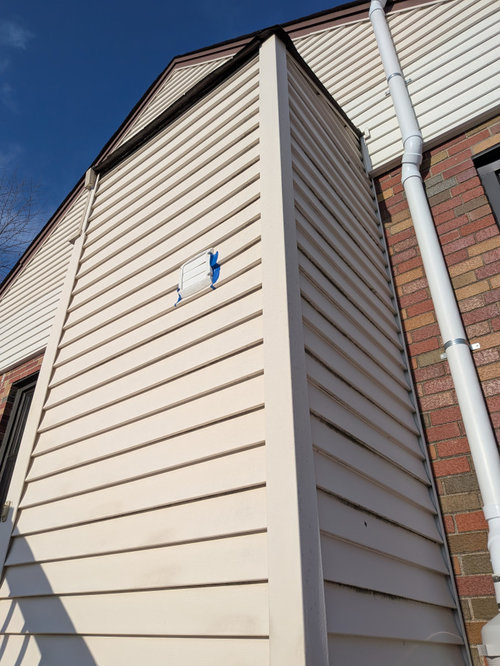
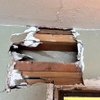
I am trying to understand what could be under this vinyl siding to investigate cold weather issues. This structure is attached to the house and houses a bedroom closet. This closet is getting frigid and unfortunately previous owner converted this closet (no vent present) to washer/dryer and I am worried that with all the recent cold weather, pipes are at risk of getting frozen. I blocked the closet with draft stoppers and painters tape as the bedroom was getting frigid.


I would really love to understand how could this structure have been constructed? Are there studs and joists for this structure? Then is there typically insulation between vinyl siding and studs/drywall/plaster? This house has a basement and I am wondering what is that concrete foundation - does it provide support to the structure? Is there anything between concrete and the vinyl siding? I am sure there is a blueprint of what goes behind that vinyl siding somewhere as same standard principles are used in construction for code compliance, correct?


Thanks for any suggestions!


Comments (16)

  • PRO
    8 days ago

    Theoretically the vinyl siding is mounted over a building wrap, over orientated strand board, nailed to 2x6 studs @ 16" on center with 5 1/2" fiberglass batt insulation.

    In reality heaven only knows with only two pictures provided. Tear it apart and find out the truth.

  • 8 days ago
    last modified: 8 days ago

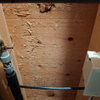
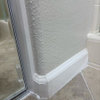
    Thanks @Mark Bischak, Architect Here are two more pictures looking into the vinyl siding from ground level. Does it give any additional clues? I can see some sort of blue insulation and then some wood. Are these the studs or oriented board? I am going to look up what an oriented board is.


    For studs these wooden elements are not spaced at 16" - they are more closely packed.


  • PRO
    8 days ago

    Not sure what is on the outside makes any difference.


    If the space is cold it's an insulation problem and it's easier to open the wall from INSIDE the house, see what you have in terms of insulation, fix the problem and drywall what has been fixed.


    You can't take anything off the exterior and expect to reattach it. It will be destroyed, & any new product will not match. Coming at the problem from the outside will not fix the issues.

  • 8 days ago

    If there are electrical outlets on the outside walls, you can take off the faceplates, and see how much, if any, insulation is in the walls.

    'Code' is time dependent. What was 'code' in 1950 isn't the same as 'code' in 1970, which isn't the same as 'code' in 1990. It is also location dependent.

    Blocking the closet off makes it much more likely that the pipes will freeze, since you are blocking off heat from the rest of the house.

  • PRO
    8 days ago

    If it is that important to you, contact a local builser to come out and investigate the existing construction to address your concens.

  • 8 days ago

    Make sure the ceiling has enough insulation too. You could be getting cold air from there. I would check ceiling first, and then do wall by wall. Or hire someone else to come and do it, if you are not sure about getting it all back together.

  • 8 days ago

    Construction practices vary tremendously by climate zone.

  • 7 days ago

    It appears it was added later. The brick continues behind it and the appendage just stops with it's own roof. It was as if it was a fireplace, but seems too big for that. Are you able to access it from the basement? Water and plumbing has to get in there somehow.

    The looking up pictures appear to be Celotex with a thin blue foam board put over it during the re-siding. To combat the cold, air seal from inside and verify insulation. The can foam you did from outside may actually be harmful, as there will be some water that needs to exit from behind the siding.

  • 6 days ago

    What I see is vinyl siding, and the contractor put down a layer of 1/4" foam insulating (common), followed by Bildrite , a fiberboard used a lot from the 1950's into the early 80's, but lost favor to OSB board. Wall studs are more than likely 2 x 4's based on the era suggested by the buidrite, and the insulation could be anywhere from zero to R11 (3 1/2"), followed by sheet rock.
    I've seen an entire subdivision built in the mid sixty with bildrite exterior sheathing with only 1" of fiberglass insulation in the walls, (not a typo, 1" thick insulation), so what you have can't be determined without cutting a hole in the sheet rock to see.
    If the insulation is little to none the best approach to fixing your problem is to remove the vinyl siding, tear off the bildrite and insulate from the outside, followed by sheathing the wall with OSB and residing. You can also add up to a 1 1/2" foam insulation to the OSB followed by the vinyl siding. (1" is the more common and someone should do this).
    If the wall insulation is sufficient, I'd still remove the siding and check the Buidrite to see if water has gotten wet and rotted out (common). If OK, I'd sheath over the bildrite with OSB, then add at least 1" of foam insulation (taping the seams) followed by the vinyl siding. I've done this to entire homes and much easier then adding insulation from the inside, with less of a mess compared to ripping out all the sheet rock from the inside.
    Corners are a big problem and often the leakiest and coldest part of the home's envelope pulling in cold air from numerous leaks, with a large thermal bridge area to the inside. If you feel the wall corner a person can actually feel the effect as they move their hand across the wall and over the corner. It's caused by how the corners are framed, and can be addressed when the walls are striped from the outside. Stuffing insulation between the blocks of a three stick corner, and then caulking all cracks where the studs are nailed together will reduce air infiltration. Once the wall is rebuilt and covered with foam insulation, with the seams taped, it will drastically reduce the thermal bridge to the inside, not only in the corners but over all the studs in the wall.

  • 4 days ago

    Thank you all so much. I appreciate all your inputs.


    At this point, I am wondering if it makes sense for me to focus on the exterior or focus on the interior to fix my cold weather issues. I guess it would be a big project to replace what is under vinyl siding?

  • 4 days ago

    Exterior will be minimal to add warmth, the exterior is to sealed. Interior is where the insulation is and the final air sealing. Rip the drywall, seal the top and bottom plates, ugrade the insulation and go. The floor beams if you have access should be insulated from underneath as well, spray foam if you cannot get enough access.

  • 4 days ago

    Interior will require me to move stackable washer/dryer, uninstall supply lines, reroute PEX and drain lines. Hmmm....do you think it is worth it?

  • 4 days ago

  • 3 days ago

    Ahh, from your other thread of filling the annular gaps around pipes. There is a crawl space at least, either you can get to it from the basement or the subfloor was up when they installed all the plumbing/electrical. That is where you need to air seal and insulate, down below.

    Be realistic, you are not going to remove the siding. And just assume there is R11 batt insulation in the walls, so clearing out and demo'ing drywall to get air sealing and a little more R value probably won't be worth it for this little appendage.

    I'd probably take a step back and think long term about having a spacemaker stacked W/D unit in a closet for a bedroom. By the time you figure out what you want to do with the big picture, it'll be spring and you won't have cold drafts.

  • 2 days ago

    " Hmmm....do you think it is worth it? "


    Being you will NEVER seal it and properly insulate the space from the outside, only you can determine if it is worth it to you.

  • 2 days ago

    Good question… the choice is tear out interior drywall, fix the problem OR frozen pipes, water damage. In the meantime I would turn off the water source to the washer when not using it. Call for someone to help fix soon.