Software
Houzz Logo Print
jdpyn2

Ways to Vent a Garage Ceiling....Tastefully?

23 days ago

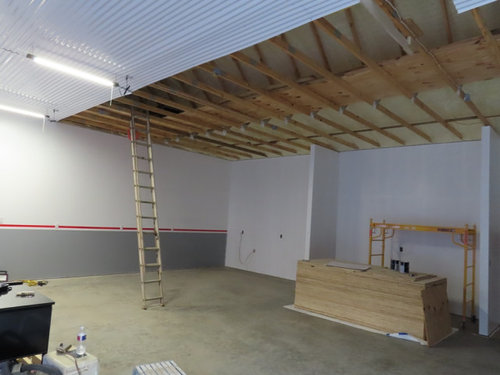
I'm nearing the end of a garage build and I am now at the point I need to make a decision on how I will vent the closed attic space down into the "living" space.

The garage is 30' X 40' with 12' walls and a 4/12 roof pitch. My open-cell spray-foam contractor recommended insulating the under side of the roof rather than insulating the top of the ceiling. The walls have 4" of foam and the underside of the roof has 6". So, I ditched my plans to vent the attic space to the outside...no soffet vents, no gable vents, no ridge vents. I'm putting up PVC corrugated panels for the ceiling and now have a decent minds-eye for how that will look...and can envision different openings in the ceiling to vent attic space air down into the room space. I'm not crazy about big, square, black holes and I really have no idea how many square feet of opening area I should have to adequately vent the attic. I do have HVAC and the air handler is already in the attic and ready to be set up by my HVAC guy. BUT, I don't plan to run that unit enough for it to serve as the attic venting solution. I love single-room dehumidifiers and will be using one on a timer in the garage to keep the humidity down. It's more economical I think than running the HVAC unit just for humidity control.

For simplicity and economic reasons, I would prefer venting to be passive, so I expect to need more square feet of vent openings than if I had a forced-air vent. I could go with solar-powered vent fans if battery maintenance doesn't become an issue (time and $$).

Ok, hopefully that is all of the pertinent details of my setup and plans.....oh, the garage is to be multi-use, with storage, auto maintenance, and hopefully some space for a man-cave relaxation area. My climate is deep East Texas and we have high humidity and temps in the 100F range in the summer.

Some of my concepts:

A. Cut several square, round, or oval holes in the PVC ceiling on each end of the 40 ft ceiling length and depend on passive air exchange.

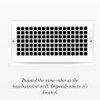
B. Cut similar holes and fit with white metal HVAC grates to help the look. Cut smaller holes on each end and fit with solar fans (several blowing up and several blowing down) to force-circulate air.

C. Put the attic HVAC unit on a timer and run the fan 5-10 minutes several times a day. HVAC intake would be in the attic and the vents would be through-ceiling.


Apologies for the long post and many thanks for sharing ideas for visually appealing passive vents and ideas/experience for other venting options!


Comments (16)

  • PRO
    23 days ago

    Is the garage a stand-alone structure or is it connected to your home? If it is connected, is there a fire-rated wall assembly separating the two? Does the air handler serve areas other than the garage?

  • 23 days ago

    The garage is stand-alone and the HVAC will only serve the garage.


    After assembling the information above to help others understand my build, it ocurred to me that I expect to run the single-room dehumidifier almost year-round and it moves a considerable volume of air. I usually set it for 30 minutes every three hours or so. It would take a little creativity to build suitable intake and exhaust ducts but I might set it up to circulate its air through the attic and down to the "living" space.

  • PRO
    23 days ago

    Humid air is less dense (more buoyant) than dry air. You'll be better served by a strategy that exhausts attic air rather than recirculating it to the garage level. If you want a passive system, consider installing a vapor diffusion port in the ridge.

    John 9a thanked Charles Ross Homes
  • 22 days ago

    Sounds like it would make sense to put the dehumidifier in the attic, feed the dry air exhaust down through the ceiling, and provide some vents at the other end of the ceiling for passive intake.

  • 22 days ago

    How tight is that PVC ceiling? If you pumped a few cfm into the attic from the garage would it find its way out?

    John 9a thanked Seabornman
  • PRO
    22 days ago

    John,

    I suggest you condition the air in the habitable portion (i.e., the garage workspace) to whatever conditions you wish to maintain and exhaust a small volume of air from the attic for humidity control. The PVC ceiling won't be air tight. Leakage from the workspace should provide the required exhaust volume. I'd install a powered vent fan in the attic controlled by a humidistat.

    John 9a thanked Charles Ross Homes
  • 22 days ago

    Your insulation in the roof plane needs to meet R38 for Climate Zone 2. So your OCSP is short. However, you only need R5 for condensation control, so meeting that.


    People smarter than me have figured out that in your climate, with air impermeable (6" of OCSP should achieve that, but 4" is close to still being air permeable) insulation, no air supply to the attic is needed, nor are vapor ports. However, it doesn't hurt, so you can follow the amount of 50cfm/1000sf of attic listed for other types of roof assemblies. Since your HVAC is in the attic, this is very easy to do, just tap off of it, and when the HVAC is running is when you would be concerned with moisture anyway. Much simpler and better than overthinking with holes, solar powered fans, and timers.


    Also, if you didn't know, you cannot store anything in the attic with exposed foam without a thermal barrier, only access for maintenance to the HVAC is allowed.


    I would recommend reading IRC R806.5-unvented attics, N1102 R-values, and R303.4-Foam Plastic (from 2024 IRC, sections have moved around from 2018/2021).

    John 9a thanked 3onthetree
  • 22 days ago

    Some good suggestions regarding the gaps in the PVC ceiling. It will certainly let some air exchange occur, and I might put a remote temp/humidity sensor up there and see how things go before going whole-hog on more complex options. I like the look of the ceiling and am not crazy about cutting holes.

  • PRO
    22 days ago

    I've built a couple of homes with conditioned attics and I retrofitted one of my personal homes in climate zone 4c (mixed-humid) to have a conditioned attic. In the real world, the required R-value for insulation installed under roof sheathing is a function of the air permeability of the insulation and the conditioning of the attic space. The prescriptive code, in my opinion, is at least a couple of years behind what we know from actual field experience. Whether or not your (unvented) attic meets prescriptive code requirements, you'll need to control relative humidity either by passive means (e.g., a vapor diffusion port) or active (conditioning) means. If you don't, you can expect mold/mildew in the attic space.

    John 9a thanked Charles Ross Homes
  • 21 days ago

    Tim, you're picking and choosing which codes to follow again. One thing is certain, any rando on the internet can say anything, unverified. When you use code as a reference, it is official, no guessing and having an OP try and choose which commenter is the right one. One can argue how the process of code is adopted, or lags behind, so I would suggest get on the code hearings for 2030 if you have hard research data, not eye tests.

    Also, a climate zone is very broad. Take your VA location in Zone 4, it runs through Kansas, near Las Vegas, all the way to Seattle. So when establishing a prescriptive baseline, even though the inputs of delta and average high/lows may be similar across the zone, there may be short periods in certain areas that resemble a Zone 3 or 5.

    Also, installing a vapor port for the purpose of diffusing interior moisture in a spray foamed unvented attic would need the foam to not cover the vapor port, which would then compromise the purpose of having insulation in the roof plane. I'm sure you've read DofE, Lstiburek, and GBA on the history of vapor ports being tested since the 1990-2000s and brought into the 2018 code for batt insulation. If one is concerned about risk of mold on the interior of foam or floor, then the HVAC or dehumidifier options are more suited.

    John 9a thanked 3onthetree
  • PRO
    21 days ago

    I don't know what codes, if any, apply to the OP's detached garage. In Virginia, if it's an agricultural building, it's exempt from residential building codes. If codes do apply, there is likely to be an option to request a code modification or a performance-based alternative with regard to insulation. We have both options in Virginia. In my experience building conditioned attics in zone 4c, it's neither economic nor necessary to insulate conditioned attics to code-specified R-values. It may be in other climate zones.

    Irrespective of whether codes apply, managing moisture in attics where spray foam insulation is installed under the roof decking is important. It can be done passively or actively. I'll respectfully disagree that installing a dehumidifier in the attic is best suited to this particular application. I don't want to spend a lot to condition an attic, but I do want to manage relative humidity Given that the structure is a garage and should have fresh air introduced for ventilation, I think a more elegant solution is simply to exhaust air from the attic at an equivalent flowrate.

    John 9a thanked Charles Ross Homes
  • 20 days ago
    last modified: 20 days ago

    Lest we get too bogged down in codes (you will see below that I also have passions about codes. Apologies in advance!), I think I have the needed input. I plan to monitor temperature and humidity for a while with the ceiling intact. I like the $20 weather stations that have two sensors, one with the display and another battery-powered remote sensor. I plan to put the remote sensor in the attic so I can get a humidity estimate. Certainly humidity is my most serious concern since I am already concerned with it and corresponding mold/mildew, hence I like the demudifiers. They do a great job pumping out water in the seasons when I don't need AC. I also think I may see heat build up in the attic in the summer without a cooling source.. I guess I'll see just how effective the blow-in foam is.

    Regarding what codes may apply, really none apply to me, in a sense that I'm out of the city limits and not building through a loan or having inspectors come out to qualify my work. I sometimes like to know what the code is, especially for electrical installation (and I do have to meet code for my connection with the power company), but I have a tendency to look at code "requirements" with a big common sense/practical application filter. The electric service connection that DOES have to meet code is a great example of my mulish wanderings. I paid $1,500 for a licensed electrician to come out and install a new meter socket and adjoining main breaker panel. He violated some bold print in my elecricity provider's installation requirements manual and I pointed it out before he left the job. He said they might not like it but it would be fine. No, they didn't like it and they weren't fine. I spent another $200 getting more wire and the right socket box and a biologist ended up making an electrician's work meet code. In the city limits, I probably would not be allowed, by code, to have made the correction. Code is written for the big picture, and I think it's good in a broad sense for safety and effective building outcomes but code requirements sometimes seem to me like painting everything with a 12" roller. It's all painted in the end but it sure would have looked better if I had used a 1" wedge brush on the trim.

    Sorry I just HAD to get on my own soapbox on the code topic. I went back and deleted a lot from my own rant because it's just too argumentative. I had 18 years of dealing with federal and state agencies and it left me with a really slanted view of "just do it or we will fine you" concepts. Code, at the least, gives us a starting point and we can all begin with code requirements and meet them or discard them as we see fit in our unique environments.

  • 19 days ago

    3othetree, good analysis. I'm good with code as long as I'm at liberty to tweak my installation to meet some site-specific needs. But there is no way I could remodel a home in town.


    I shake my head every time I install electrical outlets. I'm more of a mechanic than an electrician and I think of all the details of electrical code and wonder how manufacturers of electrical outlets can get away with manufacturing them with screws (the set that screws into the outlet box) that are milled so shallow that you HAVE to use a power drill so you can lean on it sufficiently for the bit to get a good purchase on the screw. That kind of stuff bothers me enough that it really gets my goat when I see details that exclude me from being able to do certain jobs in areas where code is enforced. Yes, I know, it protects the adjoining homes in a neighborhood from also burning down if I do something boneheaded...but that knowledge doesn't keep my hackles from raising...having seen jobs I have had hired out to the "experts."

    Having myself fallen back into the code discussion abyss, y'all are welcome to continue in that vein but I'm pretty sure the horse is beyond resuscitation!

  • 18 days ago
    last modified: 18 days ago

    To accomplish what you want, two issues should be put to bed. Issue one, code,issue two passive ventilation. From the standpoint of humidity control/mold prevention, code in Lufkin and Woodville ASSUMES that that heat or cool will be running every day, year around, which yours will not. Therefore if you follow code to the letter, humidity will not be controlled because system isn't always running.

    Passive ventilation between attic and garage does nothing to alter humidity so you must use a dehumidifier. Square foot capacity/rating of stand-alone dehumidifiers take into consideration for occupants perspiring, moisture they add through breathing along with showering and opening doors to allow outdoor air inside. None of that applies to your garage when vacant so even a small dehumidifier can handle it. Hopefully a moisture barrier was used below concrete floor.

    I'm not familiar with pvc ceilings but you mentioned gaps might be air permeable. Your ac contractor should be able to run a quick test to establish whether and how much air easily passes through ceiling. I would put dehumidifier in attic and in route air discharge via duct to a generic ac vent in ceiling. It might be necessary to boost cfm and velocity with a fan. If ceiling was found to leak/pass air, there's no need for return vent but if a return is needed, place it on opposite side of garage. A perforated panel similar to perforated vinyl soffit would look clean.

    I agree with you on wait and see while monitoring before taking remedial actions.

  • PRO
    17 days ago

    That's a full fledged mold farm as built. You need to do whatever it takes to fix that.