

Choosing a 30" Gas Range
I'm in the process of planning some minor kitchen upgrades. We're not changing countertops or cabinets (beyond removing the cabinet above the current over the range microwave to replace it with a proper hood). So we're limited to a 30" range. There's currently gas, but no 240V power to the range location, so I'd prefer to stay with an all-gas range for ease of install.
Currently we have an older Kenmore range, but it has a couple of weak points. It only has 1 higher powered burner (17k BTU). I'd really like at least a second higher power burner (next most powerful on the current range is 9500 BTU). And something more than the current 17k on the highest powered burner would be good, as I've found the current burner a little weak at times with a wok or for searing. The current burners are also pretty terrible for heat distribution, as they flare out to the sides badly at high power settings (the power burner will have the hottest point right at the edges of a 12" skillet for example). We've been happy enough with the current oven (neither of us is a big baker), so any oven that's at least decent will be fine, and there's no real need for a double oven range.
The easy answer for a good upgrade in my mind would be something like a Bluestar RNB or Capital Culinarian. But this isn't going to be a forever house and doesn't necessarily have the perfect kitchen design currently either, so I don't think it really makes sense to spend $5000+ on a range.
Currently, the front runner in my mind is the 30" Cafe 6 burner single oven (CGS700P2MS1, $2700). The ability to swap the center grate for a griddle is a nice to have, it has a 21k BTU tri ring for the most powerful burner, and also has a 15k and a 12k in addition to the lower powered burners. And the layout seems good for a 30" setup, as the 2 center burners (as opposed to one oval) would allow use of 3x 12" pans at the same time (front corners and back center) without pushing the pans off-center on the burners. My biggest concern is about heat flare out to the sides with the big burner for use with a wok, etc.
I have found a couple of other possible options that look reasonable. One is the Frigidaire PCFG3080AF ($2400). It's also 6 burners, but lower powered and none of them are multi-ring or anything. The most powerful are 18k, and the "standard" size burners are only 7500 BTU instead of 9500, so I worry about having enough power and heat distribution problems on the big burners, although the flame holes do appear a little better placed to let flames go upward instead of just outward compared to the typical mushroom cap burners I have now (and the GE has for 5 of the 6).
Another possible option is the Electrolux ECFG3068AS ($3200). It's more expensive than the other options and also has the somewhat less useful oval center burner (fine for a griddle but nothing else). The front burners are also only 18k on this range, but both rears are 12k. And they appear to all be multi-ring, plus the outer rings have the flame holes on the top of the cap angled up and outward, so at first glance it looks like they'd have a bit less outward flare and might distribute heat better.
What does everyone here think might be the best of those options? And what other options are out there that I might have missed that have decent burners?
Comments (21)
 6 months ago
The option I'd favor is to figure out how much running a a 220v line will be. Since I've done them myself, it can be very inexpensive.
With cost in the mix a lot better choices open up.
rslifkin
Original Author6 months agoCost-wise, I don't have a hard budget set for this, but based on the options I'm finding it looks like I'm planning to stay under $3000 or so unless there's a really compelling reason to go higher. If I were going to spend significantly more I'd be strongly leaning towards the open burner Capital Classic Chef (culinarian) at $5000. A Bluestar would also be on the table, but the open burner RCS (which is less powerful) plus the not-included backguard it needs to go against a wall is only $100 cheaper (I don't know if they used non-combustible material under the tile backsplash, so I have to assume they didn't). And a Bluestar RNB plus the backguard is almost $6500.
Similarly, adding a 220 line is possible if it opens up compelling enough range options, but it's going to be a bit of work. I'll have to either add a sub-panel or move some circuits onto tandem breakers as the current panel is full (although amperage-wise there's enough headroom for a range circuit). The other issue is getting the line into the kitchen. Half of the kitchen was added onto the house many years ago (100 year old house) and isn't over the basement. The range is about 5 feet into that addition and there's no crawl space underneath. So running and properly securing the wiring would potentially be challenging.
As far as gas vs electric oven goes, neither of us has any complaints with the gas oven in the current 2008-vintage Kenmore range and I've been happy with electric ovens in the past, so I'm fine with whatever is either easier to get or gives me a better stove.
The big thing is that this isn't going to be a forever kitchen. Realistically, I don't expect us to be in this house more than about 5 years, so combined with not doing a full kitchen renovation, I'm trying to find the point where we'll be happy with the range and get enough of an upgrade over what we have now, but not spend extra money for little gain.Related Professionals
Potsdam Kitchen & Bathroom Designers · Ardmore Bathroom Remodelers · Las Cruces Bathroom Remodelers · Sarnia Bathroom Remodelers · Lake City Kitchen Remodelers · Morgan City Kitchen Remodelers · Lebanon Kitchen Remodelers · Salt Lake City Kitchen Remodelers · Fredericksburg Kitchen & Bathroom Designers · Tallahassee Kitchen Remodelers · Hagerstown Kitchen Remodelers · College Station Kitchen Remodelers · Boise Kitchen Remodelers · Provo Kitchen Remodelers · Coos Bay Custom Countertops- 6 months ago
Consumer Reports has tested single-oven gas ranges ($10/month digital) including three of the four you mentioned. You might also consider the GE Profile PGS930YPFS and LG LSGL6337F. You get the most information about how these appliances actually operate by reading the linked user manuals.
rslifkin
Original Author6 months agoThe GE PGS930YPFS was also a consideration, as it has the same left and right front burners as the Cafe. The primary things that push me to think the extra $600 for the Cafe are worth it are the 6 burner layout instead of 5 (the center burner on the Profile is only really useful for a griddle and doesn't allow a pot/pan in the back center). And the Cafe has more power on the back right burner, while the Profile only has more than 10k BTU on the front burners. So the Cafe seems to me like a more flexible cooktop for the bit of extra money.
Based on personal opinions of the brand and reliability concerns a few friends and family members have had with various appliances, I haven't been considering LG or Samsung to be an option at all. The 23k BTU multi-ring burner on a few of their ranges is appealing though.
Thanks for the tip on the CR subscription being that cheap. I'll grab one and see what they have to say, although I'm not confident they'll have good feedback about things like how well a wok heats on a given burner.- 6 months ago
I just purchased a Bluestar 30"all gas with open burners. I love it! The open burners are the old Garland commercial type with an ultra low simmer that can be adjusted lower if you wanted. The oven also is a great performer! IMO at the 4k price point, it's at the top of the home pro market. Wolf, Thermador at 6k+ their sealed burners can't compair.
- 6 months ago
"The primary things that push me to think the extra $600 for the Cafe are worth it are the 6 burner layout instead of 5 (the center burner on the Profile is only really useful for a griddle and doesn't allow a pot/pan in the back center)."
A 6-burner layout on a 30" stove is bad design IMO. You're being sold something you can't take full advantage of. The burners are too close together, you can't get medium or large pots on all the burners at the same time. I had a 5-burner 30", and it's the same story. You'd be better off with a good 4-burner where you can actually use all 4 burners at once, because using 4 burners max is pretty much the reality of a 5- or 6-burner anyway. If you want more burners, size up. rslifkin
Original Author6 months agolast modified: 6 months agoI fully agree that the 6 burner layout is crowded and you'd need to use only small pans to be able to use all 6 at the same time. Realistically, I can't think of a time when I'd use more than 4 burners, and even that's rare. 2 is common and 3 happens sometimes. However, outside of the more commercial type ranges, most of options have no more than 10" centerline spacing front to rear between the burners. So if you're using a 12" pan on the front, then anything bigger than 8" is pushed off-center on the rear burner.
With the 6 burner layout, you can stagger diagonally and fit 3x 12" pans on the front left and right burners and the rear center burner (leaving the rear left/right and front center empty). Our current range is a sort of 5/6 burner hybrid (the oval center griddle burner is 3 parts, front, rear, and center). I've occasionally done the staggered placement using the back part of the griddle burner in situations where the slightly funky burner shape (and only being 6k BTU for that one section) isn't an issue.
So it's not so much that the number of burners matters in this case, but that the placement of the burners on the 6 burner layout is potentially more useful than the common 5 burner layout. 4 burner layouts seem to be absent from the middle of the market in a 30" range, they only seem to exist on cheap ranges that wouldn't be an upgrade and high-budget ranges.
As best I can determine from pictures, the Cafe stove has 10" centerline spacing between the burners both front to rear and side to side, so it's an improvement over the current range. The current range doesn't have edge to edge grates, so spacing is only 9" front to rear and 8" side to side (between burner centers). I'll take a tape measure over to the appliance store and confirm the spacing on the Cafe range before making any definite decisions though.
EDIT: As a thought on layout, another thing that caught my interest was the Forno Capriasca (5x 20k BTU multi-ring burners). I didn't put it on the list as after a little research, I don't trust that it would actually be a decent piece of equipment. But the layout seems practical. You either use it as a 4 burner and ignore the center burner, or if you're using a wok or doing another high-smoke task and only need 1 burner at that moment, you use the center burner to get further from the edges of the range hood for less risk of smoke escape.- 6 months ago
Why don't you just spring for the Bluestar or Capital Culinarian that you want? Keep the old Kenmore to put back into place if/when you sell the house, or exclude the stove from the sale of the house and take it with you to the new place. People do it all the time.
rslifkin
Original Author6 months agoNow that's a thought... I hadn't really thought about the possibility of moving a range to a future house. That would make the $5000+ pricetag more palatable as long as my wife agrees (I'm the much heavier kitchen user so she'll see the price tag more than the functionality).
So I guess this decision comes down to 2 basic questions: Is there something I'd be happy with in the $3000 range, or is there just not enough improvement until I get to the $5000+ range? And if I'm in the $5000 range, do I get the Capital Culianarian (which would be $5000 all in, as it includes the back guard to install against a wall that isn't non-combustible) or is there a reason to spend more on a Bluestar RNB?- 6 months agolast modified: 6 months ago
Depends on your priorities. For me, it was the open Garland burners of the Bluestar. Even cooking, low simmer, the ability to remove the grate and place a wok right in. Also to be able to stack grates on top of eack other to lift the pot even.higher off the flame. Any size skillet sits level, no teater tottering on the grates.
- 6 months ago
It’s really hard to argue with the good points made about open style gas burners. But it should be said that as the BTUs increase with any of these ranges, you are looking at, so too will the need for make up air (MUA)requirements increase. . When the time comes to sell your place and move, the issue could also come up again when the house is inspected. Of course, your own health is a priority, and the MUA is important regardless of the kind of range you have, but with more heat comes more MUA needs. (see the numerous threads in the forum on this topic.)
As I was reading your thoughtful post about the many things you are considering, and the priorities you have, I kept coming back to your mentioning about heat distribution under cookware and the way gas flames on sealed burners, often spread out and “lick“ the sides of the cookware, sending most of the heat into the room. I recall having this experience myself some years back while using a gas range in an apartment, I rented as a grad student I would always end up with a few singed fingers when I wanted to turn the burner on high to get going with cooking and discovering that most of that heat was not getting onto the bottom of the pot/ pan itself.
And since you mentioned that the heat distribution is one of the highest priorities for you, I keep coming back to the Electrolux model that you mentioned. I haven’t really paid much attention to their offerings in this category lately, but I was pleasantly surprised to see that the four key burners on that model you mentioned each have dual ring burner set ups. You don’t see that very often and that could be a nice compromise or middle ground for your needs versus investing, considerably more for a commercial style range. , Of course, dual ring burners are not exactly the same as open style burners, but they are certainly an improvement over the standard single ring with the Sealed cap burner that most ranges come with. Yes, taking a range with you could certainly be an option when you move, but the details of uninstalling, a heavy commercial style range such as the blue star or the capital models could be more involved
at a time when you would already be super busy with the process of moving. It’s also hard to speculate what the layout of a future home’s kitchen will look like, along with what your needs will be at that time. The Electrolux could improve your cooking experience for the time being while not having you spend more on something that you may or may not get back when you sell the home. - 6 months ago
5 feet from the original basement access is not much of a challenge if that 5 feet will be behind cabinets. I'd install a 240v Hubbell industrial level receptacle at that location and use a plug or hardwire if code requires it
Wirecutter has a review of a 120v induction range with a LFP battery to give you 240v equivalent power. Copperhome Charlie is the product. Induction will require less exhaust capacity and possibly no makeup air.
rslifkin
Original Author6 months agolast modified: 6 months agoI don't particularly want to go with induction for now, I'd rather stay with a gas cooktop. A wok is more satisfying to use over a real flame in my opinion and we don't have space to have both in this kitchen.
I need to upgrade ventilation regardless, as things like stir fry and searing are smoky regardless of the heat source, as is occasional high heat roasting with the oven set to 550 (for things like tandoori chicken).
There's no avoiding the need for MUA unfortunately, although the only combustion appliance that isn't sealed combustion is the water heater. We may change that, in which case the MUA setup wouldn't need to be as perfect as the house will tolerate a little more depressurization.
As far as burners go, I don't necessarily need perfection, just something better than we have now. And I don't necessarily need great heat distribution on every burner as not every task or piece of cookware is sensitive to it. Better heat distribution for high heat tasks would be good, but I don't tend to notice it much at lower heats. And of course for some things like boiling water it just doesn't matter as long as the heat isn't blowing right past the sides of the pot.
We'll be stopping in to one of our local appliance stores soon to look at a replacement microwave and a dishwasher, so I'll see what they have on display for ranges that I can get my eyes on. I'll bring a tape measure to check burner spacing as well to get an idea of what will fit on different layouts. Unfortunately I don't know that anywhere local has any live demo stoves and it's surprisingly hard to find any decent pictures or video of the flame pattern from various burners.- 6 months agolast modified: 6 months ago
To complete the induction option with 120v the Impulse cooktop with battery outputs 10000 watts, beyond the boost levels of 240v induction ranges/cooktops. That can be paired with a Miele CSO. A Miele dw at the G5000 level without some bells is my choice. No built-in micro. Munro Live has a tech review of Impulse.
rslifkin
Original Author6 months agoSeparate cooktop and oven isn't an option here. If that turned out to be the only good option then we'd just keep the existing range. We're not replacing any counters or cabinets, so upgrades are limited to appliance swaps only.
rslifkin
Original Author6 months agoEnded up going by an appliance store today. They didn't have the Electrolux on the floor to look at, but they had the Cafe and the Frigidaire.
Haven't pulled the trigger on anything yet, but I think we're going to go with the Cafe. The burner spacing is much better than the Frigidaire (which has the side burners too far in from the edge in my opinion). And the tri ring burner isn't excessively large. It's probably not ideal for a wok but has to be better than what we've got now. The Cafe burner spacing is certainly more usable if I want to use the center griddle and another burner (vs putting an overlay griddle on one side and using the burners on the other side). And it'll easily fit 3x 12 inch pans staggered diagonally.
Realistically if I have more than 1 big burner cranked up then the second probably has a pot of water on it where heat distribution doesn't really matter, so only having 1 fancy burner is fine, and having a second high powered burner at all is a big improvement over the current stove.
The other thing that's pushing me to go with the Cafe and not stretch for something fancier is price. President's day sale at the appliance store up the street gets the single oven all gas version of the Cafe down to $2300 (plus tax and a few bucks for the edge trim), so to get anything significantly better I'd probably be looking at double or more the price. The appliance guy also agreed that you have to make a pretty big step up from there to get much functional improvement. Plus the Cafe seems to be pretty consistently well liked (as is the Frigidaire, the Electrolux has far less info out there).rslifkin
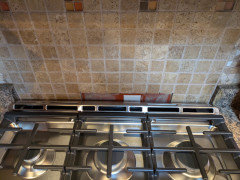
Original Author6 months agoNew stove was just installed. Just a few things left to do, have to adjust the simmer setting on the burners, install the side trim, and sort out some stainless trim to fill the 1" gap behind the range (gas pipe isn't in the ideal spot so it's pushed forward slightly) and cover the poor design of the backsplash. The range outlet is up way too high, so now that we have a stove without a backguard the outlet placement and resulting backsplash issue is visible.
So far it looks good and comparing back to back, the cooking surface is much bigger than the old stove. It won't get a thorough test for a few more days until a few things arrive and I can install the new range hood. We'll keep it to low grease/smoke cooking until then.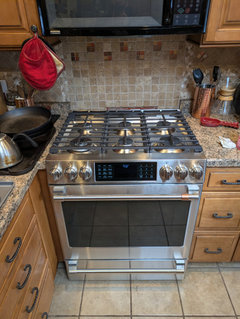
rslifkin
Original Author6 months agoFigured out the backsplash situation. I realized the installer forgot to put on the trim piece that goes behind the oven vents, so I did that. Between that and correcting the position of the gas flex line there's no longer a gap to the backsplash (trim piece filled most of it and now it sits about 1/4" further back to fix the rest).
The cut out for the outlet is still visible above the trim, but that's an easier fix now. I'll just stick a piece of stainless to the backsplash running from just behind the range trim to even with the top of the back piece of the countertop. Based on my test run, oven heat seems to be mostly directed up and forward, plus the trim piece is slotted for airflow (and GE doesn't list a minimum clearance to a combustible rear wall), so I'm not worried about heat against the wall.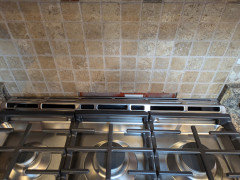
rslifkin
Original Author6 months agoPut the stainless trim piece in behind the stove last night.
Now I just have to get the hood install done and decide if I want to lower the stove slightly or not. Currently the base of the grates are about 1/2" above the trim strips installed on the counter edges (the trim is 3/8" thick, so the stove is almost an inch above the counters). I don't mind it being a little high to keep more heat away from the laminate countertop when using large pans, but I haven't decided yet if it's just a little too high.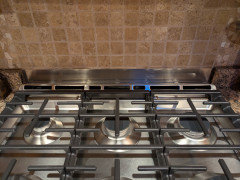
rslifkin
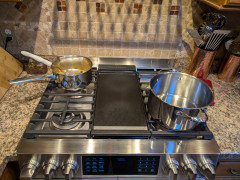
Original Author5 months agolast modified: 5 months agoI think this will be the final update on this thread. We've been using the new range for a couple weeks now and it's definitely a big upgrade. The Bluestar, Capital, etc. would be better in some ways, but they're also much more expensive. And in the 30" size, the cooktop layout is probably a bit better and more flexible on the Cafe. One of the pictures below shows the side burners being usable (at least up to a 10" pot/pan) with the griddle installed in the middle, which wasn't the case on the old Kenmore.
So far, the oven on the Cafe works great. Heat seems even enough, preheating time is reasonable, etc. The broiler is definitely not as good as the fancy infrared broilers, but it's better than the one on the old Kenmore (similar flame tube design, but the Cafe broiler gets more width-wise coverage and has more power). And realistically, I don't broil all that much as I hate the resulting cleanup.
As far as the stove top, the burners have plenty of power. Especially on the 12, 15, and 21k burners they can be a little large relative to some cookware once flare is factored in, but the flare only gets really significant when they're turned up all the way. Backing off even a little reduces it significantly. At high power with pans that are susceptible to uneven heating you can definitely end up with a distinct hot ring toward the edges of the pan, but I've yet to find a situation where it was a real problem (and it's helped by choosing a burner based on the pan in use or using a pan that spreads heat better).
The big 21k tri-ring burner is definitely a big upgrade, particularly with a wok on it. Until you crank it way up it heats pretty evenly (at high heat the proportion of heat coming from the outer ring increases). With a 14" flat bottom wok sitting on it, the center of the wok gets decent heat (significantly better than a plain capped burner). The hottest part of the wok doesn't end up being the bottom, the hot spot comes as a ring of heat just above the flat part where the flames from the outer ring hit (and the flames do contact the wok above the grates when cranked up). The ring of heat is similar to what I've seen described about induction wok burners, and doesn't seem to present any real problem as far as being able to produce a good stir fry. Heat-wise, it blows the 17k burner on the old Kenmore out of the water. I don't think I've wished for more heat yet with this one.
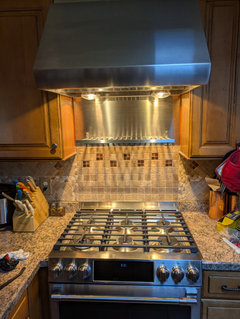
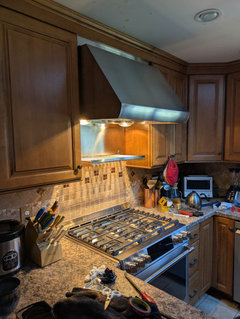
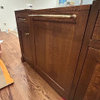
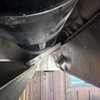
Here are a few photos of the new range in action and the new hood setup we just installed over it. The hood is a 30" Proline PLJW 109, spaced 3" off the wall to accommodate rear ducting and for additional capture depth. Still need to sort out MUA (one step at a time being that this is DIY work), so for now it's kitchen window open when cooking. And we decided to stick with a 30" hood instead of rearranging the cabinets to fit a 36, as it would have required some backsplash surgery and would have made the cabinet over the peninsula much harder to get things in/out of. So far the 30" captures the smoke/grease from a wok on the front left burner just fine with the blower at high speed.

rslifkinOriginal Author