Software
Houzz Logo Print
fig_insanity

Quest for the "blue" rose- the science

Ran across a video that gives a good summary of the quest to create a blue rose, and why it has failed. It's old news to most of us, but there is a bit at the end I hadn't heard about. You might find it interesting. It's obvious the presenter (and writers) don't know much about roses, but they do know their science, lol.

https://www.youtube.com/watch?v=oby-7rVVAgA

Comments (33)

  • 4 months ago

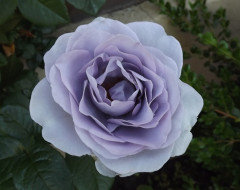
    But there already is a blue rose.

    This one.


  • 4 months ago

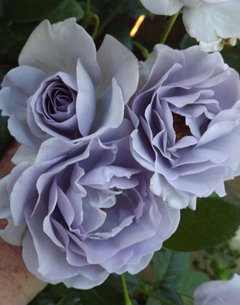
    I just watched the whole video, and I must say that a couple of my lavender roses are more blue than the Suntory 'Applause'. Including my late lamented Blue Bayou that Diane posted... hers is also late and lamented. But thanks for posting the video. The current experiments make me think we're no closer to a blue rose... they sound more similar to the dyeing of roses than genetic engineering :-D

  • 4 months ago

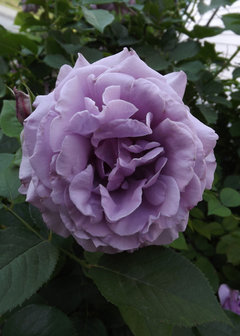
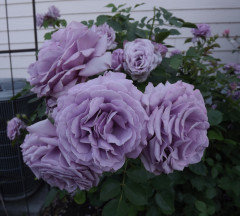
    Is that the same video from a number of years ago that was brought forward. The Japanese were obsessed then with developing a blue rose, and the one they'd come up with wasn't very blue. I pulled my Blue Bayous photos out then. It looks like they are still seeking the blue unicorn. I grow some very blueish Love Song roses, so I don't worry about the late, non lamented Blue Bayou. Love Song is so much better. Diane


    Not quite as blue as Blue Bayou, but a much better rose, Love Song.


  • 4 months ago

    In my opinion it's not a search for more beauty, but rather a gee-whiz kind of thing: creating a blue rose! I find those shown rather leaden in color--an unflattering adjective I also apply to my beloved Gallicas when there are too many of them together, so don't take it unkindly--and am perfectly happy to have in my garden the pinks, reds, yellows, purples etc etc of genetically unaltered roses. For blue there are chicory, rosemary, shrub germander and so many others, much purer colors.

  • 4 months ago
    last modified: 4 months ago

    Diane - I love your Love Song blooms!!! Wonderful!!


    It seems so strange to think of a delphinium blue rose. Would we like that? I'm not sure.

  • 4 months ago

    Attempting to create a blue - as in properly blue - rose seems a strange and pointless exercise to me. I think it would look really weird and artificial. Would you expect to see a blue sunflower or blue blossom on a cherry tree?


    There are lots of lavender roses and they blend beautifully with other colours, but blue? Ugh!

  • 4 months ago

    I love blue flowers...Soo pretty like a field of Forget Me Nots...

    Awhile back when I was new to this hobby I did a lot of research on "blue roses". That said, one obviously doesn't exist excluding Applause but Applause doesn't and will not pass down it's blue pigmentation in breeding. Honestly, our best bet is genetic modification and I see not much of a problem with it. It's not like many of the plants around us are GMO, heck, they are even blue mums (they're GMO)! Perhaps my ignorant mind thinking this would be a cool experiment is wrong but I'll leave that for the scientist haha.

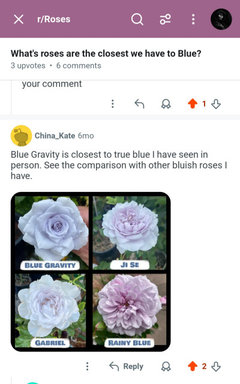
    Here is an image that someone sent on one of my post a bit back.

  • 4 months ago

    Blue Grawn is one of the bluest Hybrid Teas and Blue Gravity being the bluest rose created so far. I've also heard those lavender color genes come from Tuscany/Tuscany Superb as well but that was a guess from a HMF roses member

  • 4 months ago

    I think a blue rose would be lovely, but it would depend on the type of blue. I'd particularly love a periwinkle blue rose. The true concern for me would be how the flower color ages. If they age to grey, that might look dreadful


    Diane, your Blue Bayou and Love Song look amazing. Both of those over here are more mauve than purple/blue. I wonder if our soil has an impact on the color?


    Rainy Blue is probably my most blue rose, but it's hardly blue, just a cooler toned lavender. I've heard about Blue Grawn and Blue Gravity and would love to see them in person

  • 4 months ago

    Elestrial, thank you. Our soil in the semi arid desert here is quite alkaline, so you would think my roses would be pinker. But not so, including the deep purples. I haven't tried hydrangeas and have been warned that they would be pink without acidifying the soil. I'd love to try one of the purple hydrangeas, but doubt that I could keep it purple. It would be tricky, I think. Diane

  • 4 months ago

    My soil is very alkaline too, and I haven't had luck getting the hydrangeas blue. But I have managed to get them to be purple with a few cups of aluminum sulfate per bush - may be worth a try if you ever want to go down that road

  • 4 months ago

    Nollie - yes, that would be strange. But just to add to the discussion, we've changed flower colors many times, for example, petunias used to be just white and purple. Now there are other colors, and we love them all. I especially love pink! :)


    Ian - I see that I made the same "argument" that you did. This is an interesting discussion. :)


    Elestrial - interesting idea that soil type could influence the more intense blue that Diane's gorgeous Blue Bayou has.


  • 4 months ago

    Alkaline soil, which should promote pink flowers, does not here--at least roses. But it certainly wouldn't promote more intense blue flowers. Think litmus paper. Diane


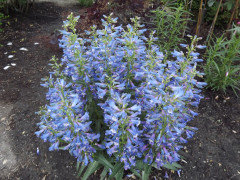
    Penstemon is not pink.


  • 4 months ago

    Such a beautiful Penstemon!!!

  • 4 months ago
    last modified: 4 months ago

    @Ian Stewart: Zone 6 Western Kentucky, USA Ian, Applause IS a genetically modified/GMO rose. If you watched the video, it specifically says they took the blueness gene from petunias and inserted it into rose DNA. But until they can create rose PETALS (not soil) with the correct pH, the blue enzyme cannot express. Since it's unlikely the petals themselves would endure a drastic change in pH (to less acidic), they are currently at a dead end with genetic splicing. I suspect it will take several, not just one or two, modifications to achieve "blue", and by that point, will it be recognizable as a rose?


  • 4 months ago

    I know it's a GMO rose and I do have to agree that it will take several modifications to achieve the blue rose

  • 4 months ago
    last modified: 4 months ago

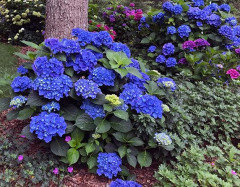
    @Elestrial 7a I've had the same problem with my hydrangeas. Through years of trial and error, I've found that by first mitigating/buffering your soil pH with LOTS of organic matter, and THEN applying elemental sulfur (it takes LOTS, here) you can get your blue 'drangeas. The sulphur must be applied religiously, at least twice yearly, and the amount of organic matter has to be kept up, or the pH rapidly reverts, and so will the flower color. It's a lot of trouble, and I only do it for about 10 (my Mathilda Gutges) of my 70+ hydrangeas.

    EDIT: found a pic that shows that even with good intentions, Mathilda still has very pink/red blooms among mostly blue flowers, lol.


  • 4 months ago

    Thank you @fig_insanity Z7b E TN - I'll have to try that. We just made some new beds to create two hedges of nikko blue hydrangeas on either side of a pathway and brought in a ton of mushroom soil, compost and sand - mixed with the native soil. Should I mix in the sulphur now? Or wait until next year?

  • 4 months ago
    last modified: 4 months ago

    @Elestrial 7a For next Spring's flowers, you need to start amending now to no later than June, and again in the Fall. It takes elemental sulfur at least a few months to affect the pH...even though some brands say "fast acting". But it's also longer lasting than things like aluminum sulfate. I use Hi-Yield brand sulfur, but you can find elemental sulfur in bulk amounts for cheaper.

  • 4 months ago

    Aweome - thanks for the tips!

  • 4 months ago
    last modified: 4 months ago

    For clarity, the mechanism by which roses and hydrangeas present color is different. For hydrangeas, lower (more acidic) SOIL pH affects the uptake of aluminum, which enables the production of blue pigment. In roses, it would take HIGHER (alkaline) pH levels (around 6.6–7.7) in the FLOWER itself to promote a blue color by turning anthocyanins (delphinidin in this case) from red to blue. Since roses are acidic by nature, they partly change some of the "blue" delphinidin to "red". It's why Applause, in spite of having the bluest of blue genetics, is just lavender...the pH of the petals themselves prevents the delphinidin from reaching its potential.

  • 4 months ago

    Fig - those are wonderfully colored hydrangea blooms!! Do they last all summer or just for a short while? Thanks for the info. I didn't know that's why roses have trouble expressing blue.

  • 4 months ago

    I wonder what a Rugosa would do since they like more acidic soil, guessing impossible due to soil PH as Fig suggested?

  • 4 months ago

    Well said Paul, well said 👏

  • 4 months ago

    Thank you, Paul. I appreciate your perspective. I have a close neighbor and friend who has Huntingtons Disease. It’s devastating. She’s using one of the experimental treatments that aren’t available to the general public yet and I am so grateful to see how much it’s helping her. With that many of your family affected by this disease, I can understand how important it is to encourage more research. And yes, cancer is rampant in our world.

  • 4 months ago

    Paul, I am so sorry your family had HD. I loved Woody Guthrie and agree we need to focus more on critical issues than fringe issues.

  • 4 months ago

    I agree with you Paul. So many better ways to spend resesrch dollars. I am so sorry about the loss of your family members . What a cruel disease.

  • 4 months ago

    Paul: AMEN! You've mentioned your family's tragedy previously, and you have my deepest sympathy. Your thoughts and opinions are always so considered and informed. I'm always glad to see you here.

    I had a dear friend who had Huntington's. It's right up there with Alzheimers in stealing away the "person" before they're actually gone. I for one would forever forego a blue rose, an AI assistant, wars, "smart" anything, and all the next "latest and greatest", if they could cure or prevent either condition.

  • 4 months ago
    last modified: 4 months ago

    @rosecanadian The pH sensitive macrophylla and serrata hydrangea varieties vary in how long it takes them to fully present their color, and how long they retain color. The Mathilda Gutges in the photo are among the darkest of all in the proper conditions, and because of that deep color they are effective even before the blooms are fully mature. I've never kept records (see this thread) but I'm guessing that once she starts blooming, MG takes three weeks to reach full coloration, is at peak for at least six weeks, and is presentable for another month. Then the flowers fade to a lavender grey tinged green for a lonnnng time, even up to first frost. My longest lasting (at full color) varieties, are:

    Nantucket Blue

    Seaside Serenade Newport

    Mathilda Gutges

    Nikko Blue

    All of these are exceptionallly long lasting, with months of color into Fall. YMMV, depending on summer temps, water and amount of shade.

  • 4 months ago

    Thanks, Fig. Last year I planted my first hydrangea plant, and I love it!! The blooms held, as you said, until frost. Wonderful plants.

  • 4 months ago

    @rifis (zone 6b-7a NJ) Yes, I saw a couple of interviews with doctors involved with this gene therapy. It looks very promising, and if people can get it before they become symptomatic, the idea is that it might stave off symptoms for decades. I wish my siblings had been able to benefit from this treatment.

Sponsored
Bella Casa LLC
Average rating: 5 out of 5 stars17 Reviews
The Leading Interior Design Studio in Franklin County